


Endocrine Disorders Market Size
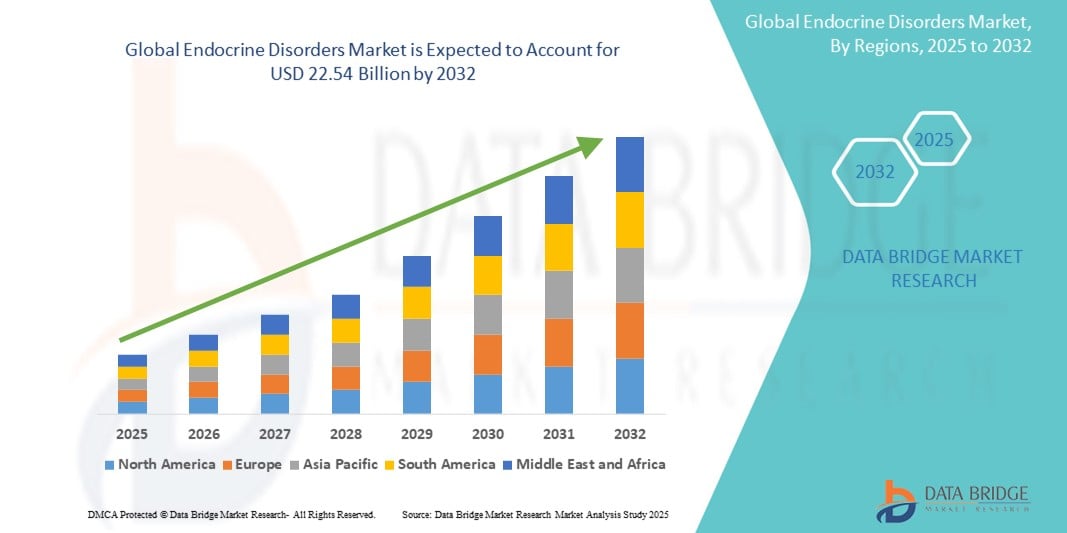
- The global endocrine disorders market size was valued at USD 12.73 billion in 2024 and is expected to reach USD 22.54 billion by 2032, at a CAGR of 7.40% during the forecast period
- The market growth is largely fueled by the growing adoption and technological progress within connected home devices and smart home technology, leading to increased digitalization in both residential and commercial settings
- Furthermore, rising consumer demand for secure, user-friendly, and integrated solutions for their homes and businesses is establishing smart locks as the modern access control system of choice. These converging factors are accelerating the uptake of Endocrine Disorders solutions, thereby significantly boosting the industry's growth
Endocrine Disorders Market Analysis
- Endocrine disorders, including diabetes, PCOS, and hormonal deficiencies, are increasingly being addressed with advanced therapeutic and diagnostic solutions due to rising global prevalence, growing health awareness, and technological progress in endocrinology care
- The escalating demand for endocrine disorder treatments is primarily fueled by increasing hormonal imbalances across populations, growing incidence of lifestyle-related conditions such as obesity and diabetes, and the surge in early screening and diagnosis owing to improved healthcare access and patient education
- North America dominated the endocrine disorders market with the largest revenue share of 41.8% in 2024, driven by robust healthcare infrastructure, high awareness levels, and a strong presence of major pharmaceutical companies. The U.S. leads the region, backed by early adoption of hormone therapies, continuous R&D investment, and growing patient preference for personalized medicine
- Asia-Pacific is expected to be the fastest-growing region with 12.4% CAGR in the endocrine disorders market during the forecast period, attributed to increasing urbanization, rising disposable incomes, growing awareness of endocrine health, and expansion of healthcare access in countries such as China and India
- Diabetes segment dominated the endocrine disorders market with a market share of 61.3% in 2024, owing to its high prevalence worldwide, increased screening rates, and strong product pipeline in insulin and non-insulin therapies. The demand is further propelled by innovations in glucose monitoring and digital health integration
Report Scope and Endocrine Disorders Market Segmentation
|
Attributes |
Endocrine Disorders Key Market Insights |
|
Segments Covered |
|
|
Countries Covered |
North America
Europe
Asia-Pacific
Middle East and Africa
South America
|
|
Key Market Players |
|
|
Market Opportunities |
|
|
Value Added Data Infosets |
In addition to the insights on market scenarios such as market value, growth rate, segmentation, geographical coverage, and major players, the market reports curated by the Data Bridge Market Research also include in-depth expert analysis, pricing analysis, brand share analysis, consumer survey, demography analysis, supply chain analysis, value chain analysis, raw material/consumables overview, vendor selection criteria, PESTLE Analysis, Porter Analysis, and regulatory framework. |
Endocrine Disorders Market Trends
“Growing Technological Integration and Patient-Centric Solutions in Endocrine Disorders Management”
- A significant and accelerating trend in the global endocrine disorders market is the increasing convergence of digital health technologies and patient-centric care models aimed at improving disease monitoring, early diagnosis, and personalized treatment strategies. This advancement is streamlining how patients and healthcare providers interact and manage chronic endocrine conditions such as diabetes, thyroid dysfunction, and adrenal disorders
- For instance, digital health platforms such as Glooko and mySugr offer integrated solutions for diabetes management, allowing patients to track glucose levels, medication adherence, and diet through user-friendly mobile apps. These tools are often compatible with devices such as continuous glucose monitors (CGMs) and insulin pumps, enabling real-time data sharing with healthcare providers for timely interventions
- Integration with telehealth and remote monitoring systems has also enabled endocrinologists to remotely monitor hormonal levels and patient symptoms. This reduces the need for frequent clinic visits, especially for those in remote or underserved regions. Wearable health devices, including smartwatches and biosensors, are increasingly being used to track biometric indicators such as blood sugar levels, heart rate, and physical activity, further enhancing disease control
- These patient-centric tools empower individuals to take a more active role in managing their endocrine conditions. For instance, thyroid patients now have access to digital platforms that help track symptoms and medication side effects, while AI-powered algorithms support physicians in optimizing hormone replacement therapies based on patient-specific data.
- The integration of connected technologies into endocrine disorder management is not only enhancing clinical outcomes but also increasing treatment adherence and improving quality of life. Consequently, companies such as Medtronic, Dexcom, and Abbott are developing more advanced monitoring systems, while startups are innovating on mobile app solutions and connected platforms to address evolving patient needs
- The growing demand for accessible, intuitive, and technologically advanced solutions is transforming the endocrine care landscape, positioning digital integration as a core element of innovation in this expanding market
Endocrine Disorders Market Dynamics
Driver
“Growing Need Due to Rising Prevalence of Hormonal Imbalances and Advancements in Diagnostic Tools”
- The global rise in endocrine-related disorders, such as diabetes, thyroid dysfunction, adrenal and pituitary gland disorders, is a significant driver accelerating the demand for effective diagnostic and treatment solutions. With increasing awareness of hormonal health and its impact on overall well-being, the need for timely diagnosis and long-term management is becoming more critical than ever
- For instance, in March 2024, Ascendis Pharma A/S made notable progress with its TransCon technology platform aimed at treating rare endocrine diseases, signaling the industry's growing investment in advanced therapeutic options. This is further complemented by the development of combination therapies and long-acting hormone formulations by companies such as Eli Lilly and Novo Nordisk, which are reshaping the endocrine treatment landscape
- As patients and healthcare providers seek improved disease monitoring and tailored treatment plans, technological advancements in diagnostic tools, including point-of-care testing and continuous hormone monitoring systems, are supporting earlier intervention and better disease control. These innovations are particularly vital for chronic conditions such as diabetes and hypothyroidism, where continuous monitoring plays a key role in treatment success
- In addition, the increasing adoption of digital health platforms, such as mobile apps for tracking symptoms and medication adherence, is empowering patients to take a proactive approach in managing their endocrine health. The integration of these tools with telehealth services ensures accessible and efficient care, especially in underserved regions
- The growing burden of endocrine disorders across all age groups, combined with advancements in therapeutic options and diagnostics, is driving consistent market growth. Companies are increasingly focusing on patient-centric care, precision medicine, and long-term disease management strategies to address the complex nature of hormonal disorders
Restraint/Challenge
“Limited Access to Specialized Endocrine Care and High Treatment Costs”
- One of the major challenges limiting the growth of the endocrine disorders market is the limited availability of endocrinologists and specialized care in many regions, particularly in low- and middle-income countries. This often results in delayed diagnoses and suboptimal treatment, exacerbating the disease burden on patients
- Moreover, the high cost associated with diagnostic testing, hormone replacement therapies, and lifelong disease management can be a significant financial burden for patients. For instance, advanced biologics and hormone analogs used in treating conditions such as growth hormone deficiency or adrenal insufficiency can be prohibitively expensive for uninsured or underinsured populations
- While efforts are being made to expand insurance coverage and include endocrine therapies in national health plans, the cost barrier remains a concern in various healthcare systems. In addition, disparities in access to cutting-edge treatments and awareness campaigns further widen the gap in disease management outcomes across different demographic groups
- Addressing these challenges will require a multi-pronged approach that includes expanding healthcare infrastructure, incentivizing specialist training, increasing affordability through generic alternatives, and promoting early screening initiatives. As stakeholders collaborate to resolve these systemic issues, the potential for market expansion—particularly in emerging economies—remains significant
Endocrine Disorders Market Scope
The market is segmented on the basis of disease, drug class, route of administration, end-users, and distribution channel.
• By Disease
On the basis of disease, the endocrine disorders market is segmented into Addison’s Disease, Gigantism, Goiter, Cushing’s Syndrome, polycystic ovary syndrome (PCOS), diabetes, acromegaly, and others. The diabetes segment dominated the largest market revenue share of 61.3% in 2024, driven by its high global prevalence and continuous advancements in treatment and monitoring technologies.
The polycystic ovary syndrome (PCOS) segment is expected to register the fastest CAGR of 9.7% from 2025 to 2032, owing to increasing cases among women of reproductive age and rising awareness of hormonal health.
• By Drug Class
On the basis of drug class, the endocrine disorders market is segmented into estrogen, testosterone, and progesterone replacement therapy. Estrogen segment held the largest revenue share of 45.8% in 2024, supported by its extensive application in post-menopausal and hormonal imbalance conditions.
Testosterone segment is projected to expand at the fastest CAGR of 8.9% from 2025 to 2032, driven by rising diagnosis and treatment of testosterone deficiencies in aging men.
• By Route of Administration
On the basis of route of administration, the endocrine disorders market is segmented into oral and parenteral. The oral segment accounted for the largest revenue share of 68.5% in 2024, primarily due to high patient compliance and ease of administration.
The parenteral segment is anticipated to grow at the fastest CAGR of 7.8% from 2025 to 2032, with increased use in hospital settings and for long-acting therapies.
• By End-Users
On the basis of end-users, the endocrine disorders market is segmented into hospitals, homecare, specialty centres, and others. Hospitals dominated the market with a revenue share of 52.4% in 2024, owing to advanced treatment facilities and expert endocrine care.
Specialty centres are forecasted to grow at the highest CAGR of 8.6% from 2025 to 2032, fueled by increasing demand for outpatient care and targeted hormone therapy services.
• By Distribution Channel
On the basis of distribution channel, the endocrine disorders market is segmented into hospital pharmacy, online pharmacy, and retail pharmacy. The hospital pharmacy segment captured the largest market share of 47.9% in 2024, due to its close association with hospital-based endocrine treatment and controlled prescription dispensing.
The online pharmacy segment is projected to register the highest CAGR of 10.3% from 2025 to 2032, supported by the rising popularity of e-commerce, convenience, and long-term medication subscriptions.
Endocrine Disorders Market Regional Analysis
- North America dominated the endocrine disorders market with the largest revenue share of 41.8% in 2024, driven by the rising prevalence of diabetes, thyroid disorders, and other hormonal imbalances, along with strong healthcare infrastructure and early access to innovative treatments
- The region's high healthcare spending, robust insurance coverage, and continuous advancements in hormone therapies contribute to greater diagnosis and treatment rates
- The presence of leading pharmaceutical companies and strong R&D investments further support the market's expansion, particularly across the U.S. and Canada
U.S. Endocrine Disorders Market Insight
The U.S. endocrine disorders market captured the largest share of 65% within North America in 2024, fueled by a high disease burden of conditions such as diabetes and PCOS, increased health awareness, and early adoption of advanced diagnostic and treatment options. Government initiatives to manage chronic endocrine conditions and a strong presence of specialty endocrinology clinics are enhancing treatment access. Moreover, the increasing availability of hormone replacement therapies (HRT) and advanced parenteral drug delivery methods further drive the market.
Europe Endocrine Disorders Market Insight
The Europe endocrine disorders market is projected to expand at a substantial CAGR during the forecast period, driven by heightened health consciousness, aging populations, and the demand for precision medicine in managing endocrine diseases. The region benefits from universal healthcare systems, advanced clinical research networks, and supportive reimbursement policies that promote early diagnosis and comprehensive disease management.
U.K. Endocrine Disorders Market Insight
The U.K. endocrine disorders market is anticipated to grow at a noteworthy CAGR, fueled by rising cases of thyroid disorders, PCOS, and diabetes. Public health campaigns focusing on women's reproductive health and metabolic conditions are enhancing patient awareness. In addition, the NHS’s emphasis on digital health solutions and telemedicine access for endocrinology consultations is improving patient outcomes and supporting market growth.
Germany Endocrine Disorders Market Insight
The Germany endocrine disorders market is expected to witness considerable growth, underpinned by a high prevalence of hormonal disorders and strong government funding for chronic disease management. Germany's well-developed healthcare infrastructure, combined with its emphasis on early detection and preventive care, is promoting the use of innovative hormone therapies, particularly in aging populations.
Asia-Pacific Endocrine Disorders Market Insight
The Asia-Pacific endocrine disorders market is poised to grow at the fastest CAGR of 12.4% from 2025 to 2032, driven by increasing urbanization, rising healthcare awareness, and improved access to endocrinology specialists. Countries such as India, China, and Japan are investing in expanding healthcare coverage, boosting early screening for diabetes and thyroid disorders, and launching awareness programs on PCOS and menopause management. The rise of private hospitals and telemedicine platforms is also making endocrine care more accessible in rural and underserved regions.
Japan Endocrine Disorders Market Insight
The Japan endocrine disorders market is growing steadily due to a rising geriatric population and high demand for hormone-related therapies. The country's commitment to personalized healthcare, combined with its well-established diagnostic systems and government backing for chronic disease prevention, continues to drive adoption of advanced treatments for conditions such as hypothyroidism and adrenal insufficiency.
China Endocrine Disorders Market Insight
The China endocrine disorders market accounted for the largest market revenue share in the Asia-Pacific region in 2024, owing to an increasing prevalence of diabetes, improved healthcare access, and government initiatives supporting chronic disease management. Rapid urbanization, a growing middle-class population, and expansion of specialty endocrinology clinics are further accelerating the demand for endocrine disorder treatments. Domestic pharmaceutical manufacturers are also investing heavily in developing cost-effective hormone therapies, fueling market growth.
Endocrine Disorders Market Share
The endocrine disorders industry is primarily led by well-established companies, including:
- Teva Pharmaceutical Industries Ltd. (Israel)
- Johnson & Johnson Services, Inc. (U.S.)
- F. Hoffmann-La Roche Ltd (Switzerland)
- Lilly (U.S.)
- Merck & Co., Inc. (U.S.)
- Aurobindo Pharma Limited (India)
- Bristol-Myers Squibb Company (U.S.)
- GSK plc. (U.K.)
- Ascendis Pharma A/S (Denmark)
- Bio-Rad Laboratories, Inc. (U.S.)
Latest Developments in Global Endocrine Disorders Market
- In April 2024, Pfizer Inc. announced the launch of its next-generation hormone replacement therapy (HRT) for managing postmenopausal symptoms and osteoporosis associated with estrogen deficiency. The therapy integrates a novel delivery system to enhance hormone absorption and patient compliance, underscoring Pfizer’s commitment to advancing treatment options in the endocrine disorders landscape
- In March 2024, Eli Lilly and Company received FDA approval for its new long-acting GLP-1 receptor agonist aimed at improving glycemic control in patients with Type 2 diabetes. This milestone expands the company’s endocrinology portfolio and emphasizes its strategic focus on metabolic and endocrine health innovations
- In February 2024, Novartis AG announced positive Phase III trial results for its investigational therapy targeting acromegaly, a rare endocrine disorder. The new formulation demonstrated improved efficacy and safety over existing treatments, positioning Novartis to meet the growing demand for targeted endocrine therapeutics
- In January 2024, Abbott Laboratories introduced an upgraded version of its continuous glucose monitoring (CGM) system tailored for pediatric patients with diabetes. The launch addresses an underserved population within the endocrine disorders market and highlights Abbott's efforts in advancing pediatric endocrinology care through wearable technologies
- In December 2023, Sanofi entered into a strategic collaboration with a leading biotech firm to co-develop innovative gene therapies for congenital endocrine disorders such as congenital adrenal hyperplasia. This partnership reflects Sanofi’s ambition to explore curative approaches and expand its footprint in the rare endocrine disease segment

- Interactive Data Analysis Dashboard
- Company Analysis Dashboard for high growth potential opportunities
- Research Analyst Access for customization & queries
- Competitor Analysis with Interactive dashboard
- Latest News, Updates & Trend analysis
- Harness the Power of Benchmark Analysis for Comprehensive Competitor Tracking
Table of Content
1 INTRODUCTION
1.1 OBJECTIVES OF THE STUDY
1.2 MARKET DEFINITION
1.3 OVERVIEW OF GLOBAL ENDOCRINE DISORDERS MARKET
1.4 CURRENCY AND PRICING
1.5 LIMITATION
1.6 MARKETS COVERED
2 MARKET SEGMENTATION
2.1 KEY TAKEAWAYS
2.2 ARRIVING AT THE GLOBAL ENDOCRINE DISORDERS MARKET SIZE
2.2.1 VENDOR POSITIONING GRID
2.2.2 TECHNOLOGY LIFE LINE CURVE
2.2.3 TRIPOD DATA VALIDATION MODEL
2.2.4 MARKET GUIDE
2.2.5 MULTIVARIATE MODELLING
2.2.6 TOP TO BOTTOM ANALYSIS
2.2.7 CHALLENGE MATRIX
2.2.8 APPLICATION COVERAGE GRID
2.2.9 STANDARDS OF MEASUREMENT
2.2.10 VENDOR SHARE ANALYSIS
2.2.11 SALES VOLUME DATA
2.2.12 DATA POINTS FROM KEY PRIMARY INTERVIEWS
2.2.13 DATA POINTS FROM KEY SECONDARY DATABASES
2.3 GLOBAL ENDOCRINE DISORDERS MARKET : RESEARCH SNAPSHOT
2.4 ASSUMPTIONS
3 MARKET OVERVIEW
3.1 DRIVERS
3.2 RESTRAINTS
3.3 OPPORTUNITIES
3.4 CHALLENGES
4 EXECUTIVE SUMMARY
5 PREMIUM INSIGHTS
5.1 PESTEL ANALYSIS
5.2 PORTER’S FIVE FORCES MODEL
6 INDUSTRY INSIGHTS
6.1 MICRO AND MACRO ECONOMIC FACTORS
6.2 PENETRATION AND GROWTH PROSPECT MAPPING
6.3 KEY PRICING STRATEGIES
6.4 INTERVIEWS WITH SPECIALIST
6.5 ANALYIS AND RECOMMENDATION
7 INTELLECTUAL PROPERTY (IP) PORTFOLIO
7.1 PATENT QUALITY AND STRENGTH
7.2 PATENT FAMILIES
7.3 LICENSING AND COLLABORATIONS
7.4 COMPETITIVE LANDSCAPE
7.5 IP STRATEGY AND MANAGEMENT
7.6 OTHER
8 COST ANALYSIS BREAKDOWN
9 TECHNONLOGY ROADMAP
10 INNOVATION TRACKER AND STRATEGIC ANALYSIS
10.1 MAJOR DEALS AND STRATEGIC ALLIANCES ANALYSIS
10.1.1 JOINT VENTURES
10.1.2 MERGERS AND ACQUISITIONS
10.1.3 LICENSING AND PARTNERSHIP
10.1.4 TECHNOLOGY COLLABORATIONS
10.1.5 STRATEGIC DIVESTMENTS
10.2 NUMBER OF PRODUCTS IN DEVELOPMENT
10.3 STAGE OF DEVELOPMENT
10.4 TIMELINES AND MILESTONES
10.5 INNOVATION STRATEGIES AND METHODOLOGIES
10.6 RISK ASSESSMENT AND MITIGATION
10.7 MERGERS AND ACQUISITIONS
10.8 FUTURE OUTLOOK
11 REGULATORY COMPLIANCE
11.1 REGULATORY AUTHORITIES
11.2 REGULATORY CLASSIFICATIONS
11.3 REGULATORY SUBMISSIONS
11.4 INTERNATIONAL HARMONIZATION
11.5 COMPLIANCE AND QUALITY MANAGEMENT SYSTEMS
11.6 REGULATORY CHALLENGES AND STRATEGIES
FIGURE 1 TOP ENTITIES BASED ON R&D GLANCE FOR GLOBAL ENDOCRINE DISORDERS MARKET
Sources: Press Releases, Annual Reports, SEC Filings, Investor Presentations, Other Government Sources, Analysis Based on Inputs from Secondary, Expert Interviews
12 REIMBURSEMENT FRAMEWORK
13 OPPUTUNITY MAP ANALYSIS
14 VALUE CHAIN ANALYSIS
15 HEALTHCARE ECONOMY
15.1 HEALTHCARE EXPENDITURE
15.2 CAPITAL EXPENDITURE
15.3 CAPEX TRENDS
15.4 CAPEX ALLOCATION
15.5 FUNDING SOURCES
15.6 INDUSTRY BENCHMARKS
15.7 GDP RATION IN OVERALL GDP
15.8 HEALTHCARE SYSTEM STRUCTURE
15.9 GOVERNMENT POLICIES
15.1 ECONOMIC DEVELOPMENT
16 GLOBAL ENDOCRINE DISORDERS MARKET , BY DISORDER TYPE
16.1 OVERVIEW
16.2 DIABETES
16.2.1 TYPE 1 DIABETES
16.2.2 TYPE 2 DIABETES
16.2.3 GESTATIONAL DIABETES
16.2.4 PRE-DIABETES
16.3 THYROID DISORDERS
16.3.1 1.2.1 HYPOTHYROIDISM
16.3.2 1.2.2 HYPERTHYROIDISM
16.3.3 1.2.3 THYROID CANCER
16.3.4 1.2.4 THYROID NODULES
16.3.5 GOITER
16.4 ADRENAL DISORDERS
16.4.1 ADDISON'S DISEASE
16.4.2 CUSHING'S SYNDROME
16.4.3 ADRENAL INSUFFICIENCY
16.4.4 ADRENAL HYPERPLASIA
16.5 PITUITARY DISORDERS
16.5.1 PITUITARY TUMORS
16.5.2 HYPOPITUITARISM
16.5.3 HYPERPROLACTINEMIA
16.5.4 ACROMEGALY
16.6 PARATHYROID DISORDERS
16.6.1 HYPERPARATHYROIDISM
16.6.2 HYPOPARATHYROIDISM
16.6.3 PARATHYROID CANCER
16.7 OTHER
17 GLOBAL ENDOCRINE DISORDERS MARKET , BY TREATMENT TYPE
17.1 OVERVIEW
17.2 DRUG THERAPY
17.2.1 BY TYPE
17.2.1.1. HORMONE REPLACEMENT THERAPY (HRT)
17.2.1.1.1. ESTROGEN
17.2.1.1.2. TESTOSTERONE
17.2.1.1.3. GROWTH HORMONE
17.2.1.1.4. PROGESTERONE REPLACEMENT
17.2.1.1.5. OTHERS
17.2.1.2. INSULIN THERAPY
17.2.1.2.1. RAPID-ACTING INSULIN
17.2.1.2.2. LONG-ACTING INSULIN
17.2.1.2.3. INTERMEDIATE-ACTING INSULIN
17.2.1.3. CORTICOSTEROIDS
17.2.1.4. ANTI-THYROID MEDICATIONS
17.2.1.5. HYPOGLYCEMICS
17.2.1.6. OTHERS
17.2.2 BY ROUTE OF ADMINISTRATION
17.2.2.1. ORAL
17.2.2.2. PARENTERAL
17.2.2.3. OTHERS
17.2.3 BY DRUG CLASS
17.2.3.1. BRANDED
17.2.3.2. GENERIC
17.3 SURGERY
17.3.1 THYROIDECTOMY
17.3.1.1. PARTIAL THYROIDECTOMY
17.3.1.2. TOTAL THYROIDECTOMY
17.3.2 ADRENALECTOMY
17.3.2.1. LAPAROSCOPIC ADRENALECTOMY
17.3.2.2. OPEN ADRENALECTOMY
17.3.3 PARATHYROIDECTOMY
17.3.4 PITUITARY SURGERY
17.3.4.1. TRANSSPHENOIDAL SURGERY
17.3.4.2. CRANIOTOMY
17.4 RADIOTHERAPY
17.4.1 RADIOACTIVE IODINE THERAPY
17.4.2 STEREOTACTIC RADIOSURGERY
17.5 OTHERS
18 GLOBAL ENDOCRINE DISORDERS MARKET , BY DIAGNOSTIC TYPE
18.1 OVERVIEW
18.2 BLOOD TESTS
18.2.1 HORMONE LEVEL TESTS
18.2.2 GLUCOSE TESTS
18.2.3 ANTIBODY TESTS
18.2.4 GENETIC TESTING
18.3 IMAGING TESTS
18.3.1 ULTRASOUND
18.3.1.1. HYPOTHYROIDISM THYROID ULTRASOUND
18.3.1.2. ADRENAL GLAND ULTRASOUND
18.3.2 MRI
18.3.3 CT SCAN
18.3.4 OTHERS
18.4 BIOPSY
18.4.1 CORE NEEDLE BIOPSY
18.4.2 FINE NEEDLE ASPIRATION BIOPSY (FNAB)
18.5 FUNCTIONAL TESTS
18.6 OTHERS
19 GLOBAL ENDOCRINE DISORDERS MARKET , BY PATIENT AGE GROUP
19.1 OVERVIEW
19.2 PEDIATRICS
19.3 ADULTS
19.4 GERIARTIC
20 GLOBAL ENDOCRINE DISORDERS MARKET , BY END USER
20.1 OVERVIEW
20.2 HOSPITALS
20.3 SPECIALITY CLINICS
20.4 HOMECARE
20.5 ACADEMIC AND RESEARCH INSTITUTES
20.6 OTHERS
21 GLOBAL ENDOCRINE DISORDERS MARKET , BY DISTRIBUTION CHANNEL
21.1 OVERVIEW
21.2 DIRECT TENDERS
21.3 RETAIL SALES
21.3.1 OFFLINE PHARMACIES
21.3.2 ONLINE PHARMACIES
21.4 OTHERS
22 GLOBAL ENDOCRINE DISORDERS MARKET , BY GEOGRAPHY
GLOBAL ENDOCRINE DISORDERS MARKET (ALL SEGMENTATION PROVIDED ABOVE IS REPRESENTED IN THIS CHAPTER BY COUNTRY)
22.1 NORTH AMERICA
22.1.1 U.S.
22.1.2 CANADA
22.1.3 MEXICO
22.2 EUROPE
22.2.1 GERMANY
22.2.2 FRANCE
22.2.3 U.K.
22.2.4 ITALY
22.2.5 SPAIN
22.2.6 RUSSIA
22.2.7 TURKEY
22.2.8 BELGIUM
22.2.9 NETHERLANDS
22.2.10 SWITZERLAND
22.2.11 REST OF EUROPE
22.3 ASIA-PACIFIC
22.3.1 JAPAN
22.3.2 CHINA
22.3.3 SOUTH KOREA
22.3.4 INDIA
22.3.5 AUSTRALIA
22.3.6 SINGAPORE
22.3.7 THAILAND
22.3.8 MALAYSIA
22.3.9 INDONESIA
22.3.10 PHILIPPINES
22.3.11 REST OF ASIA-PACIFIC
22.4 SOUTH AMERICA
22.4.1 BRAZIL
22.4.2 ARGENTINA
22.4.3 PERU
22.4.4 CHILE
22.4.5 COLOMBIA
22.4.6 VENEZUELA
22.4.7 REST OF SOUTH AMERICA
22.5 MIDDLE EAST AND AFRICA
22.5.1 SOUTH AFRICA
22.5.2 SAUDI ARABIA
22.5.3 UAE
22.5.4 EGYPT
22.5.5 ISRAEL
22.5.6 REST OF MIDDLE EAST AND AFRICA
22.6 KEY PRIMARY INSIGHTS: BY MAJOR COUNTRIES
23 GLOBAL ENDOCRINE DISORDERS MARKET , COMPANY LANDSCAPE
23.1 COMPANY SHARE ANALYSIS: GLOBAL
23.2 COMPANY SHARE ANALYSIS: NORTH AMERICA
23.3 COMPANY SHARE ANALYSIS: EUROPE
23.4 COMPANY SHARE ANALYSIS: ASIA-PACIFIC
23.5 MERGERS & ACQUISITIONS
23.6 NEW PRODUCT DEVELOPMENT & APPROVALS
23.7 EXPANSIONS
23.8 REGULATORY CHANGES
23.9 PARTNERSHIP AND OTHER STRATEGIC DEVELOPMENTS
24 GLOBAL ENDOCRINE DISORDERS MARKET , SWOT AND DBMR ANALYSIS
25 GLOBAL ENDOCRINE DISORDERS MARKET , COMPANY PROFILE
25.1 NOVO NORDISK
25.1.1 COMPANY OVERVIEW
25.1.2 REVENUE ANALYSIS
25.1.3 GEOGRAPHIC PRESENCE
25.1.4 PRODUCT PORTFOLIO
25.1.5 RECENT DEVELOPMENTS
25.2 SANOFI
25.2.1 COMPANY OVERVIEW
25.2.2 REVENUE ANALYSIS
25.2.3 GEOGRAPHIC PRESENCE
25.2.4 PRODUCT PORTFOLIO
25.2.5 RECENT DEVELOPMENTS
25.3 ABBVIE
25.3.1 COMPANY OVERVIEW
25.3.2 REVENUE ANALYSIS
25.3.3 GEOGRAPHIC PRESENCE
25.3.4 PRODUCT PORTFOLIO
25.3.5 RECENT DEVELOPMENTS
25.4 MERCK & CO., INC.
25.4.1 COMPANY OVERVIEW
25.4.2 REVENUE ANALYSIS
25.4.3 GEOGRAPHIC PRESENCE
25.4.4 PRODUCT PORTFOLIO
25.4.5 RECENT DEVELOPMENTS
25.5 PFIZER
25.5.1 COMPANY OVERVIEW
25.5.2 REVENUE ANALYSIS
25.5.3 GEOGRAPHIC PRESENCE
25.5.4 PRODUCT PORTFOLIO
25.5.5 RECENT DEVELOPMENTS
25.6 BOEHRINGER INGELHEIM
25.6.1 COMPANY OVERVIEW
25.6.2 REVENUE ANALYSIS
25.6.3 GEOGRAPHIC PRESENCE
25.6.4 PRODUCT PORTFOLIO
25.6.5 RECENT DEVELOPMENTS
25.7 ROCHE
25.7.1 COMPANY OVERVIEW
25.7.2 REVENUE ANALYSIS
25.7.3 GEOGRAPHIC PRESENCE
25.7.4 PRODUCT PORTFOLIO
25.7.5 RECENT DEVELOPMENTS
25.8 NOVARTIS
25.8.1 COMPANY OVERVIEW
25.8.2 REVENUE ANALYSIS
25.8.3 GEOGRAPHIC PRESENCE
25.8.4 PRODUCT PORTFOLIO
25.8.5 RECENT DEVELOPMENTS
25.9 ABBOTT LABORATORIES
25.9.1 COMPANY OVERVIEW
25.9.2 REVENUE ANALYSIS
25.9.3 GEOGRAPHIC PRESENCE
25.9.4 PRODUCT PORTFOLIO
25.9.5 RECENT DEVELOPEMENTS
25.1 BRISTOL-MYERS SQUIBB
25.10.1 COMPANY OVERVIEW
25.10.2 REVENUE ANALYSIS
25.10.3 GEOGRAPHIC PRESENCE
25.10.4 PRODUCT PORTFOLIO
25.10.5 RECENT DEVELOPMENTS
25.11 FRESENIUS KABI
25.11.1 COMPANY OVERVIEW
25.11.2 REVENUE ANALYSIS
25.11.3 GEOGRAPHIC PRESENCE
25.11.4 PRODUCT PORTFOLIO
25.11.5 RECENT DEVELOPMENTS
25.12 IPSEN
25.12.1 COMPANY OVERVIEW
25.12.2 REVENUE ANALYSIS
25.12.3 GEOGRAPHIC PRESENCE
25.12.4 PRODUCT PORTFOLIO
25.12.5 RECENT DEVELOPMENTS
25.13 HORIZON THERAPEUTICS
25.13.1 COMPANY OVERVIEW
25.13.2 REVENUE ANALYSIS
25.13.3 GEOGRAPHIC PRESENCE
25.13.4 PRODUCT PORTFOLIO
25.13.5 RECENT DEVELOPMENTS
25.14 TAKEDA PHARMACEUTICAL COMPANY
25.14.1 COMPANY OVERVIEW
25.14.2 REVENUE ANALYSIS
25.14.3 GEOGRAPHIC PRESENCE
25.14.4 PRODUCT PORTFOLIO
25.14.5 RECENT DEVELOPMENTS
25.15 ASCENDIS PHARMA A/S
25.15.1 COMPANY OVERVIEW
25.15.2 REVENUE ANALYSIS
25.15.3 GEOGRAPHIC PRESENCE
25.15.4 PRODUCT PORTFOLIO
25.15.5 RECENT DEVELOPMENTS
25.16 BIO-RAD LABORATORIES, INC.
25.16.1 COMPANY OVERVIEW
25.16.2 REVENUE ANALYSIS
25.16.3 GEOGRAPHIC PRESENCE
25.16.4 PRODUCT PORTFOLIO
25.16.5 RECENT DEVELOPMENTS
25.17 AUROBINDO PHARMA
25.17.1 COMPANY OVERVIEW
25.17.2 REVENUE ANALYSIS
25.17.3 GEOGRAPHIC PRESENCE
25.17.4 PRODUCT PORTFOLIO
25.17.5 RECENT DEVELOPMENTS
25.18 JOHNSON & JOHNSON SERVICES, INC.
25.18.1 COMPANY OVERVIEW
25.18.2 REVENUE ANALYSIS
25.18.3 GEOGRAPHIC PRESENCE
25.18.4 PRODUCT PORTFOLIO
25.18.5 RECENT DEVELOPMENTS
25.19 ENDO INTERNATIONAL
25.19.1 COMPANY OVERVIEW
25.19.2 REVENUE ANALYSIS
25.19.3 GEOGRAPHIC PRESENCE
25.19.4 PRODUCT PORTFOLIO
25.19.5 RECENT DEVELOPMENTS
26 CONCLUSION
27 QUESTIONNAIRE
28 ABOUT DATA BRIDGE MARKET RESEARCH

Data collection and base year analysis are done using data collection modules with large sample sizes. The stage includes obtaining market information or related data through various sources and strategies. It includes examining and planning all the data acquired from the past in advance. It likewise envelops the examination of information inconsistencies seen across different information sources. The market data is analysed and estimated using market statistical and coherent models. Also, market share analysis and key trend analysis are the major success factors in the market report. To know more, please request an analyst call or drop down your inquiry.
The key research methodology used by DBMR research team is data triangulation which involves data mining, analysis of the impact of data variables on the market and primary (industry expert) validation. Data models include Vendor Positioning Grid, Market Time Line Analysis, Market Overview and Guide, Company Positioning Grid, Patent Analysis, Pricing Analysis, Company Market Share Analysis, Standards of Measurement, Global versus Regional and Vendor Share Analysis. To know more about the research methodology, drop in an inquiry to speak to our industry experts.
Data Bridge Market Research is a leader in advanced formative research. We take pride in servicing our existing and new customers with data and analysis that match and suits their goal. The report can be customized to include price trend analysis of target brands understanding the market for additional countries (ask for the list of countries), clinical trial results data, literature review, refurbished market and product base analysis. Market analysis of target competitors can be analyzed from technology-based analysis to market portfolio strategies. We can add as many competitors that you require data about in the format and data style you are looking for. Our team of analysts can also provide you data in crude raw excel files pivot tables (Fact book) or can assist you in creating presentations from the data sets available in the report.












