


What is the Endoscopic Vessel Harvesting System Market Size and Growth Rate?
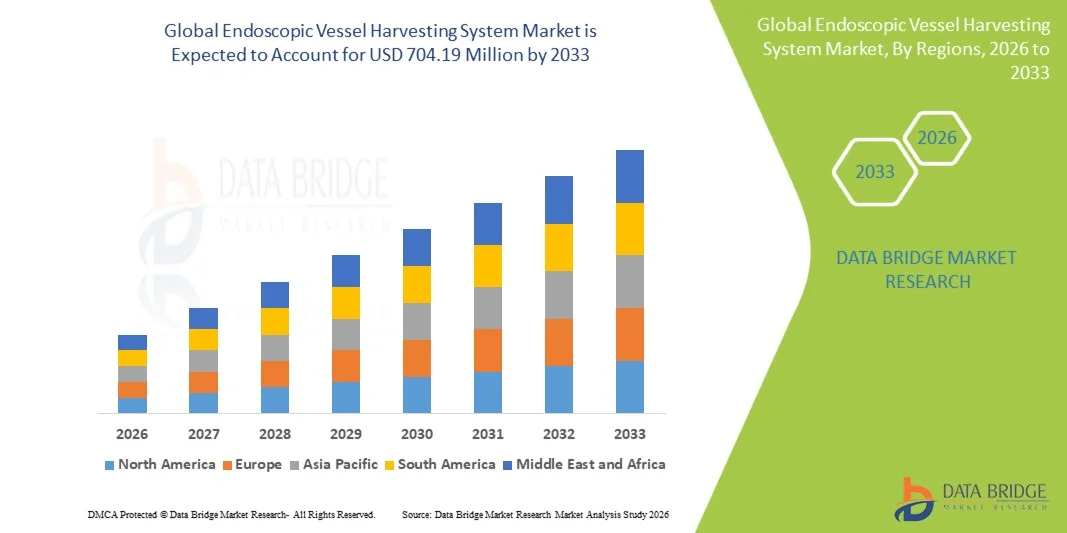
- As per Data Bridge Market Research analysis, the endoscopic vessel harvesting system market was valued at USD 532.30 million in 2025 and is projected to reach USD 704.19 million by 2033, growing at a CAGR of 3.56% from 2026 to 2033.
- The market is experiencing consistent growth driven by rising demand for minimally invasive cardiac procedures, increasing adoption of endoscopic vessel harvesting techniques, and growing prevalence of coronary artery disease requiring coronary artery bypass grafting (CABG).
- The increasing number of cardiovascular surgeries globally, combined with growing preference for minimally invasive procedures that can reduce wound complications and recovery time, is encouraging hospitals and cardiac centers to adopt advanced vessel harvesting systems. Improved visualization, specialized harvesting instruments, and increasing surgeon familiarity are further supporting the transition from conventional open harvesting techniques to endoscopic approaches.
Market Size & Forecast
- Global Market Value (2025): USD 532.30 Million
- Expected Market Value (2033): USD 704.19 Million
- Forecast CAGR (2026–2033): 3.56%
- Leading Region in 2025: North America
- Fastest Growing Region: Asia Pacific
What are the Major Takeaways of the Endoscopic Vessel Harvesting System Market?
- North America dominated the endoscopic vessel harvesting system market with the largest revenue share of 40.6% in 2025, supported by advanced cardiac surgery infrastructure, high cardiovascular disease prevalence, and widespread adoption of minimally invasive harvesting techniques.
- Asia-Pacific is expected to be the fastest-growing region at a CAGR of 8.2% from 2026 to 2033, fueled by rising cardiovascular disease burden, increasing cardiac surgery volumes, improving healthcare infrastructure, and growing adoption of minimally invasive surgical technologies.
- The EVH segment led the market with a 52.3% share in 2025, driven by its central role in minimally invasive vessel harvesting for coronary and peripheral vascular procedures.
- Accessories are the fastest-growing product type, projected to register a CAGR of 7.92%, reflecting the surge in demand for procedure-specific, single-use components that improve procedural efficiency, support minimally invasive vessel harvesting, and reduce instrument reprocessing requirements.
- The disposable segment dominated the usability category with a 64.05% revenue share in 2025, led by infection-control requirements and the convenience of single-use harvesting components.
- Radial artery accounted for 42.12% of the market share in 2025, preferred by increasing utilization of arterial conduits in coronary revascularization and the growing adoption of endoscopic radial artery harvesting.
- The peripheral artery disease (PAD) segment is the fastest-growing application category, with a CAGR of 7.26%, driven by the rising prevalence of PAD, increasing demand for peripheral vascular bypass procedures, and growing adoption of minimally invasive vessel-harvesting techniques
Report Scope and Endoscopic Vessel Harvesting System Market Segmentation
|
Attributes |
Endoscopic Vessel Harvesting System Key Market Insights |
|
Segments Covered |
|
|
Countries Covered |
North America
Europe
Asia-Pacific
Middle East and Africa
South America
|
|
Key Market Players |
|
|
Market Opportunities |
|
|
Value Added Data Infosets |
In addition to the insights on market scenarios such as market value, growth rate, segmentation, geographical coverage, and major players, the market reports curated by the Data Bridge Market Research also include in-depth expert analysis, patient epidemiology, pipeline analysis, pricing analysis, and regulatory framework. |
What is the Key Trend in the Endoscopic Vessel Harvesting System Market?
- Endoscopic vessel harvesting is increasingly shifting toward minimally invasive techniques that emphasize smaller incisions, reduced wound complications, and faster postoperative recovery compared with conventional open vessel harvesting.
- For instance, in September 2025, Oxford Academic’s Interdisciplinary CardioVascular and Thoracic Surgery published an article reporting that endoscopic vein harvesting has evolved significantly to reduce hospital stay, infection rates, postoperative pain, and scarring, reinforcing the continued shift toward minimally invasive vessel harvesting.
- Improved visualization and refined endoscopic instrumentation are enabling surgeons to dissect and retrieve saphenous vein conduits through smaller access sites while reducing unnecessary tissue disruption during harvesting procedures.
- Cardiac surgery centers are increasingly emphasizing structured EVH training because operator experience directly influences conduit handling, vessel trauma, procedural efficiency, and long-term graft quality.
- For instance, in September 2025, PubMed, published a research article on the minimally invasive no-touch (MINT) technique, describing endoscopic hydrodissection as an emerging approach for saphenous vein harvesting that aims to preserve the vein while reducing tissue manipulation during CABG procedures.
- As cardiac surgery providers continue prioritizing minimally invasive conduit harvesting, improved visualization, standardized training, and preservation of graft quality, adoption of advanced endoscopic vessel harvesting systems is expected to accelerate, strengthening their role in CABG procedures.
What are the Key Drivers of the Endoscopic Vessel Harvesting System Market?
- The rising prevalence of coronary artery disease and continued demand for coronary artery bypass grafting (CABG) are significantly increasing the need for reliable saphenous vein harvesting techniques that can provide suitable vascular conduits while minimizing surgical trauma.
- For instance, in June 2025, Oxford Academic’s BJS published an audit of 25 CABG patients comparing endoscopic and open vein harvesting; the endoscopic group had a shorter average hospital stay of 8 versus 9 days, superior day-3 functional outcomes, and satisfactory wound healing in 100% of patients compared with 60% in the open group, supporting the clinical advantages driving adoption of EVH.
- Hospitals and cardiac surgery centers are increasingly adopting endoscopic harvesting because smaller incisions can reduce wound-related morbidity, particularly among patients with diabetes, obesity, and other conditions associated with higher risks of postoperative leg complications.
- For instance, in December 2025, PubMed Central published an article in Journal of Cardiothoracic Surgery discussing contemporary saphenous-vein harvesting techniques and highlighting endoscopic vein harvesting as a minimally invasive approach that reduces incision size and leg-wound complications, supporting continued demand for less invasive conduit-harvesting methods.
- With cardiac centers increasingly seeking less invasive approaches that improve patient recovery while maintaining effective conduit procurement, the growing adoption of EVH is expected to remain a significant driver of endoscopic vessel harvesting system demand globally.
Which Factors are Challenging the Growth of the Endoscopic Vessel Harvesting System Market?
- Advanced endoscopic vessel harvesting systems require specialized equipment, trained personnel, and substantial procedural expertise, creating adoption barriers for hospitals and cardiac centers with limited resources or low procedure volumes.
- For instance, in September 2025, Oxford Academic’s Interdisciplinary CardioVascular and Thoracic Surgery published an article reporting that EVH devices are technically complex and that the learning curve can range from 5 to 30 cases, with some studies indicating that learning may remain incomplete even after 100 cases, highlighting the substantial training requirement as a barrier to wider adoption.
- These requirements can make implementation challenging for smaller hospitals, particularly where surgeons and harvesting technicians have limited exposure to EVH procedures and structured training programs are not readily available.
- The technical learning curve can also affect conduit quality because inexperienced operators may cause vessel trauma during dissection, potentially increasing the risk of compromised graft performance and limiting confidence in newly adopted systems.
- For instance, in August 2022, Oxford Academic’s published an article highlighting the technical challenges of endoscopic vein harvesting, including the need for appropriate patient selection and operator expertise during the learning curve. The article noted that factors such as obesity, difficult anatomy, and severe varicosities can complicate vein identification and increase procedural difficulty, demonstrating the training and technical barriers that can restrain EVH adoption.
- The need for specialized training, experienced operators, and consistent procedural standards therefore continues to constrain adoption, particularly in lower-volume and resource-constrained cardiac centers, despite the clinical advantages associated with minimally invasive vessel harvesting.
How is the Endoscopic Vessel Harvesting System Market Segmented?
The endoscopic vessel harvesting system market is segmented on the basis of product type, usability, vessel type, application, and end user.
- By Product Type
On the basis of product type, the endoscopic vessel harvesting system market is segmented into EVH systems, endoscopes, and accessories. The EVH systems segment dominated the market with a 52.3% revenue share in 2025, driven by its central role in minimally invasive vessel harvesting for coronary and peripheral vascular procedures. These systems combine visualization, dissection, and vessel retrieval functions within the harvesting workflow. Hospitals and cardiac centers increasingly favor integrated systems because they support controlled harvesting through small incisions. Technological improvements in visualization, ergonomics, and vessel dissection are further strengthening their adoption. Rising CABG volumes and the growing preference for minimally invasive surgery continue to support demand for complete EVH platforms.
The accessories segment is projected to be the fastest-growing product category at a 7.92% CAGR through 2033. Accessories include components such as cannulas, adapters, insufflation tubing, and other supporting instruments required for efficient harvesting. Their demand is increasing as hospitals seek standardized procedural workflows and compatible components for EVH systems. Single-use and procedure-specific accessories can also simplify preparation and reduce reprocessing requirements. Growing emphasis on infection control and operating-room efficiency is supporting procurement of these components. Increasing EVH adoption across cardiac and peripheral vascular procedures is expected to sustain strong accessory demand.
- By Usability
On the basis of usability, the market is segmented into disposable and reusable systems. The disposable segment dominated the market with a 64.05% revenue share in 2025, supported by infection-control requirements and the convenience of single-use harvesting components. Disposable systems eliminate the need for post-procedure sterilization and reduce the risk of cross-contamination associated with reusable instruments. They are particularly attractive to hospitals seeking faster operating-room turnover and standardized procedural preparation. Growing regulatory and institutional emphasis on preventing healthcare-associated infections is further supporting their use. The segment also benefits from increasing acceptance of single-use technologies in minimally invasive cardiovascular procedures.
The reusable segment is projected to be the fastest-growing usability category at a CAGR of 8.05% from 2026 to 2033. Reusable systems are attractive to high-volume cardiac centers because they can reduce the recurring cost of purchasing complete single-use equipment. They can also be integrated into established endoscopic operating-room infrastructure. Hospitals with large procedure volumes may achieve better economics through repeated use after appropriate sterilization and maintenance. Improvements in instrument durability, visualization platforms, and reprocessing protocols are supporting their continued adoption. Growth is particularly relevant in healthcare systems where equipment utilization rates and long-term cost efficiency are major procurement considerations.
- By Vessel Type
On the basis of vessel type, the market is segmented into saphenous vein, radial artery, and internal mammary artery. The radial artery segment dominated with a 42.12% market share in 2025, reflecting increasing utilization of arterial conduits in coronary revascularization and the growing adoption of endoscopic radial artery harvesting. Radial artery grafts can provide an important alternative conduit for selected CABG patients. Improvements in endoscopic harvesting techniques are making minimally invasive radial artery procurement more feasible for cardiac centers. Increasing surgeon familiarity with arterial harvesting is supporting the segment's expansion.
The saphenous vein segment is projected to be the fastest-growing vessel category at a CAGR of 7.48% through 2033. Saphenous veins remain an important conduit for CABG and peripheral vascular procedures. Endoscopic harvesting enables procurement through substantially smaller incisions than conventional open harvesting. This can reduce leg-wound morbidity and support faster postoperative recovery. Continued CABG procedure volumes therefore provide a substantial underlying demand base for saphenous-vein harvesting systems. Increasing surgeon experience and improvements in visualization and harvesting technology are expected to further support adoption of endoscopic saphenous-vein harvesting.
- By Application
On the basis of application, the market is segmented into coronary artery disease (CAD) and peripheral artery disease (PAD). The CAD segment dominated the market with an 83.78% share in 2025, primarily because endoscopic vessel harvesting is extensively used to obtain conduits for coronary artery bypass grafting. CABG remains an important revascularization procedure for patients with complex or multivessel coronary disease. The increasing prevalence of cardiovascular disease and aging populations are supporting the underlying procedural demand. Minimally invasive harvesting can reduce incision-related complications compared with conventional open harvesting. Growing adoption of EVH within cardiac surgery centers therefore continues to reinforce CAD as the principal application.
The PAD segment is projected to be the fastest-growing application at a CAGR of 7.26% through 2033. Increasing peripheral vascular disease prevalence is creating additional demand for vascular bypass procedures requiring suitable conduits. EVH can provide a less invasive approach to vessel procurement for selected peripheral vascular procedures. Smaller incisions may be particularly beneficial in patients with compromised lower-extremity tissue and wound-healing risks. Hospitals are increasingly viewing EVH as a platform that can support both cardiac and peripheral vascular programs. Expansion of minimally invasive peripheral vascular surgery is therefore expected to broaden the addressable market for EVH systems.
- By End User
On the basis of end user, the market is segmented into hospitals, cardiac specialty centers, and ambulatory surgical centers. Hospitals dominated the market with a 58.21% revenue share in 2025, supported by their high cardiac procedure volumes, specialized surgical infrastructure, and availability of multidisciplinary cardiac-care teams. Hospitals perform complex CABG and peripheral vascular procedures that require advanced operating rooms and postoperative intensive-care capabilities. Teaching hospitals also provide an important environment for surgeon training and adoption of new harvesting technologies. High patient throughput allows hospitals to achieve greater utilization of EVH equipment. These factors continue to make hospitals the principal purchasing and utilization centers for endoscopic vessel harvesting systems.
The ambulatory surgical centers segment is projected to be the fastest-growing end-user category at a CAGR of 9.25% through 2033. The shift toward lower-cost and increasingly outpatient-oriented surgical care is creating opportunities for EVH adoption in suitable procedures. EVH's minimally invasive nature can support earlier ambulation and potentially shorter recovery pathways. ASCs also have incentives to use standardized, efficient procedural systems that reduce operating-room preparation and turnaround time. Increasing adoption of disposable harvesting components can further simplify equipment management in these facilities. As patient selection and perioperative care improve, the role of ASCs in minimally invasive vascular and cardiac procedures is expected to expand.
Which Region Holds the Largest Share of the Endoscopic Vessel Harvesting System Market?
- North America dominated the endoscopic vessel harvesting system market with the largest revenue share of 40.6% in 2025, supported by advanced cardiac surgery infrastructure, high cardiovascular disease prevalence, and widespread adoption of minimally invasive harvesting techniques.
- The region also benefits from the presence of leading medical device manufacturers, high volumes of coronary artery bypass grafting procedures, and greater availability of specialized cardiac surgeons and training programs. Increasing preference for minimally invasive procedures, continuous improvements in endoscopic harvesting systems, and favorable reimbursement infrastructure continue to strengthen North America’s leadership position in the global market.
U.S. Endoscopic Vessel Harvesting System Market Insight
The U.S. endoscopic vessel harvesting system market is witnessing strong growth due to the high prevalence of cardiovascular diseases, substantial volumes of coronary artery bypass grafting procedures, and increasing adoption of minimally invasive cardiac surgery. The country’s advanced cardiac-care infrastructure, along with the presence of leading medical device manufacturers and specialized surgical centers, is driving demand for EVH technologies. In addition, growing emphasis on reducing leg-wound complications, shortening recovery time, and improving patient outcomes is accelerating adoption across hospitals and cardiac centers.
Asia-Pacific Endoscopic Vessel Harvesting System Market Insight
The Asia-Pacific endoscopic vessel harvesting system market is expected to witness rapid growth, driven by rising cardiovascular disease prevalence, expanding healthcare infrastructure, and increasing cardiac surgery volumes across countries such as China, India, and Japan. Growing awareness regarding minimally invasive procedures, improving access to advanced surgical technologies, and rising healthcare investments are supporting regional market expansion. In addition, increasing adoption of modern cardiac surgery techniques and development of specialized cardiovascular centers are accelerating EVH system adoption across the region.
Japan Endoscopic Vessel Harvesting System Market Insight
The Japan endoscopic vessel harvesting system market is witnessing consistent growth due to rising investments in advanced cardiovascular care, minimally invasive surgical technologies, and healthcare modernization. Hospitals and cardiac surgery centers are increasingly adopting endoscopic harvesting techniques for CABG procedures to minimize surgical trauma and postoperative wound complications. Moreover, Japan’s aging population, high cardiovascular disease burden, and focus on improving surgical outcomes are further contributing to market growth.
China Endoscopic Vessel Harvesting System Market Insight
The China endoscopic vessel harvesting system market is growing rapidly, driven by increasing cardiovascular disease prevalence, expanding hospital infrastructure, and rising demand for coronary artery bypass procedures. Growing adoption of minimally invasive cardiac surgery and increasing investments in advanced surgical equipment across major hospitals are significantly boosting market demand. In addition, government efforts to strengthen cardiovascular healthcare, increasing availability of specialized cardiac centers, and technological advancements are positioning China as one of the fastest-growing markets for endoscopic vessel harvesting systems in Asia-Pacific.
U.K. Endoscopic Vessel Harvesting System Market Insight
The U.K. endoscopic vessel harvesting system market is experiencing steady growth, supported by increasing adoption of minimally invasive cardiac surgery, advanced cardiovascular healthcare infrastructure, and growing demand for improved postoperative outcomes. Hospitals and cardiac centers are increasingly utilizing EVH systems for CABG procedures to reduce leg-wound complications and support faster patient recovery. Furthermore, continued clinical research, surgeon training, and integration of advanced visualization technologies are improving procedural capabilities, positioning the U.K. as an important market for endoscopic vessel harvesting systems.
Germany Endoscopic Vessel Harvesting System Market Insight
The Germany endoscopic vessel harvesting system market is expanding steadily due to the country’s advanced healthcare infrastructure, strong cardiovascular treatment capabilities, and increasing adoption of minimally invasive surgical technologies. Hospitals, cardiac centers, and specialized surgical institutions are increasingly utilizing EVH systems for CABG procedures and vascular interventions. Continuous advancements in endoscopic visualization, surgeon training, and vessel-preservation techniques, along with Germany’s strong focus on high-quality cardiovascular care and medical innovation, are further driving market growth in the country.
Which are the Top Companies in Endoscopic Vessel Harvesting System Market?
The endoscopic vessel harvesting System industry is primarily led by well-established companies, including:
- Getinge AB (Sweden)
- Terumo Cardiovascular Systems Corporation (U.S.)
- LivaNova PLC (U.K.)
- Zimmer Biomet (U.S.)
- Medtronic (U.S.)
- Olympus Corporation (Japan)
- CONMED Corporation (U.S.)
- B. Braun SE (Germany)
- KARL STORZ SE & Co. KG (Germany)
- Johnson & Johnson Services, Inc. (U.S.)
- LeMaitre Vascular, Inc. (U.S.)
- Boston Scientific Corporation (U.S.)
- Stryker (U.S.)
- Teleflex Incorporated (U.S.)
- Cardio Medical GmbH (Germany)
- Valeriot GmbH (Germany)
- Med Europe S.r.l. (Italy)
- CardioPrecision Ltd (U.K.)
- Scanlan International, Inc. (U.S.)
- Applied Medical Resources Corporation (U.S.)
What are Latest Developments in Endoscopic Vessel Harvesting System Market?
- In June 2026, Getinge officially launched the Vasoview Hemopro 3 Endoscopic Vessel Harvesting (EVH) System in the U.S., including the Hemopro 3 Harvesting Tool and dedicated Hemopro 3 Power Supply. The system incorporates enhancements in ergonomics, energy control, visualization, smoke evacuation, and workflow efficiency, with development input from more than 100 vessel-harvesting specialists. Getinge stated that the system is designed for harvesting the saphenous vein and radial artery for CABG procedures.
- In March 2024, Getinge announced FDA 510(k) clearance for its Vasoview Hemopro 3, describing it as the latest addition to its endoscopic vessel harvesting portfolio and confirming plans for a U.S. launch in the third quarter of 2024. The new system included enhanced smoke evacuation, regulated energy control, an ergonomic game-controller-style handle, and an integrated cable designed to improve harvesting efficiency and workflow.
- In July 2023, CardioPrecision introduced its CoreVista technology for endoscopic vessel harvesting during coronary artery bypass grafting (CABG) surgery at Massachusetts General Hospital in Boston. The introduction marked the company’s expansion of its EVH technology into the U.S. market, with CoreVista designed to provide enhanced visualization and improved ergonomics during minimally invasive vessel harvesting
- In August 2022, CardioPrecision announced its entry into the U.S. market with its CoreVista devices for endoscopic vessel harvesting and reported the completion of its first U.S. clinical cases at Massachusetts General Hospital in Boston. The company had launched the EVH products in the U.K. in 2021 and subsequently expanded into the U.S. market, representing an important commercialization milestone for the technology.
- In September 2021, CardioPrecision officially launched its CoreVista suite of devices for endoscopic vessel harvesting (EVH) during coronary artery bypass grafting (CABG) surgery. The company stated that CoreVista was designed to bring an HD monitor directly into the EVH operator's field of view, with the aim of making the procedure easier to learn and improving operator ergonomics.

- Interactive Data Analysis Dashboard
- Company Analysis Dashboard for high growth potential opportunities
- Research Analyst Access for customization & queries
- Competitor Analysis with Interactive dashboard
- Latest News, Updates & Trend analysis
- Harness the Power of Benchmark Analysis for Comprehensive Competitor Tracking
Data collection and base year analysis are done using data collection modules with large sample sizes. The stage includes obtaining market information or related data through various sources and strategies. It includes examining and planning all the data acquired from the past in advance. It likewise envelops the examination of information inconsistencies seen across different information sources. The market data is analysed and estimated using market statistical and coherent models. Also, market share analysis and key trend analysis are the major success factors in the market report. To know more, please request an analyst call or drop down your inquiry.
The key research methodology used by DBMR research team is data triangulation which involves data mining, analysis of the impact of data variables on the market and primary (industry expert) validation. Data models include Vendor Positioning Grid, Market Time Line Analysis, Market Overview and Guide, Company Positioning Grid, Patent Analysis, Pricing Analysis, Company Market Share Analysis, Standards of Measurement, Global versus Regional and Vendor Share Analysis. To know more about the research methodology, drop in an inquiry to speak to our industry experts.
Data Bridge Market Research is a leader in advanced formative research. We take pride in servicing our existing and new customers with data and analysis that match and suits their goal. The report can be customized to include price trend analysis of target brands understanding the market for additional countries (ask for the list of countries), clinical trial results data, literature review, refurbished market and product base analysis. Market analysis of target competitors can be analyzed from technology-based analysis to market portfolio strategies. We can add as many competitors that you require data about in the format and data style you are looking for. Our team of analysts can also provide you data in crude raw excel files pivot tables (Fact book) or can assist you in creating presentations from the data sets available in the report.













