


What is the Endotoxin Detecting Reagents Market Size and Growth Rate?
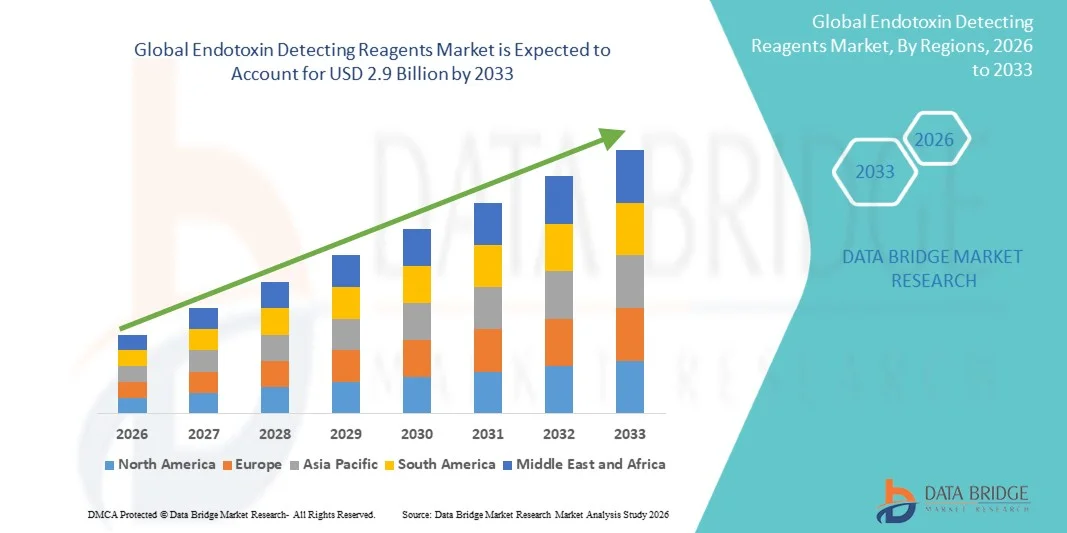
- As per Data Bridge Market Research analysis, the Endotoxin Detecting Reagents market was valued at USD 1.12 billion in 2025 and is projected to reach USD 2.9 billion by 2033, growing at a CAGR of 12.70% from 2026 to 2033.
- The market is experiencing robust growth as a result of expanding pharmaceutical and biotechnology industries, stringent regulatory requirements for product safety, and a growing emphasis on quality control in drug and medical device manufacturing.
- The global endotoxin detecting reagents market has evolved significantly, with quality control laboratories shifting from traditional gel clot assays to more sophisticated and sensitive methods such as chromogenic and turbidimetric reagents, as well as recombinant factor C assays. The shift toward recombinant reagents is reducing reliance on horseshoe crab blood, aligning with sustainability initiatives and ethical sourcing. The global endotoxin detecting reagents market is poised for continued expansion in the coming years, driven by the escalating demand for sterile pharmaceutical products, the rise of biologics and cell and gene therapies, and the rapid growth of the biotechnology and medical device industries worldwide.
Market Size & Forecast
- Global Market Value (2025): USD 1.12 Billion
- Expected Market Value (2033): USD 2.9 Billion
- Forecast CAGR (2026 to 2033): 12.70%
- Leading Region in 2025: North America
- Fastest Growing Region: Asia Pacific
What are the Major Takeaways of the Endotoxin Detecting Reagents Market?
- North America dominated the global endotoxin detecting reagents market with the largest revenue share of 57.66% in 2025, supported by a strong biologics manufacturing base, advanced quality control practices, and increasing adoption of recombinant endotoxin testing reagents. The North America endotoxin testing reagents market reached USD 320.8 million in 2025.
- Asia Pacific is expected to be the fastest-growing region, with the market projected to reach USD 243.0 million by 2026, driven by rapid expansion in biologics, vaccines, biosimilars, and CDMO manufacturing, along with improvements in quality control infrastructure across China, India, Japan, South Korea, and Southeast Asia.
- The natural source segment held the largest share of 69.20% in 2025, driven by widespread availability and established supply chains of traditional LAL reagents derived from horseshoe crabs.
- The recombinant source segment is the fastest-growing at a CAGR of 14.20% from 2026 to 2033, driven by increasing shift toward animal-free alternatives and growing demand for sustainable, synthetic testing solutions that address supply chain concerns and environmental regulations.
- The chromogenic test method segment dominated with a 35.10% share in 2025, driven by high sensitivity, accuracy, and widespread adoption in pharmaceutical and biotechnology quality control applications.
- The recombinant Factor C (rFC) assay segment is expected to witness the fastest growth at a CAGR of 14.80% from 2026 to 2033, reflecting the surge in demand for rapid, reliable, and animal-free testing methods as alternatives to traditional LAL tests.
Report Scope and Endotoxin Detecting Reagents Market Segmentation
|
Attributes |
Endotoxin Detecting Reagents Key Market Insights |
|
Segments Covered |
|
|
Countries Covered |
North America
Europe
Asia-Pacific
Middle East and Africa
South America
|
|
Key Market Players |
|
|
Market Opportunities |
|
|
Value Added Data Infosets |
In addition to the insights on market scenarios such as market value, growth rate, segmentation, geographical coverage, and major players, the market reports curated by the Data Bridge Market Research also include in-depth expert analysis, patient epidemiology, pipeline analysis, pricing analysis, and regulatory framework. |
What is the Key Trend in the Endotoxin Detecting Reagents Market?
- The endotoxin detecting reagents market is experiencing significant transformation as a result of increasing adoption of recombinant and animal-free testing methods, growing integration of automation and digitalization in quality control laboratories, and the rising emphasis on supply chain resilience and regulatory compliance.
- For instance, the adoption of recombinant factor C assays is accelerating, driven by regulatory developments such as the approval of USP Chapter <86>, which marks a major milestone for recombinant endotoxin testing. The natural segment is set to hold a 69.2% share in 2026, though recombinant reagents are gaining significant traction.
- The market is witnessing increased adoption of chromogenic and turbidimetric reagents, which have significantly expanded the testing options available to pharmaceutical quality control laboratories.
- Sustainability and transparency are becoming core focuses, with reagent manufacturers introducing eco-friendly production methods and sustainable sourcing practices to address environmental concerns associated with horseshoe crab harvesting.
- The convergence of endotoxin testing with digital platforms is accelerating innovation, with the landscape transitioning from manual, operator-dependent workflows toward automation-ready testing ecosystems.
What are the Key Drivers of the Endotoxin Detecting Reagents Market?
- The expanding pharmaceutical and biotechnology industries are primary drivers, with increasing complexity of biologics, biosimilars, and cell and gene therapies necessitating precise and rapid endotoxin quantification. The surge in vaccine production, biologics development, and personalized medicine is driving the need for rapid and reliable endotoxin testing throughout the product lifecycle.
- For instance, the rise in surgical procedures and the development of complex medical devices, such as catheters and implants, necessitate stringent endotoxin testing to prevent infections.
- Stringent regulatory requirements imposed by agencies such as the FDA, EMA, and PMDA are driving adoption, with endotoxin testing being a critical quality control test required during the final formulation stage for all drugs.
- The rapid growth of the medical device industry is significantly driving market growth, with the rise in surgical procedures and complex devices necessitating stringent endotoxin testing to prevent infections.
- With the pharmaceutical and biotechnology industries increasingly relying on endotoxin testing to ensure product safety and comply with regulations, endotoxin detecting reagents will remain indispensable for the development of safe pharmaceutical products and medical devices.
Which Factors are Challenging the Growth of the Endotoxin Detecting Reagents Market?
- Advanced endotoxin detecting reagents and testing systems require significant upfront investment due to the integration of sophisticated technologies, high-precision instrumentation, and complex assay development processes.
- These high costs limit adoption among small and medium-sized pharmaceutical companies, contract research organizations, and testing laboratories in emerging economies.
- For instance, in 2025, the United States introduced a series of tariff adjustments targeting imported biomedical reagents and diagnostic kits, including chromogenic LAL assay components, leading to an elevated cost structure for both reagent consumables and complete test kits.
- Regulatory complexity and lack of global harmonization pose significant challenges, with national registration requirements for endotoxin assay kits remaining a substantial barrier to market entry.
- For instance, while the European Pharmacopoeia has fully approved recombinant Factor C (rFC) assays as a valid alternative to LAL testing, regulatory acceptance remains inconsistent in other major markets, creating fragmentation and delaying product approvals.
- These challenges, ranging from high capital requirements and regulatory fragmentation to raw material supply constraints and validation complexities, continue to restrict market penetration, particularly among small and medium-sized organizations and price-sensitive markets. This cost barrier slows market expansion in developing regions, limiting the widespread deployment of advanced testing technologies despite growing regulatory scrutiny and expanding biopharmaceutical production.
How is the Endotoxin Detecting Reagents Market Segmented?
The Endotoxin Detecting Reagents market is segmented on the basis of product type, application, technique, and end-user.
- By Product Type
On the basis of product type, the global endotoxin detecting reagents market is segmented into chromogenic reagents, turbidimetric reagents, gel clot reagents, recombinant reagents, and others. The chromogenic reagents segment is set to hold a 35.1% share in 2026, driven by their high sensitivity, quantitative results, and widespread adoption in pharmaceutical, biologics, vaccine, and medical device testing. This approach maintains the highest percentage by enabling laboratories to accurately assess endotoxin levels, thereby facilitating routine quality control and batch release testing. Faster turnaround times, superior compatibility with high-throughput workflows, and robust integration with regulated manufacturing settings further reinforce the segment's leadership. Additionally, the effective combination of precision, workflow efficiency, and growing awareness of applications in endotoxin testing programs has led many end-users to prefer chromogenic assays, sustaining strong demand across QC labs worldwide.
The recombinant reagents segment is experiencing significant growth and is expected to increase at a CAGR of 12.41% during the forecast period, driven by the increasing demand for animal-free testing methods and regulatory developments such as USP Chapter <86>. The natural segment is set to hold a 69.2% share in 2026. Reagent-based LAL test kits continue to represent roughly 70–75% of global demand, while recombinant Factor C (rFC) alternatives are gaining adoption at 2–4% annually, particularly in regions with horseshoe crab conservation regulations.
- By Application
On the basis of application, the global endotoxin detecting reagents market is segmented into pharmaceutical and biotechnology, medical devices, diagnostics, and others. The pharmaceutical and biotechnology segment dominated the market with a 47.70% share in 2025, supported by stringent regulatory requirements for endotoxin testing of all biologics, injectables, and sterile drug products. Rising pharmaceutical R&D investments and increasing focus on product quality and patient safety are reinforcing the leading position of this segment.
The diagnostics segment is expected to witness the fastest growth at a CAGR of 13.90% from 2026 to 2033, driven by increasing demand for rapid diagnostic tests, growing prevalence of infectious diseases, and rising adoption of endotoxin testing in clinical diagnostics. Advances in detection technologies and expanding applications in point-of-care testing are accelerating segment expansion.
- By Technique
On the basis of technique, the global endotoxin detecting reagents market is segmented into chromogenic, turbidimetric, gel clot, and recombinant Factor C (rFC) assay. The chromogenic test method segment dominated with a 35.10% share in 2025, driven by high sensitivity, accuracy, and widespread adoption in pharmaceutical and biotechnology quality control applications. These techniques deliver quantitative results with high precision, making them the preferred choice for quality control laboratories and regulatory compliance testing.
The recombinant Factor C (rFC) assay segment is expected to witness the fastest growth at a CAGR of 14.80% from 2026 to 2033, reflecting the surge in demand for rapid, reliable, and animal-free testing methods as alternatives to traditional LAL tests. Advances in assay technologies and growing regulatory acceptance are accelerating segment expansion.
- By End-User
On the basis of end user, the global endotoxin detecting reagents market is segmented into pharmaceutical and biotechnology companies, medical device companies, contract research organizations, and others. The pharmaceutical and biotechnology companies segment dominated the market with a 62.10% share in 2025, supported by stringent regulatory requirements for endotoxin testing of all biologics, injectables, and medical devices. Rising quality control investments and increasing focus on product safety are reinforcing the leading position of this segment.
The contract research organizations (CROs) segment is expected to witness the fastest growth at a CAGR of 14.50% from 2026 to 2033, driven by increasing outsourcing of quality control testing services, growing number of CROs, and rising demand for third-party testing and validation services. Expanding service portfolios and growing adoption of advanced testing technologies are accelerating segment expansion.
Which Region Holds the Largest Share of the Endotoxin Detecting Reagents Market?
- North America dominated the global endotoxin detecting reagents market with the largest revenue share of 57.66% in 2025, supported by a strong biologics manufacturing base, advanced quality control practices, and stringent FDA regulations for pharmaceutical product safety.
- The region also benefits from the presence of major market players such as Charles River Laboratories, Lonza, and Associates of Cape Cod, along with increasing adoption of recombinant endotoxin testing reagents. The U.S. market is projected to reach approximately USD 290.8 million in 2026, representing about 30.7% of the global market.
U.S. Endotoxin Detecting Reagents Market Insight
The U.S. endotoxin detecting reagents market is experiencing steady growth, supported by rising pharmaceutical and biotechnology research activities, increasing biologics manufacturing, and growing adoption of advanced endotoxin testing technologies. Increasing investments in drug discovery and growing demand for recombinant testing solutions are contributing to market growth. Furthermore, integration of advanced detection technologies and stringent quality control practices are improving testing efficiency and accuracy, positioning the U.S. as a key innovation hub in the endotoxin detecting reagents industry.
Canada Endotoxin Detecting Reagents Market Insight
The Canada endotoxin detecting reagents market is expanding steadily due to the country's growing pharmaceutical manufacturing base, increasing biologics production, and rising adoption of quality control testing solutions. Pharmaceutical companies and research institutes are increasingly utilizing advanced endotoxin detection technologies for quality assurance and regulatory compliance. Continuous advancements in testing methodologies and recombinant reagent development, along with strong government support for pharmaceutical innovation, are further driving market growth in Canada.
Europe Endotoxin Detecting Reagents Market Insight
The Europe endotoxin detecting reagents market is witnessing steady growth, driven by the presence of a well-established pharmaceutical and biotechnology industry, stringent regulatory requirements, and increasing focus on biologics and biosimilars manufacturing. Countries such as Germany, France, and the U.K. are major contributors to market growth, supported by strong pharmaceutical R&D investments and advanced quality control infrastructure. Additionally, increasing adoption of recombinant technologies and growing emphasis on animal-free testing alternatives are further propelling market expansion across the region.
Asia-Pacific Endotoxin Detecting Reagents Market Insight
The Asia-Pacific endotoxin detecting reagents market is expected to witness rapid growth, driven by rapid growth in biologics, vaccines, biosimilars, CDMO manufacturing, and expanding quality control infrastructure across countries such as China, India, and Japan. Growing prevalence of infectious diseases, rising pharmaceutical outsourcing, and increasing investments in healthcare infrastructure are supporting regional market expansion. Additionally, the growing presence of domestic reagent manufacturers and expanding pharmaceutical research capabilities is accelerating market penetration across commercial and research sectors.
Japan Endotoxin Detecting Reagents Market Insight
The Japan endotoxin detecting reagents market is witnessing consistent growth due to rising investments in pharmaceutical research and development, biologics manufacturing, and quality control infrastructure. Pharmaceutical companies, biotechnology firms, and research institutes are increasingly adopting advanced endotoxin testing reagents for drug development and regulatory compliance purposes. Moreover, increasing integration of recombinant technologies and the country's focus on innovative healthcare solutions are further contributing to market growth.
China Endotoxin Detecting Reagents Market Insight
The China endotoxin detecting reagents market is growing rapidly, driven by increasing pharmaceutical production, expanding biologics manufacturing, and rising government focus on quality control and regulatory compliance in the pharmaceutical industry. Growing adoption of advanced endotoxin testing technologies across commercial, research, and clinical sectors is significantly boosting market demand. In addition, rising investments in pharmaceutical R&D, increasing prevalence of infectious diseases, and rapid expansion of contract research organizations are positioning China as one of the fastest-growing markets for endotoxin detecting reagents globally.
India Endotoxin Detecting Reagents Market Insight
The India endotoxin detecting reagents market is experiencing robust growth, supported by expanding pharmaceutical manufacturing, growing biologics and biosimilars production, and increasing focus on quality assurance and regulatory compliance. The country's growing contract research and manufacturing sectors, combined with increasing adoption of advanced testing technologies, are driving market expansion. Additionally, rising healthcare expenditure, government initiatives promoting pharmaceutical innovation, and growing availability of endotoxin detection solutions are further accelerating market adoption across research and commercial laboratories.
Which are the Top Companies in Endotoxin Detecting Reagents Market?
The Endotoxin Detecting Reagents industry is primarily led by well-established companies, including:
- Charles River Laboratories (U.S.)
- Lonza (Switzerland)
- bioMérieux (France)
- FUJIFILM Corporation (Japan)
- Merck KGaA (Germany)
- Associates of Cape Cod, Inc. (U.S.)
- Thermo Fisher Scientific Inc. (U.S.)
- InvivoGen (U.S.)
- GenScript (U.S.)
- Xiamen Bioendo Technology Co., Ltd. (China)
- Accugen Laboratories Inc. (U.S.)
- Pacific BioLabs (U.S.)
- STERIS (U.S.)
- ACROBiosystems (U.S.)
- Avantor, Inc. (U.S.)
- Eurofins Scientific SE (Luxembourg)
What are Latest Developments in Endotoxin Detecting Reagents Market?
- In August 2026, Charles River Laboratories announced the expansion of its Endosafe cartridge recycling program in partnership with TerraCycle, allowing users of Endosafe BET cartridge technology to recycle single-use cartridges used for routine water testing. The program reinforces Charles River's commitment to sustainability in endotoxin testing and provides an environmentally responsible solution for laboratories seeking to reduce waste generated during quality control processes.
- In July 2026, Charles River Laboratories introduced the Endosafe Trillium rCR cartridge, the first rapid animal-free bacterial endotoxin test building upon its flagship Endosafe cartridge technology. The offering combines recombinant cascade reagent (rCR) with cartridge technology to deliver rapid, quantitative results while eliminating the need for preparation of multiple reagents and reducing the opportunity for technician error. The product is fully aligned and integrated with Charles River's existing suite of Endosafe cartridge instrumentation and software, allowing current LAL cartridge clients to transition seamlessly.
- In June 2026, Lonza Group AG launched the Nebula Absorbance Reader, a next-generation microplate reader developed to simplify endotoxin and pyrogen testing. Fully integrated with Lonza's WinKQCL software, the system supports data integrity compliance, reduces validation efforts, and is optimized for Lonza's absorbance-based endotoxin assays. The launch represents a significant advancement in automated endotoxin testing solutions for pharmaceutical quality control laboratories.
- In May 2026, Associates of Cape Cod (ACC) issued a formal position statement on USP Chapter <86> and recombinant BET reagents. The company stated that USP <86> marks a major milestone for recombinant endotoxin testing and reiterated that PyroSmart NextGen was the first commercially available rCR reagent. The statement reinforced ACC's commitment to supporting broader recombinant BET adoption in regulated quality control environments.
- In January 2026, the European Union implemented the removal of the Rabbit Pyrogen Test from the European Pharmacopoeia, accelerating the shift toward animal-free testing methods. This regulatory change has significantly boosted demand for recombinant factor C assays and monocyte activation tests as sustainable alternatives.

- Interactive Data Analysis Dashboard
- Company Analysis Dashboard for high growth potential opportunities
- Research Analyst Access for customization & queries
- Competitor Analysis with Interactive dashboard
- Latest News, Updates & Trend analysis
- Harness the Power of Benchmark Analysis for Comprehensive Competitor Tracking
Data collection and base year analysis are done using data collection modules with large sample sizes. The stage includes obtaining market information or related data through various sources and strategies. It includes examining and planning all the data acquired from the past in advance. It likewise envelops the examination of information inconsistencies seen across different information sources. The market data is analysed and estimated using market statistical and coherent models. Also, market share analysis and key trend analysis are the major success factors in the market report. To know more, please request an analyst call or drop down your inquiry.
The key research methodology used by DBMR research team is data triangulation which involves data mining, analysis of the impact of data variables on the market and primary (industry expert) validation. Data models include Vendor Positioning Grid, Market Time Line Analysis, Market Overview and Guide, Company Positioning Grid, Patent Analysis, Pricing Analysis, Company Market Share Analysis, Standards of Measurement, Global versus Regional and Vendor Share Analysis. To know more about the research methodology, drop in an inquiry to speak to our industry experts.
Data Bridge Market Research is a leader in advanced formative research. We take pride in servicing our existing and new customers with data and analysis that match and suits their goal. The report can be customized to include price trend analysis of target brands understanding the market for additional countries (ask for the list of countries), clinical trial results data, literature review, refurbished market and product base analysis. Market analysis of target competitors can be analyzed from technology-based analysis to market portfolio strategies. We can add as many competitors that you require data about in the format and data style you are looking for. Our team of analysts can also provide you data in crude raw excel files pivot tables (Fact book) or can assist you in creating presentations from the data sets available in the report.













