


Energy and Power Quality Meters Market Overview
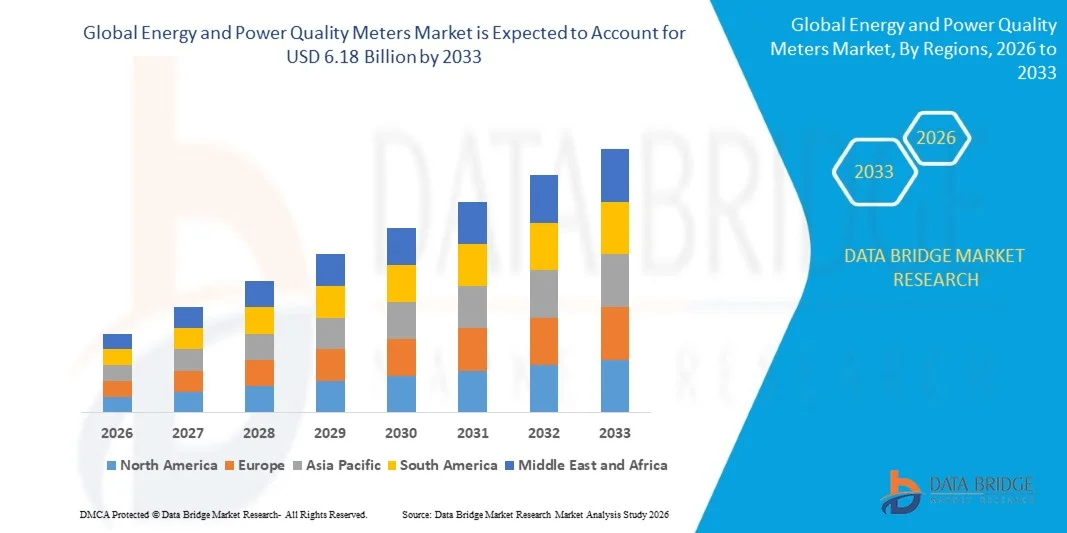
The Energy and Power Quality Meters Market was valued at USD 3.60 billion in 2025 and is projected to reach USD 6.18 billion by 2033, growing at a CAGR of 7.00% from 2026 to 2033. The market is witnessing steady expansion driven by increasing demand for reliable electricity monitoring, growing industrial automation, and rising integration of renewable energy into power grids. Utilities and industrial users are increasingly focusing on advanced metering infrastructure to ensure efficient energy utilization and minimize power losses across transmission and distribution networks.
The rising complexity of modern electrical systems, combined with growing concerns regarding voltage instability, harmonics, and power fluctuations, is accelerating the adoption of power quality meters across industrial, commercial, and utility applications. Governments and regulatory bodies are also mandating stricter energy efficiency and grid reliability standards, further supporting market growth. In addition, rapid expansion of smart grids and digital substations is encouraging the deployment of advanced energy meters with real-time monitoring and analytics capabilities for improved operational efficiency and predictive maintenance.
Key Market Trends & Insights
- North America dominated the energy and power quality meters market with the largest revenue share of approximately 36.4% in 2025, supported by strong smart grid deployment, advanced metering infrastructure penetration, and high investments in grid modernization initiatives.
- Asia-Pacific is expected to be the fastest-growing region, recording a CAGR of approximately 8.3% from 2026 to 2033. Growth is driven by rapid urbanization, expanding industrial base, increasing electricity demand, and large-scale government investments in smart city and smart grid projects across emerging economies such as China and India.
- The Three Phase segment held the largest market revenue share of approximately 63.5% in 2025 driven by its extensive deployment across industrial facilities, manufacturing plants, commercial complexes, and utility-scale power distribution networks where high-load monitoring and balanced power distribution are critical. Three phase meters are widely preferred due to their ability to handle higher loads, improved accuracy in industrial environments, and suitability for continuous monitoring of complex electrical systems.
- The Single Phase segment is projected to register the fastest growth at a CAGR of 8.1% from 2026 to 2033, driven by rising adoption in residential applications, small commercial units, and decentralized energy systems. Increasing installation of smart home energy monitoring systems and rooftop solar integrations is further supporting segment expansion, particularly in developing economies with expanding urban electricity demand.
- The Substation Monitoring segment held the largest market revenue share of approximately 34.2% in 2025 driven by increasing deployment of smart grid infrastructure and rising demand for real-time grid stability monitoring in transmission and distribution networks. Utilities are widely adopting advanced power quality meters in substations to detect faults, reduce outages, and improve overall grid reliability.
- The Distribution Panels segment accounted for approximately 27.6% share in 2025, supported by growing integration of energy monitoring systems in commercial buildings and industrial plants to optimize electricity usage at the distribution level. The Equipment segment held around 23.1% share, driven by increasing demand for machine-level energy monitoring in manufacturing and process industries. The Others segment accounted for the remaining share, supported by niche applications in laboratories, research facilities, and infrastructure projects.
- The Industrial and Manufacturing segment held the largest market revenue share of approximately 41.8% in 2025 driven by high electricity consumption, rising automation, and increasing focus on energy efficiency and predictive maintenance across production facilities. Industries such as steel, chemicals, automotive, and electronics are widely deploying power quality meters to minimize downtime and improve operational efficiency.
- The Commercial Utilities segment accounted for approximately 38.5% share in 2025, supported by large-scale smart grid deployments, utility modernization programs, and rising investments in advanced metering infrastructure. The Transportation segment is projected to register the fastest growth at a CAGR of 8.6% from 2026 to 2033, driven by electrification of rail networks, expansion of electric vehicle charging infrastructure, and growing demand for real-time energy monitoring in transit systems. The Others segment held a smaller share, supported by adoption in data centers, defense installations, and institutional facilities.
Market Size & Forecast
- Global Market Value (2025): USD 3.60 Billion
- Expected Market Value (2033): USD 6.18 Billion
- Forecast CAGR (2026–2033): 7.00%
- Leading Region in 2025: North America
- Fastest Growing Region: Asia-Pacific
Report Scope and Energy and Power Quality Meters Market Segmentation
|
Attributes |
Energy and Power Quality Meters Key Market Insights |
|
Segments Covered |
|
|
Countries Covered |
North America
Europe
Asia-Pacific
Middle East and Africa
South America
|
|
Key Market Players |
• Eaton (U.S.) |
|
Market Opportunities |
• Expansion Of Smart Grid Infrastructure • Rising Adoption Of Renewable Energy Integration |
|
Value Added Data Infosets |
In addition to the insights on market scenarios such as market value, growth rate, segmentation, geographical coverage, and major players, the market reports curated by the Data Bridge Market Research also include in-depth expert analysis, geographically represented company-wise production and capacity, network layouts of distributors and partners, detailed and updated price trend analysis and deficit analysis of supply chain and demand. |
Energy and Power Quality Meters Market Trends
Trend: Growth In Digitalization, Smart Grid Deployment, And Advanced Power Monitoring Systems
Increasing demand for reliable, real-time, and highly accurate energy monitoring solutions across industrial, commercial, and utility sectors is driving the adoption of advanced energy and power quality meters. Traditional electromechanical meters are being replaced by digital and smart meters capable of providing detailed insights into voltage fluctuations, harmonics, load imbalance, and power factor variations, enabling better energy optimization and grid stability management.
In modern smart grid systems, utilities are increasingly deploying advanced power quality meters for real-time monitoring and fault detection, For instance in smart substations and distribution networks, to reduce transmission losses and improve outage response times. In industrial facilities, these meters are being integrated with energy management systems to monitor high-energy equipment performance, optimize electricity consumption, and reduce downtime caused by power disturbances.
The rapid expansion of renewable energy integration, including solar and wind power, is also increasing the need for precise grid monitoring solutions capable of handling variable and intermittent power inputs. In addition, data centers and semiconductor manufacturing plants are adopting high-accuracy power quality meters to ensure uninterrupted power supply and prevent equipment failure caused by harmonic distortion or voltage instability. Pilot smart grid projects in Europe and China during 2024 demonstrated that advanced metering infrastructure improved grid efficiency by 12–18% through better load balancing and real-time analytics.
Energy and Power Quality Meters Market Dynamics
Key Market Driver: Rising Demand For Energy Efficiency And Smart Grid Modernization
Global energy consumption is rising rapidly due to industrial expansion, urbanization, and electrification of transport systems, creating strong demand for efficient energy monitoring and management solutions. Utilities and industries are increasingly focusing on reducing transmission losses, optimizing energy usage, and improving grid reliability through the deployment of smart metering infrastructure and digital power quality monitoring systems.
Governments worldwide are enforcing stricter energy efficiency regulations and grid modernization programs, encouraging large-scale adoption of smart meters and advanced monitoring devices. For instance, smart meter rollout programs in the European Union have achieved penetration rates exceeding 50% in several member states, supporting improved demand-side management and reduced peak load pressures.
In addition, industries such as manufacturing, oil and gas, and commercial real estate are deploying power quality meters to monitor electrical disturbances and prevent equipment damage, reduce downtime, and improve operational efficiency. Industrial case studies in India and Germany during 2025 showed that advanced power monitoring systems helped reduce energy wastage by approximately 8–12% through predictive maintenance and real-time optimization
Key Restraint/Challenge: High Installation Costs And Integration Complexity
The deployment of advanced energy and power quality meters requires significant upfront investment in smart infrastructure, communication systems, and software integration platforms, which can limit adoption among small and medium-sized enterprises. In addition, the need for skilled technical personnel for installation, calibration, and data interpretation increases operational complexity and overall project costs.
Compatibility issues with legacy grid infrastructure further slow down large-scale deployment, particularly in developing regions where grid modernization is still in early stages. The integration of smart meters with existing SCADA and energy management systems often requires additional upgrades, increasing both time and capital requirements.
Field deployment data from utility modernization projects in Asia-Pacific indicate that full-scale smart metering implementation can increase initial infrastructure costs by 20–35%, depending on grid complexity and communication technology used, creating affordability challenges for cost-sensitive markets.
Key Market Opportunity: Expansion Of Renewable Energy Integration And Smart Grid Infrastructure
The growing global shift toward renewable energy sources such as solar and wind is creating strong demand for advanced power quality meters capable of managing fluctuating and distributed energy inputs. These systems are essential for maintaining grid stability, preventing voltage instability, and ensuring efficient power distribution in decentralized energy networks.
Utilities are increasingly investing in smart grid infrastructure to support bidirectional energy flow, electric vehicle charging networks, and distributed energy resources. For instance, large-scale smart grid projects in the U.S. and China are integrating advanced metering systems to improve real-time energy visibility and reduce grid congestion during peak demand periods.
In addition, advancements in IoT-enabled energy monitoring devices and cloud-based analytics platforms are creating new opportunities for predictive energy management and automated fault detection. Renewable integration projects in 2025 have demonstrated that smart power quality meters can improve grid reliability by 10–20% while reducing outage durations through faster fault localization and response mechanisms.
Energy and Power Quality Meters Market Scope
The market is segmented on the basis of phase, application, and end-use application.
• By Phase
On the basis of phase, the energy and power quality meters market is segmented into Single Phase and Three Phase. The Three Phase segment held the largest market revenue share of approximately 63.5% in 2025 driven by its extensive deployment across industrial facilities, manufacturing plants, commercial complexes, and utility-scale power distribution networks where high-load monitoring and balanced power distribution are critical. Three phase meters are widely preferred due to their ability to handle higher loads, improved accuracy in industrial environments, and suitability for continuous monitoring of complex electrical systems.
The Single Phase segment is projected to register the fastest growth at a CAGR of 8.1% from 2026 to 2033, driven by rising adoption in residential applications, small commercial units, and decentralized energy systems. Increasing installation of smart home energy monitoring systems and rooftop solar integrations is further supporting segment expansion, particularly in developing economies with expanding urban electricity demand.
• By Application
On the basis of application, the market is segmented into Distribution Panels, Substation Monitoring, Equipment, and Others. The Substation Monitoring segment held the largest market revenue share of approximately 34.2% in 2025 driven by increasing deployment of smart grid infrastructure and rising demand for real-time grid stability monitoring in transmission and distribution networks. Utilities are widely adopting advanced power quality meters in substations to detect faults, reduce outages, and improve overall grid reliability.
The Distribution Panels segment accounted for approximately 27.6% share in 2025, supported by growing integration of energy monitoring systems in commercial buildings and industrial plants to optimize electricity usage at the distribution level. The Equipment segment held around 23.1% share, driven by increasing demand for machine-level energy monitoring in manufacturing and process industries. The Others segment accounted for the remaining share, supported by niche applications in laboratories, research facilities, and infrastructure projects.
• By End User
On the basis of end user, the market is segmented into Industrial and Manufacturing, Commercial Utilities, Transportation, and Others. The Industrial and Manufacturing segment held the largest market revenue share of approximately 41.8% in 2025 driven by high electricity consumption, rising automation, and increasing focus on energy efficiency and predictive maintenance across production facilities. Industries such as steel, chemicals, automotive, and electronics are widely deploying power quality meters to minimize downtime and improve operational efficiency.
The Commercial Utilities segment accounted for approximately 38.5% share in 2025, supported by large-scale smart grid deployments, utility modernization programs, and rising investments in advanced metering infrastructure. The Transportation segment is projected to register the fastest growth at a CAGR of 8.6% from 2026 to 2033, driven by electrification of rail networks, expansion of electric vehicle charging infrastructure, and growing demand for real-time energy monitoring in transit systems. The Others segment held a smaller share, supported by adoption in data centers, defense installations, and institutional facilities.
Energy and Power Quality Meters Market Regional Analysis
North America Energy And Power Quality Meters Market Insight
North America dominated the energy and power quality meters market with the largest revenue share of approximately 36.4% in 2025, supported by rapid smart grid modernization, strong penetration of advanced metering infrastructure, and rising demand for real-time energy monitoring across industrial and utility sectors. The region benefits from highly developed power distribution networks and increasing investments in grid reliability, efficiency, and digitalization. Utilities and industrial users are increasingly deploying advanced power quality meters to detect voltage disturbances, reduce transmission losses, and enhance overall energy efficiency across large-scale networks.
U.S. Energy And Power Quality Meters Market Insight
The U.S. energy and power quality meters market captured the largest revenue share in North America in 2025, driven by large-scale smart grid deployment programs, strong regulatory focus on energy efficiency, and widespread adoption of IoT-enabled energy monitoring systems. Utilities are actively integrating advanced metering infrastructure across transmission and distribution networks to improve grid resilience and reduce outage durations. In addition, increasing electricity demand from data centers, semiconductor manufacturing, and electric vehicle charging infrastructure is further accelerating adoption of high-accuracy power quality meters.
Europe Energy And Power Quality Meters Market Insight
The Europe energy and power quality meters market is expected to witness the fastest growth rate from 2026 to 2033, primarily driven by strict energy efficiency regulations, aggressive carbon reduction targets, and rapid expansion of renewable energy integration across the grid. European utilities are increasingly deploying advanced monitoring systems to manage distributed energy resources such as wind and solar power. The region is also experiencing strong adoption across industrial automation and smart building applications, where real-time energy analytics is being used to optimize consumption and reduce operational costs.
U.K. Energy And Power Quality Meters Market Insight
The U.K. energy and power quality meters market is expected to witness strong growth from 2026 to 2033, driven by national smart meter rollout programs and increasing investments in grid modernization and decarbonization initiatives. Rising concerns over energy security and fluctuating electricity prices are encouraging both utilities and commercial users to adopt advanced monitoring systems. The integration of renewable energy sources into the national grid is also increasing demand for precise power quality monitoring to maintain stability and reduce system inefficiencies.
Germany Energy And Power Quality Meters Market Insight
The Germany energy and power quality meters market is expected to witness steady expansion from 2026 to 2033, supported by strong industrial automation, advanced manufacturing infrastructure, and the country’s leadership in renewable energy adoption. Germany’s Energiewende transition is significantly driving demand for intelligent metering systems capable of managing complex and decentralized power generation networks. Industrial facilities are increasingly using power quality meters to optimize energy consumption, reduce downtime, and improve operational efficiency in high-energy-consuming sectors such as automotive and chemicals.
Asia-Pacific Energy And Power Quality Meters Market Insight
The Asia-Pacific energy and power quality meters market is expected to witness the fastest growth rate from 2026 to 2033, supported by rapid urbanization, expanding industrial base, and large-scale investments in smart grid infrastructure across China, India, and Southeast Asia. The region is witnessing strong growth in electricity demand from manufacturing, transportation electrification, and commercial infrastructure development. Governments are increasingly promoting smart metering initiatives to improve energy efficiency, reduce power theft, and enhance grid reliability across densely populated urban centers.
Japan Energy And Power Quality Meters Market Insight
The Japan energy and power quality meters market is expected to witness steady growth from 2026 to 2033 due to the country’s advanced technological infrastructure, high focus on energy efficiency, and increasing adoption of smart grid systems. Japan’s emphasis on disaster-resilient and highly stable power networks is driving the deployment of advanced power quality monitoring systems. In addition, rising integration of renewable energy sources and smart building technologies is increasing demand for precise energy management solutions across residential, commercial, and industrial applications.
China Energy And Power Quality Meters Market Insight
The China energy and power quality meters market accounted for the largest market revenue share in Asia Pacific in 2025, attributed to rapid industrialization, large-scale smart city development, and strong government support for digital power infrastructure. China is one of the largest adopters of smart grid technologies, with utilities widely deploying advanced metering systems to improve grid efficiency and reduce transmission losses. In addition, rapid expansion of manufacturing industries and electric vehicle charging infrastructure is further strengthening demand for high-performance energy and power quality meters.
Energy and Power Quality Meters Market Share
The Energy and Power Quality Meters industry is primarily led by well-established companies, including:
• Eaton (U.S.)
• Danaher (U.S.)
• GENERAL ELECTRIC (U.S.)
• Schneider Electric (France)
• Siemens (Germany)
• ABB (Switzerland)
• Accuenergy Ltd (Canada)
• Emerson Electric Co. (U.S.)
• Honeywell International Inc (U.S.)
• Itron Inc (U.S.)
• Sensus (U.S.)
• Wasion Group (China)
• ZHEJIANG YONGTAILONG ELECTRONIC CO., LTD. (China)
• ROHM CO., LTD. (Japan)
• TOSHIBA ELECTRONIC DEVICES AND STORAGE CORPORATION (Japan)
• Seiko Epson Corporation (Japan)
• Nuvoton Technology Corporation (Taiwan)
• Ambiq Micro (U.S.)
• ELAN Microelectronic Corp. (Taiwan)
• Marvell (U.S.)
• XMOS (U.K.)
• Zilog, Inc. (U.S.)
• Holtek Semiconductor Inc. (Taiwan)

- Interactive Data Analysis Dashboard
- Company Analysis Dashboard for high growth potential opportunities
- Research Analyst Access for customization & queries
- Competitor Analysis with Interactive dashboard
- Latest News, Updates & Trend analysis
- Harness the Power of Benchmark Analysis for Comprehensive Competitor Tracking
Global Energy And Power Quality Meters Market, Supply Chain Analysis and Ecosystem Framework
To support market growth and help clients navigate the impact of geopolitical shifts, DBMR has integrated in-depth supply chain analysis into its Global Energy And Power Quality Meters Market research reports. This addition empowers clients to respond effectively to global changes affecting their industries. The supply chain analysis section includes detailed insights such as Global Energy And Power Quality Meters Market consumption and production by country, price trend analysis, the impact of tariffs and geopolitical developments, and import and export trends by country and HSN code. It also highlights major suppliers with data on production capacity and company profiles, as well as key importers and exporters. In addition to research, DBMR offers specialized supply chain consulting services backed by over a decade of experience, providing solutions like supplier discovery, supplier risk assessment, price trend analysis, impact evaluation of inflation and trade route changes, and comprehensive market trend analysis.
Data collection and base year analysis are done using data collection modules with large sample sizes. The stage includes obtaining market information or related data through various sources and strategies. It includes examining and planning all the data acquired from the past in advance. It likewise envelops the examination of information inconsistencies seen across different information sources. The market data is analysed and estimated using market statistical and coherent models. Also, market share analysis and key trend analysis are the major success factors in the market report. To know more, please request an analyst call or drop down your inquiry.
The key research methodology used by DBMR research team is data triangulation which involves data mining, analysis of the impact of data variables on the market and primary (industry expert) validation. Data models include Vendor Positioning Grid, Market Time Line Analysis, Market Overview and Guide, Company Positioning Grid, Patent Analysis, Pricing Analysis, Company Market Share Analysis, Standards of Measurement, Global versus Regional and Vendor Share Analysis. To know more about the research methodology, drop in an inquiry to speak to our industry experts.
Data Bridge Market Research is a leader in advanced formative research. We take pride in servicing our existing and new customers with data and analysis that match and suits their goal. The report can be customized to include price trend analysis of target brands understanding the market for additional countries (ask for the list of countries), clinical trial results data, literature review, refurbished market and product base analysis. Market analysis of target competitors can be analyzed from technology-based analysis to market portfolio strategies. We can add as many competitors that you require data about in the format and data style you are looking for. Our team of analysts can also provide you data in crude raw excel files pivot tables (Fact book) or can assist you in creating presentations from the data sets available in the report.













