


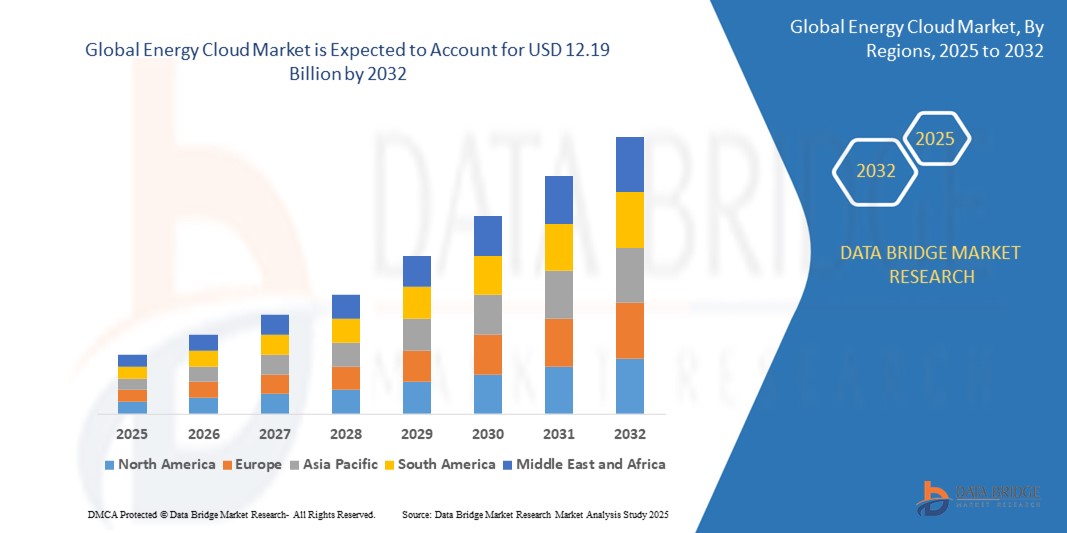
Energy Cloud Market Size
- The global energy cloud market size was valued at USD 2.69 billion in 2024 and is expected to reach USD 12.19 billion by 2032, at a CAGR of 20.80% during the forecast period
- This growth is driven by factors such as the increasing adoption of smart grid technologies, the need for efficient energy management systems, rising investments in renewable energy, advancements in cloud computing and data analytics, and regulatory initiatives promoting digital transformation in the energy sector.
Energy Cloud Market Analysis
- The energy cloud market is experiencing significant growth as organizations increasingly adopt cloud-based solutions to enhance energy management and operational efficiency
- The integration of advanced technologies such as artificial intelligence, machine learning, and the Internet of Things is driving the development of intelligent energy systems and enabling real-time monitoring and optimization
- North America is expected to dominate the energy cloud market due to its advanced technological infrastructure, high adoption rate of cloud solutions, significant investments in renewable energy, and strong presence of key energy companies and cloud service providers
- Asia-Pacific is expected to be the fastest-growing region in the Energy Cloud market during the forecast period due to rapid urbanization, increasing energy demand, supportive government policies for renewable energy integration, and the rising adoption of smart grid technologies across the region
- The enterprise asset management segment is expected to dominate the energy cloud market with the largest share of 51.5% in 2025 due to its ability to streamline asset lifecycle management, enhance operational visibility, and reduce downtime through predictive maintenance tools integrated with cloud platforms. It allows energy companies to monitor and control physical assets in real time, resulting in improved efficiency, cost savings, and regulatory compliance, which are critical for infrastructure-heavy operations such as utilities and grid management.
Report Scope and Energy Cloud Market Segmentation
|
Attributes |
Energy Cloud Key Market Insights |
|
Segments Covered |
|
|
Countries Covered |
North America
Europe
Asia-Pacific
Middle East and Africa
South America
|
|
Key Market Players |
|
|
Market Opportunities |
|
|
Value Added Data Infosets |
In addition to the market insights such as market value, growth rate, market segments, geographical coverage, market players, and market scenario, the market report curated by the Data Bridge Market Research team includes in-depth expert analysis, import/export analysis, pricing analysis, production consumption analysis, and pestle analysis. |
Energy Cloud Market Trends
“Adoption of Artificial Intelligence in Energy Cloud Systems”
- Artificial intelligence is playing a key role in transforming energy cloud systems by improving decision-making processes and enabling predictive analytics
- AI is being used to forecast energy demand and optimize grid management, leading to better resource allocation and reduced operational costs
- For instance, Siemens has integrated AI into its energy management system, allowing utilities to predict demand fluctuations more accurately
- By analyzing large datasets from various energy sources, AI can identify patterns and anomalies that help utilities manage power generation more efficiently
- Companies such as Google and IBM are increasingly integrating AI into their energy cloud platforms, enhancing their ability to predict and manage energy consumption
- AI-driven systems are also being used to improve energy storage capabilities, allowing for more efficient storage and distribution of renewable energy, such as solar or wind power
Energy Cloud Market Dynamics
Driver
“Increasing Demand for Energy Efficiency”
- The rising global energy consumption has led industries and consumers to prioritize solutions that improve energy efficiency and reduce wastage
- Cloud-based energy management systems enable real-time monitoring, automation, and optimization of energy use, contributing to cost savings and a reduced carbon footprint
- The integration of intelligent energy solutions powered by the cloud allows utilities, businesses, and residential users to track energy consumption more closely and make data-driven decisions
- Energy providers can optimize power distribution, predict demand, and store renewable energy more efficiently, reducing dependence on non-renewable energy sources
- For instance, Duke Energy uses cloud systems to enhance grid stability and improve energy flow
- Industries such as manufacturing are leveraging energy cloud solutions to monitor and adjust energy use, helping to meet sustainability goals while lowering operational costs. Companies such as Ford have implemented energy cloud technologies to reduce energy consumption in their production processes
Opportunity
“Expansion of Renewable Energy Integration”
- A key opportunity in the energy cloud market is the growing need for renewable energy integration as the world shifts toward cleaner energy sources such as wind, solar, and hydroelectric power
- Energy cloud platforms provide essential tools for optimizing the production, storage, and distribution of renewable energy, supporting a more sustainable energy ecosystem
- The intermittent nature of renewable energy sources, such as solar and wind, presents challenges in managing power supply, but energy cloud systems address this through real-time data analysis and predictive modeling
- These systems enhance grid management, improving energy reliability and reducing the need for backup fossil fuel plants
- For instance, Tesla’s Powerwall uses cloud-based technology to store and release energy as needed, ensuring more efficient use of solar energy
- With energy cloud platforms facilitating better integration of renewable sources, market players have the opportunity to create innovative solutions that support the transition to a cleaner energy grid
Restraint/Challenge
“Security Concerns in Cloud-Based Systems”
- One of the major challenges facing the energy cloud market is the security of cloud-based systems as energy infrastructure becomes more connected through cloud technology
- The growing risks associated with cybersecurity make energy cloud systems attractive targets for cybercriminals, as they store vast amounts of sensitive data such as energy usage patterns, grid operations, and financial transactions
- Cyberattacks on energy systems can lead to significant disruptions in power generation, distribution, and data breaches, potentially causing severe consequences for both providers and consumers
- The increase in the use of Internet of Things devices in energy grids adds more potential entry points for cyber threats, making it harder to secure every connected device effectively
- Energy companies must invest in cybersecurity measures such as data encryption and multi-factor authentication, but the complexity and cost of these solutions can be a barrier for smaller businesses, limiting widespread adoption of energy cloud systems
Energy Cloud Market Scope
The market is segmented on the basis of solution, service, and service model.
|
Segmentation |
Sub-Segmentation |
|
By Solution |
|
|
By Service |
|
|
By Service Model |
|
In 2025, the enterprise asset management is projected to dominate the market with a largest share in solution segment
The enterprise asset management segment is expected to dominate the energy cloud market with the largest share of 51.5% in 2025 due to its ability to streamline asset lifecycle management, enhance operational visibility, and reduce downtime through predictive maintenance tools integrated with cloud platforms. It allows energy companies to monitor and control physical assets in real time, resulting in improved efficiency, cost savings, and regulatory compliance, which are critical for infrastructure-heavy operations such as utilities and grid management.
The software-as-a-service (SaaS) is expected to account for the largest share during the forecast period in service model segment
In 2025, the software-as-a-service (SaaS) segment is expected to dominate the market with the largest market share due to its flexible deployment model, lower upfront costs, and scalability that supports rapid adoption across enterprises of all sizes. SaaS enables energy firms to access advanced applications without the burden of managing underlying infrastructure, making it ideal for dynamic and data-intensive environments that require constant updates, real-time collaboration, and enhanced data security.
Energy Cloud Market Regional Analysis
“North America Holds the Largest Share in the Energy Cloud Market”
- North America is the dominating region in the energy cloud market, holding a significant market share
- The region's advanced technological infrastructure and high adoption of digital solutions contribute to its leadership in the energy cloud sector
- Strong regulatory support and government initiatives promoting grid modernization and clean energy integration further bolster market dominance
- The presence of major energy companies and cloud service providers in North America facilitates innovation and market growth
- Significant investments in renewable energy and smart grid technologies enhance the region's position in the global energy cloud market
“Asia-Pacific is Projected to Register the Highest CAGR in the Energy Cloud Market”
- Asia-Pacific is the fastest-growing region in the energy cloud market, experiencing rapid expansion
- The region's increasing energy demand and urbanization drive the adoption of digital energy solutions
- Government policies and investments in renewable energy infrastructure accelerate the growth of energy cloud technologies
- Technological advancements and a growing tech-savvy population support the rapid deployment of cloud-based energy solutions
- Strategic initiatives by global cloud service providers in the region further stimulate market growth
Energy Cloud Market Share
The market competitive landscape provides details by competitor. Details included are company overview, company financials, revenue generated, market potential, investment in research and development, new market initiatives, global presence, production sites and facilities, production capacities, company strengths and weaknesses, product launch, product width and breadth, application dominance. The above data points provided are only related to the companies' focus related to market.
The Major Market Leaders Operating in the Market Are:
- Accenture (Ireland)
- IBM Corporation (U.S.)
- HCL Technologies Limited (India)
- SAP SE (Germany)
- Cisco Systems, Inc. (U.S.)
- Oracle Corporation (U.S.)
- Capgemini (France)
- Tata Consultancy Services Limited (India)
- Hewlett Packard Enterprise Development LP (U.S.)
- Microsoft (U.S.)
- Brillio (U.S.)
- DLT Solutions (U.S.)
- Kamatera (Israel)
- Salesforce Cloud (U.S.)
- Verizon Cloud (U.S.)
Latest Developments in Global Energy Cloud Market
- In May 2023, Iberdrola introduced the Advanced Smart Assistant, a connected energy solution aimed at empowering consumers to actively participate in the energy transition. This platform, accessible through the Iberdrola app, utilizes artificial intelligence to manage and optimize household energy consumption. By connecting to various digital electrical solutions within the home, it enables automatic adjustments to improve efficiency and reduce energy costs. The system is designed to operate on the Amazon Web Services (AWS) cloud infrastructure, with Deloitte serving as the service provider. According to Iberdrola, the Advanced Smart Assistant has the potential to decrease smart device energy consumption by 10% to 30%
- In February 2023, Tata Consultancy Services (TCS) announced the availability of its award-winning TCS Clever Energy solution on Google Cloud. This enterprise-grade energy and emission management platform leverages Internet of Things (IoT), artificial intelligence (AI), machine learning (ML), and cloud technologies to help commercial and industrial organizations reduce carbon emissions and achieve their sustainability goals. Integrated with Google Cloud’s carbon-neutral data infrastructure, TCS Clever Energy provides 24/7 energy monitoring, predictive analytics, and insights to optimize energy consumption and improve asset utilization. The solution empowers organizations to make informed, data-driven decisions without compromising business needs, thereby facilitating a transition toward net-zero emissions

- Interactive Data Analysis Dashboard
- Company Analysis Dashboard for high growth potential opportunities
- Research Analyst Access for customization & queries
- Competitor Analysis with Interactive dashboard
- Latest News, Updates & Trend analysis
- Harness the Power of Benchmark Analysis for Comprehensive Competitor Tracking
Data collection and base year analysis are done using data collection modules with large sample sizes. The stage includes obtaining market information or related data through various sources and strategies. It includes examining and planning all the data acquired from the past in advance. It likewise envelops the examination of information inconsistencies seen across different information sources. The market data is analysed and estimated using market statistical and coherent models. Also, market share analysis and key trend analysis are the major success factors in the market report. To know more, please request an analyst call or drop down your inquiry.
The key research methodology used by DBMR research team is data triangulation which involves data mining, analysis of the impact of data variables on the market and primary (industry expert) validation. Data models include Vendor Positioning Grid, Market Time Line Analysis, Market Overview and Guide, Company Positioning Grid, Patent Analysis, Pricing Analysis, Company Market Share Analysis, Standards of Measurement, Global versus Regional and Vendor Share Analysis. To know more about the research methodology, drop in an inquiry to speak to our industry experts.
Data Bridge Market Research is a leader in advanced formative research. We take pride in servicing our existing and new customers with data and analysis that match and suits their goal. The report can be customized to include price trend analysis of target brands understanding the market for additional countries (ask for the list of countries), clinical trial results data, literature review, refurbished market and product base analysis. Market analysis of target competitors can be analyzed from technology-based analysis to market portfolio strategies. We can add as many competitors that you require data about in the format and data style you are looking for. Our team of analysts can also provide you data in crude raw excel files pivot tables (Fact book) or can assist you in creating presentations from the data sets available in the report.













