Energy Efficient Glass Market Size
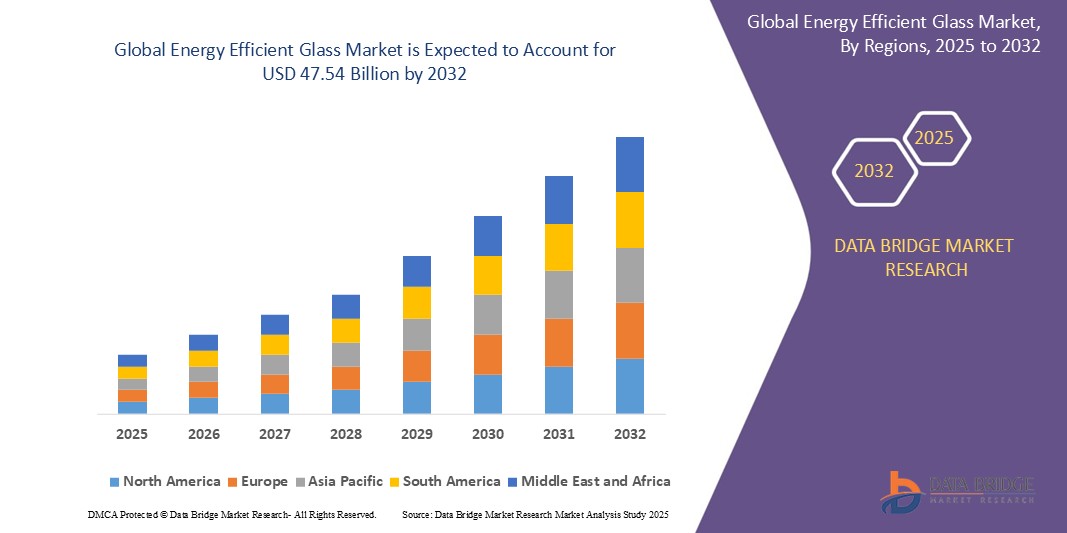
- The global energy efficient glass market size was valued at USD 30.97 billion in 2024 and is expected to reach USD 47.54 billion by 2032, at a CAGR of 5.50% during the forecast period
- The market growth is largely fueled by the rising demand for sustainable construction materials that help reduce energy consumption and carbon emissions
- Governments and builders are increasingly adopting green building standards, encouraging the use of energy efficient glass in residential and commercial projects to improve insulation and reduce HVAC energy usage
- Consumers are also becoming more environmentally conscious, leading to a surge in demand for eco-friendly materials such as low-emissivity and solar control glass in modern architecture and renovation projects
Energy Efficient Glass Market Analysis
- The global energy efficient glass market is currently gaining traction as consumers and industries increasingly prioritize thermal insulation and cost-effective energy solutions through building materials that enhance indoor climate control
- The manufacturers are now offering multi-functional glass products that combine thermal insulation with soundproofing capabilities to meet modern architectural demands in both residential and commercial projects
- Asia-Pacific dominates the energy efficient glass market with share of 28.05% in 2024, driven by increasing adoption of green building practices and stringent government regulations promoting energy conservation across residential and commercial sectors
- Europe is expected to be the fastest growing region in the energy efficient glass market during the forecast period due to strong regulatory frameworks promoting energy efficiency in construction. The rise of urbanization and demand for sustainable buildings are key factors influencing market expansion.
- The building and construction segment accounted for the largest market revenue share of 38.12% in 2024, driven by increasing global focus on green building initiatives, energy-efficient infrastructure, and stringent building codes mandating thermal performance
Report Scope and Energy Efficient Glass Market Segmentation
|
Attributes |
Energy Efficient Glass Key Market Insights |
|
Segments Covered |
|
|
Countries Covered |
North America
Europe
Asia-Pacific
Middle East and Africa
South America
|
|
Key Market Players |
|
|
Market Opportunities |
|
|
Value Added Data Infosets |
In addition to the insights on market scenarios such as market value, growth rate, segmentation, geographical coverage, and major players, the market reports curated by the Data Bridge Market Research also include in-depth expert analysis, pricing analysis, brand share analysis, consumer survey, demography analysis, supply chain analysis, value chain analysis, raw material/consumables overview, vendor selection criteria, PESTLE Analysis, Porter Analysis, and regulatory framework. |
Energy Efficient Glass Market Trends
“Growing Preference for Advanced Coated Glass Solutions”
- The global energy efficient glass market is witnessing a growing trend toward integrating advanced coatings that enhance thermal performance and light transmission
- Consumers and developers are increasingly selecting coated glass solutions to reduce indoor heat gain and improve comfort without compromising on natural daylight
- Manufacturers are focusing on developing multi-layered coatings that improve durability and maintain clarity over time, even in extreme weather conditions
- This trend is also encouraging the use of coated glass in both commercial and residential buildings as part of sustainable construction practices
- In conclusion, as the demand for intelligent building materials rises, coated energy efficient glass is positioning itself as a preferred choice for balancing energy savings and visual appeal in modern architectural designs
Energy Efficient Glass Market Dynamics
Driver
“Increasing Focus on Energy-Efficient Building Materials”
- Increasing environmental awareness and rising energy costs are driving residential and commercial developers to adopt energy efficient glass that minimizes heat loss in winter and heat gain in summer, improving indoor comfort and reducing energy consumption
- Energy efficient glass supports compliance with green building certifications such as LEED and BREEAM, which many large construction projects now require for sustainability goals, for instance, numerous corporate offices and public buildings have integrated these materials to achieve certification
- Government incentives such as tax credits and subsidies for energy-saving building materials encourage builders to choose energy efficient glass over traditional options, with countries such as the U.S. and Germany actively promoting such policies
- The growing trend of urbanization and infrastructure development is expanding demand for eco-friendly construction materials, and energy efficient glass is increasingly used not only in new buildings but also in retrofit projects to improve energy performance
- Manufacturers are investing in innovation to develop high-performance glass products that meet stringent regulatory standards and market demands, for example, advancements in low emissivity coatings and laminated glass technology are becoming mainstream
- Overall, the push for sustainability and cost savings is fueling widespread adoption of energy efficient glass across various construction sectors
Restraint/Challenge
“High Initial Installation and Product Costs”
- The high upfront cost of energy efficient glass, including advanced coatings and laminated layers, often deters small- to medium-scale developers from investing despite long-term energy savings, for instance, many residential builders in cost-sensitive markets still prefer conventional glass
- Specialized manufacturing processes and the need for professional installation increase overall expenses, making energy efficient glass less accessible for budget-restricted projects, especially in regions with limited skilled labor availability
- Retrofitting existing buildings with energy efficient glass can require complex structural adjustments, further raising costs and discouraging property owners from upgrading older constructions, as seen in many older urban development worldwide
- Price-sensitive markets prioritize immediate cost savings over long-term benefits, leading to slower adoption rates in developing countries where green building financing and incentives are less established
- The return on investment may take several years, making energy efficient glass less attractive to short-term-oriented builders or owners who seek quicker paybacks, affecting market penetration in certain commercial segments
- Overall, while energy efficient glass offers clear advantages, high initial costs remain a barrier that requires innovation in cost reduction and supportive financing to enable broader adoption
Energy Efficient Glass Market Scope
The energy efficient glass market is segmented on the basis of coating, glazing, and end-use industry.
By Coating
On the basis of coating, the energy efficient glass market is segmented into hard coat and soft coat. The soft coat segment held the largest market revenue share in 2024, driven by its superior thermal insulation properties and higher performance in reducing heat transfer. Soft-coat low-emissivity (low-e) glass typically offers better u-values, making it highly effective in energy conservation for both heating and cooling. This segment benefits from advancements in coating technology that allow for multi-layer metallic coatings, maximizing energy efficiency. Its increasing adoption in residential and commercial buildings aiming for higher energy ratings also contributes to its market dominance.
The hard coat segment is anticipated to witness significant growth from 2025 to 2032, fueled by its enhanced durability and scratch resistance, making it suitable for applications where robustness is a priority. Hard-coat low-e glass is often easier to handle and process during manufacturing, reducing production costs. Its robust nature makes it ideal for certain window and door applications, as well as for solar panel coverings that require long-term resistance to environmental elements. The simplicity of its manufacturing process and cost-effectiveness also drive its consistent demand.
By Glazing
On the basis of glazing, the energy efficient glass market is segmented into single glazing, double glazing, and triple glazing. The double-glazing segment held the largest market revenue share in 2024, driven by its optimal balance of energy efficiency, cost-effectiveness, and acoustic insulation. Double-glazed units significantly improve thermal performance compared to single glazing by creating an insulating air or gas gap between two panes of glass. This makes it a widely adopted solution in residential and commercial construction seeking improved energy ratings without the higher cost of triple glazing.
The triple glazing segment is expected to witness the fastest CAGR from 2025 to 2032, fueled by increasing stringent energy efficiency regulations and the growing demand for superior thermal and acoustic performance, especially in colder climates. Triple-glazed units offer the highest level of insulation by incorporating an additional pane of glass and two insulating layers, leading to significantly lower u-values. The rising awareness about passive house standards and net-zero energy buildings also drives the adoption of triple glazing in high-performance building envelopes.
By End-Use Industry
On the basis of end-use industry, the energy efficient glass market is segmented into building and construction, automotive, solar panel, and others. The building and construction segment accounted for the largest market revenue share of 38.12% in 2024, driven by increasing global focus on green building initiatives, energy-efficient infrastructure, and stringent building codes mandating thermal performance. Energy-efficient glass is crucial for reducing heating, ventilation, and air conditioning (hvac) loads in residential and commercial buildings, leading to substantial energy savings. The continuous expansion of urban areas and the demand for sustainable architectural solutions further propel this segment.
The automotive segment is expected to witness the fastest CAGR from 2025 to 2032, driven by the increasing integration of energy-efficient glass in vehicles to improve fuel economy, enhance passenger comfort, and reduce the load on air conditioning systems. Automotive manufacturers are increasingly adopting lightweight and high-performance energy-efficient glass to meet emissions targets and consumer demand for advanced features. The rise of electric vehicles, which prioritize energy conservation for extended battery range, also contributes significantly to the growth of this segment.
Energy Efficient Glass Market Regional Analysis
- Asia Pacific dominates the energy efficient glass market with a share of 28.05% in 2024, driven by the increasing adoption of green building practices and stringent government regulations promoting energy conservation across residential and commercial sectors, which are helping to reduce overall energy consumption and carbon footprints
- The region’s strong focus on sustainability and green building certifications encourages widespread adoption of energy efficient glass in both new constructions and renovations, as developers and homeowners seek to meet higher environmental standards and improve building performance
- Growing consumer awareness about energy cost savings and environmental impact, along with advances in coating technologies, further boosts market demand in North America, where homeowners and businesses prioritize long-term energy efficiency and reduced utility expenses through innovative glass solutions
U.S. Energy Efficient Glass Market Insight
The U.S. Energy efficient glass market captured the market, supported by stringent energy codes and widespread green building initiatives. The region benefits from a well-established construction sector that prioritizes sustainability and energy savings. Increasing consumer demand for smart homes equipped with energy efficient materials drives growth. For instance, office buildings and residential complexes often incorporate coated glass solutions to reduce energy costs. Continued investments in infrastructure upgrades and government incentives further fuel the adoption of advanced energy efficient glass products in North America.
Europe Energy Efficient Glass Market Insight
Europe’s energy efficient glass market is projected to grow steadily, driven by strong regulatory frameworks promoting energy efficiency in construction. The rise of urbanization and demand for sustainable buildings are key factors influencing market expansion. European developers prefer energy efficient glass to meet strict environmental standards and to improve occupant comfort. For instance, many new residential and commercial developments in countries such as France and the Netherlands integrate high-performance glass to achieve sustainability certifications. Renovation projects to upgrade older buildings also contribute to market growth across the continent.
U.K. Energy Efficient Glass Market Insight
The U.K. energy efficient glass market is growing due to increasing interest in home automation and energy-efficient building solutions. Rising concerns over energy costs and environmental impact encourage homeowners and businesses to adopt these technologies. The country’s strong e-commerce infrastructure facilitates access to advanced energy efficient glass products. For instance, smart residential buildings often utilize coated glass to optimize thermal comfort and reduce utility bills. Government support and growing awareness of green building benefits continue to drive market demand in the U.K..
Germany Energy Efficient Glass Market Insight
Germany’s energy efficient glass market is expanding rapidly, fueled by heightened focus on energy conservation and innovation. The country’s commitment to sustainability and well-developed infrastructure support the adoption of energy efficient glass in residential and commercial sectors. German consumers favor glass products that combine energy savings with eco-friendly attributes. For example, smart office buildings increasingly incorporate glass with advanced coatings to meet energy efficiency standards. The integration of energy efficient glass with automated building management systems is becoming common, further propelling market growth.
Asia-Pacific Energy Efficient Glass Market Insight
The Asia-Pacific energy efficient glass market is poised for the fastest growth due to rapid urbanization, rising incomes, and increased technological adoption. Countries such as China, India, and Japan are investing heavily in smart city projects that emphasize energy efficiency. The region’s expanding middle class drives demand for energy efficient glass in residential and commercial construction. For instance, large-scale housing developments in China utilize coated glass to enhance energy performance. In addition, Asia-Pacific’s emergence as a manufacturing hub for energy efficient glass components helps improve affordability and availability, supporting market expansion.
Japan Energy Efficient Glass Market Insight
Japan’s energy efficient glass market is growing steadily, driven by its high-tech culture and aging population’s demand for convenient, secure building solutions. The country places strong emphasis on energy efficiency and integration of smart home technologies. Japanese developers increasingly use energy efficient glass in connected homes and commercial buildings to enhance comfort and security. For example, buildings equipped with IoT devices often feature glass that supports thermal insulation and smart control. Government initiatives promoting digitalization and sustainability further boost market growth.
China Energy Efficient Glass Market Insight
China dominates the Asia-pacific energy efficient glass market, owing to rapid urbanization, a growing middle class, and government support for smart cities. The country is a major consumer and producer of energy efficient glass, with wide adoption in residential, commercial, and rental properties. For instance, large urban housing projects incorporate energy efficient glass to meet energy codes and reduce environmental impact. Strong domestic manufacturing capabilities and competitive pricing make China a key driver in the global market. The ongoing push for sustainable urban development continues to fuel demand.
Energy Efficient Glass Market Share
The energy efficient glass industry is primarily led by well-established companies, including:
- Saint-Gobain Glass India (India)
- AGC Inc. (Japan)
- Nippon Sheet Glass Co., Ltd (Japan)
- SCHOTT AG (Germany)
- Sisecam (Turkey)
- Guardian Industries (U.S.)
- Vitro (Mexico)
- Morley Glass & Glazing Ltd. (U.K.)
- KAPHS S.A. (Greece)
- Sedak GmbH & Co. KG (Germany)
- Metro Glass site (New Zealand)
- CSG Holding Co., Ltd. (China)
- Taiwan Glass Industry Corporation (Taiwan)
- Abrisa Technologies (U.S.)
- Bendheim (U.S.)
- Central Glass Co., Ltd. (Japan)
- GSC Glass Ltd. (India)
- Arnold Glas (Germany)
- Fuso (Japan)
- DuPont (U.S.)
- Corning Incorporated (U.S.)
- PPG Industries Inc. (U.S.)
- Raven Products Pty Ltd. (Australia)
- Smartglass International (Ireland)
Latest Developments in Global Energy Efficient Glass Market
- In January 2023, Yes World Climate Tech Pte Ltd, based in Singapore, introduced the first energy-efficient Windows Solution for residential and commercial buildings. This new range of specialty glass products is part of the company's SAVE EARTH MISSION, which aims to reduce the carbon footprint on the environment
- In June 2021, Saint Gobain acquired Vi-Lux Building Products, a leading manufacturer of cellular polyvinyl chloride (PVC) moulding. This strategic acquisition was driven by Saint Gobain's goal of expanding its product portfolio and meeting the diverse needs of its customers. The purchase of Vi-Lux Building Products allowed Saint Gobain to improve its offerings and better address the requirements of a wide range of customers

- Interactive Data Analysis Dashboard
- Company Analysis Dashboard for high growth potential opportunities
- Research Analyst Access for customization & queries
- Competitor Analysis with Interactive dashboard
- Latest News, Updates & Trend analysis
- Harness the Power of Benchmark Analysis for Comprehensive Competitor Tracking
Data collection and base year analysis are done using data collection modules with large sample sizes. The stage includes obtaining market information or related data through various sources and strategies. It includes examining and planning all the data acquired from the past in advance. It likewise envelops the examination of information inconsistencies seen across different information sources. The market data is analysed and estimated using market statistical and coherent models. Also, market share analysis and key trend analysis are the major success factors in the market report. To know more, please request an analyst call or drop down your inquiry.
The key research methodology used by DBMR research team is data triangulation which involves data mining, analysis of the impact of data variables on the market and primary (industry expert) validation. Data models include Vendor Positioning Grid, Market Time Line Analysis, Market Overview and Guide, Company Positioning Grid, Patent Analysis, Pricing Analysis, Company Market Share Analysis, Standards of Measurement, Global versus Regional and Vendor Share Analysis. To know more about the research methodology, drop in an inquiry to speak to our industry experts.
Data Bridge Market Research is a leader in advanced formative research. We take pride in servicing our existing and new customers with data and analysis that match and suits their goal. The report can be customized to include price trend analysis of target brands understanding the market for additional countries (ask for the list of countries), clinical trial results data, literature review, refurbished market and product base analysis. Market analysis of target competitors can be analyzed from technology-based analysis to market portfolio strategies. We can add as many competitors that you require data about in the format and data style you are looking for. Our team of analysts can also provide you data in crude raw excel files pivot tables (Fact book) or can assist you in creating presentations from the data sets available in the report.