


Energy Management at Workplace Market Size
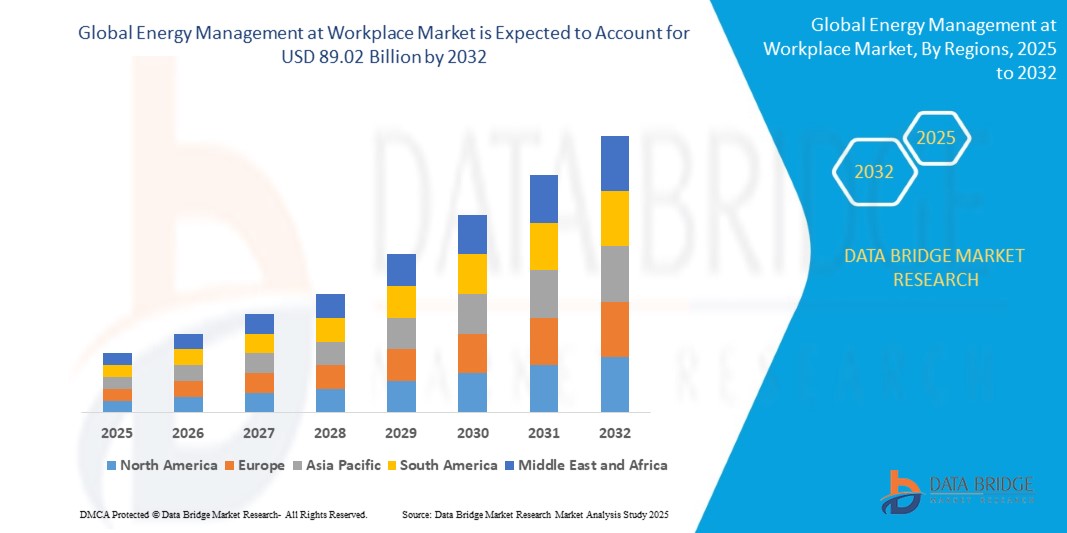
- The global energy management at workplace market size was valued at USD 35.19 billion in 2024 and is expected to reach USD 89.02 billion by 2032, at a CAGR of 12.3% during the forecast period
- The market growth is largely fueled by the increasing implementation of energy-efficient technologies and automation systems across workplaces, driven by rising energy costs and stringent government regulations promoting sustainability and emissions reduction
- Furthermore, growing awareness around environmental impact, along with the need for real-time monitoring and optimization of energy usage, is encouraging commercial and industrial facilities to adopt integrated energy management solutions. These factors are accelerating digital energy transformation efforts, significantly propelling market expansion
Energy Management at Workplace Market Analysis
- Energy management at the workplace involves the use of software, sensors, and control systems to monitor, analyze, and optimize energy consumption across buildings, facilities, and production environments. These systems enhance operational efficiency, reduce energy waste, and support compliance with environmental standards
- The rising demand for workplace energy management is primarily driven by increasing corporate focus on ESG goals, integration of IoT and AI technologies for intelligent energy control, and the need to improve cost-efficiency while ensuring long-term sustainability
- North America dominated the energy management at workplace market with a share of 36.1% in 2024, due to stringent energy efficiency regulations, increasing adoption of smart building technologies, and growing awareness around sustainability practices across commercial and industrial sectors
- Asia-Pacific is expected to be the fastest growing region in the energy management at workplace market during the forecast period due to rapid industrialization, digital infrastructure growth, and increasing government efforts to promote energy efficiency in both public and private sectors
- System segment dominated the market with a market share of 61.8% in 2024, due to the increasing integration of energy management hardware and software into commercial and industrial infrastructures. Organizations are investing heavily in comprehensive systems that provide real-time monitoring, control, and optimization of energy usage to reduce costs and meet regulatory compliance. The growing emphasis on achieving energy efficiency certifications and reducing operational expenditures is further strengthening the adoption of energy management systems across workplaces
Report Scope and Energy Management at Workplace Market Segmentation
|
Attributes |
Energy Management at Workplace Key Market Insights |
|
Segments Covered |
|
|
Countries Covered |
North America
Europe
Asia-Pacific
Middle East and Africa
South America
|
|
Key Market Players |
|
|
Market Opportunities |
|
|
Value Added Data Infosets |
In addition to the insights on market scenarios such as market value, growth rate, segmentation, geographical coverage, and major players, the market reports curated by the Data Bridge Market Research also include in-depth expert analysis, geographically represented company-wise production and capacity, network layouts of distributors and partners, detailed and updated price trend analysis and deficit analysis of supply chain and demand. |
Energy Management at Workplace Market Trends
“Rising Adoption of AI-Driven Energy Management Systems”
- There is significant growth in the adoption of AI-driven energy management systems in workplaces, as businesses seek to optimize energy consumption while reducing operational costs and environmental impact. These systems use IoT sensors and machine learning to monitor and predict energy usage, enabling real-time adjustments to lighting, HVAC, and other energy-consuming equipment
- For instance, companies such as C3 AI offer AI-powered platforms that unify data from sensors and operational systems to predict energy consumption and identify efficiency opportunities, allowing organizations to reduce costs and greenhouse gas emissions at scale
- AI-enabled lighting and climate control systems can automatically adjust based on occupancy and environmental factors, enhancing energy efficiency and comfort
- Such technologies support sustainability goals while improving utility management and compliance with environmental regulations
- Cloud-based AI energy management systems offer scalability and remote accessibility, making deployment feasible across multiple sites
- Despite the benefits, integration with existing infrastructure and cybersecurity remain key considerations for enterprises adopting AI solutions
Energy Management at Workplace Market Dynamics
Driver
“Improved Employee Productivity”
- AI-driven energy management enhances workplace comfort—through intelligent lighting and HVAC adjustment—which directly correlates to improved employee productivity and satisfaction. Optimizing thermal comfort and lighting conditions based on occupancy and preferences helps reduce distractions and fatigue
- For instance, businesses deploying AI energy management systems from providers such as Pecan AI have reported substantial energy savings alongside enhanced indoor environmental quality, which contributes to happier, more productive employees
- Automated energy controls free up facility managers to focus on strategic tasks rather than manual adjustments, supporting operational efficiency
- Predictive maintenance capabilities reduce equipment downtime, further stabilizing workplace conditions
- AI insights allow organizations to align energy-saving measures with employee presence and activities, ensuring minimal disruption. The growing emphasis on workplace well-being fosters adoption of smart energy solutions as part of holistic employee experience management
Restraint/Challenge
“Lack of Skilled Personnel”
- Despite growing demand, many organizations face a shortage of skilled staff capable of effectively implementing and managing AI-driven energy management systems. These solutions require expertise in AI, data analytics, IoT integration, and cybersecurity to maximize benefits
- For instance, companies report difficulties in transitioning from traditional energy management to sophisticated AI systems, citing gaps in technical know-how and change management—highlighted in workforce observations by InData Labs and others
- Training facility managers and IT staff to interpret AI-generated data and operate integrated platforms demands continuous investment
- Smaller enterprises may struggle to justify hiring or outsourcing this expertise due to budget constraints
- Rapid technology evolution increases the need for ongoing upskilling to keep pace with AI advancements. Workforce collaboration skills are essential as AI automates routine tasks, requiring a human-machine hybrid approach to energy management
Energy Management at Workplace Market Scope
The market is segmented on the basis of offering, component, type, end user, and vertical.
• By Offering
On the basis of offering, the energy management at workplace market is segmented into system and service. The system segment dominated the largest market revenue share of 61.8% in 2024, driven by the increasing integration of energy management hardware and software into commercial and industrial infrastructures. Organizations are investing heavily in comprehensive systems that provide real-time monitoring, control, and optimization of energy usage to reduce costs and meet regulatory compliance. The growing emphasis on achieving energy efficiency certifications and reducing operational expenditures is further strengthening the adoption of energy management systems across workplaces.
The service segment is expected to witness the fastest growth rate from 2025 to 2032, fueled by rising demand for consultation, maintenance, and analytics support. With organizations seeking expert guidance to tailor energy strategies and maintain optimal system performance, energy management services are gaining traction. The shift toward managed services models, especially among enterprises lacking in-house expertise, is accelerating market growth in this segment.
• By Component
On the basis of component, the market is segmented into sensor, controller, software, and others. The software segment accounted for the largest market share in 2024, supported by its central role in data analysis, energy forecasting, and system integration. Energy management software enables centralized dashboards, predictive maintenance alerts, and AI-based energy optimization, which are increasingly sought after in digitally transformed workplaces.
The sensor segment is projected to grow at the fastest CAGR from 2025 to 2032, driven by the expanding deployment of IoT-based devices for real-time energy data collection. Sensors play a crucial role in monitoring usage patterns, occupancy, temperature, and lighting conditions. The proliferation of smart buildings and demand for granular visibility into energy flows are major contributors to the segment’s accelerated growth.
• By Type
On the basis of type, the market is segmented into home energy management system, building energy management system, and industrial energy management system. The building energy management system (BEMS) segment dominated the market in 2024, owing to the growing emphasis on optimizing energy performance in commercial office spaces, educational institutions, and retail environments. BEMS are widely implemented due to their ability to automate HVAC, lighting, and power systems while aligning with sustainability goals.
The industrial energy management system segment is anticipated to experience the highest growth from 2025 to 2032, fueled by increased energy consumption in manufacturing facilities and the pressing need to comply with global carbon reduction targets. The integration of advanced analytics, automation, and load optimization tools within industrial settings is propelling this segment’s rapid expansion.
• By End User
On the basis of end user, the market is bifurcated into residential and commercial. The commercial segment held the largest market share in 2024, attributed to the widespread adoption of energy-saving measures in offices, warehouses, and institutions. Growing energy bills, stringent environmental regulations, and the push for green building certifications such as LEED and BREEAM are encouraging commercial users to invest in energy management solutions.
The residential segment is expected to register the fastest CAGR from 2025 to 2032, driven by rising awareness of energy efficiency among homeowners, integration of smart home devices, and government incentives for sustainable living. The growth of remote work has also increased energy consumption in households, prompting the need for more efficient energy use and control.
• By Vertical
On the basis of vertical, the market is segmented into power and energy, telecom and IT, manufacturing, enterprise, healthcare, and others. The power and energy segment led the market in 2024, due to the sector’s critical demand for load balancing, grid optimization, and energy loss reduction. Energy-intensive operations and the transition to renewable sources have intensified the need for robust management systems in this vertical.
The telecom and IT segment is projected to grow at the highest rate from 2025 to 2032, propelled by the exponential rise in data center energy consumption. With digitization accelerating, telecom operators and IT service providers are under pressure to reduce their carbon footprint while maintaining uptime. Efficient energy usage through smart monitoring and AI-driven load distribution is becoming indispensable in this vertical.
Energy Management at Workplace Market Regional Analysis
- North America dominated the energy management at workplace market with the largest revenue share of 36.1% in 2024, driven by stringent energy efficiency regulations, increasing adoption of smart building technologies, and growing awareness around sustainability practices across commercial and industrial sectors
- Organizations across the region are actively deploying energy management systems to lower operational costs, meet environmental standards, and integrate renewable energy sources
- High levels of digital infrastructure, coupled with government incentives for energy optimization, are fostering the widespread implementation of energy monitoring and control systems across offices, factories, and institutions
U.S. Energy Management at Workplace Market Insight
The U.S. held the largest revenue share within the North American market in 2024, attributed to widespread adoption of intelligent energy platforms across corporate campuses, manufacturing plants, and public infrastructure. The growing urgency among enterprises to meet ESG goals, reduce energy waste, and adhere to evolving federal energy policies is driving the demand for energy management systems. The presence of leading technology vendors, early adoption of IoT, and a robust trend toward smart city development further strengthen the market in the U.S. The proliferation of cloud-based solutions also supports scalability and real-time analytics, making energy management systems increasingly indispensable in modern workplaces.
Europe Energy Management at Workplace Market Insight
Europe is projected to expand at a strong CAGR over the forecast period, led by regulatory pressures under the EU Green Deal and Energy Performance of Buildings Directive (EPBD). Countries across the region are aggressively investing in energy optimization technologies for office buildings, educational institutions, and healthcare facilities to support sustainability goals. The emphasis on reducing carbon emissions, improving energy ratings, and enhancing building intelligence has triggered widespread deployment of energy management systems. With rising energy prices and a push toward electrification, workplace environments are increasingly leveraging analytics-driven platforms to streamline usage, integrate renewables, and enhance occupant comfort.
U.K. Energy Management at Workplace Market Insight
The U.K. energy management at workplace market is expected to grow at a noteworthy pace, supported by the country’s legally binding net-zero targets and strong incentives for energy efficiency upgrades in both public and private sectors. Commercial properties are adopting building automation and smart metering technologies to meet compliance and reduce operating costs. The growing focus on sustainability reporting, combined with rising energy bills and an expanding commercial real estate sector, is encouraging greater investment in workplace energy control systems.
Germany Energy Management at Workplace Market Insight
Germany is witnessing steady growth in the energy management at workplace market, driven by its energy transition agenda (Energiewende), digital transformation in industries, and emphasis on sustainable development. The commercial and manufacturing sectors are rapidly incorporating intelligent energy systems to support compliance with efficiency mandates, lower energy expenses, and enhance operational resilience. Government support for clean energy innovations, paired with Germany’s strong engineering capabilities and commitment to decarbonization, further positions the country as a key adopter of advanced energy management technologies.
Asia-Pacific Energy Management at Workplace Market Insight
Asia-Pacific is poised to register the fastest CAGR from 2025 to 2032, propelled by rapid industrialization, digital infrastructure growth, and increasing government efforts to promote energy efficiency in both public and private sectors. Countries such as China, Japan, and India are investing heavily in smart buildings, factory automation, and green infrastructure, creating strong demand for energy management systems in the workplace. Rising energy costs, growing awareness of climate change, and widespread adoption of smart grid solutions are compelling commercial users and manufacturers to integrate centralized energy monitoring and optimization systems. The availability of low-cost hardware and domestic technology providers is also improving market accessibility and penetration across emerging economies.
Japan Energy Management at Workplace Market Insight
Japan is gaining significant momentum in the energy management at workplace market due to its advanced technological infrastructure and policy-driven focus on energy efficiency. The government’s Zero Energy Building (ZEB) targets are accelerating demand for intelligent systems in commercial offices, hospitals, and educational facilities. Japan’s aging population and labor efficiency challenges further support the need for automation and smart control systems. Integration of BEMS with IoT, AI, and real-time analytics is becoming increasingly prevalent, enabling organizations to optimize energy use while ensuring safety and convenience.
China Energy Management at Workplace Market Insight
China accounted for the largest market revenue share in Asia-Pacific in 2024, driven by its aggressive environmental policy agenda, industrial digitalization programs, and growing middle-class business sector. National strategies such as the dual-carbon goal and new energy efficiency standards are prompting widespread adoption of energy management systems across commercial buildings, government complexes, and manufacturing zones. The presence of numerous domestic solution providers, along with strong investments in urban smart infrastructure and energy tech innovation, is enabling faster, cost-effective implementation of workplace energy solutions across the country.
Energy Management at Workplace Market Share
The energy management at workplace industry is primarily led by well-established companies, including:
- Blendtec (U.S.)
- Hamilton Beach Brands, Inc. (U.S.)
- Santos Ltd (France)
- JTC Electronics (Taiwan)
- WARING COMMERCIAL (U.S.)
- Ceado srl (Italy)
- Sammic S.L (Spain)
- Techmate Industries (India)
- Schneider Electric SE (France)
- Siemens AG (Germany)
- Johnson Controls International plc (U.S.)
- Honeywell International Inc. (U.S.)
- ABB Ltd. (Switzerland)
- IBM Corporation (U.S.)
- Verdigris Technologies Inc. (U.S.)
- GridPoint Inc. (U.S.)
- EnergyCAP, LLC (U.S.)
- Spacewell Energy by Dexma (Spain)
Latest Developments in Global Energy Management at Workplace Market
- In November 2024, Emerson introduced the Emerson Energy Manager solution, designed to track asset energy consumption in real time. This tool provides customers with detailed insights into the energy usage and associated costs of energy-intensive equipment, such as machinery, across various production lines. By leveraging this data, users can make strategic decisions to lower energy expenses while enhancing sustainability and overall energy efficiency
- In December 2023, The U.A.E Ministry of Energy and Infrastructure deployed an AI-powered Energy Management System for federal roads. This system features an adaptive street lighting solution, transitioning from traditional high-pressure sodium lamps to LED lights. The initiative aims to optimize illumination levels, enhancing energy efficiency and reducing costs
- In July 2023, Schneider Electric, in collaboration with Pacific Gas and Electric Company, launched a new Distributed Energy Resource Management System (DERMS) on the Microsoft Azure platform. This system optimizes energy storage, electric vehicles, and solar power, improving energy affordability and value for customers by enhancing the management of distributed energy resources
- In February 2023, Emerson introduced the Ovation Green platform, combining its power-sector expertise with renewable energy capabilities. The platform supports power generation companies in transitioning to green energy, incorporating Mita-Teknik software to advance sustainable operations and meet increasing consumer demands for environmentally friendly energy solutions
- In March 2022, ABB India unveiled new smart metering solutions designed for efficient energy management and power consumption monitoring. These solutions, which include network analyzers and multifunction meters, are tailored for industries such as hospitality, healthcare, infrastructure, and food and beverages, enhancing power quality analysis and management

- Interactive Data Analysis Dashboard
- Company Analysis Dashboard for high growth potential opportunities
- Research Analyst Access for customization & queries
- Competitor Analysis with Interactive dashboard
- Latest News, Updates & Trend analysis
- Harness the Power of Benchmark Analysis for Comprehensive Competitor Tracking
Global Energy Management At Workplace Market, Supply Chain Analysis and Ecosystem Framework
To support market growth and help clients navigate the impact of geopolitical shifts, DBMR has integrated in-depth supply chain analysis into its Global Energy Management At Workplace Market research reports. This addition empowers clients to respond effectively to global changes affecting their industries. The supply chain analysis section includes detailed insights such as Global Energy Management At Workplace Market consumption and production by country, price trend analysis, the impact of tariffs and geopolitical developments, and import and export trends by country and HSN code. It also highlights major suppliers with data on production capacity and company profiles, as well as key importers and exporters. In addition to research, DBMR offers specialized supply chain consulting services backed by over a decade of experience, providing solutions like supplier discovery, supplier risk assessment, price trend analysis, impact evaluation of inflation and trade route changes, and comprehensive market trend analysis.
Data collection and base year analysis are done using data collection modules with large sample sizes. The stage includes obtaining market information or related data through various sources and strategies. It includes examining and planning all the data acquired from the past in advance. It likewise envelops the examination of information inconsistencies seen across different information sources. The market data is analysed and estimated using market statistical and coherent models. Also, market share analysis and key trend analysis are the major success factors in the market report. To know more, please request an analyst call or drop down your inquiry.
The key research methodology used by DBMR research team is data triangulation which involves data mining, analysis of the impact of data variables on the market and primary (industry expert) validation. Data models include Vendor Positioning Grid, Market Time Line Analysis, Market Overview and Guide, Company Positioning Grid, Patent Analysis, Pricing Analysis, Company Market Share Analysis, Standards of Measurement, Global versus Regional and Vendor Share Analysis. To know more about the research methodology, drop in an inquiry to speak to our industry experts.
Data Bridge Market Research is a leader in advanced formative research. We take pride in servicing our existing and new customers with data and analysis that match and suits their goal. The report can be customized to include price trend analysis of target brands understanding the market for additional countries (ask for the list of countries), clinical trial results data, literature review, refurbished market and product base analysis. Market analysis of target competitors can be analyzed from technology-based analysis to market portfolio strategies. We can add as many competitors that you require data about in the format and data style you are looking for. Our team of analysts can also provide you data in crude raw excel files pivot tables (Fact book) or can assist you in creating presentations from the data sets available in the report.













