


Engine and Transmission Thermal Systems Market Overview
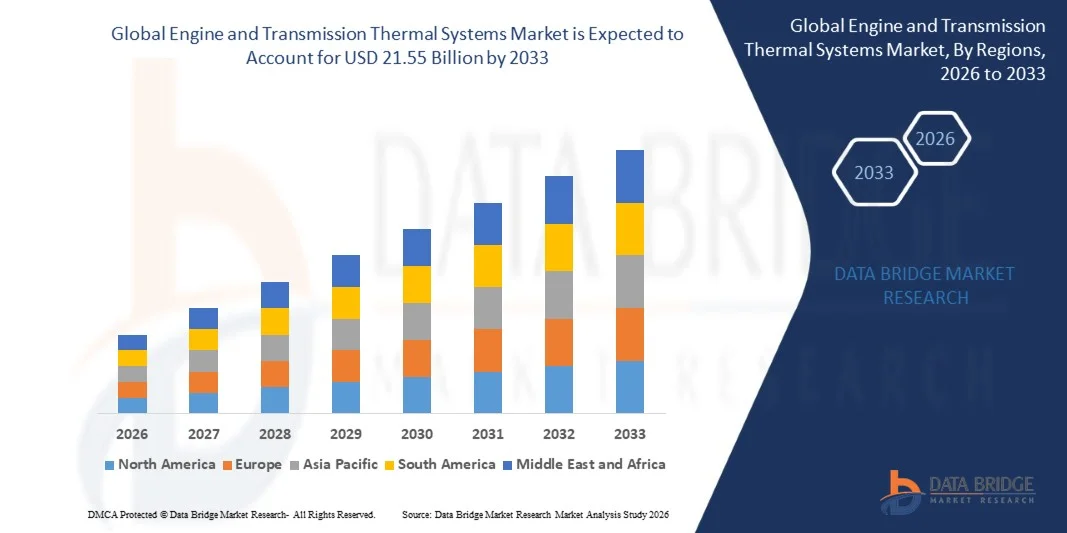
As per Data Bridge Market Research analysis the global engine and transmission thermal systems market was valued at USD 15.87 billion in 2025 and is projected to reach USD 21.55 billion by 2033, growing at a CAGR of 3.90% from 2026 to 2033 The market is experiencing steady growth driven by the increasing demand for fuel-efficient and low-emission vehicles, rising adoption of electrified powertrains, and continuous advancements in thermal management technologies for engines and transmissions.
Stringent vehicle emission regulations, growing production of passenger and commercial vehicles, and the need to enhance engine efficiency, transmission durability, and overall vehicle performance are accelerating the adoption of advanced engine and transmission thermal systems. Automakers are increasingly integrating intelligent cooling modules, electronic thermostats, transmission oil coolers, electric coolant pumps, and heat exchangers to optimize operating temperatures, reduce energy losses, improve fuel economy, and extend component lifespan. Furthermore, the rapid expansion of hybrid and plug-in hybrid vehicles, which require sophisticated thermal management for both internal combustion engines and transmission systems, continues to create significant growth opportunities for the Engine and Transmission Thermal Systems market.
Market Size & Forecast
- Market Value (2025): USD 15.87 Billion
- Expected Market Value (2033): USD 21.55 Billion
- Forecast CAGR (2026–2033): 3.90%
- Leading Region in 2025: Asia Pacific
- Fastest Growing Region: Europe
Key Market Trends & Insights
- Asia-Pacific dominated the global engine and transmission thermal systems market with the largest revenue share of an estimated 46.92% in 2025, driven by its strong automotive manufacturing base, high passenger and commercial vehicle production, increasing adoption of advanced thermal management technologies, and the presence of major automotive OEMs across China, Japan, India, and South Korea.
- The passenger car segment dominated the market with an estimated 52.84% share in 2025, owing to its significantly higher production volumes compared to other ICE vehicle categories and the widespread integration of advanced thermal management technologies to improve fuel efficiency and reduce emissions.
- Europe is expected to be the fastest-growing region at an estimated CAGR of 7.2% from 2026 to 2033, fueled by stringent vehicle emission regulations, increasing adoption of hybrid and electrified powertrains, growing investments in advanced thermal management technologies, and continuous innovation by leading automotive manufacturers across the region.
- The active transmission warm up segment is projected to witness the fastest growth at an estimated CAGR of 7.5% from 2026 to 2033, driven by increasing demand for faster transmission warm-up, improved fuel efficiency, and lower cold-start emissions.
- The light commercial vehicle (LCV) segment is projected to register the fastest growth at an estimated CAGR of 7.3% from 2026 to 2033, driven by the rapid expansion of e-commerce, last-mile delivery services, and urban logistics fleets worldwide.
Report Scope and Engine and Transmission Thermal Systems Market Segmentation
|
Attributes |
Engine and Transmission Thermal Systems Key Market Insights |
|
Segments Covered |
|
|
Countries Covered |
North America
Europe
Asia-Pacific
Middle East and Africa
South America
|
|
Key Market Players |
|
|
Market Opportunities |
|
|
Value Added Data Infosets |
In addition to the insights on market scenarios such as market value, growth rate, segmentation, geographical coverage, and major players, the market reports curated by the Data Bridge Market Research also include in-depth expert analysis, geographically represented company-wise production and capacity, network layouts of distributors and partners, detailed and updated price trend analysis and deficit analysis of supply chain and demand. |
Engine and Transmission Thermal Systems Market Trends
Trend: Increasing Adoption of Integrated Thermal Management Modules
Automotive manufacturers are increasingly replacing conventional standalone engine and transmission cooling components with integrated thermal management modules that combine coolant pumps, heat exchangers, valves, condensers, chillers, and electronic controls into a single compact system. These integrated architectures improve engine warm-up, maintain optimal transmission oil temperature, reduce packaging space, lower vehicle weight, and improve fuel economy while supporting hybrid powertrains. As OEMs move toward highly efficient powertrains, integrated thermal systems are becoming a standard design strategy for both internal combustion and hybrid vehicles. For instance, in April 2024, MAHLE announced that it secured nearly USD 1.72 billion in orders for its next-generation thermal management modules, which integrate multiple thermal components into one unit to simultaneously regulate the battery, powertrain, and vehicle cabin. The company stated that these modules can increase EV driving range by up to 20%, highlighting the industry's shift toward integrated thermal architectures.
Engine and Transmission Thermal Systems Market Dynamics
Key Market Driver: Increasing Demand for Higher Fuel Efficiency and Compliance with Stringent Emission Regulations
Governments worldwide continue to tighten fuel economy and emission regulations, compelling automakers to improve engine and transmission efficiency. Advanced thermal systems maintain optimal coolant and lubricant temperatures, reduce engine warm-up time, minimize friction losses, and improve transmission durability, enabling manufacturers to meet regulatory requirements while enhancing vehicle performance. The growing adoption of turbocharged engines and hybrid powertrains has further increased the need for sophisticated thermal management technologies. For Instance, in May 2025, BorgWarner secured its largest North American contract for 400V High-Voltage Coolant Heaters (HVCH) for plug-in hybrid vehicles. The technology is designed to improve battery conditioning and thermal efficiency while supporting optimal operating temperatures across multiple PHEV platforms, reflecting OEM demand for advanced thermal solutions to meet efficiency and emission targets. Increasing regulatory pressure to improve fuel economy and reduce emissions continues to accelerate OEM investment in advanced Engine and Transmission Thermal Systems that maximize powertrain efficiency and reliability.
Key Restraint/Challenge: High Development Cost and Engineering Complexity of Advanced Thermal Systems
Modern Engine and Transmission Thermal Systems require multiple electronically controlled components, advanced heat exchangers, electric coolant pumps, sensors, valves, and sophisticated control software that must operate seamlessly under varying driving conditions. Developing and validating these integrated systems requires significant investment in engineering, calibration, durability testing, and manufacturing, increasing overall vehicle development costs. This cost burden is particularly challenging for mass-market and cost-sensitive vehicle platforms. For instance, in April 2024, MAHLE stated that its latest thermal management module integrates heat exchangers, coolant pumps, condensers, chillers, sensors, and valves into a single system specifically to reduce engineering complexity and installation space, illustrating the significant design and development effort required for next-generation thermal systems. The increasing sophistication of integrated cooling architectures significantly raises development costs and engineering complexity, making affordability one of the primary challenges in the Engine and Transmission Thermal Systems market.
Key Market Opportunity: Expansion of Hybrid and Electrified Powertrains
The rapid growth of hybrid and plug-in hybrid vehicles is creating strong demand for advanced Engine and Transmission Thermal Systems capable of simultaneously managing engine coolant, transmission oil, batteries, electric motors, and power electronics. Manufacturers are increasingly replacing mechanically driven cooling components with electronically controlled coolant pumps and heating systems that improve efficiency, reduce energy consumption, and optimize powertrain performance. For instance, in August 2023, BorgWarner announced a supply agreement to provide its 800V High-Voltage Coolant Heater (HVCH) for multiple global OEM electric vehicle platforms. The heater regulates battery temperature and cabin heating while supporting fast charging and overall thermal efficiency, demonstrating the expanding opportunity for advanced thermal technologies across electrified vehicle platforms. -The accelerating transition toward hybrid and electrified vehicles is creating substantial long-term opportunities for suppliers of advanced Engine and Transmission Thermal Systems, particularly those offering intelligent, electronically controlled thermal management solutions.
Engine and Transmission Thermal Systems Market Scope
The engine and transmission thermal systems market is segmented on the basis of ICE vehicle type, technology, electric vehicle type, and component.
- By ICE Vehicle Type
On the basis of ICE vehicle type, the global engine and transmission thermal systems market is segmented into passenger car, light commercial vehicle (LCV), truck, and bus. The passenger car segment dominated the market with an estimated 52.84% share in 2025, owing to its significantly higher production volumes compared to other ICE vehicle categories and the widespread integration of advanced thermal management technologies to improve fuel efficiency and reduce emissions. Passenger vehicles increasingly incorporate electronically controlled thermostats, electric water pumps, transmission oil coolers, and compact heat exchangers to maintain optimal operating temperatures under varying driving conditions. Growing consumer demand for fuel-efficient vehicles and stringent emission regulations across Europe, North America, and Asia-Pacific have encouraged OEMs to adopt sophisticated engine and transmission cooling systems. In addition, the increasing use of turbocharged gasoline engines and downsized powertrains generates higher thermal loads, further driving demand for advanced thermal management solutions. Continuous innovations in cooling architectures and lightweight thermal components are enhancing vehicle performance while extending engine and transmission lifespan. The large-scale production of passenger cars in China, Japan, India, Germany, and the United States further reinforces the segment's leadership. Furthermore, increasing investments by global automakers in improving thermal efficiency and vehicle reliability continue to strengthen the dominance of the passenger car segment within the engine and transmission thermal systems market.
The light commercial vehicle (LCV) segment is projected to register the fastest growth at an estimated CAGR of 7.3% from 2026 to 2033, driven by the rapid expansion of e-commerce, last-mile delivery services, and urban logistics fleets worldwide. Fleet operators are increasingly demanding vehicles with improved fuel economy, lower operating costs, and enhanced durability, creating strong demand for efficient engine and transmission thermal systems. Modern LCVs operate under frequent stop-and-go driving conditions that generate significant thermal stress on engines and transmissions, necessitating advanced cooling technologies. Governments are also implementing stricter emission regulations for commercial fleets, encouraging OEMs to adopt intelligent thermal management solutions. Technological advancements in electric coolant pumps, integrated cooling modules, and transmission oil management systems are improving vehicle efficiency and reliability. Furthermore, increasing investments in commercial vehicle manufacturing across emerging economies and the growing replacement of aging fleet vehicles are expected to further accelerate adoption of advanced thermal systems throughout the forecast period.
- By Technology
On the basis of technology, the global engine and transmission thermal systems market is segmented into active transmission warm up, EGR, engine thermal mass reduction, reduced HVAC system loading, and others. The EGR segment dominated the market with an estimated 34.62% share in 2025, owing to its widespread adoption across gasoline and diesel-powered vehicles to comply with increasingly stringent emission standards. Exhaust Gas Recirculation (EGR) technology lowers combustion temperatures by recirculating a portion of exhaust gases back into the engine, significantly reducing nitrogen oxide (NOx) emissions while improving overall thermal efficiency. The growing implementation of Euro 6, China VI, Bharat Stage VI, and EPA emission regulations has substantially increased the integration of EGR cooling systems within modern engines. Automotive manufacturers continue to optimize EGR coolers, valves, and heat exchangers to improve combustion stability and fuel economy. The technology also supports downsized turbocharged engines that require effective thermal control to maintain efficiency and durability. Continuous advancements in high-efficiency EGR cooling modules and lightweight materials are further supporting market growth. Moreover, strong adoption among passenger cars and commercial vehicles worldwide reinforces the leading position of the EGR segment within the engine and transmission thermal systems market.
The active transmission warm up segment is projected to witness the fastest growth at an estimated CAGR of 7.5% from 2026 to 2033, driven by increasing demand for faster transmission warm-up, improved fuel efficiency, and lower cold-start emissions. Automotive manufacturers are increasingly integrating electronically controlled thermal management systems that rapidly bring transmission fluids to their optimal operating temperatures, reducing friction losses and improving shifting performance. The technology is gaining importance in hybrid vehicles, where engines frequently switch on and off, making efficient transmission temperature control essential. In addition, stricter global fuel economy standards are encouraging OEMs to adopt intelligent transmission thermal management strategies. The growing deployment of electric coolant pumps, smart valves, and predictive thermal control software further supports segment growth. Increasing investments in next-generation transmission technologies and higher production of fuel-efficient vehicles are expected to accelerate adoption throughout the forecast period.
- By Electric Vehicle Type
On the basis of electric vehicle type, the global engine and transmission thermal systems market is segmented into battery electric vehicle (BEV), hybrid electric vehicle (HEV), plug-in hybrid electric vehicle (PHEV), fuel cell electric vehicle (FCEV), and 48V mild hybrid vehicle. The hybrid electric vehicle (HEV) segment dominated the market with an estimated 39.48% share in 2025, owing to the dual requirement of managing the thermal performance of both the internal combustion engine and electric propulsion components. Unlike conventional vehicles, HEVs rely on sophisticated thermal management systems to regulate engine coolant, transmission oil, electric motors, power electronics, and battery temperatures simultaneously, ensuring maximum efficiency and durability. The increasing adoption of hybrid vehicles as an intermediate solution toward full electrification has significantly accelerated demand for advanced engine and transmission thermal systems. Automotive manufacturers are integrating electric coolant pumps, electronic thermostats, heat exchangers, and intelligent thermal control units to optimize operating temperatures and reduce energy losses. Furthermore, stringent emission regulations, growing consumer preference for fuel-efficient vehicles, and supportive government policies are encouraging OEMs to expand hybrid vehicle production. The strong presence of hybrid vehicle manufacturers across Japan, Europe, China, and North America continues to reinforce the segment's dominance. Continuous advancements in integrated thermal architectures and predictive thermal control technologies are further supporting growth within the engine and transmission thermal systems market.
The plug-in hybrid electric vehicle (PHEV) segment is projected to register the fastest growth at an estimated CAGR of 8.1% from 2026 to 2033, driven by increasing consumer demand for vehicles offering extended electric driving range while retaining the flexibility of an internal combustion engine. PHEVs require highly advanced thermal management systems capable of simultaneously controlling engine, transmission, battery, inverter, and electric motor temperatures under varying operating conditions. Governments worldwide are supporting plug-in hybrid adoption through emission regulations and financial incentives, encouraging manufacturers to invest in next-generation thermal technologies. Increasing deployment of integrated cooling modules, electric compressors, electronic valves, and intelligent thermal control software is improving vehicle efficiency and battery performance. Rising investments by global automakers in electrified powertrain development and the growing expansion of charging infrastructure are expected to accelerate PHEV production. These factors are anticipated to drive substantial demand for advanced engine and transmission thermal systems throughout the forecast period.
- By Component
On the basis of component, the global engine and transmission thermal systems market is segmented into air filter, condenser, compressor, water pump, motor, heat exchanger, heater control unit, thermoelectric generator, electric compressor, electric water pump, and electric motor. The heat exchanger segment dominated the market with an estimated 26.91% share in 2025, owing to its critical role in regulating engine coolant, transmission oil, and other vehicle fluids to maintain optimal operating temperatures. Heat exchangers are essential components across passenger cars, commercial vehicles, hybrid vehicles, and other advanced powertrain systems, enabling efficient heat dissipation while improving fuel economy and reducing emissions. Automotive manufacturers continue to develop lightweight, high-performance heat exchangers using aluminum and advanced alloy materials to enhance thermal conductivity and reduce vehicle weight. The increasing production of turbocharged engines, hybrid powertrains, and high-performance transmissions has further strengthened demand for advanced heat exchanger technologies. Continuous innovation in compact cooling architectures and integrated thermal modules is improving overall powertrain efficiency and durability. Moreover, stringent global emission standards and growing consumer demand for reliable, fuel-efficient vehicles continue to reinforce the leading position of the heat exchanger segment in the engine and transmission thermal systems market.
The electric water pump segment is projected to witness the fastest growth at an estimated CAGR of 8.4% from 2026 to 2033, driven by the rapid transition toward electrified and highly efficient powertrains. Unlike mechanically driven pumps, electric water pumps provide coolant flow only when required, reducing parasitic engine losses and improving fuel economy while enabling precise thermal management. The technology is increasingly being adopted across hybrid vehicles, plug-in hybrid vehicles, and advanced internal combustion engines to support intelligent cooling strategies. Automotive manufacturers are replacing conventional belt-driven pumps with electronically controlled systems to improve engine warm-up, optimize transmission cooling, and reduce emissions. Advancements in brushless motor technology, electronic controls, and integrated thermal management systems are further enhancing pump efficiency and reliability. Growing investments in vehicle electrification, stringent fuel economy regulations, and increasing OEM adoption of smart cooling technologies are expected to accelerate the demand for electric water pumps during the forecast period.
Engine and Transmission Thermal Systems Market Regional Analysis
The Asia-Pacific engine and transmission thermal systems market dominated the global market in 2025 and is expected to maintain its leadership throughout the forecast period. The region accounted for the largest revenue share, supported by its robust automotive manufacturing ecosystem and high production of passenger cars and commercial vehicles across China, Japan, India, and South Korea. Increasing adoption of advanced engine cooling modules, transmission oil cooling systems, electric water pumps, and lightweight heat exchangers is driving market expansion. Stringent fuel economy and emission regulations are encouraging automakers to invest in efficient thermal management technologies that improve engine performance and reduce carbon emissions. Furthermore, the rapid growth of hybrid vehicle production and continuous investments in automotive R&D are accelerating the deployment of intelligent thermal management systems. The presence of leading automotive OEMs and component manufacturers further strengthens regional demand. Growing investments in next-generation powertrain technologies and expanding vehicle production capacities continue to position Asia-Pacific as the largest regional market for engine and transmission thermal systems.
Japan Engine and Transmission Thermal Systems Market Insight
The Japan engine and transmission thermal systems market is witnessing steady growth due to the country's strong automotive industry and global leadership in hybrid vehicle manufacturing. Japanese automakers are continuously investing in advanced thermal management technologies to improve fuel efficiency, reduce emissions, and enhance engine and transmission durability. The increasing production of hybrid electric vehicles has accelerated demand for intelligent cooling systems, electric water pumps, compact heat exchangers, and electronically controlled thermostats. In addition, stringent domestic fuel efficiency regulations and continuous innovation in powertrain engineering are supporting market growth. The presence of globally recognized automotive manufacturers and thermal system suppliers further drives technological advancement. Rising investments in lightweight thermal components and integrated cooling architectures are expected to strengthen Japan's position within the Asia-Pacific engine and transmission thermal systems market.
China Engine and Transmission Thermal Systems Market Insight
The China engine and transmission thermal systems market is experiencing significant growth, supported by its position as the world's largest automobile producer and expanding investments in fuel-efficient vehicle technologies. Automotive manufacturers are increasingly adopting advanced thermal management systems to comply with China VI emission regulations and improve vehicle efficiency. Growing production of passenger vehicles, commercial vehicles, hybrid electric vehicles, and plug-in hybrid vehicles continues to generate substantial demand for engine cooling systems, transmission oil coolers, electric coolant pumps, and integrated thermal modules. Government initiatives promoting energy-efficient transportation and domestic automotive innovation are further supporting market expansion. Additionally, increasing investments by both domestic and international OEMs in manufacturing facilities and powertrain research continue to strengthen China's contribution to the regional engine and transmission thermal systems market.
Europe Engine and Transmission Thermal Systems Market Insight
The Europe engine and transmission thermal systems market is expected to register the fastest growth during the forecast period, driven by stringent vehicle emission regulations and increasing adoption of hybrid and electrified powertrains. Automotive manufacturers across the region are investing heavily in advanced thermal management technologies to improve engine efficiency, optimize transmission performance, and reduce greenhouse gas emissions. Growing deployment of electric water pumps, integrated cooling modules, intelligent thermostats, and lightweight heat exchangers is accelerating market expansion. The region also benefits from strong automotive research capabilities and continuous investments in next-generation powertrain technologies. Increasing focus on sustainable mobility and stringent Euro emission standards are encouraging widespread adoption of highly efficient thermal systems. Continuous innovation by leading European automotive manufacturers and component suppliers is expected to sustain robust market growth throughout the forecast period.
U.K. Engine and Transmission Thermal Systems Market Insight
The U.K. engine and transmission thermal systems market is growing steadily due to increasing investments in low-emission vehicle technologies and advanced automotive engineering. Automotive manufacturers are focusing on improving engine and transmission efficiency through the adoption of intelligent thermal management solutions that reduce fuel consumption and enhance vehicle reliability. Rising demand for hybrid vehicles, together with government initiatives supporting cleaner transportation, is driving the integration of advanced cooling components such as electric coolant pumps, compact heat exchangers, and electronically controlled thermal systems. Furthermore, ongoing investments in automotive research, engineering innovation, and next-generation powertrain development continue to create favorable growth opportunities for the engine and transmission thermal systems market in the U.K.
Germany Engine and Transmission Thermal Systems Market Insight
The Germany engine and transmission thermal systems market is expanding steadily, supported by the country's strong automotive manufacturing base and leadership in powertrain engineering. German automotive manufacturers are increasingly adopting advanced engine and transmission thermal management technologies to improve fuel economy, reduce emissions, and enhance vehicle performance. The growing production of premium passenger vehicles, hybrid vehicles, and high-performance commercial vehicles is driving demand for sophisticated cooling systems, integrated thermal modules, electronic thermostats, and lightweight heat exchangers. In addition, stringent European emission regulations and continuous investments in automotive R&D are accelerating technological innovation across the thermal management sector. The presence of leading global OEMs and automotive suppliers further positions Germany as one of the key contributors to the Europe engine and transmission thermal systems market.
Engine and Transmission Thermal Systems Market Share
The engine and transmission thermal systems industry is primarily led by well-established companies, including:
- MAHLE GmbH (Germany)
- Robert Bosch GmbH (Germany)
- Denso Corporation (Japan)
- BorgWarner Inc. (U.S.)
- Hanon Systems (South Korea)
- Modine (U.S.)
- Dana Limited. (U.S.)
- Schaeffler AG (Germany)
- Continental AG (Germany)
- Aptiv (Ireland)
- Rheinmetall AG (Germany)
- Conflux Technology (Australia)
- Grayson (U.K.)
- Marelli Holdings Co., Ltd. (Japan)
- Tata AutoComp Systems (India)
- T.RAD Co., Ltd. (Japan)
- Nissens Automotive A/S (Denmark)
- Gentherm (U.S.)
Latest Developments in Engine and Transmission Thermal Systems Market
- In February 2022, BorgWarner Inc. announced that it had secured its first High-Voltage eFan System production award from a major European commercial vehicle OEM. The 40 kW eFan system is designed to provide efficient thermal management for battery electric heavy-duty trucks by cooling batteries, electric motors, and power electronics, supporting the industry's transition toward zero-emission transportation
- In August 2022, BorgWarner Inc. announced that it had secured two additional High-Voltage Coolant Heater (HVCH) business wins from global automakers. The 800V HVCH technology improves battery thermal management, enhances charging speed, increases vehicle range, and provides cabin heating for next-generation electric vehicles
- In September 2022, DENSO Corporation showcased its advanced thermal management technologies developed with Toyota Gazoo Racing. The company highlighted innovations in cooling hybrid powertrains and optimizing engine and vehicle thermal performance, while emphasizing the transfer of these technologies into mass-production passenger and hybrid vehicles
- In May 2023, MAHLE GmbH announced its next-generation integrated thermal management module for electric vehicles. The compact system integrates heat exchangers, valves, sensors, coolant pumps, and refrigerant circuits into a single unit capable of improving EV driving range by up to 20% while reducing system complexity

- Interactive Data Analysis Dashboard
- Company Analysis Dashboard for high growth potential opportunities
- Research Analyst Access for customization & queries
- Competitor Analysis with Interactive dashboard
- Latest News, Updates & Trend analysis
- Harness the Power of Benchmark Analysis for Comprehensive Competitor Tracking
Data collection and base year analysis are done using data collection modules with large sample sizes. The stage includes obtaining market information or related data through various sources and strategies. It includes examining and planning all the data acquired from the past in advance. It likewise envelops the examination of information inconsistencies seen across different information sources. The market data is analysed and estimated using market statistical and coherent models. Also, market share analysis and key trend analysis are the major success factors in the market report. To know more, please request an analyst call or drop down your inquiry.
The key research methodology used by DBMR research team is data triangulation which involves data mining, analysis of the impact of data variables on the market and primary (industry expert) validation. Data models include Vendor Positioning Grid, Market Time Line Analysis, Market Overview and Guide, Company Positioning Grid, Patent Analysis, Pricing Analysis, Company Market Share Analysis, Standards of Measurement, Global versus Regional and Vendor Share Analysis. To know more about the research methodology, drop in an inquiry to speak to our industry experts.
Data Bridge Market Research is a leader in advanced formative research. We take pride in servicing our existing and new customers with data and analysis that match and suits their goal. The report can be customized to include price trend analysis of target brands understanding the market for additional countries (ask for the list of countries), clinical trial results data, literature review, refurbished market and product base analysis. Market analysis of target competitors can be analyzed from technology-based analysis to market portfolio strategies. We can add as many competitors that you require data about in the format and data style you are looking for. Our team of analysts can also provide you data in crude raw excel files pivot tables (Fact book) or can assist you in creating presentations from the data sets available in the report.













