


Engineered Foam Market Overview
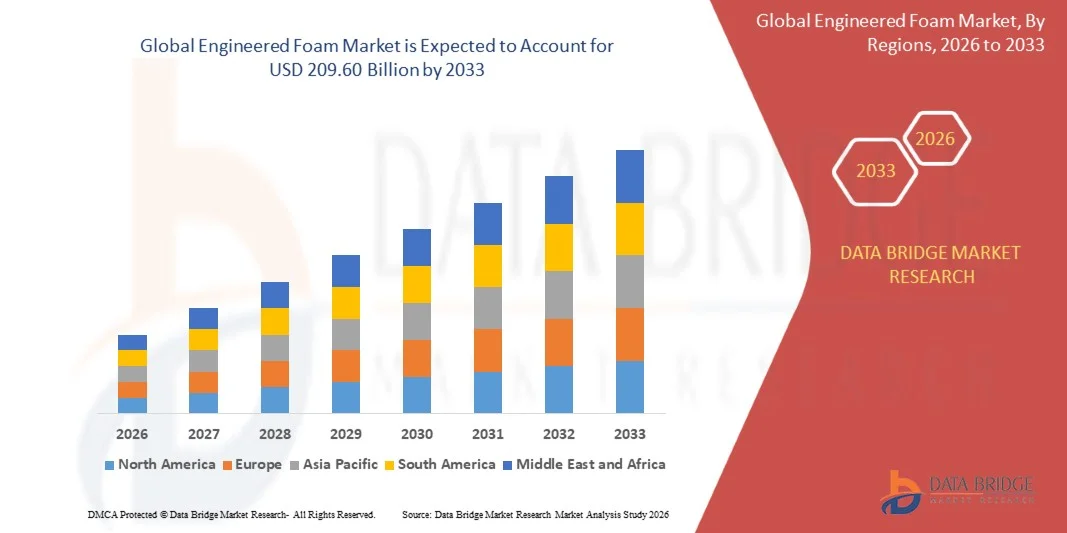
As per Data Bridge Market Research analysis the Engineered Foam Market was valued at USD 113.66 billion in 2025 and is projected to reach USD 209.60 billion by 2033, growing at a CAGR of 7.95% from 2026 to 2033. The market is witnessing strong growth driven by rising demand for lightweight, durable, and high-performance materials across automotive, construction, packaging, electronics, and healthcare industries. Increasing focus on energy efficiency, thermal insulation, and vibration damping is further accelerating the adoption of engineered foam solutions across multiple end-use sectors.
The growing shift toward electric vehicles, sustainable construction practices, and advanced protective packaging solutions is significantly boosting market expansion. Engineered foams are increasingly being used in EV battery insulation, automotive interior components, and building insulation systems due to their superior strength-to-weight ratio and thermal resistance properties. In addition, rapid urbanization, expanding infrastructure development, and rising consumer demand for comfort-driven and energy-efficient products are further supporting global market growth.
Key Market Trends & Insights
- North America dominated the engineered foam market with the largest revenue share of 36.8% in 2025, supported by strong demand from automotive lightweighting, construction insulation, and advanced manufacturing applications along with early adoption of sustainable material technologies.
- Asia-Pacific is expected to be the fastest-growing region, recording a CAGR of 8.6% from 2026 to 2033. Growth is driven by rapid industrialization, expanding automotive and construction sectors, rising demand for energy-efficient housing, and increasing adoption of engineered foam in countries such as China, India, and Japan.
- The polyurethane segment held the largest market revenue share of approximately 41.6% in 2025 driven by its extensive use in insulation, cushioning, automotive interiors, and construction applications. Polyurethane foams are widely preferred due to their superior thermal insulation, lightweight structure, durability, and versatility across rigid and flexible applications.
- The polystyrene segment is projected to register the fastest growth at a CAGR of 8.4% from 2026 to 2033, driven by increasing demand for cost-effective insulation and protective packaging solutions. Rising adoption in building insulation panels and e-commerce packaging is further accelerating segment expansion across emerging economies and large-scale infrastructure projects.
- The rigid foam segment held the largest market revenue share of approximately 46.9% in 2025 driven by strong demand in construction insulation, refrigeration systems, and structural applications. Rigid engineered foams are widely used due to their high compressive strength, thermal resistance, and long-term durability in energy-efficient building systems.
- The spray foam segment is projected to register the fastest growth at a CAGR of 9.1% from 2026 to 2033, driven by increasing adoption in residential and commercial insulation retrofitting projects. Rising demand for energy-efficient building solutions and airtight sealing applications is further supporting rapid segment growth across developed and developing regions.
- The transportation segment held the largest market revenue share of approximately 38.2% in 2025 driven by high adoption of engineered foams in automotive seating, interior systems, vibration damping, and EV lightweighting applications. Increasing production of electric vehicles and fuel-efficient vehicles is further strengthening demand across this segment.
- The medical and healthcare segment is projected to register the fastest growth at a CAGR of 8.9% from 2026 to 2033, driven by rising use of engineered foams in prosthetics, wound care, bedding systems, and medical packaging. Expanding healthcare infrastructure and increasing demand for patient comfort and pressure-relief solutions are further accelerating segment growth globally.
Market Size & Forecast
- Global Market Value (2025): USD 113.66 Billion
- Expected Market Value (2033): USD 209.60 Billion
- Forecast CAGR (2026–2033): 7.95%
- Leading Region in 2025: North America
- Fastest Growing Region: Asia-Pacific
Report Scope and Engineered Foam Market Segmentation
|
Attributes |
Engineered Foam Key Market Insights |
|
Segments Covered |
· By Type: Polyurethane, Polystyrene, Polyolefin, Polyvinyl Chloride, and Others · By Form: Flexible, Rigid, and Spray · By End-User: Aerospace and Defence, Medical and Healthcare, Transportation, Manufacturing and Construction, and Other |
|
Countries Covered |
North America · U.S. · Canada · Mexico Europe · Germany · France · U.K. · Netherlands · Switzerland · Belgium · Russia · Italy · Spain · Turkey · Rest of Europe Asia-Pacific · China · Japan · India · South Korea · Singapore · Malaysia · Australia · Thailand · Indonesia · Philippines · Rest of Asia-Pacific Middle East and Africa · Saudi Arabia · U.A.E. · South Africa · Egypt · Israel · Rest of Middle East and Africa South America · Brazil · Argentina · Rest of South America |
|
Key Market Players |
• UFP Technologies, Inc. (U.S.) |
|
Market Opportunities |
• Expansion Of Electric Vehicle Lightweight Component Demand • Increasing Adoption Of Sustainable Packaging And Insulation Solutions |
|
Value Added Data Infosets |
In addition to the insights on market scenarios such as market value, growth rate, segmentation, geographical coverage, and major players, the market reports curated by the Data Bridge Market Research also include import export analysis, production capacity overview, production consumption analysis, price trend analysis, climate change scenario, supply chain analysis, value chain analysis, raw material/consumables overview, vendor selection criteria, PESTLE Analysis, Porter Analysis, and regulatory framework. |
Engineered Foam Market Trends
Trend: Growth In Lightweight, Sustainable, And High-Performance Material Applications
Increasing demand for lightweight, durable, and energy-efficient materials across automotive, construction, packaging, electronics, and healthcare sectors is driving the adoption of engineered foam solutions. Traditional dense materials such as metals and rigid plastics are increasingly being replaced due to higher weight, lower energy efficiency, and limited design flexibility, encouraging industries to shift toward advanced foam-based alternatives with superior mechanical and thermal properties.
In modern automotive manufacturing, engineered foams are widely used in seating systems, interior cushioning, and vibration dampening components, For instance in electric vehicles where reducing overall vehicle weight directly contributes to extended driving range and improved battery efficiency. In construction, rigid polyurethane and polystyrene foams are increasingly used for thermal insulation in residential and commercial buildings, supporting energy efficiency targets and reducing heating and cooling energy consumption.
The rapid expansion of e-commerce and protective packaging requirements is also increasing demand for shock-absorbing and lightweight packaging materials capable of minimizing product damage during long-distance logistics. Additionally, healthcare and medical device manufacturers are adopting engineered foams for prosthetics, bedding systems, and wound care applications due to their biocompatibility and pressure-relief properties. Industry data from 2025 indicates that EV manufacturers using engineered foam-based interior components achieved weight reductions of approximately 8–12% per vehicle, improving overall energy efficiency and performance.
Engineered Foam Market Dynamics
Key Market Driver: Rising Demand For Energy-Efficient And Lightweight Materials Across Industries
Industries worldwide are under increasing pressure to reduce energy consumption, improve fuel efficiency, and enhance product performance, driving strong demand for engineered foam materials. Lightweight foams help reduce structural weight in automotive and aerospace applications, resulting in improved fuel efficiency and lower carbon emissions while maintaining strength and durability requirements.
Automotive manufacturers are increasingly integrating engineered foams into EV battery insulation, seating systems, and crash protection components, For instance to enhance thermal management, improve passenger safety, and reduce vehicle mass without compromising structural integrity.
Similarly, the construction industry is widely adopting polyurethane and polystyrene foams for insulation in walls, roofs, and flooring systems to improve energy efficiency in residential and commercial buildings. Large-scale infrastructure projects in Europe and North America during 2024 reported energy savings of around 20–30% in heating and cooling consumption after adopting advanced foam insulation systems in modern building designs.
Key Restraint/Challenge: Volatile Raw Material Prices And Environmental Concerns
The engineered foam market faces challenges due to fluctuations in raw material prices such as polyols and isocyanates, which are derived from petrochemical feedstocks. These price variations create cost instability for manufacturers and affect profit margins, particularly in price-sensitive markets.
In addition, environmental concerns related to foam disposal, recycling difficulties, and the use of certain blowing agents have led to stricter regulatory frameworks in several regions, increasing compliance costs for manufacturers. Limited recyclability of some foam types further restricts their adoption in sustainability-focused industries.
Industry assessments indicate that fluctuations in petrochemical-derived raw materials can impact production costs by approximately 10–18% annually, affecting pricing stability across global engineered foam supply chains.
Key Market Opportunity: Expansion Of Electric Vehicles And Sustainable Construction Applications
Rapid growth in electric vehicle production and sustainable construction practices is creating significant opportunities for engineered foam manufacturers. Automotive OEMs are increasingly focusing on lightweight interior materials and thermal insulation solutions to enhance EV efficiency, driving strong demand for advanced foam-based components.
Engineered foams are being widely adopted in EV battery insulation systems, seating comfort layers, and noise, vibration, and harshness reduction systems, For instance to improve driving comfort, extend battery life, and enhance energy efficiency in next-generation electric vehicles.
Additionally, green building initiatives and energy-efficient construction standards are accelerating demand for high-performance insulation foams in residential, commercial, and industrial buildings. Large infrastructure projects in Asia-Pacific during 2025 reported insulation efficiency improvements of around 25–35% after integrating advanced engineered foam materials into building envelopes and HVAC insulation systems.
Engineered Foam Market Scope
The market is segmented on the basis of type, form, and end-user.
- By Type
On the basis of type, the Engineered Foam Market is segmented into polyurethane, polystyrene, polyolefin, polyvinyl chloride, and others. The polyurethane segment held the largest market revenue share of approximately 41.6% in 2025 driven by its extensive use in insulation, cushioning, automotive interiors, and construction applications. Polyurethane foams are widely preferred due to their superior thermal insulation, lightweight structure, durability, and versatility across rigid and flexible applications.
The polystyrene segment is projected to register the fastest growth at a CAGR of 8.4% from 2026 to 2033, driven by increasing demand for cost-effective insulation and protective packaging solutions. Rising adoption in building insulation panels and e-commerce packaging is further accelerating segment expansion across emerging economies and large-scale infrastructure projects.
- By Form
On the basis of form, the market is segmented into flexible, rigid, and spray foams. The rigid foam segment held the largest market revenue share of approximately 46.9% in 2025 driven by strong demand in construction insulation, refrigeration systems, and structural applications. Rigid engineered foams are widely used due to their high compressive strength, thermal resistance, and long-term durability in energy-efficient building systems.
The spray foam segment is projected to register the fastest growth at a CAGR of 9.1% from 2026 to 2033, driven by increasing adoption in residential and commercial insulation retrofitting projects. Rising demand for energy-efficient building solutions and airtight sealing applications is further supporting rapid segment growth across developed and developing regions.
- By End-User
On the basis of end-user, the market is segmented into aerospace and defence, medical and healthcare, transportation, manufacturing and construction, and others. The transportation segment held the largest market revenue share of approximately 38.2% in 2025 driven by high adoption of engineered foams in automotive seating, interior systems, vibration damping, and EV lightweighting applications. Increasing production of electric vehicles and fuel-efficient vehicles is further strengthening demand across this segment.
The medical and healthcare segment is projected to register the fastest growth at a CAGR of 8.9% from 2026 to 2033, driven by rising use of engineered foams in prosthetics, wound care, bedding systems, and medical packaging. Expanding healthcare infrastructure and increasing demand for patient comfort and pressure-relief solutions are further accelerating segment growth globally.
Engineered Foam Market Regional Analysis
North America Engineered Foam Market Insight
North America dominated the engineered foam market with the largest revenue share of 36.8% in 2025, supported by strong demand from automotive, construction, packaging, and healthcare industries, along with high adoption of lightweight and energy-efficient materials. Manufacturers in the region are increasingly using engineered foams for thermal insulation, cushioning, and vibration damping applications to improve energy efficiency and product performance. The presence of advanced manufacturing infrastructure and high investments in sustainable material technologies further strengthen regional market growth.
U.S. Engineered Foam Market Insight
The U.S. engineered foam market captured the largest revenue share within North America in 2025, driven by strong demand from electric vehicle production, residential and commercial construction, and healthcare applications. Increasing use of engineered foams in EV battery insulation, automotive interiors, and building insulation systems is significantly supporting market expansion. Additionally, rising adoption of energy-efficient construction standards and growing demand for protective packaging in e-commerce are further accelerating industry growth across the country.
Europe Engineered Foam Market Insight
The Europe engineered foam market is expected to witness the fastest growth rate from 2026 to 2033, primarily driven by strict energy efficiency regulations, increasing focus on sustainable construction materials, and strong automotive lightweighting trends. European manufacturers are increasingly adopting engineered foams to reduce carbon emissions and improve building insulation performance. Growing investments in electric mobility and green building initiatives are further supporting market expansion across residential and industrial sectors.
U.K. Engineered Foam Market Insight
The U.K. engineered foam market is expected to witness strong growth from 2026 to 2033, driven by rising demand for energy-efficient housing, expansion of EV manufacturing, and increasing use of advanced packaging materials. Manufacturers are adopting engineered foams for insulation, cushioning, and noise reduction applications across construction and transportation industries. Additionally, government focus on net-zero emission targets is further encouraging the use of sustainable and lightweight materials in industrial applications.
Germany Engineered Foam Market Insight
The Germany engineered foam market is expected to witness significant growth from 2026 to 2033, fueled by strong automotive industry demand, advanced manufacturing capabilities, and emphasis on energy-efficient building solutions. Engineered foams are widely used in EV components, automotive interiors, and high-performance insulation systems. Germany’s focus on sustainability and innovation is further driving adoption in construction and industrial applications where lightweight and durable materials are essential.
Asia-Pacific Engineered Foam Market Insight
The Asia-Pacific engineered foam market is expected to witness the fastest growth rate from 2026 to 2033, supported by rapid industrialization, urbanization, and expanding automotive and construction sectors in countries such as China, India, and Japan. Rising demand for affordable housing, growing EV production, and increasing e-commerce activities are significantly boosting the adoption of engineered foam materials. Additionally, the region’s strong manufacturing base is enhancing availability and cost competitiveness of foam products.
Japan Engineered Foam Market Insight
The Japan engineered foam market is expected to witness steady growth from 2026 to 2033 due to high demand for lightweight materials, advanced automotive technologies, and energy-efficient construction solutions. Engineered foams are widely used in automotive interiors, electronics, and medical applications due to their durability and precision performance. Japan’s aging infrastructure and focus on modernizing housing and transportation systems are further driving adoption of advanced foam materials.
China Engineered Foam Market Insight
The China engineered foam market accounted for the largest market revenue share in Asia-Pacific in 2025, attributed to rapid urbanization, strong growth in automotive and construction industries, and increasing demand for consumer goods packaging. China’s expanding electric vehicle market and large-scale infrastructure development are significantly driving foam consumption. Additionally, strong domestic manufacturing capabilities and government support for energy-efficient materials are further accelerating market expansion across the country.
Engineered Foam Market Share
The Engineered Foam industry is primarily led by well-established companies, including:
• UFP Technologies, Inc. (U.S.)
• FXI (U.S.)
• Trelleborg AB (publ) (Sweden)
• Armacell (Luxembourg)
• Sekisui Chemical Co., Ltd. (Japan)
• Future Foam (U.S.)
• Foamcraft (U.S.)
• BASF SE (Germany)
• Bayer MaterialScience (U.S.)
• Dow (U.S.)
• Huntsman International L.L.C (U.S.)
• Rogers Corporation (U.S.)
• Ube Corporation (Japan)
• Recticel (Belgium)
• Zotefoams Plc (U.K.)
• The Woodbridge Group (Canada)
• Sekisui Alveo (Switzerland)
• Indoac Corporation (Japan)
• Covestro AG (Germany)
Latest Developments in Engineered Foam Market
- In November 2026, Covestro AG announced a capacity expansion investment in a new high-performance foam production facility aimed at increasing output for automotive, construction, and industrial applications. This development is expected to strengthen its global supply capability and improve competitiveness by addressing rising demand for lightweight and durable engineered foam materials while supporting sustainability-focused manufacturing.
- In October 2025, Rogers Corporation launched a new engineered foam product line designed specifically for electronics applications, focusing on advanced thermal management solutions. This initiative is expected to enhance product specialization, expand its presence in the high-growth electronics sector, and improve performance efficiency in compact and high-heat electronic devices.
- In September 2025, Sealed Air Corporation entered into a strategic partnership with a leading packaging company to develop sustainable foam solutions for eco-friendly packaging applications. This collaboration is expected to expand its sustainable product portfolio, strengthen market positioning, and accelerate adoption of environmentally responsible foam materials across the packaging industry.
- In March 2025, BASF introduced biomass balance grades of its Elastoflex polyurethane foam targeting furniture and interior applications such as seating, headrests, and armrests. This development is expected to enhance its sustainability offerings, support circular economy goals, and increase adoption of eco-friendly foam materials in the furniture manufacturing sector.
- In July 2023, Carpenter Company acquired Recticel NV’s Engineered Foams Division, including Foam Partner and Otto Bock operations, significantly expanding its global manufacturing footprint. This acquisition is expected to strengthen Carpenter’s position as a leading vertically integrated foam producer, improve production capabilities, and consolidate its market share in polyurethane and specialty foam segments.

- Interactive Data Analysis Dashboard
- Company Analysis Dashboard for high growth potential opportunities
- Research Analyst Access for customization & queries
- Competitor Analysis with Interactive dashboard
- Latest News, Updates & Trend analysis
- Harness the Power of Benchmark Analysis for Comprehensive Competitor Tracking
Global Engineered Foam Market, Supply Chain Analysis and Ecosystem Framework
To support market growth and help clients navigate the impact of geopolitical shifts, DBMR has integrated in-depth supply chain analysis into its Global Engineered Foam Market research reports. This addition empowers clients to respond effectively to global changes affecting their industries. The supply chain analysis section includes detailed insights such as Global Engineered Foam Market consumption and production by country, price trend analysis, the impact of tariffs and geopolitical developments, and import and export trends by country and HSN code. It also highlights major suppliers with data on production capacity and company profiles, as well as key importers and exporters. In addition to research, DBMR offers specialized supply chain consulting services backed by over a decade of experience, providing solutions like supplier discovery, supplier risk assessment, price trend analysis, impact evaluation of inflation and trade route changes, and comprehensive market trend analysis.
Data collection and base year analysis are done using data collection modules with large sample sizes. The stage includes obtaining market information or related data through various sources and strategies. It includes examining and planning all the data acquired from the past in advance. It likewise envelops the examination of information inconsistencies seen across different information sources. The market data is analysed and estimated using market statistical and coherent models. Also, market share analysis and key trend analysis are the major success factors in the market report. To know more, please request an analyst call or drop down your inquiry.
The key research methodology used by DBMR research team is data triangulation which involves data mining, analysis of the impact of data variables on the market and primary (industry expert) validation. Data models include Vendor Positioning Grid, Market Time Line Analysis, Market Overview and Guide, Company Positioning Grid, Patent Analysis, Pricing Analysis, Company Market Share Analysis, Standards of Measurement, Global versus Regional and Vendor Share Analysis. To know more about the research methodology, drop in an inquiry to speak to our industry experts.
Data Bridge Market Research is a leader in advanced formative research. We take pride in servicing our existing and new customers with data and analysis that match and suits their goal. The report can be customized to include price trend analysis of target brands understanding the market for additional countries (ask for the list of countries), clinical trial results data, literature review, refurbished market and product base analysis. Market analysis of target competitors can be analyzed from technology-based analysis to market portfolio strategies. We can add as many competitors that you require data about in the format and data style you are looking for. Our team of analysts can also provide you data in crude raw excel files pivot tables (Fact book) or can assist you in creating presentations from the data sets available in the report.













