


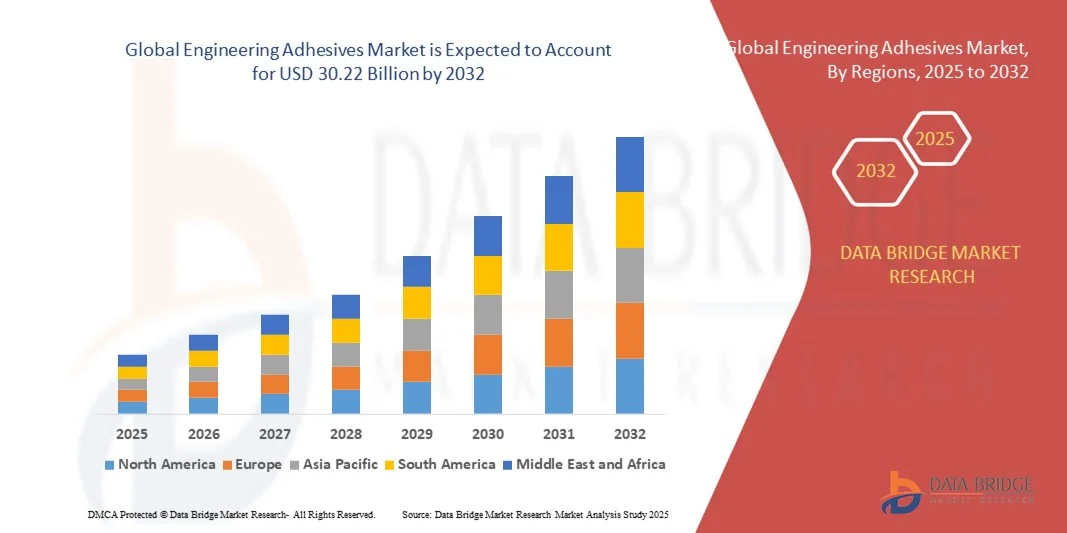
What is the Global Engineering Adhesives Market Size and Growth Rate?
- The global engineering adhesives market size was valued at USD 20.3 billion in 2024 and is expected to reach USD 30.22 billion by 2032, at a CAGR of 5.1% during the forecast period
- The increase in demand for engineering adhesive products, especially in developing regions acts as one of the major factors driving the growth of engineering adhesives market
- The replacement of conventional fasteners with bonding products owning to the widespread applications in construction, transportation, and other sectors, and high utilization for the improving quality and reliability of equipment & machinery accelerate the market growth
- The rise in popularity owing to properties such as rigid bonds, high strength, and high viscosity, and use of the products to achieve more dynamic and static strength and reduce corrosion problems during assembly further influence the market
What are the Major Takeaways of Engineering Adhesives Market?
- Advancement of polyurethane adhesive products, expansion of various end use industries, rapid urbanization, and increase in government funding and investment positively affect the engineering adhesives market
- Less stability of adhesives at high temperature and increase in safety and environment concerns are expected to obstruct the market growth. Complexity associated with bonding large objects is projected to challenge the engineering adhesives market
- North America dominated the engineering adhesives market with the largest revenue share of 39.8% in 2024, driven by strong demand across automotive, aerospace, and construction sectors
- The Asia-Pacific region is projected to grow at the fastest CAGR of 10.36% from 2025 to 2032, fueled by industrial expansion, urbanization, and technological advancement across China, Japan, and India
- Deadbolt segment dominated the Engineering Adhesives market with a market share of 43.2% in 2024, driven by its established reputation for security and ease of retrofit into existing door setups
Report Scope and Engineering Adhesives Market Segmentation
|
Attributes |
Engineering Adhesives Key Market Insights |
|
Segments Covered |
|
|
Countries Covered |
North America
Europe
Asia-Pacific
Middle East and Africa
South America
|
|
Key Market Players |
|
|
Market Opportunities |
|
|
Value Added Data Infosets |
In addition to the insights on market scenarios such as market value, growth rate, segmentation, geographical coverage, and major players, the market reports curated by the Data Bridge Market Research also include in-depth expert analysis, pricing analysis, brand share analysis, consumer survey, demography analysis, supply chain analysis, value chain analysis, raw material/consumables overview, vendor selection criteria, PESTLE Analysis, Porter Analysis, and regulatory framework. |
What is the Key Trend in the Engineering Adhesives Market?
Shift Toward Sustainable and High-Performance Adhesive Solution
- A major trend shaping the engineering adhesives market is the transition toward eco-friendly, bio-based, and high-performance adhesive formulations driven by sustainability initiatives and stricter environmental regulations. Manufacturers are increasingly replacing solvent-based adhesives with water-based, UV-curable, and hot-melt alternatives to reduce VOC emissions and improve workplace safety
- Companies are also developing lightweight structural adhesives for automotive, aerospace, and electronics applications to support energy efficiency and carbon reduction goals. These advanced materials enhance bonding strength while minimizing weight and waste
- In September 2024, 3M (U.S.) introduced a new low-VOC structural adhesive series designed for EV battery assembly, providing strong heat resistance and improved sustainability
- This growing emphasis on sustainable chemistry and energy-efficient production processes is reshaping the competitive landscape, positioning green innovation as a core driver of the Engineering Adhesives industry’s evolution
What are the Key Drivers of Engineering Adhesives Market?
- The increasing demand for lightweight and durable materials across industries such as automotive, construction, and electronics is a primary driver of the Engineering Adhesives market. Adhesives are increasingly replacing traditional mechanical fasteners to reduce weight, enhance durability, and improve design flexibility
- In June 2024, Henkel AG & Co. KGaA (Germany) launched an advanced polyurethane adhesive range tailored or EV assembly, enhancing bonding efficiency and thermal management.
- Technological advancements, including smart adhesives with self-healing and temperature resistance properties, are fueling innovation in end-use applications
- In addition, the growing adoption of automation and robotics in manufacturing is accelerating the use of adhesives for precise and efficient bonding
- Rising emphasis on energy-efficient infrastructure and eco-friendly production further reinforces demand, making engineering adhesives an essential component in achieving performance and sustainability targets across multiple industries
Which Factor is Challenging the Growth of the Engineering Adhesives Market?
- A key challenge for the engineering adhesives market is the fluctuating cost of raw materials, particularly petrochemical derivatives such as epoxy resins, acrylates, and polyurethanes. Volatile crude oil prices and supply chain disruptions have increased production costs and affected price stability
- In April 2024, Arkema (France) reported higher raw material costs impacting its adhesive segment profitability, prompting initiatives to increase efficiency through localized sourcing and recycling programs
- Moreover, stringent environmental regulations in regions such as Europe and North America are compelling manufacturers to reformulate adhesives to meet sustainability and safety standards, which can increase R&D expenses
- The limited availability of bio-based raw materials also poses a production constraint.
- To overcome these challenges, market players are investing in recycling technologies, circular material usage, and renewable raw material sourcing, ensuring long-term resilience and regulatory compliance in the global engineering adhesives market
How is the Engineering Adhesives Market Segmented?
The market is segmented on the basis of product, application, and end-user.
- By Product
On the basis of product, the engineering adhesives market is segmented into Epoxies, Polyurethanes, Cyanocrylates, Methacrylates, and Others. The Epoxies segment dominated the market in 2024 with the largest revenue share of 41.6%, owing to its superior mechanical strength, chemical resistance, and versatility in bonding metals, composites, and plastics. Epoxies are widely used in aerospace, automotive, and construction applications where high structural integrity is essential.
The Polyurethanes segment is projected to witness the fastest CAGR from 2025 to 2032, driven by its flexibility, impact resistance, and ability to bond diverse substrates under varying temperature conditions. Increasing usage of polyurethane adhesives in automotive lightweighting and electronic encapsulation further accelerates segment growth. The demand for high-performance and durable bonding materials in critical engineering environments continues to solidify epoxy’s dominance while positioning polyurethanes as the next growth frontier in advanced adhesive technologies.
- By Application
On the basis of application, the engineering adhesives market is categorized into Transportation, Construction, Electrical & Electronics, Energy, and Others. The Transportation segment dominated the market in 2024, accounting for 38.9% of total revenue, fueled by the growing need for lightweight, durable, and heat-resistant adhesives in automotive and aerospace applications. Engineering adhesives enable the replacement of mechanical fasteners, enhancing vehicle fuel efficiency and structural performance.
The Electrical & Electronics segment is anticipated to record the fastest CAGR from 2025 to 2032, driven by the rapid expansion of consumer electronics, EV batteries, and semiconductor assembly. Adhesives in this segment offer insulation, miniaturization, and thermal conductivity benefits. With ongoing innovation in mobility and energy-efficient systems, adhesives play a critical role in improving safety, sustainability, and design flexibility across key industries, ensuring steady growth across multiple end-use sectors.
- By End-User
Based on end-user, the engineering adhesives market is segmented into Aerospace, Road Transport, Marine, Rail, Electronics and Communication, and Sports. The Aerospace segment dominated the market in 2024, holding a revenue share of 34.2%, driven by the increasing use of high-strength, lightweight adhesives for bonding composite materials in aircraft structures. Adhesives enhance fuel efficiency and reduce assembly time compared to traditional mechanical joints.
The Electronics and Communication segment is expected to witness the fastest CAGR from 2025 to 2032, propelled by growing applications in circuit board assembly, device sealing, and electronic packaging. Rising adoption of miniaturized and smart devices further boosts demand for precision-engineered adhesives. The shift toward lightweight materials, stringent performance standards, and enhanced bonding efficiency across industries underscores the vital role of adhesives in ensuring structural reliability and long-term durability in advanced engineering applications.
Which Region Holds the Largest Share of the Engineering Adhesives Market?
- North America dominated the engineering adhesives market with the largest revenue share of 39.8% in 2024, driven by strong demand across automotive, aerospace, and construction sectors
- The region’s well-established industrial infrastructure, along with growing emphasis on lightweight, high-performance materials, is fueling adhesive usage in manufacturing and assembly applications
- In addition, the region’s shift toward sustainable and low-VOC adhesives, in line with environmental regulations, further strengthens market growth. The increasing use of epoxy and polyurethane adhesives in structural bonding and component integration across industries reinforces North America’s market dominance
U.S. Engineering Adhesives Market Insight
The U.S. engineering adhesives market accounted for over 78% of North America’s total share in 2024, driven by extensive adoption in automotive, aerospace, and electrical & electronics manufacturing. The nation’s strong R&D ecosystem and presence of major players such as 3M and Dow accelerate innovation in high-performance adhesive formulations. Moreover, the shift toward EV manufacturing and composite material adoption has intensified demand for structural adhesives that improve efficiency and reduce weight. The U.S. market continues to benefit from regulatory support for eco-friendly, solvent-free adhesives, propelling steady growth through 2032.
Europe Engineering Adhesives Market Insight
The Europe engineering adhesives market is expected to register substantial growth through 2032, driven by sustainability initiatives and increased adoption of green adhesive technologies. The region’s strong automotive and aerospace sectors, particularly in Germany, France, and the U.K., heavily rely on advanced adhesives for lightweight assemblies. European Union regulations promoting low-emission and energy-efficient materials are boosting demand for waterborne and bio-based formulations. In addition, the growing focus on renewable energy infrastructure and electronic component manufacturing sustains consistent market expansion across the region.
Germany Engineering Adhesives Market Insight
The Germany engineering adhesives market is expanding rapidly, supported by the country’s leadership in automotive innovation and precision engineering. Germany’s emphasis on electrification, sustainability, and high-performance materials drives demand for advanced adhesives in vehicle manufacturing, railways, and construction. The country’s strong research capabilities and collaboration with chemical manufacturers foster continuous product development. Furthermore, the integration of smart manufacturing technologies and preference for eco-conscious production methods contribute significantly to Germany’s dominant position in Europe’s engineering adhesives sector.
Which Region is the Fastest-Growing Region in the Engineering Adhesives Market?
The Asia-Pacific region is projected to grow at the fastest CAGR of 10.36% from 2025 to 2032, fueled by industrial expansion, urbanization, and technological advancement across China, Japan, and India. Rising investments in automotive manufacturing, infrastructure development, and electronics production are key growth drivers. Increasing awareness of sustainable bonding solutions and the establishment of local adhesive manufacturing facilities are also enhancing accessibility and cost efficiency. The region’s proactive adoption of energy-efficient production methods positions Asia-Pacific as a major global growth hub for engineering adhesives.
China Engineering Adhesives Market Insight
The China engineering adhesives market captured the largest share within Asia-Pacific in 2024, underpinned by strong industrial output, expanding EV production, and rapid infrastructure development. Local and international manufacturers are increasingly investing in bio-based and low-VOC adhesives to align with national environmental goals. The integration of adhesives in electronics miniaturization and renewable energy systems further supports growth. In addition, China’s focus on technological self-reliance and cost-effective manufacturing continues to strengthen its global leadership in the engineering adhesives market.
Japan Engineering Adhesives Market Insight
The Japan engineering adhesives market is witnessing robust growth driven by the nation’s high-tech manufacturing ecosystem and focus on lightweight materials in automotive and electronics industries. Adhesives are increasingly used as alternatives to mechanical fasteners, enhancing structural integrity and reducing product weight. Japan’s commitment to precision engineering, quality standards, and sustainability supports ongoing innovation in adhesive technologies. Moreover, the adoption of smart factories and automation is creating new opportunities for high-performance adhesive applications across multiple industrial segments.
Which are the Top Companies in Engineering Adhesives Market?
The engineering adhesives industry is primarily led by well-established companies, including:
- Henkel AG & Co. KGaA (Germany)
- H.B. Fuller Company (U.S.)
- Arkema (France)
- 3M (U.S.)
- Dow (U.S.)
- Hexion (U.S.)
- Anabond (India)
- Grupo Lamosa (Mexico)
- Permabond LLC (U.K.)
- EMS-CHEMIE HOLDING AG (Switzerland)
- Loxeal S.r.l. (Italy)
- Fasto Advance Adhesives Technologies (India)
- Dymax Corporation (U.S.)
- LORD Corporation (U.S.)
- ThreeBond Co., Ltd (Japan)
- Parson Adhesives, Inc. (U.S.)
- Royal Adhesives & Sealants (U.S.)
- Sika AG (Switzerland)
- UniSeal, Inc. (U.S.)
- Huntsman International LLC (U.S.)
What are the Recent Developments in Global Engineering Adhesives Market?
- In August 2023, 3M, an American multinational conglomerate, introduced the Scotchbond Hi-Strength Structural Adhesive, designed to bond a wide range of materials including plastics, metals, and composites, providing superior structural integrity and versatility across industrial applications. This launch reinforces 3M’s commitment to delivering high-performance adhesive solutions for modern manufacturing needs
- In June 2023, Avery Dennison, a global materials science company, launched a new series of structural adhesives engineered to deliver exceptional bonding strength and durability in automotive and aerospace manufacturing. This introduction highlights the company’s focus on innovation and sustainability in high-performance adhesive technologies
- In March 2023, Sika AG, a multinational company headquartered in Switzerland, released the SikaForce-7700 high-performance structural adhesive designed for bonding steel and aluminum components with superior strength and durability. This development underscores Sika’s ongoing advancements in lightweight bonding solutions for industrial applications

- Interactive Data Analysis Dashboard
- Company Analysis Dashboard for high growth potential opportunities
- Research Analyst Access for customization & queries
- Competitor Analysis with Interactive dashboard
- Latest News, Updates & Trend analysis
- Harness the Power of Benchmark Analysis for Comprehensive Competitor Tracking
Global Engineering Adhesives Market, Supply Chain Analysis and Ecosystem Framework
To support market growth and help clients navigate the impact of geopolitical shifts, DBMR has integrated in-depth supply chain analysis into its Global Engineering Adhesives Market research reports. This addition empowers clients to respond effectively to global changes affecting their industries. The supply chain analysis section includes detailed insights such as Global Engineering Adhesives Market consumption and production by country, price trend analysis, the impact of tariffs and geopolitical developments, and import and export trends by country and HSN code. It also highlights major suppliers with data on production capacity and company profiles, as well as key importers and exporters. In addition to research, DBMR offers specialized supply chain consulting services backed by over a decade of experience, providing solutions like supplier discovery, supplier risk assessment, price trend analysis, impact evaluation of inflation and trade route changes, and comprehensive market trend analysis.
Data collection and base year analysis are done using data collection modules with large sample sizes. The stage includes obtaining market information or related data through various sources and strategies. It includes examining and planning all the data acquired from the past in advance. It likewise envelops the examination of information inconsistencies seen across different information sources. The market data is analysed and estimated using market statistical and coherent models. Also, market share analysis and key trend analysis are the major success factors in the market report. To know more, please request an analyst call or drop down your inquiry.
The key research methodology used by DBMR research team is data triangulation which involves data mining, analysis of the impact of data variables on the market and primary (industry expert) validation. Data models include Vendor Positioning Grid, Market Time Line Analysis, Market Overview and Guide, Company Positioning Grid, Patent Analysis, Pricing Analysis, Company Market Share Analysis, Standards of Measurement, Global versus Regional and Vendor Share Analysis. To know more about the research methodology, drop in an inquiry to speak to our industry experts.
Data Bridge Market Research is a leader in advanced formative research. We take pride in servicing our existing and new customers with data and analysis that match and suits their goal. The report can be customized to include price trend analysis of target brands understanding the market for additional countries (ask for the list of countries), clinical trial results data, literature review, refurbished market and product base analysis. Market analysis of target competitors can be analyzed from technology-based analysis to market portfolio strategies. We can add as many competitors that you require data about in the format and data style you are looking for. Our team of analysts can also provide you data in crude raw excel files pivot tables (Fact book) or can assist you in creating presentations from the data sets available in the report.













