




Global Enterprise Mobility Management Market
Market Size in USD Billion
CAGR :
% 
 USD
23.78 Billion
USD
140.40 Billion
2025
2033
USD
23.78 Billion
USD
140.40 Billion
2025
2033
 Forecast Period Forecast Period |
2026 –2033 |
 Market Size (Base Year) Market Size (Base Year) |
USD 23.78 Billion |
 Market Size (Forecast Year) Market Size (Forecast Year) |
USD 140.40 Billion |
 CAGR CAGR |
% |
| Major Markets Players |
|
Enterprise Mobility Management Market Size
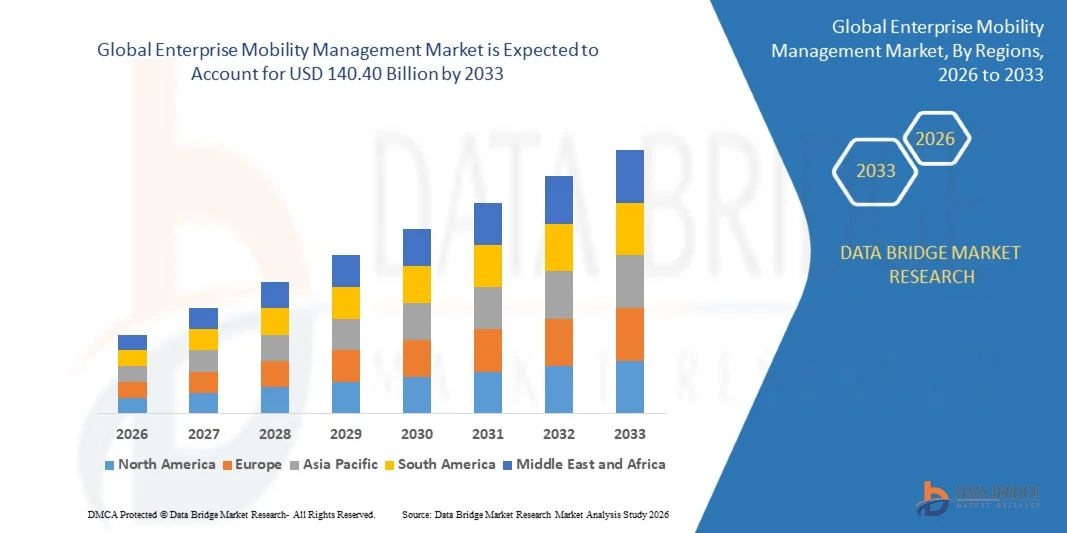
- The global enterprise mobility management market size was valued at USD 23.78 billion in 2025 and is expected to reach USD 140.40 billion by 2033, at a CAGR of 24.85% during the forecast period
- The market growth is largely fuelled by the increasing adoption of mobile devices and applications in enterprises, the rising need for secure remote access, and the demand for enhanced workforce productivity
- Growing trends of BYOD (Bring Your Own Device) policies, cloud-based solutions, and the integration of advanced security protocols are also driving market expansion
Enterprise Mobility Management Market Analysis
- The enterprise mobility management market is witnessing significant growth due to the rapid digital transformation across sectors, enabling seamless device management and secure access to corporate resources
- Organizations are increasingly focusing on unified endpoint management (UEM) solutions to manage smartphones, tablets, laptops, and IoT devices from a single platform, improving operational efficiency
- North America dominated the enterprise mobility management market with the largest revenue share of 38.75% in 2025, driven by the widespread adoption of mobile devices, increasing need for secure corporate data access, and growing enterprise digitization initiatives
- Asia-Pacific region is expected to witness the highest growth rate in the global enterprise mobility management market, driven by rising demand for mobile device management solutions in small and medium enterprises, increasing cybersecurity concerns, and expanding IT infrastructure. The surge in remote working and mobile workforce adoption also supports rapid EMM market expansion
- The solutions segment held the largest market revenue share in 2025, driven by the rising adoption of mobile device management (MDM), mobile application management (MAM), and unified endpoint management (UEM) tools. EMM solutions enable enterprises to centralize control of corporate devices, enforce security policies, and streamline application management across multiple platforms. Organizations benefit from enhanced operational efficiency, compliance with data protection regulations, and reduced risk of security breaches. The increasing need to support remote and hybrid work models further strengthens the demand for integrated EMM solutions
Report Scope and Enterprise Mobility Management Market Segmentation
|
Attributes |
Enterprise Mobility Management Key Market Insights |
|
Segments Covered |
|
|
Countries Covered |
North America
Europe
Asia-Pacific
Middle East and Africa
South America
|
|
Key Market Players |
• Microsoft (U.S.) |
|
Market Opportunities |
• Expansion Of Cloud-Based Enterprise Mobility Solutions |
|
Value Added Data Infosets |
In addition to the market insights such as market value, growth rate, market segments, geographical coverage, market players, and market scenario, the market report curated by the Data Bridge Market Research team includes in-depth expert analysis, import/export analysis, pricing analysis, production consumption analysis, and pestle analysis. |
Enterprise Mobility Management Market Trends
“Rising Adoption Of Cloud-Based And BYOD Solutions”
• The increasing adoption of mobile and remote working solutions is significantly shaping the enterprise mobility management (EMM) market, as organizations seek to enhance operational efficiency while maintaining data security. EMM solutions enable IT teams to manage devices, applications, and content across multiple platforms, ensuring secure access and compliance. This trend is driving demand across industries such as banking, healthcare, IT, and retail, encouraging vendors to innovate with integrated, scalable solutions
• Growing focus on security, compliance, and workforce flexibility has accelerated the adoption of enterprise mobility management platforms. Organizations are increasingly deploying mobile device management (MDM), mobile application management (MAM), and unified endpoint management (UEM) solutions to secure sensitive data and streamline operations. Partnerships between software providers and system integrators are also helping companies deliver enhanced functionality and ease of deployment
• The shift towards hybrid work environments and digital transformation is influencing enterprise technology investments, with organizations prioritizing centralized management, real-time monitoring, and automated policy enforcement. These factors enable businesses to reduce operational risk, improve employee productivity, and strengthen data governance. Vendors are emphasizing user experience and cross-platform support to differentiate their offerings in a competitive landscape
• For instance, in 2024, Microsoft in the U.S. and VMware in the U.K. expanded their EMM portfolios with cloud-based and AI-enabled features to address growing enterprise demands. These updates improved device security, facilitated seamless app deployment, and enhanced remote workforce management, thereby reinforcing customer trust and adoption
• Sustained market expansion depends on continuous innovation, integration with emerging technologies, and the ability to scale across global operations. EMM providers are focusing on improving interoperability, simplifying administration, and offering cost-effective subscription models to drive adoption across large and medium-sized enterprises
Enterprise Mobility Management Market Dynamics
Driver
“Rising Adoption Of Mobile Workforces And BYOD Policies”
• Increasing reliance on mobile devices and remote access solutions is a major driver for the EMM market. Organizations are implementing policies to manage device usage while maintaining security, which boosts demand for comprehensive EMM platforms
• Growing digital transformation initiatives across industries, including finance, healthcare, and IT, are driving the deployment of cloud-based and AI-enabled mobility solutions. EMM facilitates centralized control, secure data access, and streamlined device management, meeting evolving enterprise needs
• Vendors are actively expanding service offerings through product updates, integration of AI analytics, and partnerships with cloud service providers. These efforts help enterprises manage heterogeneous devices and applications efficiently while improving user experience and security
• For instance, in 2023, IBM in the U.S. and Citrix in the U.K. enhanced their mobility management solutions by integrating AI-driven security features, real-time monitoring, and multi-platform support. This led to increased adoption, improved data protection, and operational efficiency for enterprise customers
• Although the demand for EMM solutions is growing, adoption may be affected by implementation costs, compatibility issues, and workforce training requirements. Investment in seamless onboarding, user education, and multi-device support is critical for maximizing market penetration and sustaining growth
Restraint/Challenge
“Data Security Concerns And Complex IT Environments”
• Concerns over cybersecurity threats, data breaches, and regulatory compliance remain key challenges for enterprises adopting mobility management solutions. Protecting sensitive corporate data across diverse devices and networks is complex and resource-intensive
• Limited IT expertise and infrastructure in certain organizations can hinder EMM implementation and optimization. Integration with legacy systems and ensuring cross-platform compatibility adds operational challenges
• Vendor dependency and high subscription or licensing costs may also restrict adoption, particularly among small and medium-sized enterprises. Ongoing maintenance, updates, and training requirements further increase total cost of ownership
• For instance, in 2024, several mid-sized companies in the U.S. and Europe reported delayed deployment of EMM solutions due to high integration complexity, compliance concerns, and inadequate IT support, affecting operational efficiency and ROI
• Overcoming these challenges requires robust security protocols, simplified management tools, and vendor support for seamless deployment. Collaboration between EMM providers, IT departments, and compliance teams is essential to enhance data security, reduce complexity, and drive long-term market growth
Enterprise Mobility Management Market Scope
The enterprise mobility management (EMM) market is segmented on the basis of component, organization size, deployment mode, and verticals.
• By Component
On the basis of component, the market is segmented into solutions and services. The solutions segment held the largest market revenue share in 2025, driven by the rising adoption of mobile device management (MDM), mobile application management (MAM), and unified endpoint management (UEM) tools. EMM solutions enable enterprises to centralize control of corporate devices, enforce security policies, and streamline application management across multiple platforms. Organizations benefit from enhanced operational efficiency, compliance with data protection regulations, and reduced risk of security breaches. The increasing need to support remote and hybrid work models further strengthens the demand for integrated EMM solutions.
The services segment is expected to witness the fastest growth rate from 2026 to 2033, driven by the rising need for consulting, implementation, and managed services to ensure smooth deployment and continuous management of mobility systems. Services help organizations overcome technical complexities, optimize device performance, and improve user experience. Managed services also provide real-time monitoring, troubleshooting, and reporting, reducing the IT burden on enterprises. Growing awareness among small and mid-sized businesses about the benefits of professional EMM services is also propelling adoption.
• By Organization Size
On the basis of organization size, the market is segmented into large enterprises and small and medium-sized enterprises (SMEs). Large enterprises accounted for the largest market revenue share in 2025, supported by their extensive IT infrastructure and higher volume of mobile endpoints. These organizations prioritize security, regulatory compliance, and centralized management of devices and applications, making them major consumers of EMM solutions. Enterprise-wide adoption helps standardize mobile policies, enhance data security, and reduce operational costs.
The SME segment is expected to witness the fastest growth rate from 2026 to 2033, driven by increased awareness of mobile security and the affordability of cloud-based EMM solutions. SMEs are rapidly adopting digital tools to support remote workforces, manage BYOD (Bring Your Own Device) policies, and secure sensitive corporate data. Cloud-based EMM offerings make it easier for smaller organizations to implement enterprise-grade security without heavy upfront investment. This adoption trend is also fueled by competitive pressures and the need for operational efficiency.
• By Deployment Mode
On the basis of deployment mode, the market is segmented into cloud and on-premises. The cloud segment held the largest market revenue share in 2025, owing to its scalability, cost-effectiveness, and flexibility for remote access. Cloud-based EMM solutions allow organizations to manage devices and applications in real-time, deploy updates instantly, and integrate with other enterprise systems. They also reduce IT maintenance costs and provide continuous monitoring of security threats. The adoption of cloud platforms is further encouraged by increasing mobile workforce penetration and multi-location business operations.
The on-premises segment is expected to witness the fastest growth rate from 2026 to 2033, driven by the need for enhanced control, strict compliance with local data regulations, and secure handling of sensitive corporate information. On-premises deployment offers direct oversight of security protocols, data storage, and application management. Large organizations in highly regulated sectors prefer on-premises solutions to maintain full control over critical assets. The continued focus on privacy, confidentiality, and internal IT governance will support adoption in the coming years.
• By Verticals
On the basis of verticals, the market is segmented into BFSI, retail and e-commerce, healthcare and life sciences, IT and telecom, manufacturing, government, transportation and logistics, travel and hospitality, and other verticals. The BFSI vertical accounted for the largest market revenue share in 2025, due to stringent regulatory requirements, the sensitive nature of financial data, and the high volume of mobile devices used by employees. EMM solutions in BFSI help enforce compliance, prevent data breaches, and maintain secure remote operations.
The healthcare and life sciences vertical is expected to witness the fastest growth rate from 2026 to 2033, driven by digital transformation initiatives, adoption of mobile health applications, and increasing demand for secure access to patient records and clinical data. Hospitals and research institutions are leveraging EMM solutions to manage mobile endpoints, secure confidential patient data, and improve operational efficiency. In addition, the surge in telemedicine, wearable devices, and mobile-enabled healthcare services is further accelerating EMM adoption in this sector.
Enterprise Mobility Management Market Regional Analysis
• North America dominated the enterprise mobility management market with the largest revenue share of 38.75% in 2025, driven by the widespread adoption of mobile devices, increasing need for secure corporate data access, and growing enterprise digitization initiatives
• Organizations in the region highly value the ability to manage, monitor, and secure mobile endpoints across employees and departments, enabling enhanced productivity and operational efficiency
• High investments in IT infrastructure, cloud technologies, and cybersecurity, coupled with the presence of major EMM solution providers, are supporting rapid adoption across large enterprises and SMEs
U.S. Enterprise Mobility Management Market Insight
The U.S. enterprise mobility management market captured the largest revenue share in 2025 within North America, fueled by increasing mobile workforce adoption and stringent corporate security requirements. Organizations are prioritizing secure access to enterprise applications and data across mobile devices. Growing trends in BYOD (Bring Your Own Device) policies, cloud-based solutions, and integration with existing IT systems further accelerate market growth. In addition, strong investments in IT infrastructure and cybersecurity initiatives are significantly contributing to the expansion of EMM solutions across industries.
Europe Enterprise Mobility Management Market Insight
The Europe enterprise mobility management market is expected to witness the fastest growth rate from 2026 to 2033, primarily driven by rising digital transformation initiatives, stringent data privacy regulations, and the need for secure mobile workforce management. Organizations are increasingly implementing EMM solutions to ensure compliance, protect sensitive data, and streamline mobile device management. The growth is further bolstered by the adoption of cloud-based deployment models and the integration of AI-driven analytics in EMM solutions across various sectors.
U.K. Enterprise Mobility Management Market Insight
The U.K. enterprise mobility management market is expected to witness the fastest growth rate from 2026 to 2033, driven by an increasing focus on cybersecurity, regulatory compliance, and mobile workforce enablement. Organizations are rapidly adopting cloud-based EMM solutions to improve operational efficiency and safeguard corporate data. The country’s strong IT infrastructure, high smartphone penetration, and a growing emphasis on remote and hybrid work models are expected to fuel market adoption.
Germany Enterprise Mobility Management Market Insight
The Germany enterprise mobility management market is expected to witness the fastest growth rate from 2026 to 2033, fueled by the increasing demand for secure mobile device management, data protection compliance, and digital workplace transformation. German enterprises are actively deploying EMM solutions to enhance productivity, monitor device usage, and protect sensitive business data. The presence of leading technology providers and strong investment in enterprise IT infrastructure are key factors supporting adoption.
Asia-Pacific Enterprise Mobility Management Market Insight
The Asia-Pacific enterprise mobility management market is expected to witness the fastest growth rate from 2026 to 2033, driven by rapid digitalization, rising mobile workforce adoption, and increasing smartphone penetration in countries such as China, Japan, and India. Organizations in the region are increasingly focusing on securing mobile devices, managing applications, and enabling remote work. Government initiatives promoting digital infrastructure and enterprise mobility, combined with affordable cloud-based solutions, are accelerating EMM adoption.
Japan Enterprise Mobility Management Market Insight
The Japan enterprise mobility management market is expected to witness the fastest growth rate from 2026 to 2033 due to the country’s technologically advanced corporate sector, high smartphone adoption, and growing emphasis on mobile workforce enablement. Enterprises are deploying EMM solutions to ensure secure data access, simplify device management, and comply with regulatory standards. The integration of EMM with other enterprise IT systems and cloud platforms is further driving adoption across multiple sectors.
China Enterprise Mobility Management Market Insight
The China enterprise mobility management market accounted for the largest market revenue share in Asia-Pacific in 2025, attributed to the country’s rapid digital transformation, increasing mobile workforce, and high adoption of smartphones and tablets in enterprises. Organizations are leveraging EMM solutions to manage devices, secure applications, and protect sensitive business data. Government policies promoting digital infrastructure, coupled with growing cloud adoption and competitive enterprise IT investments, are key factors driving market growth in China.
Enterprise Mobility Management Market Share
The Enterprise Mobility Management industry is primarily led by well-established companies, including:
• Microsoft (U.S.)
• IBM (U.S.)
• MobileIron Inc. (U.S.)
• Symantec Corporation (U.S.)
• VMware, Inc. (U.S.)
• Ventraq Corporation (U.S.)
• Citrix Systems Inc. (U.S.)
• Good Technology (U.S.)
• SAP SE (Germany)
• SOTI Inc. (Canada)
• HyperOffice (U.S.)
• MDM Solutions (U.K.)
• MobileIRON (U.S.)
• Zoho Corp. (India)
• FileWave (U.S.)
• V|CA Technologies (U.S.)
• Centrify Corporation (U.S.)
• Sophos Ltd. (U.K.)
• Infosys Ltd. (India)
• Cisco Meraki (U.S.)
Latest Developments in Global Enterprise Mobility Management Market
- In May 2025, SAP SE, Partnership/Software Implementation, Announced that VFS Global will adopt SAP S/4HANA Cloud Public Edition and other SAP solutions to develop AI-powered digital systems aimed at improving cross-border mobility and citizen services. This integration enhances operational efficiency, strengthens digital security, and supports government digital transformation initiatives, driving demand for advanced enterprise mobility solutions
- In November 2023, Broadcom Inc., Acquisition, Completed its acquisition of VMware to strengthen edge and cloud services, including VMware Tanzu, Advanced Security, and VMware Software-Defined Edge. The move accelerates application deployment, improves security, and enhances network capabilities, expanding Broadcom’s presence in enterprise mobility and cloud management markets
- In October 2023, Deloitte, Strategic Expansion, Expanded its SAP Business Technology Platform practices with Generative AI to deliver industry-specific solutions and productivity tools. The initiative improves operational efficiency, reduces AI-related risks, and builds consumer trust, driving adoption of intelligent enterprise management solutions across sectors
- In August 2023, Siemens AG, Partnership, Partnered with Heliox to enhance e-truck and e-bus charging infrastructure across North America and Europe. This collaboration strengthens Siemens’ footprint in eMobility, improves power electronics competencies, and supports sustainable transportation initiatives, positively impacting the enterprise mobility ecosystem
- In January 2023, Microsoft Corporation, Acquisition, Acquired Fungible Inc. to advance high-efficiency, low-power data processing units for data centers. The acquisition boosts storage and networking performance, reduces energy consumption, and enhances server density, supporting scalable enterprise mobility solutions and driving technological adoption
- In September 2022, Evergreen Coast Capital and Vista Equity Partners, Acquisition, Completed the acquisition and syndication of Citrix Systems with TIBCO Software. The platform enhances cloud software offerings, expands enterprise client relationships, and strengthens critical mission-support capabilities, supporting long-term growth in enterprise mobility management markets
SKU-
Get online access to the report on the World's First Market Intelligence Cloud

- Interactive Data Analysis Dashboard
- Company Analysis Dashboard for high growth potential opportunities
- Research Analyst Access for customization & queries
- Competitor Analysis with Interactive dashboard
- Latest News, Updates & Trend analysis
- Harness the Power of Benchmark Analysis for Comprehensive Competitor Tracking
Research Methodology
Data collection and base year analysis are done using data collection modules with large sample sizes. The stage includes obtaining market information or related data through various sources and strategies. It includes examining and planning all the data acquired from the past in advance. It likewise envelops the examination of information inconsistencies seen across different information sources. The market data is analysed and estimated using market statistical and coherent models. Also, market share analysis and key trend analysis are the major success factors in the market report. To know more, please request an analyst call or drop down your inquiry.
The key research methodology used by DBMR research team is data triangulation which involves data mining, analysis of the impact of data variables on the market and primary (industry expert) validation. Data models include Vendor Positioning Grid, Market Time Line Analysis, Market Overview and Guide, Company Positioning Grid, Patent Analysis, Pricing Analysis, Company Market Share Analysis, Standards of Measurement, Global versus Regional and Vendor Share Analysis. To know more about the research methodology, drop in an inquiry to speak to our industry experts.
Customization Available
Data Bridge Market Research is a leader in advanced formative research. We take pride in servicing our existing and new customers with data and analysis that match and suits their goal. The report can be customized to include price trend analysis of target brands understanding the market for additional countries (ask for the list of countries), clinical trial results data, literature review, refurbished market and product base analysis. Market analysis of target competitors can be analyzed from technology-based analysis to market portfolio strategies. We can add as many competitors that you require data about in the format and data style you are looking for. Our team of analysts can also provide you data in crude raw excel files pivot tables (Fact book) or can assist you in creating presentations from the data sets available in the report.












