


What is the Global Environmental Test Equipment Market Size and Growth Rate?
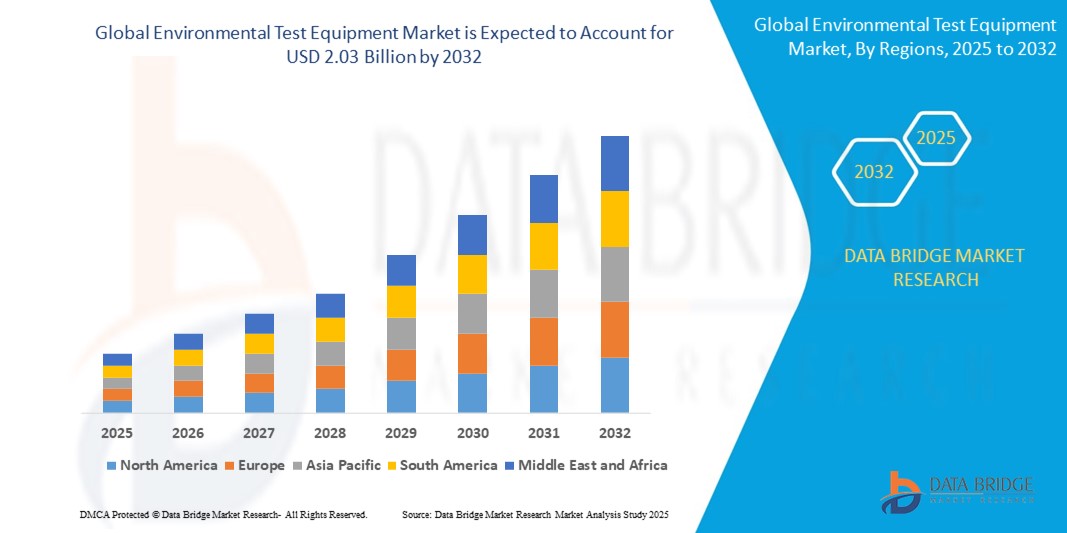
- The global environmental test equipment market size was valued at USD 1.26 billion in 2024 and is expected to reach USD 2.03 billion by 2032, at a CAGR of 6.10% during the forecast period
- This growth is driven by increasing regulatory mandates, rising public awareness regarding environmental sustainability, and the need for accurate monitoring of pollutants across air, water, and soil
- In addition, technological innovations such as portable, real-time analyzers and integration with IoT and cloud-based platforms are boosting adoption across government, industrial, and residential sectors
What are the Major Takeaways of Environmental Test Equipment Market?
- Environmental Test Equipment plays a critical role in ensuring compliance with environmental standards by enabling precise detection of chemical, physical, and biological contaminants in diverse media
- The rising incidence of water and air pollution, stricter global environmental regulations, and a growing emphasis on climate action are key drivers accelerating market demand across both developed and emerging economies
- Increased deployment of smart, mobile testing platforms, especially in field-based and real-time applications, is transforming the landscape of environmental monitoring and making advanced testing tools more accessible
- North America held the largest revenue share of 43.65% in the environmental test equipment market in 2024, attributed to its stringent environmental regulations, growing awareness of climate issues, and strong presence of leading testing equipment manufacturers
- Asia-Pacific environmental test equipment market is forecasted to grow at the fastest CAGR of 14.23% from 2025 to 2032, driven by increasing industrialization, regulatory enforcement, and rising environmental awareness
- The Water Quality Test segment dominated the market with the largest revenue share of 41.7% in 2024, driven by increasing contamination incidents and the growing demand for clean water across industrial and municipal settings
Report Scope and Environmental Test Equipment Market Segmentation
|
Attributes |
Environmental Test Equipment Key Market Insights |
|
Segments Covered |
|
|
Countries Covered |
North America
Europe
Asia-Pacific
Middle East and Africa
South America
|
|
Key Market Players |
|
|
Market Opportunities |
|
|
Value Added Data Infosets |
In addition to the insights on market scenarios such as market value, growth rate, segmentation, geographical coverage, and major players, the market reports curated by the Data Bridge Market Research also include in-depth expert analysis, pricing analysis, brand share analysis, consumer survey, demography analysis, supply chain analysis, value chain analysis, raw material/consumables overview, vendor selection criteria, PESTLE Analysis, Porter Analysis, and regulatory framework. |
What is the Key Trend in the Environmental Test Equipment Market?
“Integration of AI and IoT for Real-Time Monitoring and Predictive Analysis”
- A major trend shaping the environmental test equipment market is the integration of Artificial Intelligence (AI) and Internet of Things (IoT) technologies, enabling real-time monitoring, data analytics, and predictive maintenance across environmental testing platforms
- These smart solutions allow devices to automatically collect, transmit, and analyze environmental data such as pollutant levels or temperature fluctuations without manual intervention. For instance, portable IoT-enabled air quality monitors can send real-time pollution alerts to mobile apps or central control systems
- AI-enhanced environmental testing tools can detect anomalies, forecast contamination events, and optimize testing schedules. This improves both the accuracy and responsiveness of monitoring systems in sectors such as water treatment, agriculture, and industrial emissions management
- The growing use of cloud-connected instruments allows government bodies and industries to centralize environmental data collection and reporting, ensuring timely compliance with regulations. For instance, AI-powered platforms can automate data logging and flag non-compliance in real time, reducing human error and operational delays
- Companies such as Thermo Fisher Scientific and Horiba Ltd. are investing in intelligent, integrated testing instruments that connect to broader data management ecosystems, supporting proactive decision-making and sustainable environmental practices
- This trend is revolutionizing how environmental testing is conducted making it faster, smarter, and more scalable and is expected to continue driving innovation and competitiveness across the global market
What are the Key Drivers of Environmental Test Equipment Market?
- Growing concerns about climate change, pollution, and ecosystem degradation are major drivers increasing demand for precise and scalable Environmental Test Equipment across air, water, and soil applications
- For instance, in February 2024, Shimadzu Corporation launched a next-generation portable spectrometer for field-based water testing, enabling quick detection of heavy metals and chemical pollutants in compliance with evolving government mandates
- The rising enforcement of environmental regulations by agencies such as the U.S. EPA, European Environment Agency (EEA), and local governments is compelling industries and municipalities to adopt robust testing instruments to ensure compliance
- In addition, the rapid expansion of industrialization and urbanization, especially in developing countries, is leading to increased emissions and waste generation driving the need for constant environmental quality assessments
- The shift toward sustainable industrial practices, coupled with the growth of environmental consulting and testing services, is also creating significant opportunities for market expansion, particularly for advanced, real-time analyzers and sensors
Which Factor is challenging the Growth of the Environmental Test Equipment Market?
- A significant challenge facing the environmental test equipment market is the high initial cost and complexity of advanced testing instruments, which may deter adoption, especially among small-scale users or institutions in emerging economies
- Many high-end instruments—such as mass spectrometers or molecular analyzers—require specialized training, regular calibration, and costly maintenance, which can strain operational budgets for smaller facilities
- For instance, despite their superior performance, high-precision chromatography systems are often underutilized in rural or low-income areas due to cost and infrastructure limitations
- In addition, ensuring data accuracy and consistency across multiple platforms, especially in remote or portable applications, poses a challenge. Equipment malfunctions or miscalibrations in field environments can lead to false readings or regulatory violations
- Another barrier is the fragmented regulatory landscape across regions, which can complicate product development and standardization for global manufacturers
- To overcome these challenges, companies are increasingly investing in affordable, user-friendly, and rugged equipment with simplified interfaces and minimal calibration needs, as well as offering training programs and cloud-based data tools to broaden user accessibility and reliability
How is the Environmental Test Equipment Market Segmented?
The market is segmented on the basis of application, end user, product, and platform.
• By Application
On the basis of application, the environmental testing equipment market is segmented into Air Quality Test, Soil Quality Test, and Water Quality. The Water Quality Test segment dominated the market with the largest revenue share of 41.7% in 2024, driven by increasing contamination incidents and the growing demand for clean water across industrial and municipal settings. Regulatory mandates and public health concerns are accelerating the deployment of water testing solutions globally.
The Air Quality Test segment is projected to witness the fastest CAGR from 2025 to 2032, as urbanization, climate change, and industrialization continue to elevate the need for ambient and indoor air quality monitoring across residential and commercial sectors.
• By End User
On the basis of end user, the environmental testing equipment market is segmented into Government Agencies and Municipal Authorities, Environmental Test Laboratories, Industrial Facilities, Commercial & Residential Facilities, and Others. The Government Agencies and Municipal Authorities segment held the highest market share of 34.2% in 2024, backed by stringent environmental regulations, national safety mandates, and public infrastructure investments. These organizations heavily invest in monitoring systems to ensure compliance with environmental standards.
The Industrial Facilities segment is anticipated to grow at the fastest CAGR through 2032, driven by increasing accountability for emissions, waste discharge, and workplace environmental monitoring, particularly in manufacturing, mining, and chemical sectors.
• By Product
On the basis of product, the environmental testing equipment market is segmented into Mass Spectrometers, Chromatography Products, Molecular Spectroscopy Instruments, pH meters, Dissolved Oxygen Analyzers, Conductivity Sensors, Turbidity Meters, and Other Products. The Chromatography Products segment led the market with the largest revenue share of 29.5% in 2024, due to their high precision and broad applicability in detecting chemical and biological contaminants across water, air, and soil samples.
The Mass Spectrometers segment is expected to register the fastest CAGR from 2025 to 2032, propelled by advancements in miniaturization, accuracy, and the expanding demand for real-time testing capabilities in both laboratory and field settings.
• By Platform
On the basis of platform, the environmental testing equipment market is segmented into Conventional/Benchtop Platforms, Portable/Mobile Platforms, and Handheld Platforms. The Conventional/Benchtop Platforms segment held the dominant market share of 46.8% in 2024, due to their widespread use in laboratories for high-throughput and detailed analysis. These platforms remain the gold standard for comprehensive testing in regulated environments.
The Handheld Platforms segment is projected to exhibit the fastest growth through 2032, driven by the demand for on-site, real-time testing in remote or critical applications such as disaster zones, industrial spills, and agricultural land assessment.
Which Region Holds the Largest Share of the Environmental Test Equipment Maret?
- North America held the largest revenue share of 43.65% in the environmental test equipment market in 2024, attributed to its stringent environmental regulations, growing awareness of climate issues, and strong presence of leading testing equipment manufacturers
- The region is witnessing heightened demand for air, water, and soil quality monitoring, driven by public health concerns, regulatory mandates, and increasing industrial emissions
- Technological innovation, high R&D investments, and government-funded environmental monitoring programs are supporting the market’s dominance, especially in sectors such as agriculture, utilities, and urban infrastructure
U.S. Environmental Test Equipment Market Insight
U.S. dominated North America’s environmental test equipment revenue share in 2024, owing to federal and state environmental initiatives such as the Clean Air Act and Safe Drinking Water Act. Growing concerns over industrial pollution and drinking water safety are fueling the demand for advanced analyzers and portable monitoring systems. Furthermore, increased adoption of IoT-enabled environmental monitoring in sectors such as oil & gas, energy, and manufacturing is significantly contributing to market expansion.
Europe Environmental Test Equipment Market Insight
Europe environmental test equipment market is projected to register strong growth, driven by EU-wide climate policies, emission targets, and sustainability mandates. Countries such as Germany France, and the U.K. are investing in environmental research and monitoring infrastructure to support net-zero goals. The region is also experiencing growing demand for mobile and smart testing devices, as industries seek compliance with the REACH and Water Framework Directive standards.
U.K. Environmental Test Equipment Market Insight
The U.K. environmental test equipment market is expected to grow at a notable CAGR, supported by rising efforts to monitor urban air and water quality amid concerns over environmental health. Initiatives to reduce carbon emissions and improve environmental reporting in public infrastructure are increasing the deployment of advanced test equipment. Public and private sector collaboration is also fueling investment in environmental consulting and testing laboratories, supporting the industry’s growth.
Germany Environmental Test Equipment Market Insight
Germany is anticipated to witness robust growth due to its strong environmental legislation, focus on green technologies, and commitment to industrial sustainability. The country’s leadership in engineering and precision instruments also fosters innovation in high-performance environmental testing tools. Integration of AI and cloud platforms in environmental analytics is a growing trend, aligning with Germany’s digital transformation and climate-neutral goals.
Which Region is the Fastest Growing in the Environmental Test Equipment Market?
Asia-Pacific environmental test equipment market is forecasted to grow at the fastest CAGR of 14.23% from 2025 to 2032, driven by increasing industrialization, regulatory enforcement, and rising environmental awareness. Countries such as China, Japan, and India are investing heavily in pollution monitoring, environmental safety programs, and infrastructure upgrades that incorporate environmental sensors. APAC's status as a manufacturing hub is also reducing equipment costs and enhancing availability, accelerating regional adoption across municipal and industrial sectors.
Japan Environmental Test Equipment Market Insight
Japan market is advancing due to its commitment to sustainability, innovation in smart infrastructure, and focus on public safety. The country’s environmental testing demand is rising in the context of natural disaster preparedness, waste management, and urban air quality monitoring. Japan’s aging population and its focus on tech-enabled environmental management are contributing to increased adoption of compact and user-friendly monitoring systems.
China Environmental Test Equipment Market Insight
China dominated the Asia-Pacific market share in 2024, fueled by its aggressive environmental reform policies, rapid urban expansion, and dominance in smart device manufacturing. Government programs such as the Blue Sky Protection Campaign are catalyzing the adoption of advanced air and water quality analyzers. Domestic firms and growing exports of low-cost, IoT-integrated testing devices are helping China expand its footprint both regionally and globally.
Which are the Top Companies in Environmental Test Equipment Market?
The environmental test equipment industry is primarily led by well-established companies, including:
- ALPHA ANALYTICAL, Inc. (U.S.)
- ALS (Australia)
- American Environmental Testing Laboratory, LLC (U.S.)
- Bureau Veritas (France)
- Eurofins Scientific (Luxembourg)
- Intertek Group plc (U.K.)
- AsureQuality (New Zealand)
- EMSL Analytical, Inc. (U.S.)
- Mérieux NutriSciences Corporation (U.S.)
- SGS Société Générale de Surveillance SA (Switzerland)
- Hill Laboratories Company (New Zealand)
- Analabs Inc. (U.S.)
- Microbac Laboratories, Inc. (U.S.)
- TÜV SÜD (Germany)
- Premier Analytical Services (U.K.)
- AES Laboratories Pvt. Ltd. (India)
What are the Recent Developments in Global Environmental Test Equipment Market?
- In September 2022, ALS Corporation acquired HRL Holdings, a prominent provider of sampling, laboratory testing, and data management services within the food, environmental, and occupational hygiene sectors. The expansion is particularly relevant to the global environmental testing market, as it strengthens ALS’s ability to meet increasing demand for advanced environmental testing solutions, driven by stricter regulations and growing sustainability concerns worldwide
- In July 2022, Eurofins announced its acquisition of WESSLING, a prominent laboratory specializing in environmental, food, and BioPharma product testing in Hungary. This strategic acquisition will further strengthen Eurofins' established presence in Hungary, where it already operates five laboratories focused on food, feed, environmental, agricultural, and veterinary testing. This move is particularly significant within the context of the rapidly growing global Environmental Testing Market, where increased demand for comprehensive environmental analysis is driving expansion across key regions
- In May 2022, SGS, a leading provider of sea monitoring and oceanography testing services, acquired Ecotecnos. This acquisition is in line with SGS’s strategic objectives to expand its industrial and environmental services in Chile, reinforcing the company's presence in the southern region and bolstering its capabilities in marine ecosystem governance. This acquisition expanding global environmental testing market as environmental regulations become increasingly stringent and the demand for marine and ecological testing rises, SGS's strengthened position in Chile allows the company to cater to the growing need for advanced environmental solutions
- In September 2021, Intertek announced its partnership with a Scottish Isles telecommunications company to facilitate the necessary permits, consents, and environmental support documentation for the installation of submarine fiber optic cables connecting the Shetland, Orkney, and Inner Hebrides islands. This collaboration increasing focus on ensuring environmental compliance in infrastructure projects. By providing essential environmental support for this submarine cable installation, Intertek contributes to the advancement of critical telecommunications infrastructure and reinforces its role in delivering comprehensive environmental testing solutions that ensure sustainable development and regulatory adherence in complex projects worldwide
- In June 2021, Bureau Veritas, in collaboration with the Foundation de la Mer and the French Ministry of the Sea, launched the "Ocean Approved" program. This initiative enables Bureau Veritas to certify companies that demonstrate a commitment to understanding and mitigating their impact on the ocean, thereby enhancing the credibility and reputation of their services through government-supported initiatives. This program underscores the increasing emphasis on environmental accountability, particularly in the context of marine ecosystems

- Interactive Data Analysis Dashboard
- Company Analysis Dashboard for high growth potential opportunities
- Research Analyst Access for customization & queries
- Competitor Analysis with Interactive dashboard
- Latest News, Updates & Trend analysis
- Harness the Power of Benchmark Analysis for Comprehensive Competitor Tracking
Global Environmental Test Equipment Market, Supply Chain Analysis and Ecosystem Framework
To support market growth and help clients navigate the impact of geopolitical shifts, DBMR has integrated in-depth supply chain analysis into its Global Environmental Test Equipment Market research reports. This addition empowers clients to respond effectively to global changes affecting their industries. The supply chain analysis section includes detailed insights such as Global Environmental Test Equipment Market consumption and production by country, price trend analysis, the impact of tariffs and geopolitical developments, and import and export trends by country and HSN code. It also highlights major suppliers with data on production capacity and company profiles, as well as key importers and exporters. In addition to research, DBMR offers specialized supply chain consulting services backed by over a decade of experience, providing solutions like supplier discovery, supplier risk assessment, price trend analysis, impact evaluation of inflation and trade route changes, and comprehensive market trend analysis.
Data collection and base year analysis are done using data collection modules with large sample sizes. The stage includes obtaining market information or related data through various sources and strategies. It includes examining and planning all the data acquired from the past in advance. It likewise envelops the examination of information inconsistencies seen across different information sources. The market data is analysed and estimated using market statistical and coherent models. Also, market share analysis and key trend analysis are the major success factors in the market report. To know more, please request an analyst call or drop down your inquiry.
The key research methodology used by DBMR research team is data triangulation which involves data mining, analysis of the impact of data variables on the market and primary (industry expert) validation. Data models include Vendor Positioning Grid, Market Time Line Analysis, Market Overview and Guide, Company Positioning Grid, Patent Analysis, Pricing Analysis, Company Market Share Analysis, Standards of Measurement, Global versus Regional and Vendor Share Analysis. To know more about the research methodology, drop in an inquiry to speak to our industry experts.
Data Bridge Market Research is a leader in advanced formative research. We take pride in servicing our existing and new customers with data and analysis that match and suits their goal. The report can be customized to include price trend analysis of target brands understanding the market for additional countries (ask for the list of countries), clinical trial results data, literature review, refurbished market and product base analysis. Market analysis of target competitors can be analyzed from technology-based analysis to market portfolio strategies. We can add as many competitors that you require data about in the format and data style you are looking for. Our team of analysts can also provide you data in crude raw excel files pivot tables (Fact book) or can assist you in creating presentations from the data sets available in the report.













