


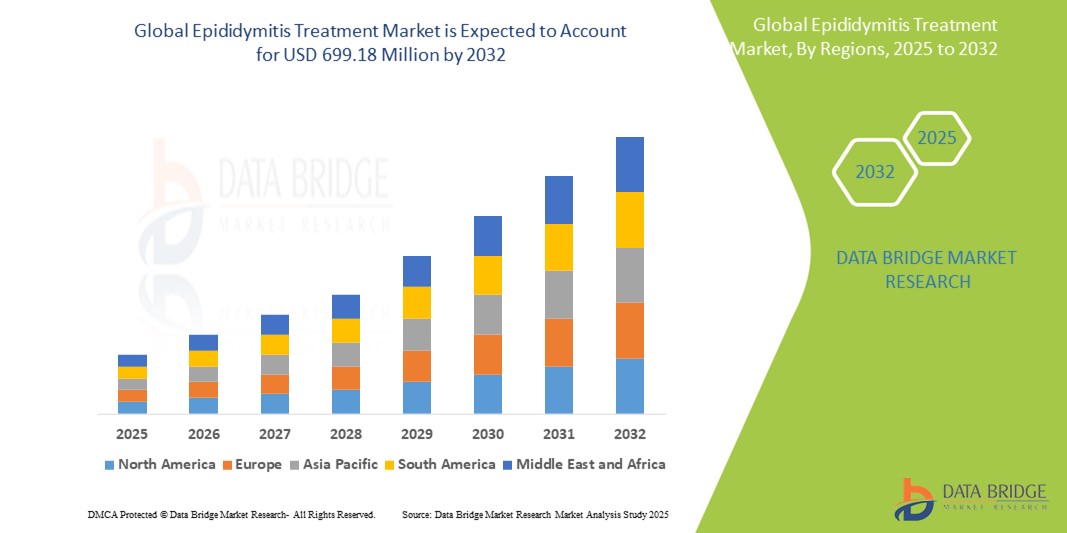
Epididymitis Treatment Market Size
- The global epididymitis treatment market size was valued at USD 427.26 million in 2024 and is expected to reach USD 699.18 million by 2032, at a CAGR of 6.35% during the forecast period
- The market growth is largely fueled by the rising prevalence of urinary tract infections (UTIs) and sexually transmitted infections (STIs), which are key contributing factors to epididymitis, particularly among sexually active males and older adults. This increasing disease burden is driving demand for effective and targeted treatment solutions globally
- Furthermore, growing awareness among patients and healthcare professionals about early diagnosis and timely intervention, along with the availability of advanced antibiotic therapies and supportive care options, is supporting market expansion. These converging factors are accelerating the uptake of Epididymitis Treatment solutions, thereby significantly boosting the industry's growth
Epididymitis Treatment Market Analysis
- The epididymitis treatment market is witnessing steady growth, primarily driven by the rising incidence of urinary tract infections (UTIs) and sexually transmitted infections (STIs), which are leading causes of epididymitis
- Increasing awareness of male reproductive health, along with improvements in diagnostic capabilities and early disease detection, are major contributors to market expansion. The availability of broad-spectrum antibiotics, supportive therapies such as analgesics, and anti-inflammatory medications further fuels treatment uptake
- North America dominates the epididymitis treatment market with the largest revenue share of 39.2% in 2024, attributed to well-established healthcare infrastructure, increased awareness of urogenital disorders, and the presence of key pharmaceutical players
- Asia-Pacific is expected to be the fastest-growing region in the epididymitis treatment market, with a CAGR of 6.8% from 2025 to 2032, fueled by urbanization, growing healthcare expenditure, and rising incidences of reproductive tract infections
- Antibiotics segment dominates the epididymitis treatment market with a market share of 56.4% in 2024, as antibiotics are the frontline treatment for both acute and chronic forms of epididymitis. Fluoroquinolones and cephalosporins are among the most commonly prescribed medications
Report Scope and Epididymitis Treatment Market Segmentation
|
Attributes |
Epididymitis Treatment Key Market Insights |
|
Segments Covered |
|
|
Countries Covered |
North America
Europe
Asia-Pacific
Middle East and Africa
South America
|
|
Key Market Players |
|
|
Market Opportunities |
|
|
Value Added Data Infosets |
In addition to the insights on market scenarios such as market value, growth rate, segmentation, geographical coverage, and major players, the market reports curated by the Data Bridge Market Research also include in-depth expert analysis, pricing analysis, brand share analysis, consumer survey, demography analysis, supply chain analysis, value chain analysis, raw material/consumables overview, vendor selection criteria, PESTLE Analysis, Porter Analysis, and regulatory framework. |
Epididymitis Treatment Market Trends
“Enhanced Convenience Through Voice Integration and Digital Health Tools”
- A significant and accelerating trend in the global epididymitis treatment market is the integration of personalized medicine, voice-controlled systems, and digital health platforms to improve diagnosis accuracy, treatment adherence, and overall patient experience. These advancements are enabling more tailored therapies and streamlined care pathways
- For instance, the adoption of voice-assisted telehealth platforms and symptom checkers is improving early detection of epididymitis symptoms by guiding patients to appropriate care more efficiently. These tools provide interactive health guidance based on symptom patterns and medical history
- Telemedicine adoption is playing a key role, especially in rural and underserved areas, by providing remote access to urologists and real-time consultations. This ensures quicker intervention for patients experiencing scrotal pain, swelling, or urinary discomfort
- Digital health applications are being widely used to support treatment adherence. These include features such as medication reminders, virtual symptom tracking, and interactive patient education, which help patients stay informed and compliant throughout the treatment duration
- In diagnostics, smart imaging systems and software are improving the accuracy and speed of ultrasound interpretations for epididymitis, aiding in faster decision-making in emergency and outpatient settings
- This trend toward intelligent, connected, and patient-centric healthcare is reshaping how providers and patients manage urological conditions. Health systems and pharmaceutical firms are increasingly investing in digital-first interventions to improve outcomes and reduce healthcare costs
- As patients continue to seek convenient, accessible, and personalized care, the demand for digitally enabled and voice-integrated treatment pathways is expected to expand significantly across both developed and emerging markets
Epididymitis Treatment Market Dynamics
Driver
“Rising Prevalence of Urinary Tract Infections and Improved Access to Urological Care”
- The increasing incidence of urinary tract infections (UTIs), particularly among sexually active men and individuals with underlying health conditions, is a major driver fueling the demand for effective Epididymitis Treatment globally. Epididymitis is often a complication arising from untreated UTIs or sexually transmitted infections (STIs), making it a growing concern across both developed and developing nations
- The global healthcare community is recognizing the need for timely diagnosis and treatment, and as awareness around male reproductive health improves, more patients are seeking medical attention at earlier stages. This growing awareness is driving the demand for antibiotics, pain management therapies, and supportive care specifically for epididymitis
- For instance, the expansion of urology departments and outpatient clinics in Asia-Pacific and Latin America is improving access to targeted treatments. Simultaneously, advancements in diagnostic tools such as scrotal ultrasound and urine culture testing are enabling faster, more accurate diagnosis
- In addition, pharmaceutical companies are investing in combination antibiotic therapies and anti-inflammatory agents that offer quicker symptom relief with fewer side effects. The increasing use of digital health platforms and teleconsultations also facilitates access to care, particularly in rural or remote areas where urologists are less accessible
- These combined trends—rising incidence, earlier diagnosis, and improved accessibility—are boosting the global Epididymitis Treatment market, particularly in emerging economies where healthcare infrastructure is rapidly evolving
Restraint/Challenge
“Antibiotic Resistance and Misdiagnosis Risk”
- One of the key challenges facing the epididymitis treatment market is the growing threat of antibiotic resistance, especially due to the overuse or misuse of antibiotics in treating urogenital infections. Since most cases of epididymitis are initially treated with broad-spectrum antibiotics, inappropriate prescriptions can lead to drug-resistant bacterial strains, making future treatment more difficult
- For instances, a 2023 study published in the Journal of Urology found that over 20% of patients treated for epididymitis in emergency settings had been given inappropriate or unnecessary antibiotics, highlighting the lack of standardized treatment protocols in some healthcare systems
- Another significant restraint is the potential for misdiagnosis, particularly in primary care or emergency departments where similar symptoms—such as testicular torsion or hernia—can complicate accurate identification. Delays in correct diagnosis may result in inadequate treatment and, in severe cases, lead to chronic pain, infertility, or abscess formation
- Furthermore, lack of awareness among patients, particularly in low- and middle-income countries, can delay care-seeking behavior. Cultural stigmas around male reproductive health also contribute to underreporting and delayed diagnosis
Epididymitis Treatment Market Scope
The market is segmented on the basis of type, mechanism of action, drugs, diagnosis , treatment, route of administration, distribution channel and end user.
• By Types
On the basis of types, the Epididymitis treatment market is segmented into acute and chronic. The acute segment dominates the largest market revenue share of 58.3% in 2024, primarily due to the high incidence of bacterial infections and the rapid onset of symptoms requiring immediate medical attention. Patients often present with pain, swelling, and discomfort, prompting urgent care visits and antibiotic prescriptions.
The chronic segment is anticipated to witness the fastest growth rate of 15.6% from 2025 to 2032, driven by increasing awareness and improved diagnosis of long-standing or recurrent epididymal inflammation. Lifestyle changes, underlying comorbidities, and delayed treatment of acute infections contribute to rising cases of chronic epididymitis.
• By Mechanism of Action
Based on mechanism of action, the market is segmented into antibiotics, analgesics, NSAIDs, and others. The antibiotics segment held the largest market revenue share of 56.4% in 2024, owing to their primary role in eliminating bacterial infections, which are the most common cause of epididymitis.
The NSAIDs segment is expected to witness the fastest CAGR of 13.4% from 2025 to 2032, as they are frequently used for managing inflammation and pain alongside antibiotic therapy, offering symptom relief and enhancing patient compliance.
• By Drugs
On the basis of drugs, the market is segmented into doxycycline, ciprofloxacin, codeine, piroxicam, and others. Doxycycline held the largest market share of 33.5% in 2024, being a first-line treatment, especially for sexually transmitted causes of epididymitis such as chlamydia.
Ciprofloxacin is expected to witness the fastest CAGR of 14.2% from 2025 to 2032, driven by its effectiveness against gram-negative bacteria and increasing usage in older, non-sexually transmitted cases of the disease.
• By Diagnosis
On the basis of diagnosis, the market is segmented into STI screening, urine test, blood test, and ultrasound. The urine test segment holds the largest market revenue share of 38.9% in 2024, owing to its widespread use, low cost, and effectiveness in detecting bacterial presence linked to urinary tract infections.
The ultrasound segment is projected to grow at the fastest CAGR of 12.8% from 2025 to 2032, due to its ability to accurately assess scrotal abnormalities, rule out testicular torsion, and monitor treatment progress.
• By Treatment
On the basis of treatment, the market is segmented into medication, home remedies, and surgery. The medication segment dominates the market with a share of 61.2% in 2024, supported by the effectiveness and accessibility of antibiotic and anti-inflammatory drug regimens for most patients.
Surgery is expected to register the fastest CAGR of 11.9% from 2025 to 2032, primarily in severe or recurrent cases where conventional therapies fail and epididymectomy or drainage procedures are necessary.
• By Route of Administration
This segment includes oral, intravenous, and others. The oral segment leads the market with the highest revenue share of 69.4% in 2024, driven by the convenience, cost-effectiveness, and strong patient adherence associated with oral formulations.
The intravenous segment is forecasted to grow at the fastest CAGR of 10.7% from 2025 to 2032, particularly in hospitalized patients requiring rapid drug action or when oral administration is not feasible.
• By Distribution Channel
On the basis of distribution channels, the market is segmented into hospital pharmacies, retail pharmacies, and online pharmacies. Hospital pharmacies captured the largest market share of 44.6% in 2024, owing to high patient volume and availability of a full range of treatments and diagnostics.
Online pharmacies are projected to witness the fastest CAGR of 16.3% from 2025 to 2032, supported by growing digital health trends, improved logistics, and the convenience of doorstep medication delivery.
• By End Users
The end-user segment includes hospitals, homecare, specialty clinics, and others. Hospitals dominate with a market share of 51.7% in 2024, as they offer comprehensive diagnosis, treatment, and follow-up care, making them the primary destination for acute and severe epididymitis cases.
Specialty clinics are expected to see the fastest CAGR of 12.1% from 2025 to 2032, driven by increased preference for outpatient care, shorter wait times, and focused urological services.
Epididymitis Treatment Market Regional Analysis
- North America dominates the epididymitis treatment market with a revenue share of 39.2% in 2024. This dominance is driven by rising patient numbers, a well-established healthcare infrastructure, and increasing awareness regarding urological infections
- Consumers in the region benefit from advanced diagnostic technologies and a strong presence of pharmaceutical companies offering targeted antibiotic therapies and other treatment options
- This widespread adoption is further supported by high disposable incomes and continuous investment in research and development, establishing advanced medical treatments as a favored solution for managing epididymitis
U.S. Epididymitis Treatment Market Insight
The U.S. epididymitis treatment market captured the largest revenue share within North America, reflecting the region's advanced healthcare infrastructure and high awareness of urological health conditions. While specific exact percentages for epididymitis treatment are often bundled within broader urology or infectious disease markets. The U.S. such as ly contributes the largest portion of this, estimated to be around 81% of the North American share. This is fueled by factors such as the high incidence of sexually transmitted infections (STIs) and other urogenital infections, increased patient awareness leading to earlier diagnosis, and robust access to diverse treatment options. Consumers increasingly prioritize effective and timely medical interventions. Moreover, continuous research and development into novel antimicrobial agents and treatment protocols are significantly contributing to the market's expansion.
Europe Epididymitis Treatment Market Insight
The Europe epididymitis treatment market is projected to expand at a substantial CAGR throughout the forecast period, primarily driven by the increasing prevalence of urogenital infections, strong public health initiatives for STI control, and well-developed healthcare systems. The increase in urbanization, coupled with rising healthcare expenditure and awareness, is fostering the adoption of appropriate epididymitis treatments. European consumers are also drawn to the effectiveness and accessibility of these medical solutions. The region is experiencing significant growth across various healthcare settings, with standard and advanced treatment protocols being adopted in both public and private healthcare facilities.
U.K. Epididymitis Treatment Market Insight
The U.K. epididymitis treatment market is anticipated to grow at a noteworthy CAGR during the forecast period, driven by the escalating focus on public health, a strong national healthcare system, and a desire for heightened well-being. In addition, concerns regarding the spread of STIs and other urogenital infections are encouraging individuals to seek timely diagnosis and treatment. The UK’s embrace of digital health services, alongside its robust pharmaceutical and healthcare infrastructure, is expected to continue to stimulate market growth.
Germany Epididymitis Treatment Market Insight
The Germany epididymitis treatment market is expected to expand at a considerable CAGR during the forecast period, fueled by increasing awareness of urological health and the demand for technologically advanced, high-quality medical solutions. Germany’s well-developed healthcare infrastructure, combined with its emphasis on precision medicine and patient data privacy, promotes the adoption of effective epididymitis treatments, particularly in hospital and specialty clinic settings. The integration of advanced diagnostics with tailored treatment plans is also becoming increasingly prevalent, with a strong preference for evidence-based, privacy-focused solutions aligning with local consumer and medical expectations.
Asia-Pacific Epididymitis Treatment Market Insight
The Asia-Pacific epididymitis treatment market is poised to grow at the fastest CAGR of 6.8% during the forecast period of 2025 to 2032. This growth is driven by increasing urbanization, rising disposable incomes, and significant improvements in healthcare infrastructure and access in countries such as China, Japan, and India. The region's growing inclination towards better healthcare access, supported by government initiatives promoting public health and medical advancements, is driving the adoption of effective Epididymitis treatments. Furthermore, as APAC emerges as a growing hub for pharmaceutical manufacturing and healthcare innovation, the affordability and accessibility of epididymitis treatment options are expanding to a wider consumer base.
Japan Epididymitis Treatment Market Insight
The Japan epididymitis treatment market is gaining momentum due to the country’s advanced medical culture, rapid urbanization, and demand for high-quality healthcare. The Japanese market places a significant emphasis on early diagnosis and precise treatment, and the adoption of effective epididymitis treatments is driven by the increasing awareness of urological health and access to specialized care. The integration of advanced diagnostics with other healthcare technologies is fueling growth. Moreover, Japan's aging population is also likely to spur demand for accessible and effective treatment solutions for various conditions, including epididymitis, in both residential and clinical sectors.
China Epididymitis Treatment Market Insight
The China epididymitis treatment market accounted for a substantial market revenue share in Asia Pacific in 2024, attributed to the country's expanding middle class, rapid urbanization, and high rates of healthcare infrastructure development. China stands as one of the largest markets for pharmaceutical products and medical services, and effective epididymitis treatments are becoming increasingly accessible in public and private hospitals. The push towards modern healthcare systems and the availability of affordable treatment options, alongside strong domestic pharmaceutical manufacturers, are key factors propelling the market in China.
Epididymitis Treatment Market Share
The epididymitis treatment industry is primarily led by well-established companies, including:
- Pfizer Inc. (U.S.)
- Bayer AG (Germany)
- Novartis AG (Switzerland)
- Abbott (U.S.)
- AbbVie Inc (U.S.)
- F. Hoffmann-La Roche Ltd (Switzerland)
- Lilly (U.S.)
- Johnson & Johnson Services, Inc (U.S.)
- GSK plc (U.K.)
- Merck & Co., Inc (U.S.)
- Bio-Rad Laboratories, Inc (U.S.)
- Promega Corporation (U.S.)
- Thermo Fisher Scientific Inc. (U.S.)
- Amneal Pharmaceuticals LLC (U.S.)
- Annora Pharma Pvt Limited (India)
- Takeda Pharmaceutical Company Limited (Japan)
Latest Developments in Global Epididymitis Treatment Market
- In February 2023, researchers published a study in the journal Translational Andrology and Urology, highlighting Lycopene (LYC) as a promising adjunctive treatment for epididymitis. The study revealed that LYC effectively reduces inflammation and oxidative stress by modulating the PI3K/AKT signaling pathway, enhancing antioxidant activity, and protecting against cellular apoptosis. This advancement points to a potential natural therapy that could complement conventional treatment approaches
- In February 2023, a case report in Frontiers in Public Health documented the first known instance of chronic epididymitis caused by the Lymphogranuloma Venereum (LGV) L2 strain of Chlamydia trachomatis in an HIV-negative heterosexual male. The patient responded positively to a targeted antibiotic regimen. This rare presentation highlights the need for clinicians to consider LGV in persistent epididymitis cases, even outside high-risk populations

- Interactive Data Analysis Dashboard
- Company Analysis Dashboard for high growth potential opportunities
- Research Analyst Access for customization & queries
- Competitor Analysis with Interactive dashboard
- Latest News, Updates & Trend analysis
- Harness the Power of Benchmark Analysis for Comprehensive Competitor Tracking
Data collection and base year analysis are done using data collection modules with large sample sizes. The stage includes obtaining market information or related data through various sources and strategies. It includes examining and planning all the data acquired from the past in advance. It likewise envelops the examination of information inconsistencies seen across different information sources. The market data is analysed and estimated using market statistical and coherent models. Also, market share analysis and key trend analysis are the major success factors in the market report. To know more, please request an analyst call or drop down your inquiry.
The key research methodology used by DBMR research team is data triangulation which involves data mining, analysis of the impact of data variables on the market and primary (industry expert) validation. Data models include Vendor Positioning Grid, Market Time Line Analysis, Market Overview and Guide, Company Positioning Grid, Patent Analysis, Pricing Analysis, Company Market Share Analysis, Standards of Measurement, Global versus Regional and Vendor Share Analysis. To know more about the research methodology, drop in an inquiry to speak to our industry experts.
Data Bridge Market Research is a leader in advanced formative research. We take pride in servicing our existing and new customers with data and analysis that match and suits their goal. The report can be customized to include price trend analysis of target brands understanding the market for additional countries (ask for the list of countries), clinical trial results data, literature review, refurbished market and product base analysis. Market analysis of target competitors can be analyzed from technology-based analysis to market portfolio strategies. We can add as many competitors that you require data about in the format and data style you are looking for. Our team of analysts can also provide you data in crude raw excel files pivot tables (Fact book) or can assist you in creating presentations from the data sets available in the report.












