


Epilepsy Treatment Market Size
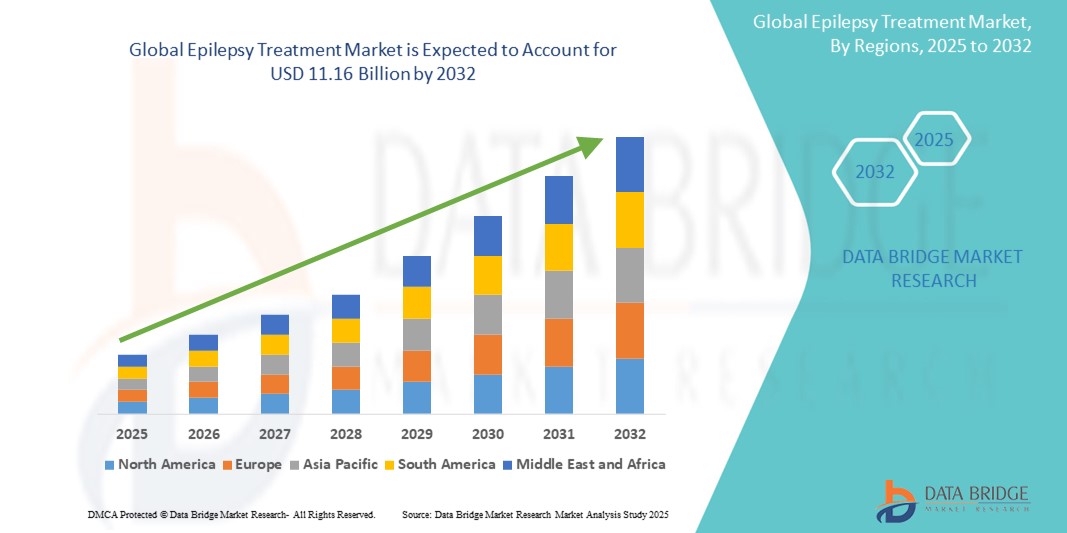
- The global epilepsy treatment market size was valued at USD 6.90 billion in 2024 and is expected to reach USD 11.16 billion by 2032, at a CAGR of 6.20% during the forecast period
- The market growth is largely fuelled by the increasing prevalence of epilepsy, rising awareness about neurological disorders, and continuous advancements in antiepileptic drug development
- The introduction of novel treatment approaches, including neurostimulation devices and personalized medicine, is further expanding therapeutic options and driving market innovation
Epilepsy Treatment Market Analysis
- The epilepsy treatment market is evolving with increased research and development activities that are leading to more effective and targeted therapies for different seizure types
- Pharmaceutical companies are investing in innovative drug formulations and delivery methods that improve patient compliance and reduce side effects
- North America dominates the epilepsy treatment market with the largest revenue share of 37.9%. This is driven by high awareness levels, easy accessibility to advanced treatments, robust healthcare infrastructure, and significant investments in research and development by pharmaceutical companies in the region
- Asia-Pacific is expected to be the fastest growing region in the epilepsy treatment market during the forecast period due to rising epilepsy prevalence, improving healthcare infrastructure, and increasing disposable incomes in key countries such as China and India. This growth is further propelled by growing awareness campaigns and supportive government initiatives for chronic disease management in the region
- The epilepsy drug resistant/intractable epilepsy segment holds the largest market revenue share due to the persistent challenge of managing uncontrolled seizures despite the use of multiple medications. These cases often require alternative treatment approaches such as vagus nerve stimulation, deep brain stimulation, or resective surgery. The high clinical need and lack of effective solutions continue to drive substantial investment in advanced therapies. As a result, this sub-segment attracts significant research attention and healthcare resources. The complexity of treatment also leads to higher healthcare spending, reinforcing its dominant market position.
Report Scope and Epilepsy Treatment Market Segmentation
|
Attributes |
Epilepsy Treatment Key Market Insights |
|
Segments Covered |
|
|
Countries Covered |
North America
Europe
Asia-Pacific
Middle East and Africa
South America
|
|
Key Market Players |
|
|
Market Opportunities |
|
|
Value Added Data Infosets |
In addition to the insights on market scenarios such as market value, growth rate, segmentation, geographical coverage, and major players, the market reports curated by the Data Bridge Market Research also include depth expert analysis, patient epidemiology, pipeline analysis, pricing analysis, and regulatory framework. |
Epilepsy Treatment Market Trends
“Rise of Personalized Medicine in Epilepsy Treatment”
- The epilepsy treatment market is increasingly embracing personalized medicine by tailoring therapies based on individual genetic makeup and seizure characteristics
- Genetic testing is now used to predict patient response to medications such as sodium channel blockers, helping reduce side effects and improve treatment efficiency
- Diagnostic tools such as neuroimaging and biomarkers are enhancing treatment precision by identifying specific seizure origins and underlying neurological variations
- For instance, patients with SCN1A gene mutations can benefit more from adjusted doses or alternative medications rather than standard drug protocols
- For instance, the deployment of responsive neurostimulation systems that detect seizure activity in real time and deliver targeted electrical pulses, especially in cases resistant to conventional therapies
- For instance, patients with SCN1A gene mutations can benefit more from adjusted doses or alternative medications rather than standard drug protocols
Epilepsy Treatment Market Dynamics
Driver
“Advancements in Diagnostic and Treatment Technologies”
- Technological advancements in diagnostic tools such as high-resolution MRI, PET, and EEG have enhanced the accuracy and speed of identifying seizure types and brain activity
- Personalized treatment approaches are gaining traction with the help of pharmacogenomics, allowing medications to be tailored to an individual's genetic profile, improving effectiveness and reducing side effects
- Neuromodulation techniques such as vagus nerve stimulation, responsive neurostimulation, and deep brain stimulation offer new hope for patients with drug-resistant epilepsy
- For instance, the FDA-approved RNS System helps manage focal seizures by detecting abnormal activity and delivering targeted electrical stimulation
- Telemedicine has expanded access to specialized epilepsy care, particularly in rural and underserved areas, bridging gaps in treatment availability
- These innovations are improving patient outcomes, boosting confidence in early diagnosis, and accelerating the growth of the epilepsy treatment market
- For instance, increased access to diagnostic imaging in community hospitals has enabled earlier detection and intervention in newly diagnosed patients
Restraint/Challenge
“High Cost of Treatment and Limited Access in Low-Income Regions”
- The high cost of epilepsy treatment, including anti-seizure medications and neuromodulation devices, creates a major financial barrier for many patients
- Advanced technologies such as vagus nerve stimulation and responsive neurostimulation involve expensive procedures and ongoing maintenance that are often not fully covered by insurance
- For instance, the cost of implanting a responsive neurostimulation device can be unaffordable for patients without strong insurance coverage
- In many low- and middle-income countries, limited access to neurologists, diagnostic tools, and a consistent drug supply results in underdiagnosis and poor treatment adherence
- For instance, large populations in sub-Saharan Africa and parts of South Asia remain untreated due to lack of infrastructure and trained specialists
- Social stigma surrounding epilepsy discourages many individuals from seeking diagnosis or long-term care, especially in conservative or rural communities
- Despite global initiatives aimed at improving access, the absence of widespread subsidies and infrastructure expansion continues to restrict equitable epilepsy care worldwide
Epilepsy Treatment Market Scope
The market is segmented on the basis of condition, drug, distribution channel, and end users.
- By Condition
On the basis of condition, the epilepsy treatment market is segmented into epilepsy drug resistant/intractable epilepsy and others. The epilepsy drug resistant/intractable epilepsy segment holds the largest market revenue share due to the persistent challenge of managing uncontrolled seizures despite the use of multiple medications. These cases often require alternative treatment approaches such as vagus nerve stimulation, deep brain stimulation, or resective surgery. The high clinical need and lack of effective solutions continue to drive substantial investment in advanced therapies. As a result, this sub-segment attracts significant research attention and healthcare resources. The complexity of treatment also leads to higher healthcare spending, reinforcing its dominant market position.
The others segment is anticipated to witness the fastest growth, supported by increased awareness and evolving diagnostic capabilities that help identify less common and emerging epilepsy syndromes. These include conditions with atypical symptoms or mild seizure activity that may have previously gone undetected. Advances in imaging and genetic testing are enabling earlier and more accurate diagnosis. Public health campaigns and improved healthcare access are also contributing to proactive management. As more cases are identified and treated from the outset, the segment continues to expand rapidly.
- By Drug
On the basis of drug, the epilepsy treatment market is segmented into first-generation, second-generation, and third-generation. The second-generation drug segment holds the largest market revenue share due to its improved side effect profiles, broader spectrum of action, and better tolerability compared to first-generation drugs. These medications are widely prescribed across various types of epilepsy and often serve as first-line treatments because of their proven efficacy and safety. Their acceptance by healthcare providers and patients such as reinforces their dominant position in the market.
The third-generation drug segment is expected to witness the fastest growth, driven by ongoing research and development that produces novel compounds with enhanced efficacy and fewer side effects. These newer drugs provide more targeted mechanisms of action, addressing unmet needs in drug-resistant epilepsy. In addition, they offer personalized treatment options, which are increasingly important in improving patient outcomes and expanding therapeutic possibilities.
- By Distribution Channel
On the basis of distribution channel, the epilepsy treatment market is segmented into hospitals, clinics, retail pharmacies, and online pharmacies. The retail pharmacies segment holds the largest market revenue share, primarily due to their widespread accessibility and convenience for patients managing ongoing epilepsy treatments. Their extensive network allows easy prescription fulfilment for chronic conditions, making them the preferred choice for many patients seeking reliable medication access.
The online pharmacies segment is expected to witness the fastest growth, driven by the rising popularity of e-commerce and the convenience of home delivery services. Digital prescription management and discreet purchasing options make online pharmacies especially attractive to patients with chronic conditions such as epilepsy. Competitive pricing and expanding internet access further support this segment’s rapid expansion in the market.
- By End Users
On the basis of end users, the epilepsy treatment market is segmented into hospitals, clinics, ambulatory surgical centres, and diagnostic centres. The hospitals segment accounted for the largest market revenue share, driven by their role in acute seizure management, diagnostic procedures such as EEG and MRI, and specialized epilepsy monitoring units. Hospitals provide comprehensive care, including initial diagnosis, surgical evaluations, and complex medication management for epilepsy patients.
The clinics segment is expected to witness the fastest CAGR, fuelled by the increasing number of neurology and epilepsy specialty clinics offering outpatient care, follow-up consultations, and medication management. The shift towards more localized and accessible care for chronic conditions supports the rapid expansion of clinic-based epilepsy management.
Epilepsy Treatment Market Regional Analysis
- North America dominates the global epilepsy treatment market, holding a significant revenue share of 37.9%, is primarily driven by the high prevalence of epilepsy, advanced healthcare infrastructure, and favourable reimbursement policies for epilepsy medications and therapies
- The presence of key pharmaceutical companies and extensive research and development activities also contribute to the region's market leadership
- Growing awareness about epilepsy and increasing government initiatives to improve diagnosis and treatment access further strengthen North America's position as a leader in the global epilepsy treatment market
U.S. Epilepsy Treatment Market Insight
The U.S. epilepsy treatment market captured the largest revenue share within North America, fuelled by a high incidence of epilepsy cases, robust healthcare spending, and increasing adoption of novel anti-epileptic drugs. The strong focus on patient awareness programs and continuous advancements in diagnostic techniques further propel market growth.
Europe Epilepsy Treatment Market Insight
The Europe epilepsy treatment market is expected to grow at a substantial growth rate throughout the forecast period, primarily driven by increasing awareness of epilepsy, improving diagnostic capabilities, and growing healthcare expenditure. The region's aging population, which is more susceptible to epilepsy, also contributes to market growth.
U.K. Epilepsy Treatment Market Insight
The U.K. epilepsy treatment market is expected to grow at a substantial growth rate during the forecast period, driven by rising epilepsy prevalence, increasing healthcare investments, and a growing emphasis on personalized medicine approaches. The availability of advanced treatment options and government initiatives to improve epilepsy care further support market expansion.
Germany Epilepsy Treatment Market Insight
The German epilepsy treatment market is expected to grow at a substantial growth rate during the forecast period, fuelled by a strong healthcare system, high diagnostic rates, and robust research and development activities. The increasing adoption of advanced anti-epileptic drugs and the emphasis on patient education contribute to market growth.
Asia-Pacific Epilepsy Treatment Market Insight
The Asia-Pacific epilepsy treatment market is expected to grow at a substantial growth rate, driven by the large patient pool, improving healthcare infrastructure, and rising awareness of epilepsy in emerging economies such as China and India. Increasing disposable incomes and growing government support for chronic disease management also contribute to rapid market expansion.
Japan Epilepsy Treatment Market Insight
The Japan epilepsy treatment market is expected to grow at a substantial growth rate due to its advanced healthcare system, high diagnostic rates, and a focus on research and development of new therapeutic agents. The increasing aging population and a growing awareness of epilepsy management further drive market growth.
China Epilepsy Treatment Market Insight
The China epilepsy treatment market is expected to grow at a substantial growth rate in Asia Pacific, attributed to its vast population, increasing diagnosis rates, and rapid development of its healthcare infrastructure. The growing investment in medical facilities and a rising awareness of epilepsy treatment options are key factors propelling the market in China.
Epilepsy Treatment Market Share
The epilepsy treatment industry is primarily led by well-established companies, including:
- Pfizer Inc. (U.S.)
- Novartis AG (Germany)
- Abbott (U.S.)
- Neurelis Inc. (U.S.)
- GSK plc (U.K.)
- Johnson & Johnson Services Inc. (U.S.)
- Teva Pharmaceutical Industries Ltd. (U.S.)
- Sumitomo Dainippon Pharma Co. Ltd (Japan)
- Bausch Health Companies Inc. (Canada)
- Sanofi (France)
- Takeda Pharmaceutical Company Limited (Japan)
- UCB S.A. (China)
- Marinus Pharmaceuticals Inc. (U.S.)
- Eisai Co. Ltd (Japan)
- H. Lundbeck A/S (Denmark)
- Supernus Pharmaceuticals Inc (U.S.)
- DAIICHI SANKYO COMPANY LIMITED (Japan)
Latest Developments in Global Epilepsy Treatment Market
- In August 2021, Yuyu Pharma secured exclusive distribution rights for three prescription drugs, including Tegretol, through an agreement with Novartis Korea. This deal enables Yuyu Pharma to expand its epilepsy treatment portfolio, improving patient access to carbamazepine-based therapies. The collaboration strengthens Yuyu’s position in the neurological drug market and supports broader availability of essential epilepsy medications
- In February 2021, Koninklijke Philips N.V. acquired BioTelemetry, Inc., a leading company in remote diagnostics and patient monitoring. This acquisition enhances Philips’ capabilities in digital health and remote care solutions, allowing better management of chronic conditions such as epilepsy. The move is expected to drive innovation in continuous monitoring technologies, improving patient outcomes and shaping the future of telehealth in neurological care

- Interactive Data Analysis Dashboard
- Company Analysis Dashboard for high growth potential opportunities
- Research Analyst Access for customization & queries
- Competitor Analysis with Interactive dashboard
- Latest News, Updates & Trend analysis
- Harness the Power of Benchmark Analysis for Comprehensive Competitor Tracking
Data collection and base year analysis are done using data collection modules with large sample sizes. The stage includes obtaining market information or related data through various sources and strategies. It includes examining and planning all the data acquired from the past in advance. It likewise envelops the examination of information inconsistencies seen across different information sources. The market data is analysed and estimated using market statistical and coherent models. Also, market share analysis and key trend analysis are the major success factors in the market report. To know more, please request an analyst call or drop down your inquiry.
The key research methodology used by DBMR research team is data triangulation which involves data mining, analysis of the impact of data variables on the market and primary (industry expert) validation. Data models include Vendor Positioning Grid, Market Time Line Analysis, Market Overview and Guide, Company Positioning Grid, Patent Analysis, Pricing Analysis, Company Market Share Analysis, Standards of Measurement, Global versus Regional and Vendor Share Analysis. To know more about the research methodology, drop in an inquiry to speak to our industry experts.
Data Bridge Market Research is a leader in advanced formative research. We take pride in servicing our existing and new customers with data and analysis that match and suits their goal. The report can be customized to include price trend analysis of target brands understanding the market for additional countries (ask for the list of countries), clinical trial results data, literature review, refurbished market and product base analysis. Market analysis of target competitors can be analyzed from technology-based analysis to market portfolio strategies. We can add as many competitors that you require data about in the format and data style you are looking for. Our team of analysts can also provide you data in crude raw excel files pivot tables (Fact book) or can assist you in creating presentations from the data sets available in the report.













