


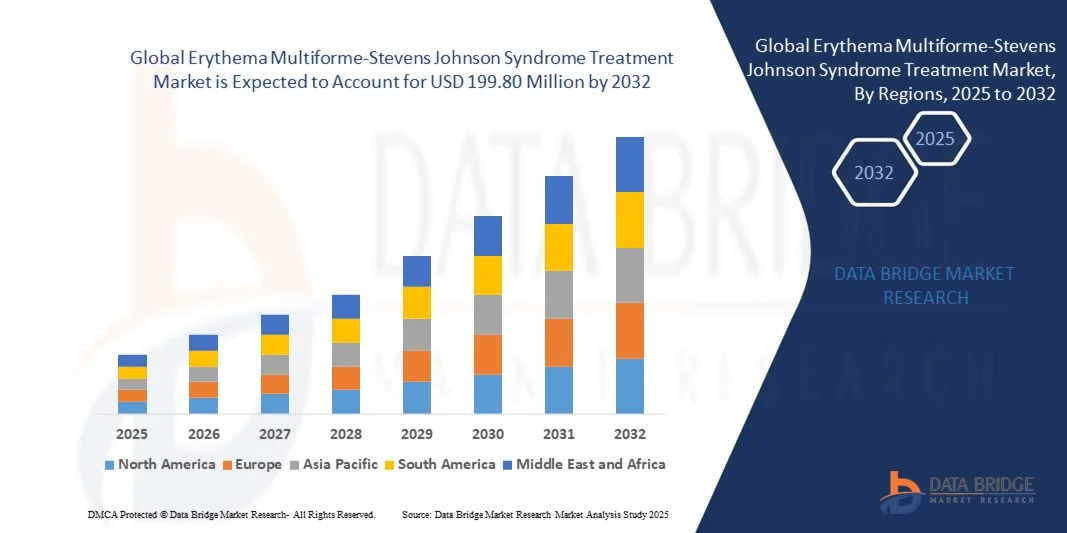
Erythema Multiforme-Stevens Johnson Syndrome Treatment Market Size
- The global Erythema Multiforme-Stevens Johnson Syndrome treatment market size was valued at USD 140.50 million in 2024 and is expected to reach USD 199.80 million by 2032, at a CAGR of 4.50% during the forecast period
- The market growth is largely fueled by the increasing incidence of EM–SJS cases worldwide, heightened awareness among healthcare professionals regarding diagnosis and treatment, and the development of innovative therapeutic options
- Furthermore, rising prevalence of infectious diseases leading to EM–SJS and growing adult and geriatric populations are establishing advanced treatment solutions as the preferred choice for clinicians. These converging factors are accelerating the adoption of EM–SJS therapies, thereby significantly boosting the industry's growth
Erythema Multiforme-Stevens Johnson Syndrome Treatment Market Analysis
- The Erythema Multiforme–Stevens-Johnson Syndrome Treatment Market, encompassing systemic therapies, topical treatments, and supportive care, is increasingly critical in managing severe adverse drug reactions and skin disorders, due to their ability to reduce mortality, prevent complications, and improve patient quality of life in both hospital and outpatient settings
- The growing adoption of Erythema Multiforme–Stevens-Johnson Syndrome treatments is primarily driven by rising awareness among healthcare professionals, increasing prevalence of causative infections and adverse drug reactions, and the development of targeted and combination treatment options
- North America dominated the global Erythema Multiforme–Stevens-Johnson Syndrome Treatment Market with the largest revenue share of 42.5% in 2024, supported by advanced healthcare infrastructure, high healthcare expenditure, and the presence of leading pharmaceutical companies investing in research and development, with the U.S. witnessing significant growth in specialized treatment protocols and hospital-based management programs
- Asia-Pacific is expected to be the fastest-growing region in the global Erythema Multiforme–Stevens-Johnson Syndrome Treatment Market during the forecast period, driven by increasing healthcare access, rising patient awareness, and expanding availability of both branded and generic drug formulations
- Topical steroids dominated the global Erythema Multiforme–Stevens-Johnson Syndrome Treatment Market with a market share of 38.9% in 2024, fueled by their established efficacy in controlling inflammation and widespread acceptance among clinicians as a frontline treatment option
Report Scope and Erythema Multiforme-Stevens Johnson Syndrome Treatment Market Segmentation
|
Attributes |
Erythema Multiforme-Stevens Johnson Syndrome Treatment Key Market Insights |
|
Segments Covered |
|
|
Countries Covered |
North America
Europe
Asia-Pacific
Middle East and Africa
South America
|
|
Key Market Players |
|
|
Market Opportunities |
|
|
Value Added Data Infosets |
In addition to the insights on market scenarios such as market value, growth rate, segmentation, geographical coverage, and major players, the market reports curated by the Data Bridge Market Research also include in-depth expert analysis, pricing analysis, brand share analysis, consumer survey, demography analysis, supply chain analysis, value chain analysis, raw material/consumables overview, vendor selection criteria, PESTLE Analysis, Porter Analysis, and regulatory framework. |
Erythema Multiforme-Stevens Johnson Syndrome Treatment Market Trends
Emerging Therapies and Personalized Treatment Approaches
- A significant and accelerating trend in the global Erythema Multiforme–Stevens-Johnson Syndrome Treatment Market is the development of targeted biologics and immunomodulatory therapies, which are enhancing treatment efficacy and reducing adverse effects for severe cases
- For instance, recent clinical studies are investigating the use of TNF-alpha inhibitors and intravenous immunoglobulins (IVIG) in severe Stevens-Johnson Syndrome patients, demonstrating improved recovery rates and reduced hospitalization time
- Advances in pharmacogenomics and patient-specific treatment regimens enable clinicians to tailor therapies based on genetic susceptibility and reaction severity, improving overall outcomes and minimizing recurrence risk
- Telemedicine integration and remote patient monitoring allow for timely intervention and follow-up care, especially for patients in remote or underserved regions, improving treatment adherence and early detection of complications
- This trend towards personalized, targeted, and digitally supported treatment strategies is fundamentally reshaping clinical management practices, driving demand for innovative EM–SJS therapies
- The adoption of advanced treatment protocols is rapidly increasing across both hospital and outpatient settings, as healthcare providers aim to optimize patient outcomes while reducing treatment-associated morbidity
Erythema Multiforme-Stevens Johnson Syndrome Treatment Market Dynamics
Driver
Rising Incidence and Awareness of Severe Skin Reactions
- The increasing prevalence of drug-induced and infection-related EM–SJS cases worldwide, coupled with growing awareness among healthcare professionals, is a significant driver for heightened demand for advanced treatments
- For instance, hospitals are implementing early detection protocols and specialized management plans for EM–SJS patients to reduce mortality and improve quality of care
- As clinicians recognize the importance of rapid intervention, advanced treatment options such as immunomodulators, IVIG, and corticosteroids offer a compelling advantage over traditional supportive care
- Furthermore, the rising adoption of clinical guidelines and standardized treatment pathways is driving the integration of EM–SJS therapies across hospitals, outpatient clinics, and home healthcare services
- The growing focus on patient education, early diagnosis, and proactive management strategies is further propelling the adoption of these therapies in both developed and emerging markets
- Increasing investment in R&D by pharmaceutical companies to develop safer and more effective EM–SJS therapies is strengthening market growth prospects over the forecast period
Restraint/Challenge
Limited Clinical Data and High Treatment Costs
- The scarcity of large-scale clinical studies and limited real-world data on EM–SJS treatments pose a significant challenge to broader adoption, as healthcare providers rely on evidence-based protocols for patient management
- For instance, variability in patient response to corticosteroids, IVIG, or biologics creates uncertainty in treatment planning, discouraging uniform adoption in clinical practice
- High costs associated with advanced therapies, including biologics and hospital-administered immunomodulators, can limit accessibility, especially in developing regions with constrained healthcare budgets
- Furthermore, complex diagnosis procedures and the need for specialized monitoring add to the overall treatment burden, creating barriers for both clinicians and patients
- Patient concerns regarding side effects, treatment efficacy, and recurrence risk can also hinder therapy adherence and market penetration
- Overcoming these challenges through expanded clinical research, cost-effective treatment options, and increased healthcare provider training will be vital for sustained market growth
Erythema Multiforme-Stevens Johnson Syndrome Treatment Market Scope
The market is segmented on the basis of symptoms, cause, management, drug type, route of administration, end-users, and distribution channel.
- By Symptoms
On the basis of symptoms, the global Erythema Multiforme–Stevens-Johnson syndrome treatment market is segmented into For Erythema Multiforme (Erythema Multiforme Rash, Erythema Multiforme Minor, Erythema Multiforme Major) and For Stevens-Johnson Syndrome (Fever, Flu Kind Symptoms/Body Ache, Cough, Rash and Blistering, Vision Loss and Scarring Near Eyes). The Rash and Blistering subsegment dominated the market with the largest revenue share in 2024, driven by its high prevalence in severe EM–SJS cases and the urgent need for medical intervention. Patients experiencing this symptom are prioritized for hospital-based treatment and intensive care, which increases the market demand for therapeutic management options. Rash and blistering also lead to significant complications if untreated, driving clinician preference for early and aggressive therapy. Pharmaceutical companies are focusing on developing faster-acting topical and systemic treatments targeting these lesions. The increasing awareness of skin complications associated with EM–SJS further reinforces the dominance of this subsegment.
The Vision Loss and Scarring Near Eyes subsegment is anticipated to witness the fastest growth rate from 2025 to 2032, fueled by rising awareness about ocular complications and the development of targeted therapies to prevent long-term damage. Advanced ophthalmologic care and supportive interventions are increasingly integrated into EM–SJS management plans, particularly in tertiary care hospitals. Early diagnosis and intervention for ocular symptoms are gaining traction, driving the demand for specialized treatments. In addition, the adoption of multidisciplinary care approaches, combining dermatology and ophthalmology, is expected to accelerate the growth of this subsegment.
- By Cause
On the basis of cause, the global Erythema Multiforme–Stevens-Johnson syndrome treatment market is segmented into infection and specific medication. The Specific Medication subsegment dominated the market with the largest revenue share in 2024, as drug-induced EM–SJS is more prevalent in clinical settings and requires immediate therapeutic intervention. Common causative drugs such as antibiotics, anticonvulsants, and sulfonamides are monitored closely, driving demand for targeted treatment options. Hospitals implement strict pharmacovigilance protocols to manage medication-induced EM–SJS, reinforcing market dominance. Treatment regimens are designed to mitigate severe adverse drug reactions, enhancing patient outcomes. The presence of established guidelines for drug-induced EM–SJS also strengthens the adoption of therapies in this subsegment.
The Infection subsegment is expected to witness the fastest growth rate from 2025 to 2032, driven by rising incidences of viral and bacterial infections triggering EM–SJS, particularly in emerging regions. Improved diagnostic capabilities allow for rapid identification of infection-induced cases, promoting early intervention. Awareness campaigns and vaccination programs further contribute to this growth. Targeted management strategies for infection-induced EM–SJS, including antiviral and antibiotic therapies, are gaining traction. Increasing hospitalizations due to infectious triggers are expected to drive steady market expansion for this subsegment.
- By Management
On the basis of management, the global Erythema Multiforme–Stevens-Johnson syndrome treatment market is segmented into topical steroids, antihistamines, prophylactic antiviral therapy, nonsteroidal anti-inflammatory drugs, antiepileptics, antibiotics, barbiturates, penicillins, and sulfonamides. The Topical Steroids subsegment dominated the market with the largest revenue share of 38.9% in 2024, due to their established efficacy in controlling inflammation and promoting faster healing of EM–SJS lesions. Clinicians prefer topical steroids as a frontline therapy for both mild and moderate cases. Their ease of application and rapid symptomatic relief contribute to high adoption rates in hospital and home-care settings. Pharmaceutical manufacturers continue to innovate steroid formulations for enhanced potency and reduced side effects. Topical steroids remain integral to combination therapy regimens, further reinforcing their market dominance.
The Prophylactic Antiviral Therapy subsegment is expected to witness the fastest growth rate from 2025 to 2032, fueled by increasing awareness of viral triggers in EM–SJS and the need to prevent secondary infections. Hospitals and specialized care centers are increasingly integrating antiviral prophylaxis into EM–SJS management protocols. Rising research and development initiatives targeting viral triggers are expanding therapeutic options. Patient preference for preventive approaches over reactive treatment is contributing to growth. This subsegment is particularly gaining traction in regions with high prevalence of herpes simplex virus-induced EM–SJS cases.
- By Drug Type
On the basis of drug type, the global Erythema Multiforme–Stevens-Johnson syndrome treatment market is segmented into branded and generic. The Branded subsegment dominated the market with the largest revenue share in 2024, as branded drugs are preferred by healthcare providers for their proven efficacy, safety, and regulatory approvals. Hospitals and specialty clinics often stock branded formulations to ensure consistent therapeutic outcomes. Strong marketing support and physician trust further enhance adoption of branded therapies. The dominance is reinforced by ongoing clinical trials and post-marketing surveillance demonstrating their reliability. Patient adherence and confidence are higher with branded options, maintaining revenue leadership.
The Generic subsegment is expected to witness the fastest growth rate from 2025 to 2032, driven by increasing demand in cost-sensitive and emerging markets. Governments and healthcare providers are promoting generics to expand patient access and reduce treatment costs. Rising patent expirations of key branded drugs are boosting generic availability. Generics also benefit from increasing awareness of affordable treatment options among patients and clinicians. Expansion of generic production facilities in Asia-Pacific and Latin America is contributing to rapid market growth for this subsegment.
- By Route of Administration
On the basis of route of administration, the global Erythema Multiforme–Stevens-Johnson syndrome treatment market is segmented into oral, topical, intravenous, and others. The Topical subsegment dominated the market with the largest revenue share in 2024, due to its widespread use for localized EM–SJS lesions and ease of application. Topical therapies are preferred for mild-to-moderate cases, providing rapid relief with minimal systemic side effects. Hospitals and home-care setups widely adopt topical administration for patient comfort and compliance. Pharmaceutical innovation in creams, gels, and ointments is further enhancing therapeutic efficiency. Topical administration remains a mainstay in combination therapy protocols, reinforcing its market dominance.
The Intravenous subsegment is expected to witness the fastest growth rate from 2025 to 2032, fueled by increasing adoption in severe EM–SJS cases requiring rapid systemic intervention. IV administration allows precise dosing of immunomodulators, corticosteroids, and biologics for critically ill patients. Rising hospitalizations and improved intensive care facilities contribute to growth. Advanced therapies delivered intravenously demonstrate higher efficacy in severe cases, driving clinician preference. Expansion of tertiary care hospitals in emerging markets is expected to support accelerated growth for IV therapies.
- By End-Users
On the basis of end-users, the global Erythema Multiforme–Stevens-Johnson syndrome treatment market is segmented into Hospitals, Ambulatory Surgical Centers, Home Healthcare, and Others. The Hospitals subsegment dominated the market with the largest revenue share in 2024, due to the need for inpatient care, monitoring, and advanced interventions for EM–SJS patients. Hospitals provide access to specialized dermatology and immunology services, making them primary treatment centers. Rising awareness and early referral programs reinforce hospital dominance. Hospitals also implement standard treatment protocols and adopt innovative therapies, ensuring better patient outcomes.
The Home Healthcare subsegment is expected to witness the fastest growth rate from 2025 to 2032, driven by increasing preference for post-hospitalization care and telemedicine-supported treatment plans. Patients with mild-to-moderate EM–SJS increasingly receive follow-up care at home to reduce hospital stays and costs. Portable treatment kits and remote monitoring solutions are enabling this shift. Growth is also supported by rising geriatric populations and chronic patients seeking comfortable, convenient care. Expansion of home healthcare services in North America and Europe further accelerates adoption in this subsegment.
- By Distribution Channel
On the basis of distribution channel, the global Erythema Multiforme–Stevens-Johnson syndrome treatment market is segmented into direct tender, hospital pharmacy, retail pharmacy, online pharmacy, and others. The Hospital Pharmacy subsegment dominated the market with the largest revenue share in 2024, as most EM–SJS treatments are prescribed and administered in hospital settings. Hospital pharmacies ensure timely availability of both branded and generic therapies. Strong hospital networks and procurement systems enhance market penetration. The subsegment also benefits from established trust among healthcare professionals and patients. Hospital pharmacy dominance is reinforced by clinical guidelines recommending in-hospital initiation of EM–SJS treatment.
The Online Pharmacy subsegment is expected to witness the fastest growth rate from 2025 to 2032, driven by rising e-pharmacy adoption, convenience of doorstep delivery, and growing patient awareness of EM–SJS treatment options. Digital platforms enable access to both branded and generic drugs, increasing patient reach. Teleconsultation and e-prescription integration support market growth. Online pharmacies are particularly gaining traction in urban and semi-urban regions. Expansion of e-commerce infrastructure in emerging markets further accelerates growth in this subsegment.
Erythema Multiforme-Stevens Johnson Syndrome Treatment Market Regional Analysis
- North America dominated the global Erythema Multiforme–Stevens-Johnson syndrome treatment market with the largest revenue share of 42.5% in 2024, supported by advanced healthcare infrastructure, high healthcare expenditure, and the presence of leading pharmaceutical companies investing in research and development
- Patients and healthcare providers in the region highly prioritize timely diagnosis, access to specialized dermatology and immunology care, and availability of advanced therapies such as immunomodulators, IVIG, and topical steroids
- This widespread adoption is further supported by well-established hospital networks, high healthcare expenditure, and growing awareness among clinicians about standardized treatment protocols, establishing EM–SJS therapies as the preferred choice for both inpatient and outpatient care
U.S. Erythema Multiforme-Stevens Johnson Syndrome Treatment Market Insight
The U.S. Erythema Multiforme–Stevens-Johnson syndrome treatment market captured the largest revenue share of 78% in 2024 within North America, fueled by the rising prevalence of drug-induced and infection-related EM–SJS cases and the availability of advanced healthcare facilities. Patients and clinicians increasingly prioritize early diagnosis, specialized dermatology and immunology care, and access to therapies such as immunomodulators, intravenous immunoglobulins, and topical steroids. The growing adoption of standardized treatment protocols, hospital-based care programs, and telemedicine follow-ups further propels market growth. Moreover, rising awareness campaigns and research initiatives for better EM–SJS management are significantly contributing to the market’s expansion.
Europe Erythema Multiforme–Stevens-Johnson Syndrome Treatment Market Insight
The Europe Erythema Multiforme–Stevens-Johnson syndrome treatment market is projected to expand at a substantial CAGR throughout the forecast period, primarily driven by rising incidence of severe adverse drug reactions and the presence of robust healthcare infrastructure. Increasing awareness among dermatologists and immunologists, coupled with the demand for rapid diagnosis and effective treatment, is fostering market adoption. European healthcare providers are focusing on early intervention strategies and multidisciplinary care approaches. Furthermore, supportive government healthcare initiatives and clinical guideline enforcement are encouraging the integration of EM–SJS therapies in hospitals and outpatient clinics.
U.K. Erythema Multiforme–Stevens-Johnson Syndrome Treatment Market Insight
The U.K. Erythema Multiforme–Stevens-Johnson syndrome treatment market is anticipated to grow at a noteworthy CAGR during the forecast period, driven by heightened focus on patient safety, prevention of severe drug reactions, and improved access to specialized dermatology services. Rising clinician awareness regarding prompt intervention and the adoption of advanced therapies such as biologics and corticosteroids are accelerating growth. In addition, public health campaigns and hospital-based monitoring programs are promoting better management of EM–SJS, establishing the U.K. as a key market in Europe.
Germany Erythema Multiforme–Stevens-Johnson Syndrome Treatment Market Insight
The Germany Erythema Multiforme–Stevens-Johnson syndrome treatment market is expected to expand at a considerable CAGR during the forecast period, fueled by increasing prevalence of EM–SJS cases and well-developed healthcare infrastructure. Germany’s emphasis on innovation and advanced treatment protocols promotes the adoption of biologics, IVIG, and other targeted therapies. Hospitals and specialty clinics are implementing multidisciplinary care models for EM–SJS management. Growing public and physician awareness regarding severe skin reactions and the need for early intervention further supports market growth.
Asia-Pacific Erythema Multiforme–Stevens-Johnson Syndrome Treatment Market Insight
The Asia-Pacific Erythema Multiforme–Stevens-Johnson syndrome treatment market is poised to grow at the fastest CAGR of 22% during the forecast period of 2025 to 2032, driven by rising prevalence of drug-induced and infection-related cases and increasing healthcare access. Countries such as China, Japan, and India are witnessing growing patient awareness, expanding hospital infrastructure, and better availability of advanced therapies. Government healthcare initiatives promoting early diagnosis and treatment, alongside telemedicine and home-care adoption, are further driving market expansion.
Japan Erythema Multiforme–Stevens-Johnson Syndrome Treatment Market Insight
The Japan Erythema Multiforme–Stevens-Johnson syndrome treatment market is gaining momentum due to the country’s high-quality healthcare system, growing elderly population, and increasing demand for specialized dermatology services. Early detection programs, hospital-based management strategies, and integration of advanced therapies are fueling market growth. Japan’s focus on clinical research and patient education also contributes to rising adoption of EM–SJS treatments in both residential and clinical settings.
India Erythema Multiforme–Stevens-Johnson Syndrome Treatment Market Insight
The India Erythema Multiforme–Stevens-Johnson syndrome treatment market accounted for the largest revenue share in Asia-Pacific in 2024, attributed to expanding healthcare access, rising patient awareness, and increasing incidence of drug-related EM–SJS cases. Growing hospital infrastructure, availability of cost-effective generic therapies, and government initiatives promoting dermatology care are key factors driving market growth. In addition, telemedicine services and home-care support programs are enhancing treatment accessibility and adherence in both urban and semi-urban regions.
Erythema Multiforme-Stevens Johnson Syndrome Treatment Market Share
The Erythema Multiforme-Stevens Johnson Syndrome Treatment industry is primarily led by well-established companies, including:
- Merck & Co., Inc (U.S.)
- Bristol-Myers Squibb Company (U.S.)
- AstraZeneca (U.K.)
- Sanofi (France)
- Novartis AG (Switzerland)
- Pfizer Inc. (U.S.)
- GSK plc (U.K.)
- AbbVie Inc. (U.S.)
- Lilly USA, LLC. (U.S.)
- Bayer AG (Germany)
- Takeda Pharmaceutical Company Limited (Japan)
- Boehringer Ingelheim International GmbH (Germany)
- Amgen Inc. (U.S.)
- Regeneron Pharmaceuticals, Inc. (U.S.)
- Biogen Inc. (U.S.)
- Novo Nordisk A/S (Denmark)
- F. Hoffmann-La Roche Ltd (Switzerland)
- Teva Pharmaceutical Industries Ltd. (Israel)
What are the Recent Developments in Global Erythema Multiforme-Stevens Johnson Syndrome Treatment Market?
- In October 2025, Nanobiotix entered into a global co-development and commercialization agreement with Janssen for JNJ-1900 (NBTXR3), a novel therapy for SJS/TEN. This collaboration aims to advance the treatment options available for these life-threatening conditions
- In September 2025, the U.S. FDA approved Novartis' oral drug, Rhapsido (remibrutinib), for treating CSU in patients unresponsive to standard therapies. This BTK inhibitor demonstrated significant improvements in itch severity and hive count in clinical trials, offering a new treatment option for chronic skin conditions
- In July 2025, Scinai announced the development of PC111, a novel therapy targeting pemphigus vulgaris and SJS/TEN. PC111 offers rapid relief without immunosuppression, presenting a promising treatment option for these severe dermatological conditions
- In April 2025, the World Allergy Organization published Latin American guidelines addressing the diagnosis and treatment of SJS/TEN. The guidelines provide practical recommendations for clinicians in the region, focusing on early identification and management of these severe skin reactions
- In November 2024, Journey Medical Corporation, in collaboration with Dr. Reddy’s Laboratories Ltd., received U.S. FDA approval for Emrosi (Minocycline Hydrochloride Extended Release Capsules, 40 mg) for the treatment of inflammatory lesions of rosacea in adults. While primarily indicated for rosacea, Emrosi may offer insights into the management of inflammatory skin conditions

- Interactive Data Analysis Dashboard
- Company Analysis Dashboard for high growth potential opportunities
- Research Analyst Access for customization & queries
- Competitor Analysis with Interactive dashboard
- Latest News, Updates & Trend analysis
- Harness the Power of Benchmark Analysis for Comprehensive Competitor Tracking
Data collection and base year analysis are done using data collection modules with large sample sizes. The stage includes obtaining market information or related data through various sources and strategies. It includes examining and planning all the data acquired from the past in advance. It likewise envelops the examination of information inconsistencies seen across different information sources. The market data is analysed and estimated using market statistical and coherent models. Also, market share analysis and key trend analysis are the major success factors in the market report. To know more, please request an analyst call or drop down your inquiry.
The key research methodology used by DBMR research team is data triangulation which involves data mining, analysis of the impact of data variables on the market and primary (industry expert) validation. Data models include Vendor Positioning Grid, Market Time Line Analysis, Market Overview and Guide, Company Positioning Grid, Patent Analysis, Pricing Analysis, Company Market Share Analysis, Standards of Measurement, Global versus Regional and Vendor Share Analysis. To know more about the research methodology, drop in an inquiry to speak to our industry experts.
Data Bridge Market Research is a leader in advanced formative research. We take pride in servicing our existing and new customers with data and analysis that match and suits their goal. The report can be customized to include price trend analysis of target brands understanding the market for additional countries (ask for the list of countries), clinical trial results data, literature review, refurbished market and product base analysis. Market analysis of target competitors can be analyzed from technology-based analysis to market portfolio strategies. We can add as many competitors that you require data about in the format and data style you are looking for. Our team of analysts can also provide you data in crude raw excel files pivot tables (Fact book) or can assist you in creating presentations from the data sets available in the report.












