What is the Esterquats Market Size and Growth Rate?
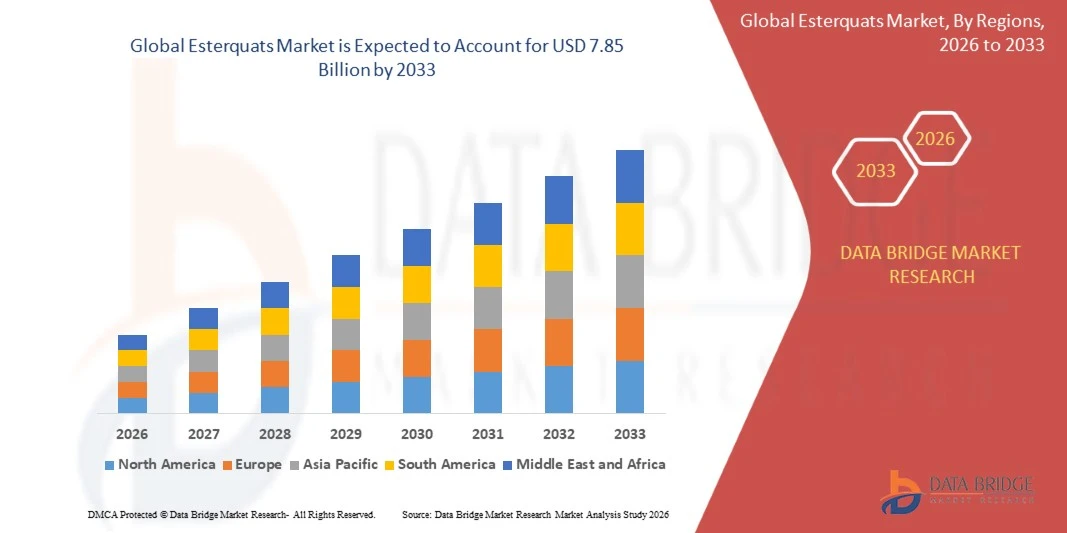
- As per Data Bridge Market Research analysis, the esterquats market was valued at USD 3.72 billion in 2025 and is projected to reach USD 7.85 billion by 2033, growing at a CAGR of 9.78% from 2026 to 2033, across household, personal care, and industrial uses.
- The market is experiencing consistent growth driven by rising demand for biodegradable cationic surfactants, increasing consumption of fabric softeners and hair conditioners, and expanding applications across household care, personal care, textile, industrial cleaning, and oil and gas sectors.
- The increasing shift toward biodegradable and low-toxicity ingredients, combined with stricter environmental standards and growing consumer preference for softer, fragranced, and gentler products, is supporting market adoption. Esterquats are being applied across liquid and sheet fabric softeners, hair conditioners, skin care, institutional laundry products, and oilfield formulations, offering formulators readily biodegradable, high-performance conditioning and antistatic functionality as modern cationic surfactants derived from renewable feedstocks.
Market Size & Forecast
- Global Market Value (2025): USD 3.72 Billion
- Expected Market Value (2033): USD 7.85 Billion
- Forecast CAGR (2026–2033): 9.78%
- Leading Region in 2025: Europe
- Fastest Growing Region: Asia-Pacific
What are the Major Takeaways of the Esterquats Market?
- Europe dominated the esterquats market with the largest revenue share of 34.60% in 2025, supported by strong fabric care and personal care manufacturing, stringent biodegradability standards, and the presence of leading surfactant producers across the region and neighboring markets.
- Asia-Pacific is expected to be the fastest-growing region at a CAGR of 11.90% from 2026 to 2033, fueled by rising disposable income, expanding laundry and personal care consumption, and growing local surfactant production.
- The TEA-based segment led the market with a 52.8% share in 2025, driven by extensive use in fabric softeners and hair conditioners across regions and household care brands.
- MDEA-based esterquats are the fastest-growing product type, projected to register a CAGR of 11.4%, reflecting the surge in demand for mild, biodegradable conditioning agents for sensitive formulations.
- The palm-based segment dominated the feedstock category with a 47.6% revenue share in 2025, led by availability, performance, and cost advantages across large production volumes.
- Fabric softeners accounted for 58.4% of the market share in 2025, preferred by increasing demand for soft, fragranced, and anti-static laundry products across retail and online channels.
- The hair and skin conditioners segment is the fastest-growing application category, with a CAGR of 11.6%, driven by increasing demand for mild personal care.
Report Scope and Esterquats Market Segmentation
|
Attributes |
Esterquats Key Market Insights |
|
Segments Covered |
|
|
Countries Covered |
North America
Europe
Asia-Pacific
Middle East and Africa
South America
|
|
Key Market Players |
|
|
Market Opportunities |
|
|
Value Added Data Infosets |
In addition to the insights on market scenarios such as market value, growth rate, segmentation, geographical coverage, and major players, the market reports curated by the Data Bridge Market Research also include in-depth expert analysis, geographically represented company-wise production and capacity, network layouts of distributors and partners, detailed and updated price trend analysis and deficit analysis of supply chain and demand. |
What is the Key Trend in the Esterquats Market?
- Manufacturers are increasingly shifting toward bio-based, readily biodegradable esterquats with low aquatic toxicity, combining renewable feedstocks, concentrated formats, and multifunctional performance to meet environmental regulations and the sustainability goals of brand owners across household and personal care.
- For instance, in November 2021, BASF SE introduced a bio-based esterquat intended for fabric softeners, reflecting growing demand for sustainable cationic surfactants that deliver performance with a reduced environmental footprint in household care, while brands seek concentrated formats that maintain softness and fragrance delivery.
- Personal care formulators are adopting esterquats as milder, more sustainable conditioning agents for hair and skin products, supporting premium, sulfate-free, and sensitive-skin positioning across mainstream and premium brands.
- Multifunctional esterquats offering softening, conditioning, and additional benefits such as antimicrobial effects are being developed to serve cleaning, textile, agricultural, and industrial applications, with analysts noting rising demand for green cleaning agents.
- For instance, in November 2020, Stepan Company introduced STEPANQUAT Soleil, an eco-friendly hair conditioning agent made from non-GMO sunflower oil sourced from Spain and France, incorporating a biodegradable esterquat with minimal environmental impact, highlighting brand interest in traceable, non-palm feedstocks for personal care.
- As sustainability regulation, consumer preference for gentler products, and renewable chemistry continue to advance, esterquats are expected to evolve beyond fabric softener actives into core cationic surfactants for sustainable home care, personal care, and industrial formulations across regions worldwide.
What are the Key Drivers of the Esterquats Market?
- Rising demand for fabric softeners and laundry conditioners is driving esterquats consumption because these ingredients provide fabric softness, antistatic properties, and conditioning performance while offering improved biodegradability compared with traditional quaternary compounds.
- In October 2025, Stepan Company introduced STEPANTEX® RA-80-G, a plant-derived esterquat for fabric softeners made from vegetable-derived fatty acids. Its liquid form enables cold-process manufacturing without heating, helping reduce energy consumption and manufacturing costs.
- Growing environmental awareness and demand for biodegradable surfactants are encouraging manufacturers to adopt esterquats as alternatives to less biodegradable conventional cationic softeners in household and personal care products.
- In February 2023, Evonik Industries promoted its VARISOFT® EQ 90 esterquat for sustainable hair-conditioning formulations, highlighting its biodegradability, low aquatic toxicity, and conditioning performance.
- Increasing demand for effective hair-conditioning products is creating opportunities for esterquats because of their ability to improve hair softness, manageability, and combability. Manufacturers are focusing on renewable feedstocks, environmentally compatible formulations, and efficient production processes to meet evolving consumer preferences.
What Factors Are Challenging the Growth of the Esterquats Market?
- Esterquat production depends on fatty acids, vegetable oils, tallow, and amines. Fluctuations in raw material prices can increase manufacturing costs, reduce profit margins, and create supply chain uncertainties for manufacturers.
- For instance, in January 2025, Clariant faced ongoing industry pressures related to raw material availability, production costs, and environmental compliance, highlighting the importance of cost-efficient manufacturing and reliable sourcing strategies.
- Regulations governing chemical safety, biodegradability, wastewater discharge, and environmental impacts can increase testing, documentation, and compliance expenses for esterquat producers, potentially slowing product development and market expansion.
- For instance,in March 2025, Kao Corporation continued emphasizing environmentally conscious chemical technologies and sustainable ingredient development, reflecting the industry's need to balance product performance, environmental compatibility, and manufacturing costs.
- Overall, raw material price volatility, sustainable sourcing requirements, environmental compliance costs, and competition from alternative conditioning ingredients remain significant challenges to the growth of the esterquats market.
How is the Esterquats Market Segmented?
The esterquats market is segmented on the basis of product, feedstock, application, and end user.
- By Product
On the basis of product, the esterquats market is segmented into TEA-based, MDEA-based, and others. The TEA-based segment dominated the market with 52.8% share in 2025, supported by extensive use in fabric softeners, hair conditioners, and personal care products. TEA-based esterquats provide strong softening, antistatic, and conditioning performance and are widely available in liquid and concentrated formats. They are widely used across household care, personal care, and textile applications. Improvements in biodegradability, concentration, and processing flexibility are further strengthening demand. Integration with renewable feedstocks and fragrance technologies also enables better performance across modern formulations, including liquid and concentrated fabric softeners.
The MDEA-based segment is projected to register the fastest growth at a CAGR of 11.4% from 2026 to 2033, driven by increasing demand for mild, biodegradable conditioning agents. MDEA-based esterquats offer good stability, low irritation potential, and strong compatibility with sensitive formulations. Their applications include fabric softeners, hair conditioners, and personal care products. Increasing focus on eco-compliant surfactants is creating additional demand across household and personal care brands. Improvements in raw material quality and process efficiency are enhancing consistency. Eco-friendly positioning is also expanding commercial use. MDEA grades are increasingly selected for gentle positioning, and producers are exploring multifunctional variants with added antimicrobial effects.
- By Feedstock
On the basis of feedstock, the esterquats market is segmented into palm-based, tallow-based, and other vegetable oils. The palm-based segment dominated the market with 47.6% share in 2025, supported by availability, performance, and cost advantages in fabric softener and conditioner production. Palm-derived fatty acids offer a balanced combination of softness, stability, and processing performance for high-volume manufacturing. Their availability across multiple regions and suppliers expands the potential customer base. Producers use palm-based feedstocks to maintain consistent quality across large production runs. The segment also benefits from established supply chains and long-term contracts across major producing regions.
The other vegetable oils segment is projected to register the fastest growth at a CAGR of 11.9% from 2026 to 2033, supported by increasing adoption of rapeseed, sunflower, and other sustainable feedstocks. Brands are increasingly requesting non-palm, traceable, and non-GMO sources to meet sustainability commitments. Suppliers are introducing esterquats based on locally sourced oils for fabric and hair care. Formulators and raw material producers are developing products that fit clean-label and sustainability claims. Improved processing and certification further strengthen the segment’s attractiveness. Feedstock cost and availability remain important considerations for expansion. Palm-free and certified options are increasingly requested by brand owners and retailers.
- By Application
On the basis of application, the esterquats market is segmented into fabric softeners, hair & skin conditioners, industrial & institutional cleaners, and others. The fabric softeners segment dominated the application category with 58.4% share in 2025, supported by increasing demand for soft, fragranced, and anti-static laundry products. Esterquats provide softness, reduced static cling, and fragrance delivery in liquid and sheet formats. Sustainability goals are increasing the use of biodegradable actives in household products. Growth in concentrated formulations further strengthens demand. Brands are also seeking materials that combine consistent performance, easy processing, and compatibility with fragrances and additives across laundry products.
The hair and skin conditioners segment is projected to register the fastest growth at a CAGR of 11.6% from 2026 to 2033, driven by increasing demand for mild personal care, premium conditioning, and sustainable ingredients. Esterquats deliver manageability, lubricity, and softness, supporting rinses, sprays, treatments, and styling products. Brands in Europe, Asia-Pacific, and North America are investing in sustainable conditioning agents. Consumer interest in gentle formulations is creating additional opportunities. Strong biodegradability profiles make esterquats particularly attractive for eco-conscious brands. Supportive regulatory trends can further improve adoption across regions and product categories. Premium hair care launches increasingly highlight sulfate-free and sustainability claims.
- By End User
On the basis of end user, the esterquats market is segmented into household care, personal care & cosmetics, textile & laundry services, industrial & institutional cleaning, oil & gas, and others. The household care segment dominated the end-user category with 56.9% share in 2025, supported by increasing requirements for fabric softeners and laundry care products. Consumer goods companies rely on esterquats to improve softness, fragrance, and sustainability. The segment includes liquid, concentrated, and sheet products sold through retail and online channels. Increasing consumption of laundry products is creating further opportunities. Large production volumes also make reliable raw material supply an important consideration in procurement decisions.
The personal care & cosmetics segment is projected to register the fastest growth at CAGR of 11.8% from 2026 to 2033, driven by increasing demand for gentle hair and skin care, premium conditioning, and sustainable ingredients. Formulators require conditioning agents that deliver sensory performance while meeting biodegradability and safety expectations. Brands and suppliers are expanding portfolios of renewable, mild cationic surfactants for global markets. Closer collaboration between ingredient makers and brand owners is accelerating development of tailored products. Clean beauty trends are further supporting adoption. Cost competitiveness, safety, and sourcing transparency remain important considerations for deployment.
Which Region Holds the Largest Share of the Esterquats Market?
- Europe dominated the esterquats market with the largest revenue share of 34.60% in 2025, supported by strong fabric care and personal care manufacturing, stringent biodegradability standards, and the presence of leading surfactant producers across the region and neighboring markets.
- The region also benefits from advanced formulation expertise, strong regulatory frameworks for biodegradability, and the presence of established surfactant producers, along with growing demand for sustainable household and personal care products. Increasing innovation, concentrated formulations, and renewable chemistry continue to strengthen Europe’s position in the global market, supported by long-standing consumer demand for fabric conditioners.
Germany Esterquats Market Insight
The Germany esterquats market is witnessing consistent growth due to rising investments in sustainable surfactants, specialty chemicals, and advanced formulation technologies. Chemical producers, consumer goods companies, and ingredient suppliers are increasingly focusing on biodegradable and renewable products. Moreover, a strong specialty chemicals base and continued innovation in personal care and home care ingredients, supported by strict environmental standards, are further contributing to market growth in Germany, particularly among export-oriented producers.
U.K. Esterquats Market Insight
The U.K. esterquats market is driven by rising demand for sustainable surfactants in fabric softeners, laundry conditioners, and personal care products. Esterquats offer effective fabric-softening, antistatic, and conditioning properties, supporting their adoption in household and industrial formulations. Growing consumer preference for biodegradable ingredients and environmentally responsible products is encouraging manufacturers to develop improved formulations. However, fluctuating raw material costs and competition from alternative surfactants may influence market growth.
Asia-Pacific Esterquats Market Insight
The Asia-Pacific esterquats market is expected to witness rapid growth, driven by rising disposable income, expanding laundry and personal care consumption, and increasing local surfactant production across countries such as China, India, Japan, and Indonesia. Growing urbanization, rising demand for fragranced and conditioned products, and expanding retail networks are supporting regional market expansion. In addition, the region’s access to oleochemical feedstocks and growing manufacturing base are accelerating demand for esterquats across household and personal care sectors in both developed and emerging economies.
China Esterquats Market Insight
The China esterquats market is experiencing steady growth, supported by expanding laundry care consumption, growing personal care manufacturing, and increasing local production of surfactants. Consumer goods companies, textile processors, and ingredient suppliers are increasingly seeking reliable supply of conditioning agents. Furthermore, rising living standards, premium product adoption, and environmental regulation, along with expanding domestic chemical capacity, are supporting wider adoption of esterquats in China, particularly across large urban centres and fast-growing e-commerce channels.
India Esterquats Market Insight
The India esterquats market is expanding steadily due to the country’s growing middle class, rising use of fabric softeners and hair conditioners, and expanding specialty chemical manufacturing. Consumer goods companies, textile processors, and ingredient suppliers are increasingly utilizing biodegradable surfactants. Continuous advancements in local formulation, rising disposable income, and growing demand for premium home and personal care products, along with government support for domestic manufacturing, are further driving market growth in the country, especially across fast-growing metropolitan markets.
Which are the Top Companies in Esterquats Market?
The esterquats industry is primarily led by well-established companies, including:
- Evonik Industries AG (Germany)
- Stepan Company (U.S.)
- Kao Corporation (Japan)
- Clariant AG (Switzerland)
- BASF SE (Germany)
- Croda International Plc (U.K.)
- Nouryon (Netherlands)
- The Lubrizol Corporation (U.S.)
- Italmatch Chemicals S.p.A. (Italy)
- Chemelco International B.V. (Netherlands)
- ABITEC Corporation (U.S.)
- Syensqo (Belgium)
- Huntsman Corporation (U.S.)
- Innospec Inc. (U.S.)
- Oxiteno S.A. (Brazil)
- KLK OLEO (Malaysia)
- Wilmar International Limited (Singapore)
- Zschimmer & Schwarz GmbH & Co KG (Germany)
- Galaxy Surfactants Limited (India)
- Pilot Chemical Company (U.S.)
What are Latest Developments in Esterquats Market?
- In April 2024, Evonik Industries unveiled a new range of esterquats specifically designed for sensitive skin in personal care products, reflecting the growing preference for biodegradable, mild, and sustainable surfactants in household and personal care formulations, and widening its portfolio of conditioning ingredients for global brand customers and sensitive-skin product developers.
- In June 2025, Stepan Company continued promoting its esterquat-based conditioning ingredients for personal care formulations, emphasizing hair-conditioning performance and plant-derived raw materials.
- In April 2026, Evonik Industries, continued advancing sustainable surfactant technologies focused on renewable feedstocks, biodegradable ingredients, and improved performance in household and personal care formulations.
- In March 2024, Kao Chemicals Europe highlighted its TETRANYL L9-90 esterquat, derived from European vegetable oils, for fabric-softening applications, supporting demand for renewable conditioning ingredients.
- In September 2022, Clariant agreed to sell its quaternary compounds (quats) business to Global Amines, including production facilities in Germany, Indonesia, and Brazil, reshaping the competitive landscape for specialty surfactants.
- In May 2021, BASF SE introduced a bio-based esterquat intended for fabric softeners, offering formulators a renewable alternative with improved environmental credentials, and responding to rising demand from household care brands for sustainable cationic surfactants that maintain softness, fragrance delivery, and processing performance in modern laundry products across Europe, North America, and Asia-Pacific, while strengthening its bio-based surfactant offering for brand owners.
- In November 2020, Stepan Company introduced STEPANQUAT Soleil, an eco-friendly hair conditioning agent made from non-GMO sunflower oil sourced from Spain and France, incorporating a biodegradable esterquat and supporting brand owners seeking sustainable conditioning ingredients with traceable raw materials for personal care formulations, supporting brand owners that want traceable, regionally sourced raw materials, while keeping low environmental impact as a central selling point.

- Interactive Data Analysis Dashboard
- Company Analysis Dashboard for high growth potential opportunities
- Research Analyst Access for customization & queries
- Competitor Analysis with Interactive dashboard
- Latest News, Updates & Trend analysis
- Harness the Power of Benchmark Analysis for Comprehensive Competitor Tracking
Global Esterquats Market, Supply Chain Analysis and Ecosystem Framework
To support market growth and help clients navigate the impact of geopolitical shifts, DBMR has integrated in-depth supply chain analysis into its Global Esterquats Market research reports. This addition empowers clients to respond effectively to global changes affecting their industries. The supply chain analysis section includes detailed insights such as Global Esterquats Market consumption and production by country, price trend analysis, the impact of tariffs and geopolitical developments, and import and export trends by country and HSN code. It also highlights major suppliers with data on production capacity and company profiles, as well as key importers and exporters. In addition to research, DBMR offers specialized supply chain consulting services backed by over a decade of experience, providing solutions like supplier discovery, supplier risk assessment, price trend analysis, impact evaluation of inflation and trade route changes, and comprehensive market trend analysis.
Data collection and base year analysis are done using data collection modules with large sample sizes. The stage includes obtaining market information or related data through various sources and strategies. It includes examining and planning all the data acquired from the past in advance. It likewise envelops the examination of information inconsistencies seen across different information sources. The market data is analysed and estimated using market statistical and coherent models. Also, market share analysis and key trend analysis are the major success factors in the market report. To know more, please request an analyst call or drop down your inquiry.
The key research methodology used by DBMR research team is data triangulation which involves data mining, analysis of the impact of data variables on the market and primary (industry expert) validation. Data models include Vendor Positioning Grid, Market Time Line Analysis, Market Overview and Guide, Company Positioning Grid, Patent Analysis, Pricing Analysis, Company Market Share Analysis, Standards of Measurement, Global versus Regional and Vendor Share Analysis. To know more about the research methodology, drop in an inquiry to speak to our industry experts.
Data Bridge Market Research is a leader in advanced formative research. We take pride in servicing our existing and new customers with data and analysis that match and suits their goal. The report can be customized to include price trend analysis of target brands understanding the market for additional countries (ask for the list of countries), clinical trial results data, literature review, refurbished market and product base analysis. Market analysis of target competitors can be analyzed from technology-based analysis to market portfolio strategies. We can add as many competitors that you require data about in the format and data style you are looking for. Our team of analysts can also provide you data in crude raw excel files pivot tables (Fact book) or can assist you in creating presentations from the data sets available in the report.