What is the Ethoxyquin Market Size and Growth Rate?
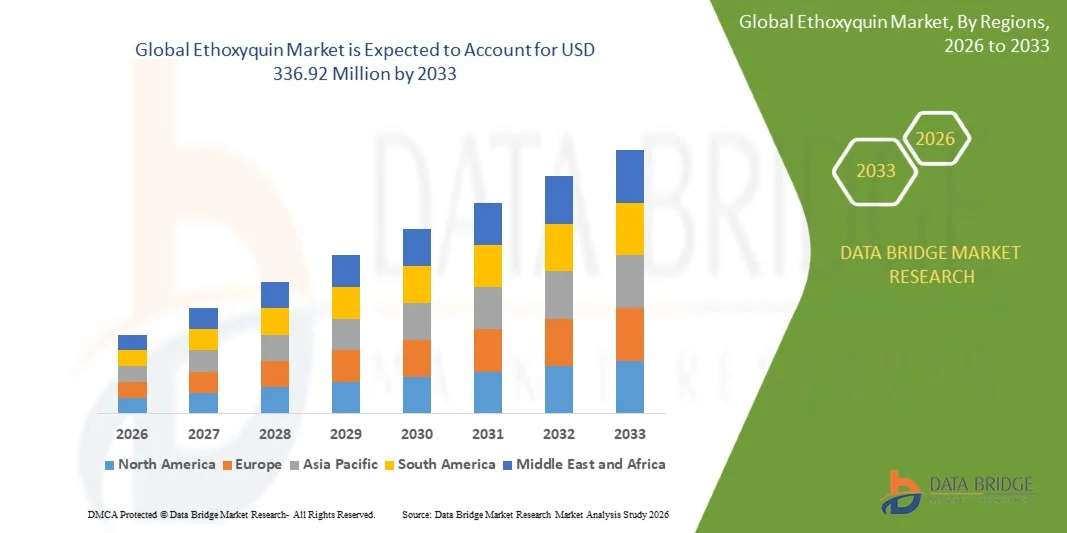
- As per Data Bridge Market Research analysis, the ethoxyquin market was valued at USD 222.90 million in 2025 and is projected to reach USD 336.92 million by 2033, growing at a CAGR of 5.30% from 2026 to 2033.
- The market is experiencing consistent growth driven by rising global livestock and aquaculture production, increasing demand for high-quality animal nutrition, and greater use of preservatives and antioxidants in feed formulations. Ethoxyquin is particularly relevant in applications where feed ingredients are susceptible to oxidation during storage and transportation. Growing consumption of poultry, seafood, meat, and pet food is consequently supporting demand for feed-preservation technologies
- The increasing production of poultry, aquaculture species, livestock, and pet food, combined with the need to maintain feed quality over extended storage periods, is encouraging manufacturers to adopt effective antioxidant solutions. Ethoxyquin can help protect fats, oils, vitamins, and other oxidation-sensitive components from degradation, thereby supporting feed stability and shelf life. In addition, expanding commercial aquaculture and the growing use of formulated feeds are creating further opportunities for ethoxyquin suppliers
Market Size & Forecast
- Global Market Value (2025): USD 222.90 Million
- Expected Market Value (2033): USD 336.92 Million
- Forecast CAGR (2026–2033): 5.30%
- Leading Region in 2025: North America
- Fastest Growing Region: Asia Pacific
What are the Major Takeaways of the Ethoxyquin Market?
- North America dominated the ethoxyquin market with the largest revenue share of 36.1% in 2025, supported by strong demand from the U.S. animal-feed and pet-food industries and established livestock production.
- Asia-Pacific is expected to be the fastest-growing region at a CAGR of 5.5% from 2026 to 2033, fueled by growing aquaculture, livestock production, and feed-manufacturing industries across China, India, and other emerging economies.
- The ethoxyquin-95 oil segment led the market with a 49.75% share in 2025, driven by its high antioxidant concentration and extensive use in animal-feed preservation.
- Ethoxyquin-33 powder are the fastest-growing product type, projected to register a CAGR of 5.0%, reflecting the surge in demand for dry antioxidant formulations.
- The liquid segment dominated the form category with a 47% revenue share in 2025, led by its ease of dispersion and efficient application in large-scale feed-processing operations.
- Poultry industry accounted for 37.2% of the market share in 2025, preferred by large-scale poultry production and extensive consumption of formulated poultry feed.
- The aquaculture industry segment is the fastest-growing application category, with a CAGR of 6.2%, driven by increasing aquafeed production and rising global seafood consumption.
Report Scope and Ethoxyquin Market Segmentation
|
Attributes |
Ethoxyquin Key Market Insights |
|
Segments Covered |
|
|
Countries Covered |
North America
Europe
Asia-Pacific
Middle East and Africa
South America
|
|
Key Market Players |
|
|
Market Opportunities |
|
|
Value Added Data Infosets |
In addition to the insights on market scenarios such as market value, growth rate, segmentation, geographical coverage, and major players, the market reports curated by the Data Bridge Market Research also include import export analysis, production capacity overview, production consumption analysis, price trend analysis, climate change scenario, supply chain analysis, value chain analysis, raw material/consumables overview, vendor selection criteria, PESTLE Analysis, Porter Analysis, and regulatory framework. |
What is the Key Trend in the Ethoxyquin Market?
- The growing need to protect oxidation-sensitive animal-feed ingredients is strengthening demand for ethoxyquin, particularly in fishmeal, fish oil, poultry feed, and other formulations containing fats and polyunsaturated fatty acids.
- For instance, in March 2022, the European Food Safety Authority (EFSA) highlighted that ethoxyquin had historically been used for its antioxidant properties in animal feed and to prevent spontaneous combustion of fishmeal during sea transportation, demonstrating its role in maintaining the stability of oxidation-sensitive feed ingredients.
- Feed manufacturers are increasingly focusing on extending storage stability and preserving nutritional quality, as oxidation can reduce the quality of fats, oils, vitamins, carotenoids, and other sensitive feed components during transportation and storage.
- Aquaculture is emerging as an important application area, because marine-derived feed materials used in aquafeed are highly susceptible to oxidation and frequently require antioxidant stabilization during extended storage and international transportation.
- For instance, in November 2022, the Australian Department of Agriculture, Fisheries and Forestry stated that ethoxyquin prevents rancidity of fats and delays degradation of fat-soluble vitamins, while also being used during transportation of high-fat animal-feed ingredients to protect against self-heating and spontaneous combustion.
- Demand is also supported by the continued use of ethoxyquin as a feed preservative and antioxidant, particularly in markets where regulatory frameworks permit its use at established concentrations and labeling requirements.
What are the Key Drivers of the Ethoxyquin Market?
- The expansion of livestock, poultry, and aquaculture production is increasing consumption of formulated animal feed, consequently raising demand for antioxidants that protect feed ingredients from oxidative deterioration throughout manufacturing, storage, and distribution.
- For instance, in June 2024, a study published in Poultry Science demonstrated that ethoxyquin supplementation at 50 mg/kg for five weeks reduced enteric oxidative stress and intestinal inflammation in heat-stressed broilers, while improving antioxidant capacity and beneficial gut microbiota. This supports demand for ethoxyquin as a functional antioxidant in poultry feed.
- Rising use of fishmeal and fish oil in aquaculture diets is particularly important because these ingredients contain high concentrations of polyunsaturated fatty acids that are highly vulnerable to oxidation.
- Increasing international transportation and longer storage periods for feed ingredients are creating additional demand for effective oxidation-control solutions, helping manufacturers maintain ingredient quality and reduce nutritional losses before feed reaches animals.
- For instance, in October 2024, researchers from China Agricultural University found that an antioxidant formulation containing ethoxyquin improved feed oxidative stability and antioxidant capacity in starter broiler chickens, confirming the importance of oxidation control in modern poultry nutrition. The study evaluated 351 broilers over 21 days, providing experimental evidence for antioxidant use in feed formulations.
- The need to maintain the stability of vitamins, carotenoids, fats, and oils is encouraging feed producers to use antioxidant systems that can provide protection during processing and extended storage conditions.
Which Factors are Challenging the Growth of the Ethoxyquin Market?
- Regulatory scrutiny surrounding ethoxyquin safety remains a major challenge, particularly because authorities have raised concerns regarding potential risks to human health, animal health, and the environment associated with continued exposure.
- For instance, in March 2022, the European Food Safety Authority (EFSA) reported that it could not conclude on the safety of ethoxyquin for certain animal groups, consumers, and the environment. EFSA also identified concerns related to the impurity p-phenetidine and potential environmental exposure, reinforcing regulatory uncertainty and limiting wider adoption in regulated markets.
- Regulatory differences between countries are creating market-access uncertainty for manufacturers and feed producers, requiring companies to comply with varying maximum-use levels, labeling requirements, residue tolerances, and authorization conditions.
- Growing regulatory pressure is also encouraging feed manufacturers to evaluate alternative antioxidants, potentially reducing long-term dependence on ethoxyquin in regions where synthetic feed additives face tighter regulatory oversight.
- For instance, in August 2022, the European Commission maintained the suspension of ethoxyquin as a feed additive in the European Union, following the earlier suspension introduced under Regulation (EU) 2017/962. The continued regulatory restriction limits the use of ethoxyquin in EU animal-feed applications and creates a significant barrier to market expansion in Europe
- The availability of alternative antioxidant systems may further intensify competitive pressure, particularly when manufacturers seek solutions that provide comparable oxidation protection while meeting increasingly stringent safety and sustainability expectations.
How is the Ethoxyquin Market Segmented?
The ethoxyquin market is segmented on the basis of product type, form, application, and end use.
- By Product Type
On the basis of product type, the ethoxyquin market is segmented into ethoxyquin-95 oil, ethoxyquin-66 powder, and ethoxyquin-33 powder. The ethoxyquin-95 Oil segment dominated the market with 49.75% share in 2025, owing to its high antioxidant concentration and extensive use in animal-feed preservation. Its liquid formulation allows efficient dispersion in feed ingredients containing fats and oils. It is particularly important in aquaculture and livestock-feed manufacturing, where oxidation can reduce nutritional quality. The product is also widely used to stabilize fishmeal and other oxidation-sensitive ingredients during storage and transportation. Its established use and strong antioxidant performance continue to support demand.
The ethoxyquin-33 powder segment is expected to be the fastest-growing product type, at 5.0% CAGR during forecast period, supported by increasing demand for dry antioxidant formulations. Powder formulations offer convenient handling, storage, and incorporation into dry feed mixtures. They can also reduce some of the logistical challenges associated with transporting liquid antioxidant products. Growing compound-feed production in emerging markets is creating additional opportunities for powdered formulations. Increasing adoption of standardized premixes and automated feed-blending processes further supports demand.
- By Form
On the basis of form, the ethoxyquin market is segmented into liquid, powder, and granular. The liquid segment dominated the market with 47% share in 2025, supported by its ease of dispersion and efficient application in large-scale feed-processing operations. Liquid ethoxyquin can be directly incorporated into fats, oils, feed ingredients, or feed pellets. This enables manufacturers to achieve relatively uniform antioxidant distribution throughout feed formulations. The form is particularly established in poultry, livestock, and aquaculture-feed applications. Its compatibility with existing liquid dosing and spraying equipment further supports adoption.
The powder segment is expected to be the fastest-growing form, at 6.0% CAGR during forecast period, driven by increasing preference for dry feed additives and convenient handling. Powder formulations can be incorporated into premixes and compound feeds without adding liquid components to the production process. They offer advantages in storage, transportation, and formulation flexibility. Growing demand for dry animal-feed products is further supporting their adoption. Powder products can also address some transportation and handling challenges associated with liquid ethoxyquin. The increasing use of automated blending systems is expected to improve the efficiency of powder incorporation.
- By Application
On the basis of application, the ethoxyquin market is segmented into pesticides, pet food preservatives, poultry industry, aquaculture industry, spice color preservatives, and industrial application. The poultry industry segment dominated the market with 37.02% share in 2025, supported by large-scale poultry production and extensive consumption of formulated poultry feed. Ethoxyquin helps protect fats, oils, and other oxidation-sensitive components incorporated into poultry feed. Maintaining feed stability is particularly important during storage and transportation. Large commercial poultry operations also require consistent feed quality to support animal productivity. Growing demand for poultry meat and eggs continues to support compound-feed production.
The aquaculture industry segment is expected to be the fastest-growing application, at 6.2% CAGR during forecast period, driven by increasing aquafeed production and rising global seafood consumption. Fishmeal and fish oil used in aquafeed are particularly susceptible to lipid oxidation. Ethoxyquin helps protect these ingredients from rancidity and oxidative deterioration during storage and transportation. Expansion of intensive fish and shrimp farming is increasing the requirement for stable, high-quality formulated feeds. Longer supply chains for aquafeed ingredients are also increasing the importance of antioxidant protection. Growing aquaculture production across Asia-Pacific is providing additional demand opportunities.
- By End Use
On the basis of end use, the ethoxyquin market is segmented into animal feed industry, agriculture, aquaculture industry, livestock industry, food processing industry, and others. The animal feed industry dominated the market with 68.99% share in 2025, supported by widespread use of ethoxyquin for protecting fats, oils, vitamins, and other oxidation-sensitive feed components. Feed manufacturers use antioxidants to maintain nutritional quality and extend product stability during storage. Large-scale poultry, livestock, and aquaculture feed production generates substantial demand for preservation solutions. Ethoxyquin's established performance and cost effectiveness further support its use in commercial feed manufacturing. Growing demand for animal protein is encouraging expansion of compound-feed production worldwide.
The aquaculture industry segment is expected to be the fastest-growing end-use segment, at 6.4% CAGR during forecast period, driven by expanding aquaculture production and increasing demand for formulated aquatic feeds. Aquafeeds frequently contain fishmeal, fish oil, and other lipid-rich ingredients that require protection against oxidation. Ethoxyquin helps maintain feed quality and nutritional stability during storage and transportation. Increasing seafood consumption is encouraging investment in intensive aquaculture operations. Expansion of aquafeed manufacturing in emerging markets is further increasing demand for feed antioxidants. Longer transportation routes and storage periods create additional requirements for oxidation control.
Which Region Holds the Largest Share of the Ethoxyquin Market?
- North America dominated the ethoxyquin market with the largest revenue share of 36.1% in 2025, supported by strong demand from the U.S. animal-feed and pet-food industries and established livestock production.
- The region also benefits from well-developed animal-feed manufacturing infrastructure, high commercial poultry production, established aquaculture activities, and a mature feed-additive supply chain. Continued demand for feed preservation solutions to maintain the stability and nutritional quality of fats, oils, and other sensitive ingredients is strengthening North America's position in the global ethoxyquin market.
U.S. Ethoxyquin Market Insight
The U.S. ethoxyquin market is witnessing steady growth due to the country’s large-scale animal feed, poultry, livestock, and aquaculture industries. Strong demand for effective antioxidants to protect fats, oils, fishmeal, and other oxidation-sensitive feed ingredients is driving ethoxyquin consumption across commercial feed applications. In addition, established feed-manufacturing infrastructure and the continued need to preserve feed quality during storage and transportation are supporting market development. Regulatory oversight and labeling requirements are also shaping product use and encouraging manufacturers to maintain compliant formulations.
Asia-Pacific Ethoxyquin Market Insight
The Asia-Pacific ethoxyquin market is expected to witness rapid growth, driven by expanding aquaculture, poultry, livestock production, and animal-feed manufacturing across countries such as China, India, Vietnam, and Indonesia. Rising consumption of meat and seafood, together with increasing commercial aquaculture production, is supporting demand for antioxidants that protect fishmeal, fish oil, and other oxidation-sensitive feed ingredients. Growing investments in feed-processing infrastructure and expanding regional supply chains are further supporting market expansion. In addition, increasing adoption of formulated animal feeds is creating further opportunities for ethoxyquin across the region.
Japan Ethoxyquin Market Insight
The Japan ethoxyquin market is witnessing consistent growth due to the country’s established aquaculture sector, developed animal-feed industry, and strong emphasis on maintaining feed quality and stability. Ethoxyquin is relevant to applications involving oxidation-sensitive ingredients such as fishmeal and fish oil, particularly within aquafeed and animal-feed formulations. The country’s mature food and feed-processing infrastructure supports reliable handling and distribution of feed additives. Moreover, continued demand for high-quality aquaculture products and efficient feed preservation solutions is contributing to ethoxyquin market development in Japan.
China Ethoxyquin Market Insight
The China ethoxyquin market is growing rapidly, driven by the country’s large poultry, livestock, and aquaculture industries and its extensive animal-feed manufacturing capacity. Rising seafood and meat consumption is increasing demand for formulated feeds, supporting the use of antioxidants that help protect fats, oils, fishmeal, and other oxidation-sensitive components. Expanding commercial aquaculture and growing investments in modern feed-production facilities are further strengthening demand. In addition, China’s large-scale agricultural and livestock ecosystem is supporting the broader application of feed-preservation technologies, positioning the country as an important growth market for ethoxyquin.
U.K. Ethoxyquin Market Insight
The U.K. ethoxyquin market is experiencing a more constrained growth environment, influenced by stringent regulatory oversight concerning the use of ethoxyquin in animal-feed applications. Demand for feed antioxidants remains supported by established livestock, poultry, and aquaculture activities, but manufacturers and feed producers face greater pressure to comply with changing additive requirements. Increasing attention toward alternative antioxidant solutions is also influencing purchasing and formulation decisions. Furthermore, the region’s focus on animal-feed safety, traceability, and regulatory compliance continues to shape the market landscape and limit broader adoption of ethoxyquin.
Germany Ethoxyquin Market Insight
The Germany ethoxyquin market is facing a regulated and challenging operating environment due to strict European Union requirements governing ethoxyquin in animal-feed applications. Germany’s advanced feed-manufacturing industry and established livestock sector continue to generate demand for effective feed-preservation technologies, but regulatory restrictions have reduced the scope for ethoxyquin usage. Feed manufacturers are increasingly evaluating alternative antioxidant systems to maintain product stability while meeting European safety requirements. In addition, Germany’s strong emphasis on feed quality, sustainability, and regulatory compliance is influencing product development and limiting the expansion of ethoxyquin compared with less restrictive markets.
Which are the Top Companies in Ethoxyquin Market?
The ethoxyquin industry is primarily led by well-established companies, including:
- Kemin Industries, Inc. (U.S.)
- Impextraco NV (Belgium)
- Rensin Chemicals Limited (China)
- Skystone Feed Co., Ltd. (China)
- Somu Group Of Companies (India)
- Crystal Pharma (India)
- EW Nutrition GmbH (Germany)
- dsm-firmenich (Switzerland)
- Alltech (U.S.)
- Cargill, Incorporated (U.S.)
- LKT Laboratories, Inc. (U.S.)
- MP Biomedicals (U.S.)
- Tokyo Chemical Industry Co., Ltd. (Japan)
- Cayman Chemical (U.S.)
- Chem Service, Inc. (U.S.)
- Santa Cruz Biotechnology Inc. (U.S.)
- MedChemExpress (U.S.)
- TargetMol Chemicals Inc. (U.S.)
- Biosynth (U.K.)
- Spectrum Chemical (U.S.)
What are Latest Developments in Ethoxyquin Market?
- In April 2025, Great Britain’s Food Standards Agency updated its official regulated feed-products register to show ethoxyquin (E 324) as a revoked feed additive for all species or categories of animals except dogs. The update confirms that ethoxyquin remains subject to regulatory restrictions in the British market and reflects the continuing transition away from its authorized use in animal-feed applications.
- In September 2024, researchers from China Agricultural University published a study evaluating the partial replacement of ethoxyquin with tea polyphenols and propyl gallate in broiler feed, finding that the alternative antioxidant combination improved feed oxidative stability and several antioxidant and gut-health indicators. The study involved 351 broilers and provides evidence of ongoing formulation development aimed at reducing reliance on ethoxyquin while maintaining antioxidant performance.
- In February 2023, a study published in Environment International reported human-biomonitoring results for ethoxyquin from the German Environmental Specimen Bank, covering samples collected between 2000 and 2021. Ethoxyquin exposure was detected in the analyzed population, while the researchers observed a decline in exposure over the study period, potentially reflecting the phase-out of ethoxyquin as an animal-feed additive in Europe. The research reinforces the importance of monitoring exposure and regulatory impacts associated with the substance.
- In August 2022, the European Commission denied authorization for ethoxyquin as a feed additive belonging to the antioxidant functional group after the European Food Safety Authority concluded that it had not been established that ethoxyquin would have no adverse effects on animal health, human health, or the environment. The decision represented a major regulatory development for the industry and formally ended the authorization process for ethoxyquin as a feed additive in the European Union.
- In March 2021, the European Commission amended the review of the suspension of ethoxyquin's authorization as a feed additive, extending the regulatory process while additional scientific information was being assessed. The measure reflected the continuing evaluation of the additive's safety and efficacy following concerns identified in earlier EFSA assessments and kept ethoxyquin's authorization suspended pending a final regulatory decision.

- Interactive Data Analysis Dashboard
- Company Analysis Dashboard for high growth potential opportunities
- Research Analyst Access for customization & queries
- Competitor Analysis with Interactive dashboard
- Latest News, Updates & Trend analysis
- Harness the Power of Benchmark Analysis for Comprehensive Competitor Tracking
Data collection and base year analysis are done using data collection modules with large sample sizes. The stage includes obtaining market information or related data through various sources and strategies. It includes examining and planning all the data acquired from the past in advance. It likewise envelops the examination of information inconsistencies seen across different information sources. The market data is analysed and estimated using market statistical and coherent models. Also, market share analysis and key trend analysis are the major success factors in the market report. To know more, please request an analyst call or drop down your inquiry.
The key research methodology used by DBMR research team is data triangulation which involves data mining, analysis of the impact of data variables on the market and primary (industry expert) validation. Data models include Vendor Positioning Grid, Market Time Line Analysis, Market Overview and Guide, Company Positioning Grid, Patent Analysis, Pricing Analysis, Company Market Share Analysis, Standards of Measurement, Global versus Regional and Vendor Share Analysis. To know more about the research methodology, drop in an inquiry to speak to our industry experts.
Data Bridge Market Research is a leader in advanced formative research. We take pride in servicing our existing and new customers with data and analysis that match and suits their goal. The report can be customized to include price trend analysis of target brands understanding the market for additional countries (ask for the list of countries), clinical trial results data, literature review, refurbished market and product base analysis. Market analysis of target competitors can be analyzed from technology-based analysis to market portfolio strategies. We can add as many competitors that you require data about in the format and data style you are looking for. Our team of analysts can also provide you data in crude raw excel files pivot tables (Fact book) or can assist you in creating presentations from the data sets available in the report.