


Ethylene Vinyl Acetate Market Size
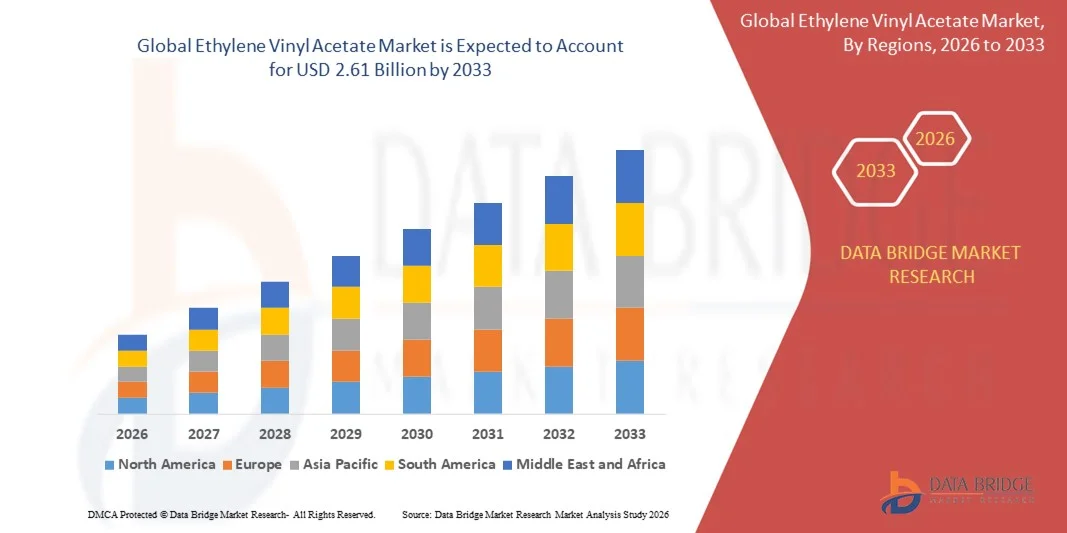
- The global ethylene vinyl acetate market size was valued at USD 1.60 billion in 2025 and is expected to reach USD 2.61 billion by 2033, at a CAGR of 6.25% during the forecast period
- The market growth is largely fuelled by the increasing demand for lightweight and durable materials in the packaging, footwear, automotive, and construction industries
- Rising applications of EVA in flexible packaging, laminates, and foams for thermal insulation are further supporting market expansion
Ethylene Vinyl Acetate Market Analysis
- EVA is widely used in packaging films, adhesives, footwear midsoles, photovoltaic encapsulation, and construction materials, driving consistent demand across industries
- Technological advancements in copolymerization and foam processing techniques are enhancing EVA performance, enabling improved mechanical strength, flexibility, and weather resistance
- North America dominated the global ethylene vinyl acetate (EVA) market with the largest revenue share in 2025, driven by strong demand from the packaging, footwear, automotive, and construction sectors. The region’s emphasis on lightweight, durable, and flexible materials, coupled with increasing adoption of sustainable products, is fueling market growth. High industrial activity and well-established manufacturing infrastructure further support EVA consumption
- Asia-Pacific region is expected to witness the highest growth rate in the global ethylene vinyl acetate market, driven by growing infrastructure development, expanding footwear and automotive sectors, and increasing investments in polymer manufacturing facilities
- The Thermoplastic EVA segment held the largest market revenue share in 2025, driven by its ease of processing, mechanical strength, and versatility across films, foams, and adhesive applications. Thermoplastic EVA is widely preferred for its balance of flexibility, durability, and cost-effectiveness, making it suitable for high-volume industrial and consumer applications
Report Scope and Ethylene Vinyl Acetate Market Segmentation
|
Attributes |
Ethylene Vinyl Acetate Key Market Insights |
|
Segments Covered |
|
|
Countries Covered |
North America
Europe
Asia-Pacific
Middle East and Africa
South America
|
|
Key Market Players |
• DuPont (U.S.) |
|
Market Opportunities |
|
|
Value Added Data Infosets |
In addition to the insights on market scenarios such as market value, growth rate, segmentation, geographical coverage, and major players, the market reports curated by the Data Bridge Market Research also include import export analysis, production capacity overview, production consumption analysis, price trend analysis, climate change scenario, supply chain analysis, value chain analysis, raw material/consumables overview, vendor selection criteria, PESTLE Analysis, Porter Analysis, and regulatory framework. |
Ethylene Vinyl Acetate Market Trends
Rising Applications Across Packaging, Footwear, Automotive, And Construction
- The growing adoption of ethylene vinyl acetate (EVA) across packaging, footwear, automotive, and construction applications is transforming the material landscape by providing lightweight, durable, and flexible solutions. Its shock absorption, sealing, and thermal insulation properties allow manufacturers to create high-performance products that meet evolving consumer demands and industrial standards. The versatility of EVA also supports innovation in niche applications such as sports equipment, electronic casings, and insulation panels, further driving market expansion
- Increasing demand for flexible and sustainable packaging solutions is accelerating EVA adoption in films, laminates, and foams. Manufacturers are leveraging EVA to improve product safety, shelf-life, and energy efficiency, particularly in food, pharmaceuticals, and consumer goods packaging. Rising regulatory emphasis on environmentally friendly packaging and consumer preference for recyclable materials is further boosting adoption across developed and emerging markets
- The affordability, ease of processing, and wide compatibility of EVA with other polymers are making it attractive for diverse applications. This enables manufacturers to optimize cost and performance, reduce material waste, and develop innovative products such as footwear midsoles, adhesive films, and building insulation. EVA’s ability to enhance product durability and comfort while maintaining lightweight characteristics strengthens its appeal across multiple industrial and consumer segments
- For instance, in 2023, automotive and footwear companies implemented EVA-based midsoles, cushioning components, and sealing foams to enhance product durability and consumer comfort. These initiatives improved product appeal while reducing weight and energy consumption. The adoption of EVA in green construction and lightweight automotive components also contributed to improved sustainability profiles and reduced carbon footprints
- While EVA applications are expanding rapidly, sustained growth depends on innovations in material formulation, recycling processes, and performance optimization. Continued investment in R&D and process improvements will be critical to meet the demands of advanced end-use industries. Furthermore, collaborations between raw material suppliers and manufacturers are enhancing EVA quality, consistency, and availability
Ethylene Vinyl Acetate Market Dynamics
Driver
Increasing Demand For Lightweight, Durable, And Flexible Materials
- Rising industrial demand for lightweight and durable materials is driving the adoption of EVA across packaging, footwear, automotive, and construction sectors. Its superior flexibility, chemical resistance, and mechanical performance make it a preferred choice over conventional plastics and rubbers. The trend is further reinforced by the need for high-performance materials in emerging applications such as wearable devices, energy-efficient packaging, and protective equipment
- EVA’s versatility enables its integration into foams, films, adhesives, and laminates, creating opportunities across multiple end-use industries. The growing preference for multifunctional materials that combine comfort, durability, and sustainability is fueling market expansion. In addition, regulatory support for eco-friendly and recyclable materials encourages manufacturers to incorporate EVA in product design, expanding its acceptance in green and circular economy initiatives
- Increasing consumer awareness regarding sustainable and energy-efficient products is promoting EVA adoption in lightweight packaging, footwear soles, and automotive components. The material’s ability to reduce overall product weight contributes to lower transportation emissions and improved energy efficiency, aligning with global sustainability goals. Rising interest in products with enhanced durability, cushioning, and thermal insulation further supports market penetration
- For instance, in 2022, a leading footwear manufacturer introduced EVA midsoles and cushioning components across several product lines, resulting in higher consumer preference and expanded market presence. Additional applications in electronics casings, flexible packaging, and sports equipment demonstrated EVA’s growing multifunctionality and relevance across diverse sectors
- While demand is being driven by material versatility and sustainability benefits, the market requires continuous innovation in EVA formulations and processing technologies to maintain competitive advantage. Investment in advanced compounding, foaming, and blending techniques will enhance product performance, enabling EVA to meet specialized application requirements
Restraint/Challenge
High Production Costs And Limited Adoption In Certain End-Use Industries
- The relatively high production cost of EVA compared to traditional polymers limits its adoption among price-sensitive manufacturers, particularly in emerging markets. Advanced processing and copolymerization techniques add to manufacturing expenses, which can restrict large-scale deployment. Companies may face challenges balancing cost-effectiveness with quality and performance requirements in competitive markets
- In some regions, limited technical expertise and processing infrastructure restrict the efficient use of EVA in specialized applications. Inadequate access to advanced extrusion, molding, and foaming equipment can result in inconsistent product quality, reducing market penetration and scalability. In addition, smaller manufacturers may struggle to implement best practices, limiting EVA utilization in complex or high-value applications
- Supply chain constraints, including availability of raw ethylene and vinyl acetate monomers, can affect production consistency and delivery timelines. These limitations can hinder adoption across automotive, construction, and packaging sectors that require large-volume, high-quality materials. Geopolitical tensions, import restrictions, and fluctuating raw material prices may exacerbate supply volatility
- For instance, in 2023, mid-sized packaging manufacturers in Southeast Asia reported difficulties in sourcing high-grade EVA for film and laminates due to raw material shortages, impacting production schedules and market supply. Similar challenges were observed in footwear and automotive component production, highlighting the need for robust procurement strategies
- While EVA technology continues to evolve, addressing cost, infrastructure, and supply chain challenges remains crucial. Market stakeholders must focus on optimizing production processes, enhancing recycling methods, and improving distribution networks to unlock full market potential. Strategic partnerships, localized production, and adoption of advanced manufacturing technologies are essential for sustainable growth
Ethylene Vinyl Acetate Market Scope
The market is segmented on the basis of type, application, and end-user.
- By Type
On the basis of type, the ethylene vinyl acetate (EVA) market is segmented into Vinyl Acetate-modified Polyethylene (Low VA Density), Thermoplastic Ethylene Vinyl Acetate (Medium VA Density), and Ethylene Vinyl Acetate Rubber (High VA Density). The Thermoplastic EVA segment held the largest market revenue share in 2025, driven by its ease of processing, mechanical strength, and versatility across films, foams, and adhesive applications. Thermoplastic EVA is widely preferred for its balance of flexibility, durability, and cost-effectiveness, making it suitable for high-volume industrial and consumer applications.
The Ethylene Vinyl Acetate Rubber (High VA Density) segment is expected to witness the fastest growth rate from 2026 to 2033, owing to its superior elasticity, shock absorption, and chemical resistance. High VA density EVA is increasingly adopted in automotive components, footwear midsoles, and industrial sealing applications. Its performance benefits in high-stress and temperature-sensitive environments are driving rapid demand across end-use industries.
- By Application
On the basis of application, the market is segmented into Film, Foam, Hot Melt Adhesives, Wire & Cable, Extrusion Casting, Solar Cell Encapsulation, and Others. The Foam segment held the largest revenue share in 2025, fueled by growing demand for lightweight, cushioning, and insulating materials in footwear, automotive, and packaging applications. EVA foam offers excellent thermal insulation, energy absorption, and durability, making it ideal for products requiring comfort, protection, and long-term performance.
The Solar Cell Encapsulation segment is expected to register the fastest growth from 2026 to 2033, driven by the expansion of the photovoltaic industry. EVA is widely used for encapsulating solar panels due to its transparency, weather resistance, and adhesive properties. The push toward renewable energy and sustainable solutions is further accelerating adoption in solar applications.
- By End-User
On the basis of end-user, the market is segmented into Automotive, Packaging & Paper, Paints, Coatings, & Adhesives, Electronics & Electrical, Pharmaceutical, Footwear, Photovoltaic Panels, and Others. The Packaging & Paper segment held the largest market share in 2025, driven by the growing need for flexible, protective, and recyclable packaging in food, pharmaceutical, and consumer goods industries.
The Automotive segment is expected to witness the fastest growth rate from 2026 to 2033, owing to the increasing use of EVA in lightweight components, insulation, and cushioning applications. The rising demand for fuel efficiency, comfort, and safety in vehicles is driving manufacturers to integrate EVA across interiors, padding, and sealing solutions.
Ethylene Vinyl Acetate Market Regional Analysis
- North America dominated the global ethylene vinyl acetate (EVA) market with the largest revenue share in 2025, driven by strong demand from the packaging, footwear, automotive, and construction sectors. The region’s emphasis on lightweight, durable, and flexible materials, coupled with increasing adoption of sustainable products, is fueling market growth. High industrial activity and well-established manufacturing infrastructure further support EVA consumption
- Consumers and manufacturers in North America highly value EVA for its versatility, chemical resistance, and performance in films, foams, adhesives, and coatings. The material’s ability to improve product durability, reduce weight, and enable energy-efficient solutions makes it a preferred choice across multiple end-use industries
- The widespread adoption of EVA is further supported by increasing awareness of recyclable and eco-friendly materials, robust R&D capabilities, and regulatory support for sustainable polymers. These factors are positioning EVA as a key material for innovation and industrial applications
U.S. Ethylene Vinyl Acetate Market Insight
The U.S. EVA market captured the largest revenue share in 2025 within North America, fueled by strong demand from footwear midsoles, automotive components, and flexible packaging. Manufacturers are leveraging EVA’s shock absorption, thermal insulation, and sealing properties to enhance product performance. Rising consumer focus on sustainability and lightweight materials, combined with investments in advanced polymer processing, is significantly driving market expansion.
Europe Ethylene Vinyl Acetate Market Insight
The Europe EVA market is expected to witness the fastest growth rate from 2026 to 2033, primarily driven by the region’s push for eco-friendly materials, renewable energy projects, and sustainable packaging. Increasing urbanization and industrial modernization are supporting adoption across automotive, construction, and packaging sectors. European manufacturers are also integrating EVA in photovoltaic panels, adhesive films, and protective foams to meet evolving industrial standards and environmental regulations.
Germany Ethylene Vinyl Acetate Market Insight
The Germany EVA market is projected to witness the fastest growth rate from 2026 to 2033, fueled by a strong focus on industrial innovation, energy-efficient materials, and sustainable manufacturing. Germany’s advanced polymer processing infrastructure and emphasis on high-quality, multifunctional materials promote EVA adoption across automotive, electronics, and packaging industries. The integration of EVA into lightweight and durable industrial applications is further enhancing its market presence.
Asia-Pacific Ethylene Vinyl Acetate Market Insight
The Asia-Pacific EVA market is expected to witness the fastest growth rate from 2026 to 2033, driven by rapid industrialization, urbanization, and increasing demand from automotive, footwear, and packaging sectors in countries such as China, Japan, and India. Rising disposable incomes, government support for sustainable materials, and the region’s emergence as a manufacturing hub for polymer-based products are contributing to wider adoption.
China Ethylene Vinyl Acetate Market Insight
The China EVA market accounted for the largest revenue share in Asia-Pacific in 2025, owing to the country’s strong manufacturing base, expanding automotive and footwear industries, and growing demand for flexible packaging solutions. The push towards lightweight, energy-efficient materials in construction, electronics, and renewable energy applications is further propelling market growth. Availability of cost-effective EVA and robust domestic production capabilities are key factors supporting the regional market expansion.
Japan Ethylene Vinyl Acetate Market Insight
The Japan EVA market is expected to witness the highest CAGR from 2026 to 2033 due to the country’s advanced manufacturing technologies, emphasis on high-performance materials, and rising adoption in automotive, electronics, and sustainable packaging. Japan’s focus on research-driven polymer innovation, coupled with demand for lightweight and energy-efficient products, is driving market penetration across multiple industrial applications.
Ethylene Vinyl Acetate Market Share
The Ethylene Vinyl Acetate industry is primarily led by well-established companies, including:
• DuPont (U.S.)
• BASF SE (Germany)
• Exxon Mobil Corporation (U.S.)
• Royal Dutch Shell (U.K.)
• SABIC (Saudi Arabia)
• LyondellBasell Industries Holdings B.V. (Netherlands)
• Westlake Chemical Corporation (U.S.)
• Braskem (Brazil)
• Mitsubishi Chemical Corporation (Japan)
• Huntsman International LLC (U.S.)
• Uz-Kor Gas Chemical (Uzbekistan)
• Praxair Technology, Inc. (U.S.)
• The Linde Group (Germany)
• NOVA Chemicals Corporation (Canada)
• Dycon Chemicals (India)
• Süd-Chemie India Pvt Ltd (India)
• NIPPON SHOKUBAI CO., LTD (Japan)
Latest Developments in Global Ethylene Vinyl Acetate Market
- In September 2024, Dow-Mitsui Polychemicals launched biomass-derived EVA and LDPE at its Chiba plant after obtaining ISCC PLUS certification. This development enables the production of carbon-reduced alternatives to conventional polymer grades, supporting sustainability initiatives and meeting growing demand for eco-friendly materials. The move enhances the company’s competitive positioning in the global EVA market while promoting environmentally responsible solutions for packaging, footwear, and construction applications
- In July 2024, Sipchem secured USD 187 million EPC contracts to expand its International Polymers Company EVA plant by 70,000 tons, increasing total annual capacity to approximately 290,000 tons by 2027. This expansion aims to strengthen supply capabilities, meet rising demand across automotive, packaging, and industrial sectors, and reinforce Sipchem’s market presence in the Asia-Pacific and global EVA markets

- Interactive Data Analysis Dashboard
- Company Analysis Dashboard for high growth potential opportunities
- Research Analyst Access for customization & queries
- Competitor Analysis with Interactive dashboard
- Latest News, Updates & Trend analysis
- Harness the Power of Benchmark Analysis for Comprehensive Competitor Tracking
Global Ethylene Vinyl Acetate Market, Supply Chain Analysis and Ecosystem Framework
To support market growth and help clients navigate the impact of geopolitical shifts, DBMR has integrated in-depth supply chain analysis into its Global Ethylene Vinyl Acetate Market research reports. This addition empowers clients to respond effectively to global changes affecting their industries. The supply chain analysis section includes detailed insights such as Global Ethylene Vinyl Acetate Market consumption and production by country, price trend analysis, the impact of tariffs and geopolitical developments, and import and export trends by country and HSN code. It also highlights major suppliers with data on production capacity and company profiles, as well as key importers and exporters. In addition to research, DBMR offers specialized supply chain consulting services backed by over a decade of experience, providing solutions like supplier discovery, supplier risk assessment, price trend analysis, impact evaluation of inflation and trade route changes, and comprehensive market trend analysis.
Data collection and base year analysis are done using data collection modules with large sample sizes. The stage includes obtaining market information or related data through various sources and strategies. It includes examining and planning all the data acquired from the past in advance. It likewise envelops the examination of information inconsistencies seen across different information sources. The market data is analysed and estimated using market statistical and coherent models. Also, market share analysis and key trend analysis are the major success factors in the market report. To know more, please request an analyst call or drop down your inquiry.
The key research methodology used by DBMR research team is data triangulation which involves data mining, analysis of the impact of data variables on the market and primary (industry expert) validation. Data models include Vendor Positioning Grid, Market Time Line Analysis, Market Overview and Guide, Company Positioning Grid, Patent Analysis, Pricing Analysis, Company Market Share Analysis, Standards of Measurement, Global versus Regional and Vendor Share Analysis. To know more about the research methodology, drop in an inquiry to speak to our industry experts.
Data Bridge Market Research is a leader in advanced formative research. We take pride in servicing our existing and new customers with data and analysis that match and suits their goal. The report can be customized to include price trend analysis of target brands understanding the market for additional countries (ask for the list of countries), clinical trial results data, literature review, refurbished market and product base analysis. Market analysis of target competitors can be analyzed from technology-based analysis to market portfolio strategies. We can add as many competitors that you require data about in the format and data style you are looking for. Our team of analysts can also provide you data in crude raw excel files pivot tables (Fact book) or can assist you in creating presentations from the data sets available in the report.













