


EV Aftermarket Market Size
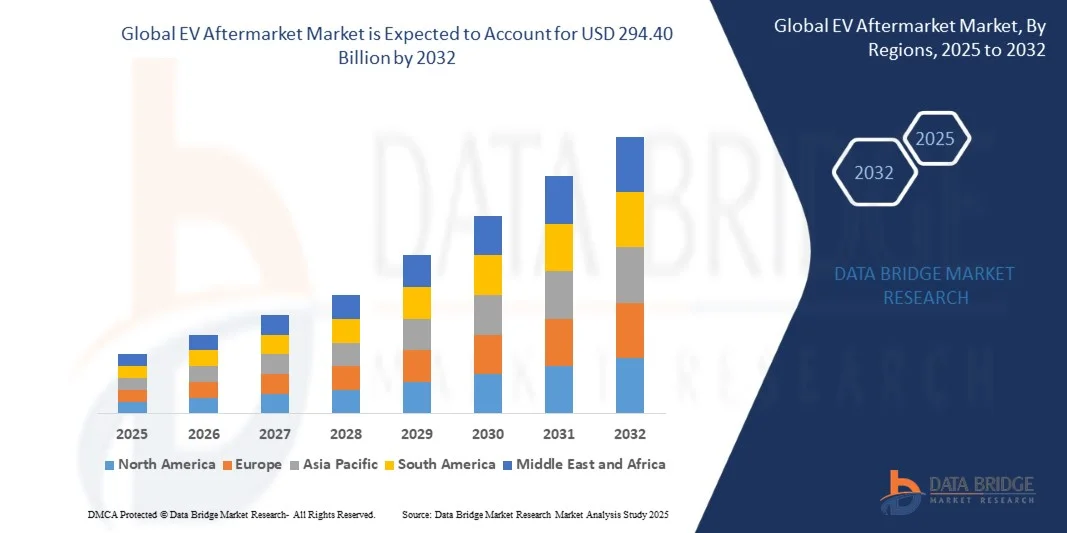
- The global EV aftermarket market size was valued at USD 79.88 billion in 2024 and is expected to reach USD 294.40 billion by 2032, at a CAGR of 17.71% during the forecast period
- The market growth is largely fueled by the accelerating adoption of electric vehicles worldwide, which is driving consistent demand for replacement parts such as batteries, tires, brake components, and electronic systems as EV fleets continue to expand
- Furthermore, advancements in battery technology, charging infrastructure, and vehicle electronics are creating sustained aftermarket opportunities, as consumers seek high-performance components and regular maintenance to optimize vehicle efficiency and lifespan. These converging factors are significantly boosting the growth of the EV aftermarket industry
EV Aftermarket Market Analysis
- The EV aftermarket comprises a wide range of products and services including replacement parts, maintenance solutions, software updates, and performance upgrades specifically designed for electric vehicles. This market supports both passenger and commercial EVs by ensuring long-term reliability and cost-effective operation beyond the initial purchase
- The rising demand for EV aftermarket services is primarily driven by the growing global EV fleet, increasing battery replacement cycles, and the need for specialized components that address the unique wear-and-tear patterns of electric drivetrains, positioning the sector for robust expansion in the coming years
- Europe dominated the EV aftermarket market with a share of 30.8% in 2024, due to the rapid expansion of electric vehicle adoption, stringent carbon emission regulations, and strong investments in EV infrastructure
- Asia-Pacific is expected to be the fastest growing region in the EV aftermarket market during the forecast period due to rapid urbanization, rising disposable incomes, and aggressive government initiatives promoting EV adoption
- Passenger cars segment dominated the market with a market share of 71.5% in 2024, due to the rapid increase in EV ownership among urban consumers and the rising popularity of premium electric sedans and SUVs. High annual mileage, frequent tire replacements, and growing consumer interest in upgrading battery packs to improve driving range support the dominance of this segment. Software updates and electronic component replacements also contribute significantly to passenger vehicle aftermarket revenue
Report Scope and EV Aftermarket Market Segmentation
|
Attributes |
EV Aftermarket Key Market Insights |
|
Segments Covered |
|
|
Countries Covered |
North America
Europe
Asia-Pacific
Middle East and Africa
South America
|
|
Key Market Players |
|
|
Market Opportunities |
|
|
Value Added Data Infosets |
In addition to the market insights such as market value, growth rate, market segments, geographical coverage, market players, and market scenario, the market report curated by the Data Bridge Market Research team includes in-depth expert analysis, import/export analysis, pricing analysis, production consumption analysis, and pestle analysis. |
EV Aftermarket Market Trends
“Rising Demand for EV-Specific Tires and Batteries”
- The EV aftermarket is witnessing rapid growth in specialized components such as tires and batteries designed specifically for electric vehicles, driven by unique performance and durability requirements compared to conventional vehicles. As EV adoption expands globally, the demand for these components is intensifying
- For instance, Michelin has introduced EV-specific tire ranges that reduce rolling resistance and improve range efficiency, while Bridgestone has launched ENLITEN technology to extend tire life for electric cars. Similarly, companies such as CATL and LG Energy Solution are focusing on long-life battery solutions tailored for EV maintenance needs
- Tires in the EV aftermarket need to withstand higher torque and increased vehicle weight while maintaining optimal energy efficiency. This has created a need for new rubber compounds, reinforced sidewalls, and AI-assisted monitoring features that ensure longevity and safety of these components
- Battery replacements also form a growing segment of the EV aftermarket as battery life often defines vehicle performance and resale value. Companies are offering modular battery replacement services and advanced diagnostic tools to ensure efficient servicing, protecting consumers from performance degradation
- In addition, the EV aftermarket is also expanding into battery recycling and refurbishment services. Firms such as Redwood Materials are creating supply chain solutions to reuse lithium, cobalt, and nickel, which reduces costs while addressing sustainability concerns in EV ownership
- The rising demand for EV-specific aftermarket components such as tires and batteries reflects the overall shift from general spare parts to highly engineered solutions. This growing reliance on specialized EV parts is setting new standards for product innovation, sustainability integration, and long-term value creation in the aftermarket segment
EV Aftermarket Market Dynamics
Driver
“Rapid Growth of Global EV Fleets”
- The expanding fleets of electric vehicles across both private and commercial sectors have created robust demand in the aftermarket for components dedicated to maintaining performance and reliability. As more EVs enter mainstream use, aftermarket services represent a vital growth area
- For instance, Tesla’s growing global fleet has significantly driven demand for third-party battery diagnostics and specialized tire replacements, while NIO has expanded battery swap stations that also serve aftermarket support functions. These company-led initiatives are reshaping consumer expectations for EV servicing
- The surge in EV sales has compelled aftermarket providers to develop a wide range of service offerings such as dedicated workshops for EV tires, software diagnostic tools, and maintenance solutions focusing on electric drivetrains. This is creating a sophisticated ecosystem tailored exclusively for EV owners
- In addition, the transition of commercial fleet operators toward electric vans, trucks, and buses is boosting demand for scalable aftermarket offerings. Fleet operators are seeking partnerships with component suppliers to ensure uninterrupted uptime and optimized total cost of ownership
- The rapid growth of EV fleets has generated strong momentum for the aftermarket sector by ensuring consistent demand for high-performance spare parts, tires, batteries, and servicing solutions. With increasing integration of AI-driven servicing platforms, the aftermarket is now positioned as a critical enabler of the EV adoption wave
Restraint/Challenge
“High Cost of Advanced Components”
- The high cost associated with advanced aftermarket components such as EV batteries, power electronics, and specialized tires remains one of the primary challenges for market expansion. These costs often exceed those of conventional vehicle counterparts, creating affordability concerns for both consumers and fleets
- For instance, premium battery replacements from companies such as Panasonic and LG Energy Solution can account for a substantial share of overall EV ownership costs, limiting the willingness of customers to purchase outside warranty coverage and affecting aftermarket adoption rates
- The complexity of EV components also raises servicing costs. Advanced systems such as regenerative braking, battery thermal management, and electronic control units require specialized knowledge, tools, and trained professionals, which adds to the cost burden of EV maintenance
- In addition, the limited availability of affordable recycled or second-life components challenges broader aftermarket development. While recycling initiatives are growing, the cost of processing lithium-ion batteries or remanufacturing high-tech components remains substantial and often matches or even exceeds new replacements
- As EV fleets expand globally, addressing the cost of aftermarket components will be essential to ensuring long-term adoption. Enhancing affordability through economies of scale, stronger recycling networks, and innovative service models will be critical to overcoming this ongoing challenge in the EV aftermarket sector
EV Aftermarket Market Scope
The market is segmented on the basis of replacement parts, propulsion type, vehicle type, and distribution channel.
• By Replacement Parts
On the basis of replacement parts, the EV aftermarket market is segmented into tire, battery, brake parts, filters, body parts, lighting and electronic components, wheels, and others. The battery segment dominated the largest market revenue share in 2024, driven by the rising demand for EV battery replacements due to gradual capacity degradation over time. Increasing global EV adoption, government-backed incentives for battery recycling, and advancements in lithium-ion and solid-state technologies further support this segment’s dominance. High replacement costs and the need for periodic upgrades to enhance range and performance make batteries a primary revenue driver within the aftermarket ecosystem.
The tire segment is anticipated to witness the fastest growth rate from 2025 to 2032, fueled by the higher wear and tear caused by the heavier weight and stronger torque of electric vehicles. EV-specific tires designed for low rolling resistance and extended mileage are seeing strong demand from both passenger and commercial fleets. The rising preference for performance tires optimized for EVs, coupled with frequent replacement cycles, positions this segment as a key growth area for aftermarket suppliers.
• By Propulsion Type
On the basis of propulsion type, the market is segmented into battery electric vehicles (BEVs), hybrid electric vehicles (HEVs), fuel cell electric vehicles (FCEVs), and plug-in hybrid electric vehicles (PHEVs). The battery electric vehicle segment dominated the market with a share of 37.7% in 2024, supported by the rapid global adoption of fully electric cars due to stricter emission norms and government incentives. BEVs require frequent battery servicing, software updates, and specialized replacement parts, making them the largest contributor to aftermarket revenues. Their simpler mechanical design compared to internal combustion engines drives consistent demand for electronic components and battery-related maintenance.
The hybrid electric vehicle segment is projected to grow at the fastest rate from 2025 to 2032, as hybrids combine electric and combustion powertrains, increasing the need for maintenance of both systems. The dual nature of HEVs leads to higher replacement demand for brake parts, filters, and electronic modules, particularly as hybrid technology gains traction in regions transitioning toward full electrification.
• By Vehicle Type
On the basis of vehicle type, the EV aftermarket market is segmented into passenger cars and commercial vehicles. The passenger cars segment dominated the market with a share of 71.5% in 2024, driven by the rapid increase in EV ownership among urban consumers and the rising popularity of premium electric sedans and SUVs. High annual mileage, frequent tire replacements, and growing consumer interest in upgrading battery packs to improve driving range support the dominance of this segment. Software updates and electronic component replacements also contribute significantly to passenger vehicle aftermarket revenues.
The commercial vehicles segment is expected to experience the fastest growth during 2025–2032, driven by the expanding use of electric delivery vans, buses, and trucks in logistics and public transportation. Fleet operators prioritize battery maintenance, tire replacements, and brake servicing to ensure cost efficiency and operational uptime, creating lucrative opportunities for aftermarket service providers.
• By Distribution Channel
On the basis of distribution channel, the market is segmented into retailers and wholesalers & distributors. The retailers segment accounted for the largest market revenue share in 2024, supported by the increasing presence of dedicated EV service centers and online platforms offering direct-to-consumer parts and services. Rising consumer preference for quick, transparent, and easily accessible aftermarket solutions drives this segment’s leadership. The growth of e-commerce platforms has further simplified the procurement of EV-specific replacement parts.
The wholesalers & distributors segment is expected to witness the fastest growth from 2025 to 2032, driven by the need for large-scale supply of EV components to independent garages and service networks. Strategic partnerships between component manufacturers and distributors, along with the expansion of global supply chains, are accelerating demand in this category as the EV market scales worldwide.
EV Aftermarket Market Regional Analysis
- Europe dominated the EV aftermarket market with the largest revenue share of 30.8% in 2024, driven by the rapid expansion of electric vehicle adoption, stringent carbon emission regulations, and strong investments in EV infrastructure
- The region benefits from the presence of leading automakers, a mature automotive service network, and government incentives encouraging EV ownership and maintenance
- Increasing demand for battery replacements, specialized EV tires, and electronic components supports robust aftermarket growth. Collaborations between OEMs, independent service providers, and parts manufacturers further reinforce Europe’s leadership in this sector
Germany EV Aftermarket Market Insight
The Germany EV aftermarket market captured a dominant share within Europe in 2024, supported by the country’s world-class automotive industry and its aggressive shift toward electrification. German automakers’ focus on battery innovation, recycling programs, and high-performance EV models drives strong demand for battery maintenance, brake components, and electronic upgrades. A highly skilled workforce and extensive service network ensure the availability of premium aftermarket solutions, strengthening Germany’s market position.
U.K. EV Aftermarket Market Insight
The U.K. EV aftermarket market is projected to grow at a notable CAGR during the forecast period, fueled by government-backed incentives, rapid EV adoption, and the expansion of charging infrastructure. The rising number of electric taxis, delivery fleets, and private vehicles is creating sustained demand for battery replacements, tire upgrades, and electronic components. Strong participation from local service providers and partnerships with global parts manufacturers further support the country’s aftermarket growth.
North America EV Aftermarket Market Insight
North America held a significant revenue share in the EV aftermarket market in 2024, driven by early adoption of EVs, advanced service networks, and the presence of major automotive and battery manufacturers. The region’s robust demand for battery maintenance, tire replacements, and software upgrades is fueled by a growing fleet of passenger and commercial EVs. Supportive policies, strong R&D investments, and increasing consumer preference for sustainable mobility continue to boost market expansion.
U.S. EV Aftermarket Market Insight
The U.S. EV aftermarket market captured the largest share in North America in 2024, supported by a high concentration of EV manufacturers, strong consumer demand, and widespread availability of specialized service centers. Growing adoption of EVs across both urban and rural regions drives strong sales of replacement tires, batteries, and electronic components. Federal and state incentives promoting EV ownership and battery recycling further accelerate aftermarket development.
Asia-Pacific EV Aftermarket Market Insight
The Asia-Pacific EV aftermarket market is anticipated to grow at the fastest CAGR during the forecast period, driven by rapid urbanization, rising disposable incomes, and aggressive government initiatives promoting EV adoption. Countries in the region are investing heavily in charging infrastructure, EV manufacturing, and service networks to meet surging demand. Expanding smart city projects, increasing ride-hailing EV fleets, and cost-effective service options further stimulate market growth.
China EV Aftermarket Market Insight
The China EV aftermarket market accounted for the largest revenue share in Asia-Pacific in 2024, supported by the country’s massive EV fleet, strong domestic manufacturing base, and government policies encouraging battery recycling and replacement. High demand for tires, brake parts, and electronic components is driven by frequent usage of EVs in urban transport and delivery services. Strategic partnerships between local service providers and global suppliers further strengthen China’s aftermarket ecosystem.
Japan EV Aftermarket Market Insight
The Japan EV aftermarket market is witnessing steady growth as the country accelerates its transition toward electric mobility. A strong focus on advanced battery technologies, vehicle longevity, and high-quality service standards supports the growing need for tire replacements, electronic upgrades, and battery maintenance. Collaborative efforts between automakers, technology firms, and service networks ensure continued market expansion and innovation.
EV Aftermarket Market Share
The EV aftermarket industry is primarily led by well-established companies, including:
- 3M (U.S.)
- ABB Ltd. (Switzerland)
- EVBox Group (Netherlands)
- ChargePoint Inc. (U.S.)
- Webasto SE (Germany)
- Siemens AG (Germany)
- Bosch Automotive Service Solution Inc. (Germany)
- Delphi Technologies (U.K.)
- Schneider Electric SE (France)
- AISIN Seiki Co., Ltd. (Japan)
- Continental AG (Germany)
- Denso Corporation (Japan)
- Robert Bosch GmbH (Germany)
Latest Developments in EV Aftermarket Market
- In April 2025, Bilstein Group established Ferdinand Bilstein India Private Limited, marking its 23rd international subsidiary, which strengthens the company’s footprint in the rapidly expanding Indian automotive aftermarket. The official opening on April 1, 2025, highlights Bilstein’s strategic focus on capturing opportunities in India’s growing demand for high-quality replacement parts for both passenger and commercial vehicles. By leveraging its brands febi, SWAG, and Blue Print, the company aims to provide professional repair solutions and reinforce its global leadership in the aftermarket components sector. This move is expected to accelerate competition in the Indian market while improving access to premium spare parts
- In December 2024, the Automotive Component Manufacturers Association of India (ACMA) hosted the first Automotive Aftermarket Expo at the Samrat Ashok International Convention Centre in Patna, creating a significant platform for collaboration among manufacturers, distributors, and suppliers. This two-day event enhanced market visibility for aftermarket players and promoted knowledge sharing across the value chain. By educating mechanics, dealers, and retailers on the importance of authentic and high-quality components, the expo is likely to strengthen the adoption of genuine parts, driving long-term growth and reducing counterfeit product circulation in India’s aftermarket industry
- In November 2024, Niterra advanced its position in the Indian automotive aftermarket by adopting a balanced strategy that combines global expertise with local market focus. The establishment of a dedicated department for eco-friendly technologies and the launch of innovative products, including oxygen sensors for OBD2 systems and advanced spark plugs for two-wheelers, underscore Niterra’s commitment to technological leadership and sustainability. This approach aligns with India’s increasing environmental regulations and also enhances the company’s competitive edge by catering to evolving consumer needs for efficient and durable components
- In June 2024, ZC Rubber introduced a new Electric Vehicle (EV) tire in Germany, integrating BPOT technology to deliver superior handling and performance. The innovative design, featuring a 5% larger contact area at high speeds, addresses the growing need for EV-specific tires that support heavier battery loads and improve driving stability. This development strengthens ZC Rubber’s presence in the European EV aftermarket and reflects the increasing demand for advanced tire solutions as electric mobility continues to expand across the region
- In January 2024, HIM Teknoforge expanded its product portfolio by launching hydraulic axle components for overseas markets, targeting the material handling industry and electric vehicles. The company also introduced brake shaft kits, steering kits, and machine castings, diversifying its offerings to meet the rising demand for high-performance and durable components. This product expansion enhances HIM Teknoforge’s global competitiveness and positions it to capture growth opportunities within the evolving EV aftermarket and industrial equipment segments

- Interactive Data Analysis Dashboard
- Company Analysis Dashboard for high growth potential opportunities
- Research Analyst Access for customization & queries
- Competitor Analysis with Interactive dashboard
- Latest News, Updates & Trend analysis
- Harness the Power of Benchmark Analysis for Comprehensive Competitor Tracking
Data collection and base year analysis are done using data collection modules with large sample sizes. The stage includes obtaining market information or related data through various sources and strategies. It includes examining and planning all the data acquired from the past in advance. It likewise envelops the examination of information inconsistencies seen across different information sources. The market data is analysed and estimated using market statistical and coherent models. Also, market share analysis and key trend analysis are the major success factors in the market report. To know more, please request an analyst call or drop down your inquiry.
The key research methodology used by DBMR research team is data triangulation which involves data mining, analysis of the impact of data variables on the market and primary (industry expert) validation. Data models include Vendor Positioning Grid, Market Time Line Analysis, Market Overview and Guide, Company Positioning Grid, Patent Analysis, Pricing Analysis, Company Market Share Analysis, Standards of Measurement, Global versus Regional and Vendor Share Analysis. To know more about the research methodology, drop in an inquiry to speak to our industry experts.
Data Bridge Market Research is a leader in advanced formative research. We take pride in servicing our existing and new customers with data and analysis that match and suits their goal. The report can be customized to include price trend analysis of target brands understanding the market for additional countries (ask for the list of countries), clinical trial results data, literature review, refurbished market and product base analysis. Market analysis of target competitors can be analyzed from technology-based analysis to market portfolio strategies. We can add as many competitors that you require data about in the format and data style you are looking for. Our team of analysts can also provide you data in crude raw excel files pivot tables (Fact book) or can assist you in creating presentations from the data sets available in the report.













