


What is the EV Charging Management Software Platform Market Size and Growth Rate?
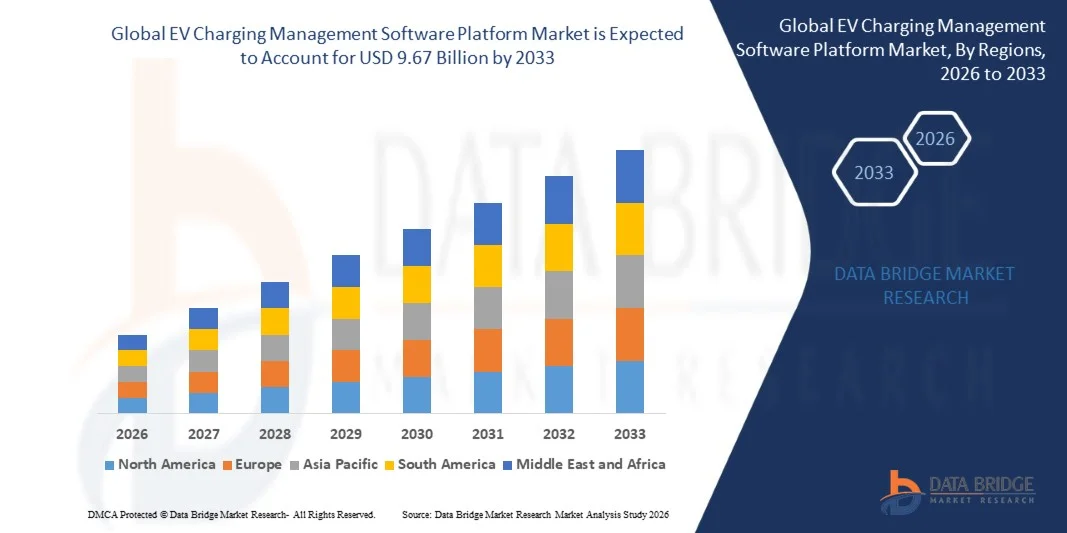
- As per Data Bridge Market Research analysis, the EV charging management software platform market was valued at USD 1.80 billion in 2025 and is projected to reach USD 9.67 billion by 2033, growing at a CAGR of 23.40 from 2026 to 2033.
- The market is experiencing strong growth driven by the rapid expansion of electric vehicle charging infrastructure, increasing adoption of cloud-based charging management platforms, and growing demand for centralized monitoring, billing, energy optimization, and remote management of charging networks.
- The increasing deployment of public and private EV charging stations, combined with rising EV adoption, government investments in charging infrastructure, and the need for efficient energy and load management, is compelling charge point operators, fleet operators, utilities, and commercial property owners to adopt advanced software platforms. Cloud-based platforms and smart charging solutions are increasingly being adopted to improve charger utilization, reduce operating costs, enable real-time monitoring, and support seamless payment and EV driver management. ChargePoint, for example, describes its platform as a cloud-based system supporting charging-station management, energy optimization, payments, remote diagnostics, and EV-driver services.
Market Size & Forecast
- Global Market Value (2025): USD 1.80 Billion
- Expected Market Value (2033): USD 9.67 Billion
- Forecast CAGR (2026–2033): 23.40%
- Leading Region in 2025: North America
- Fastest Growing Region: Asia Pacific
What are the Major Takeaways of the EV Charging Management Software Platform Market?
- North America dominated the EV charging management software platform market with the largest revenue share of 37.88% in 2025, supported by extensive charging infrastructure deployment, high EV adoption, and the presence of leading charging network operators and software providers.
- Asia-Pacific is expected to be the fastest-growing region at a CAGR of 28.01% from 2026 to 2033, fueled by rising EV adoption, rapid expansion of charging infrastructure, government electrification initiatives, and increasing investments in smart charging networks across China, India, Japan, and South Korea.
- The operation management segment led the market with a 31.26% share in 2025, driven by the growing requirement for centralized monitoring and control of expanding EV charging networks.
- Analytics & reporting are the fastest-growing module type, projected to register a CAGR of 27.97%, reflecting the surge in the increasing volume of data generated by connected EV chargers
- The cloud-based segment dominated the deployment type category with a 73.4% revenue share in 2025, led by the increasing preference for scalable and remotely accessible charging management platforms.
- Level 2 accounted for 53.37% of the market share in 2025, preferred by its extensive deployment across workplaces, commercial properties, public locations, and destination charging facilities.
- The level 3 / DC fast charging segment is the fastest-growing charger type category, with a CAGR of 28.03%, driven by the expansion of high-power charging infrastructure. DC fast chargers require sophisticated software for real-time monitoring, load management, dynamic pricing, and network optimization.
Report Scope and EV Charging Management Software Platform Market Segmentation
|
Attributes |
EV Charging Management Software Platform Key Market Insights |
|
Segments Covered |
|
|
Countries Covered |
North America
Europe
Asia-Pacific
Middle East and Africa
South America
|
|
Key Market Players |
|
|
Market Opportunities |
|
|
Value Added Data Infosets |
In addition to the market insights such as market value, growth rate, market segments, geographical coverage, market players, and market scenario, the market report curated by the Data Bridge Market Research team includes in-depth expert analysis, import/export analysis, pricing analysis, production consumption analysis, and pestle analysis. |
What is the Key Trend in the EV Charging Management Software Platform Market?
- EV charging operators are increasingly adopting AI-powered smart charging platforms to optimize energy consumption, dynamic pricing, charger utilization, network profitability, and grid responsiveness while reducing operating costs across charging networks.
- For instance, in January 2025, the Open Charge Alliance released OCPP 2.1 with bidirectional charging, DER control, improved smart charging, and expanded payment functionality, strengthening software interoperability across next-generation EV charging networks
- Software platforms are integrating bidirectional charging, distributed energy resource controls, automated payments, and intelligent load management to support increasingly connected, interoperable, and flexible EV charging ecosystems.
- These capabilities enable operators to coordinate charging loads, respond to electricity prices, and improve charger availability across geographically distributed networks.
- For instance, in March 2025, EV Connect partnered with Stable Auto to integrate AI-powered Adaptive Pricing into its platform, enabling charging operators to dynamically adjust prices based on energy costs, utilization, and demand
- Interoperability standards are becoming increasingly important as operators seek software capable of managing charging stations from multiple hardware manufacturers through a unified platform. OCPP 2.1 specifically adds V2G, DER control, improved smart charging, and enhanced transaction capabilities.
What are the Key Drivers of the EV Charging Management Software Platform Market?
- The rapid expansion of public, commercial, and fleet charging infrastructure is significantly increasing demand for centralized software platforms capable of monitoring chargers, controlling loads, processing payments, and optimizing charging operations.
- For instance, in April 2025, Vesco Clean Energy partnered with EV Connect to deploy and manage EV chargers across Michigan and the greater Midwest using EV Connect's software platform and management dashboard
- Fleet electrification is further increasing software requirements because operators must coordinate vehicle schedules, electricity prices, charger availability, facility loads, and grid capacity while ensuring vehicles remain ready for deployment.
- For instance, in November 2025, ChargePoint launched its next-generation cloud-native platform enabling operators to onboard, monitor, and control chargers from different manufacturers while integrating charging, fleet telematics, security, and energy-management capabilities.
- Smart charge management can automatically adjust charging according to vehicle schedules, utility rates, equipment capacity, and building loads, helping operators control peak demand and avoid costly electrical infrastructure upgrades.
Which Factors are Challenging the Growth of the EV Charging Management Software Platform Market?
- EV charging software ecosystems face interoperability, cybersecurity, and integration challenges because networks combine chargers, payment systems, vehicles, utilities, cloud platforms, and communication standards supplied by multiple technology vendors.
- For instance, in January 2025, the U.S. Department of Energy identified persistent cybersecurity weaknesses in EV charging equipment, including network monitoring, physical access, system hardening, and the need for backward compatibility with legacy systems, highlighting the technical complexity and cost of securing charging software ecosystems.
- Differences between protocol generations and proprietary systems can complicate charger integration, software migration, remote management, and network scaling, particularly for operators managing heterogeneous charging hardware. OCPP 1.6 and OCPP 2.1, for instance, use different application logic and are not directly compatible.
- For instance, in January 2025, the National Renewable Energy Laboratory reported that public EV charging networks had more than 205,000 charging locations in the U.S., while failed DC fast-charging sessions still required users to manually unplug and reconnect in many cases, demonstrating persistent reliability and software–hardware integration challenges.
- Public charging reliability also remains challenging; in January 2025, NREL reported more than 205,000 public charging locations in the U.S. while highlighting the continued need to improve charging reliability and failed-session recovery.
How is the EV Charging Management Software Platform Market Segmented?
The EV charging management software platform market is segmented on the basis of module, deployment, charger type, and end user.
- By Module
On the basis of module, the EV charging management software platform market is segmented into Operation Management, Energy Management, EV Billing and Payment, EV Driver Application, Analytics & Reporting, and others. The operation management segment dominated the market with 31.26% share in 2025, owing to the growing requirement for centralized monitoring and control of expanding EV charging networks. These platforms enable charge point operators to monitor charger status, manage charging sessions, identify equipment faults, and maintain network uptime. The increasing deployment of public, commercial, and fleet charging infrastructure is creating greater demand for centralized operational tools. Operation management solutions also support remote diagnostics, user authentication, maintenance workflows, and firmware management.
The analytics & reporting segment is projected to register the fastest growth at a CAGR of 27.97% through 2033, driven by the increasing volume of data generated by connected EV chargers. Analytics platforms allow operators to evaluate charger utilization, energy consumption, charging patterns, revenue performance, and equipment reliability. The growing need to optimize charging-network performance is encouraging operators to move beyond basic monitoring toward data-driven decision-making. Advanced analytics can also support predictive maintenance by identifying abnormal charging behavior and potential equipment failures. Integration of artificial intelligence and machine learning is further improving the ability of platforms to generate actionable operational insights.
- By Deployment
On the basis of deployment, the EV charging management software platform market is segmented into cloud-based, on-premise, and hybrid. The cloud-based segment dominated the market with 73.24% share in 2025, supported by the increasing preference for scalable and remotely accessible charging management platforms. Cloud-based systems allow operators to manage charging stations across multiple locations through centralized software infrastructure. They reduce the need for extensive local hardware and simplify software maintenance, upgrades, and system integration. Cloud platforms can also connect charging stations with payment systems, driver applications, energy-management systems, and roaming platforms. Their scalability makes them particularly suitable for rapidly expanding charging networks operated across different geographical locations.
The hybrid segment is projected to register the fastest growth at a CAGR of 26% during 2026 to 2033, driven by organizations seeking to combine the scalability of cloud platforms with the control and security of on-premise infrastructure. Hybrid deployment allows charging operators to retain selected operational or sensitive data locally while using cloud infrastructure for analytics, remote monitoring, and network management. This model can be particularly beneficial for large fleets, utilities, and charging networks with complex infrastructure requirements. It also provides greater flexibility when integrating charging management platforms with existing enterprise and energy-management systems. Growing concerns regarding data security, system reliability, and operational continuity are encouraging some organizations to adopt hybrid architectures.
- By Charger Type
On the basis of charger type, the EV charging management software platform market is segmented into level 1, level 2, and level 3 / DC fast charging. The level 2 segment dominated the market with.53.37% share in 2025, supported by its extensive deployment across workplaces, commercial properties, public locations, and destination charging facilities. Level 2 chargers provide a balance between charging speed, installation requirements, and operating costs. Their widespread deployment creates significant demand for software used to monitor charging sessions, manage users, process payments, and optimize charger utilization. Level 2 infrastructure is particularly suitable for locations where vehicles remain parked for longer periods.
The level 3 / DC fast charging segment is projected to witness the fastest growth at a CAGR of 28.03% through 2033, driven by the expansion of high-power charging infrastructure. DC fast chargers require sophisticated software for real-time monitoring, load management, dynamic pricing, and network optimization. The increasing development of highway charging corridors and high-utilization urban charging locations is generating greater demand for intelligent management solutions. Fast-charging infrastructure also creates more complex energy-management requirements because of its high electricity demand. Fleet operators and commercial charging providers are increasingly adopting these systems to reduce vehicle charging downtime.
- By End User
On the basis of end user, the EV charging management software platform market is segmented into charge point operators (CPOs), E-mobility service providers (eMSPs), fleet operators, utilities, automotive OEMs, commercial property owners, and others. The charge point operators (CPOs) segment dominated the market with 47.61% share in 2025, owing to the large number of charging stations and networks operated by CPOs. These operators require software platforms to monitor charger availability, manage charging sessions, process payments, and maintain network performance. CPOs also rely on software for remote diagnostics, customer management, roaming, and integration with driver applications. The continued expansion of public charging infrastructure is increasing the number of charging assets that require centralized management.
The fleet operators segment is projected to register the fastest growth at a CAGR of 28.11% during forecast period, supported by the increasing electrification of commercial vehicle fleets. Fleet operators require charging software that can coordinate charging schedules with vehicle availability and daily operating requirements. These platforms can help fleet managers optimize charging costs, monitor energy consumption, and reduce vehicle downtime. Integration with fleet-management and telematics systems is also increasing the usefulness of charging management platforms for commercial fleets. The growth of electric delivery vehicles, buses, logistics vehicles, and other commercial fleets is creating additional demand for intelligent charging coordination.
Which Region Holds the Largest Share of the EV Charging Management Software Platform Market?
- North America dominated the EV charging management software platform market with the largest revenue share of 37.88% in 2025, supported by extensive charging infrastructure deployment, high EV adoption, and the presence of leading charging network operators and software providers.
- The region also benefits from substantial investments in charging-network expansion, federal and state-level infrastructure initiatives, and increasing adoption of smart charging technologies. Growing demand for centralized monitoring, payment management, energy optimization, and remote charger management is further strengthening the regional market. The increasing electrification of commercial fleets and continued development of public charging networks are expected to support North America's leading position in the global market.
U.S. EV Charging Management Software Platform Market Insight
The U.S. EV charging management software platform market is witnessing strong growth due to rising investments in electric vehicle charging infrastructure, smart charging technologies, and digital charging networks. The country’s expanding EV ecosystem, along with increasing adoption of cloud-based charging management platforms, is driving demand across public, commercial, and fleet charging applications. In addition, growing deployment of charging stations and increasing emphasis on efficient energy management, remote monitoring, and seamless payment systems are accelerating adoption of charging management software across charging operators and businesses.
Asia-Pacific EV Charging Management Software Platform Market Insight
The Asia-Pacific EV charging management software platform market is expected to witness rapid growth, driven by increasing electric vehicle adoption, expanding charging infrastructure, and rising investments in smart mobility across countries such as China, Japan, South Korea, and India. Growing government support for EV infrastructure, increasing deployment of connected charging stations, and rising demand for scalable digital charging solutions are supporting regional market expansion. Additionally, the growing presence of EV manufacturers, charging-network operators, and technology providers is accelerating adoption of charging management platforms across commercial, residential, and fleet applications.
Japan EV Charging Management Software Platform Market Insight
The Japan EV charging management software platform market is witnessing consistent growth due to rising investments in EV infrastructure, smart charging technologies, and digital mobility solutions. Charging operators, automotive manufacturers, utilities, and commercial businesses are increasingly adopting software platforms for charger monitoring, energy optimization, billing, and network management. Moreover, increasing integration of cloud-based platforms, advanced analytics, and connected charging technologies, along with Japan’s focus on efficient and sustainable mobility solutions, is further contributing to market growth.
China EV Charging Management Software Platform Market Insight
The China EV charging management software platform market is growing rapidly, driven by expanding electric vehicle adoption, extensive charging infrastructure development, and strong government support for new energy mobility. Growing deployment of cloud-based and AI-enabled charging management platforms across public, commercial, and fleet charging networks is significantly boosting market demand. In addition, rising investments in smart charging, energy management, digital payment systems, and connected mobility infrastructure are strengthening China's position as one of the fastest-growing markets for EV charging management software platforms globally.
U.K. EV Charging Management Software Platform Market Insight
The U.K. EV charging management software platform market is experiencing steady growth, supported by rising EV adoption, expansion of public charging networks, and increasing implementation of smart charging solutions. Growing investments in advanced charging management infrastructure and demand for reliable, scalable, and digitally connected charging networks are contributing to market growth. Furthermore, integration of cloud platforms, real-time analytics, automated billing, and energy-management technologies is improving charging-network efficiency and supporting the U.K.’s development as a key market for EV charging software solutions.
Germany EV Charging Management Software Platform Market Insight
The Germany EV charging management software platform market is expanding steadily due to the country’s strong automotive industry, increasing EV adoption, and continued development of charging infrastructure. Charging operators, automotive companies, utilities, fleet operators, and commercial property owners are increasingly utilizing software platforms for charger monitoring, energy optimization, payment management, and network operations. Continuous advancements in smart charging, cloud-based management, interoperability, and data analytics, along with strong emphasis on sustainable mobility and charging infrastructure development, are further driving market growth in Germany.
Which are the Top Companies in EV Charging Management Software Platform Market?
The EV charging management software platform industry is primarily led by well-established companies, including:
- ChargePoint, Inc. (U.S.)
- Monta ApS (Denmark)
- Virta Ltd. (Finland)
- AMPECO Ltd. (Bulgaria)
- Blink Charging Co. (U.S.)
- FLO Services USA Inc. (Canada)
- Wallbox N.V. (Spain)
- Noodoe Inc. (U.S.)
- eDRV, Inc. (U.S.)
- ChargeLab Inc. (Canada)
- ev.energy (U.K.)
- Fuuse (U.K.)
- Last Mile Solutions B.V. (Netherlands)
- E-Flux by Road (Netherlands)
- Shell Recharge Solutions (Netherlands)
- Siemens AG (Germany)
- ABB Ltd (Switzerland)
- Eaton Corporation plc (Ireland)
- Schneider Electric SE (France)
- Autel Intelligent Technology Corp., Ltd. (China)
What are Latest Developments in EV Charging Management Software Platform Market?
- In In November 2025, ChargePoint released its next-generation ChargePoint Platform, a redesigned software solution for managing EV charging operations ranging from individual sites to large global networks. The platform introduced enhanced capabilities for charging-network optimization, energy management, operational visibility, and integration with evolving energy systems. It also incorporated an AI-powered Data Assistant to help customers analyze charging data more efficiently. The platform provides operators with improved tools for monitoring charging infrastructure, understanding network performance, and managing charging operations. The development reflects the industry's shift toward intelligent, software-driven charging infrastructure.
- In May 2024, Siemens launched Depot360 Managed Services in Canada, an AI-enabled solution designed to optimize electric-fleet charging and depot operations. The solution uses the Depot360 AI Platform to continuously monitor charging infrastructure and fleet performance. It is designed to proactively identify operational risks and help maintain charging-station uptime and vehicle state-of-charge requirements. The platform also incorporates load-shifting and peak-shaving capabilities to help fleets manage electricity consumption more efficiently. Siemens developed the solution to support fleet operators transitioning to electric vehicles while reducing operational complexity.
- In February 2023, bp announced plans to invest in EV charging across the U.S., alongside the expansion of its fleet-focused charging services and intelligent charge-management software. bp highlighted its Omega intelligent charge-management software as part of its offering for electric fleets. The software is designed to support fleet charging operations and help businesses manage charging requirements as vehicle electrification increases. The initiative combined charging infrastructure investment with digital services intended to improve fleet charging management. It also demonstrated the growing convergence of physical charging infrastructure and software-based energy management
- In March 2022, ChargePoint expanded its cloud-based fleet charging solution through an agreement with European delivery company Picnic to manage charging for its electric delivery fleet. The solution provided Picnic with charge management, range forecasting, and delivery route and schedule planning capabilities. ChargePoint's software also gave fleet managers operational visibility into vehicle utilization and potential issues. The platform was designed to help coordinate charging requirements with fleet operations and delivery schedules. This development highlighted the increasing role of cloud-based charging management software in commercial fleet electrification.
- In June 2021, ChargePoint and Mercedes-Benz expanded their collaboration to enhance the EV charging experience through ChargePoint's cloud-based charging platform and Mercedes-Benz's connected vehicle ecosystem. The collaboration focused on providing EV drivers with greater access to charging locations through integrated digital services. ChargePoint's cloud subscription platform supported multiple charging environments, including workplaces, parking locations, retail sites, and transportation fleets. The integration demonstrated the increasing importance of connected software platforms in simplifying EV charging access and management. It also strengthened interoperability between charging networks and automotive digital ecosystems.

- Interactive Data Analysis Dashboard
- Company Analysis Dashboard for high growth potential opportunities
- Research Analyst Access for customization & queries
- Competitor Analysis with Interactive dashboard
- Latest News, Updates & Trend analysis
- Harness the Power of Benchmark Analysis for Comprehensive Competitor Tracking
Data collection and base year analysis are done using data collection modules with large sample sizes. The stage includes obtaining market information or related data through various sources and strategies. It includes examining and planning all the data acquired from the past in advance. It likewise envelops the examination of information inconsistencies seen across different information sources. The market data is analysed and estimated using market statistical and coherent models. Also, market share analysis and key trend analysis are the major success factors in the market report. To know more, please request an analyst call or drop down your inquiry.
The key research methodology used by DBMR research team is data triangulation which involves data mining, analysis of the impact of data variables on the market and primary (industry expert) validation. Data models include Vendor Positioning Grid, Market Time Line Analysis, Market Overview and Guide, Company Positioning Grid, Patent Analysis, Pricing Analysis, Company Market Share Analysis, Standards of Measurement, Global versus Regional and Vendor Share Analysis. To know more about the research methodology, drop in an inquiry to speak to our industry experts.
Data Bridge Market Research is a leader in advanced formative research. We take pride in servicing our existing and new customers with data and analysis that match and suits their goal. The report can be customized to include price trend analysis of target brands understanding the market for additional countries (ask for the list of countries), clinical trial results data, literature review, refurbished market and product base analysis. Market analysis of target competitors can be analyzed from technology-based analysis to market portfolio strategies. We can add as many competitors that you require data about in the format and data style you are looking for. Our team of analysts can also provide you data in crude raw excel files pivot tables (Fact book) or can assist you in creating presentations from the data sets available in the report.













