


What is the EV Semiconductors Market Size and Growth Rate?
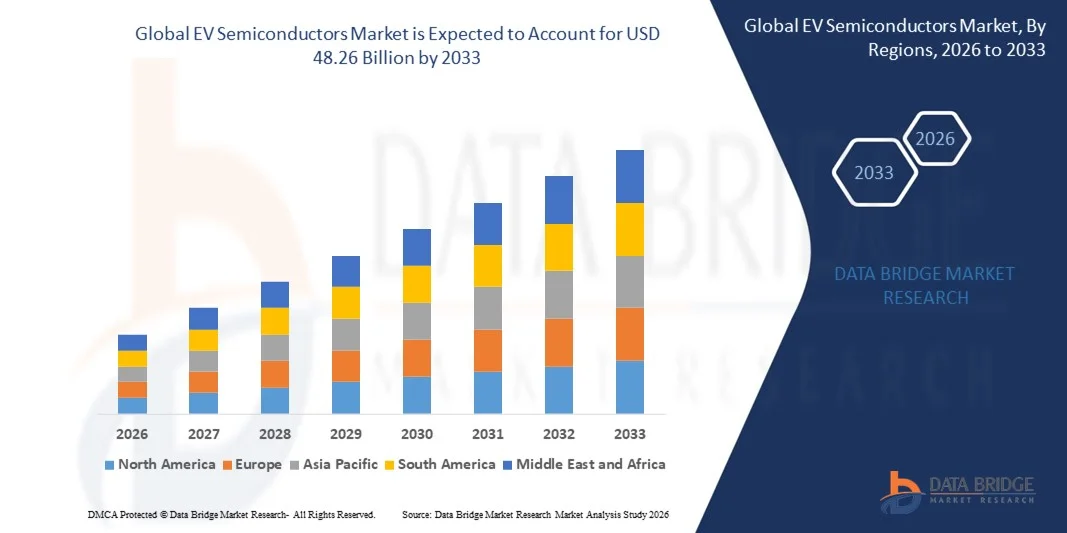
- As per Data Bridge Market Research Analysis the global EV Semiconductors Market was valued at USD 23.54 billion in 2025 and is projected to reach USD 48.26 billion by 2033, growing at a CAGR of 9.39% during the forecast period.
- This market expansion is primarily driven by the rising adoption of electric vehicles (EVs) and advancements in semiconductor technologies, which are crucial for enhancing the performance, efficiency, and safety of EVs.
- Additionally, increasing government regulations supporting EV adoption, coupled with consumer demand for eco-friendly transportation solutions, is accelerating the use of EV semiconductors, contributing significantly to the industry's robust growth.
Market Size & Forecast
- Global Market Value (2025): USD 23.54 billion
- Expected Market Value (2033): USD 48.26 billion
- Forecast CAGR (2026–2033): 9.39%
What are the Major Takeaways of Global EV Semiconductors Market Size Market?
- EV semiconductors, crucial for controlling power management, charging systems, and battery efficiency in electric vehicles (EVs), are becoming essential components in the automotive industry due to their role in enhancing EV performance, range, and safety.
- The growing demand for EV semiconductors is primarily driven by the increasing adoption of electric vehicles, advancements in battery technologies, and stricter environmental regulations pushing automakers toward more efficient and sustainable solutions.
- North America led the Global EV Semiconductors Market, capturing the largest revenue share of 34.6% in 2025, supported by a robust EV infrastructure, high consumer demand for electric vehicles, and the presence of key industry players. The U.S. continues to experience rapid growth in EV adoption, particularly in states with strong green initiatives and incentives for electric vehicle buyers.
- Asia-Pacific is expected to be the fastest-growing region in the Global EV Semiconductors Market during the forecast period, driven by rapid urbanization, government support for EV production, and increasing consumer demand for electric vehicles across countries like China, Japan, and South Korea.
- The Powertrain segment is expected to dominate the market, holding the largest market share of 62.5% in 2025, This is due to the critical role power semiconductors play in managing energy conversion, motor control, and efficiency in EV powertrains
Report Scope and Global EV Semiconductors Market Segmentation
|
Attributes |
EV Semiconductors Key Market Insights |
|
Segments Covered |
|
|
Countries Covered |
North America
Europe
Asia-Pacific
Middle East and Africa
South America
|
|
Key Market Players |
|
|
Market Opportunities |
|
|
Value Added Data Infosets |
In addition to the market insights such as market value, growth rate, market segments, geographical coverage, market players, and market scenario, the market report curated by the Data Bridge Market Research team includes in-depth expert analysis, import/export analysis, pricing analysis, production consumption analysis, and pestle analysis. |
What is the Key Trend in the Global EV Semiconductors Market Size Market?
Enhanced Performance Through AI and Voice Integration
- A significant and accelerating trend in the Global EV Semiconductors Market is the integration of artificial intelligence (AI) and voice-controlled ecosystems, such as Amazon Alexa, Google Assistant, and Apple Siri, into electric vehicle (EV) systems. This fusion of advanced technologies is improving vehicle performance, optimizing energy usage, and providing a more intuitive driving experience.
- For Instance, AI-powered EV semiconductors are enabling features such as intelligent battery management, adaptive driving modes, and predictive maintenance based on driving patterns. Voice control integration allows drivers to interact with their vehicles through voice commands, such as adjusting climate control, navigation, or even initiating charging sessions, offering a more hands-free experience.
- AI integration in EV systems enhances vehicle efficiency by learning from user behavior and optimizing energy consumption. For instance, some advanced EVs use AI to suggest the most efficient routes based on real-time traffic conditions or to adjust vehicle settings for optimal battery performance.
- The seamless integration of AI and voice assistants with connected EV platforms allows drivers to manage various vehicle functions alongside other smart home devices, such as lighting, security systems, and home energy management. This offers a unified and automated living and driving experience, making everyday interactions with technology more fluid and convenient.
- Companies like Tesla, BMW, and Audi are leveraging AI and voice control to offer more personalized driving experiences, such as automatic seat adjustments, real-time route optimization, and automated driving features. These innovations are revolutionizing the EV landscape, making vehicles smarter, safer, and more energy-efficient.
- The demand for AI and voice-enabled EV systems is growing rapidly as consumers seek more intelligent, responsive, and convenient features in their electric vehicles, reflecting a broader trend towards fully connected and automated transportation solutions.
Global EV Semiconductors Market Dynamics
Driver
Growing Need Due to Rising Adoption of Electric Vehicles and Environmental Concerns
- The increasing environmental awareness and growing preference for sustainable transportation are driving the heightened demand for electric vehicles (EVs), which in turn is accelerating the need for EV semiconductors. As governments implement stricter environmental regulations and offer incentives for EV adoption, the demand for semiconductors that optimize energy management, charging efficiency, and vehicle performance is rising.
- For instance, in March 2025, NXP Semiconductors announced advancements in automotive power management solutions, focusing on increasing the efficiency and range of electric vehicles. These innovations are expected to boost the EV semiconductor market during the forecast period.
- As consumers seek cleaner and more efficient modes of transport, EV semiconductors play a critical role in enhancing battery management systems, enabling fast charging, and improving the overall energy efficiency of electric vehicles, making them more appealing to environmentally conscious consumers.
- Additionally, the growing adoption of smart, connected EV ecosystems—which integrates autonomous driving features, real-time data collection, and vehicle-to-grid (V2G) capabilities—requires highly sophisticated semiconductor solutions. This convergence of advanced technologies is creating a demand for cutting-edge semiconductors that enable seamless connectivity and performance in electric vehicles.
- The convenience of electric mobility, coupled with the growing number of charging stations and improved range capabilities of electric vehicles, is accelerating the transition from traditional internal combustion engine (ICE) vehicles to electric vehicles. These shifts are propelling the market for EV semiconductors, which are vital for improving vehicle efficiency, safety, and functionality.
Restraint/Challenge
High Production Costs and Supply Chain Constraints
- One of the key challenges facing the Global EV Semiconductors Market is the high production costs associated with the manufacturing of advanced semiconductor chips for electric vehicles. The specialized nature of these chips, which are required for powertrain management, battery systems, and autonomous driving features, often leads to higher costs compared to traditional automotive semiconductors. This could hinder adoption, particularly in price-sensitive markets or among consumers hesitant to pay a premium for electric vehicles.
- For Instance, the cost of high-performance silicon carbide (SiC) and gallium nitride (GaN) chips, which are essential for the efficient operation of EV powertrains, remains significantly higher than traditional semiconductor materials, posing a challenge for widespread cost-effective adoption in the EV market.
- Furthermore, global supply chain constraints, exacerbated by factors like semiconductor shortages and geopolitical tensions, are affecting the timely delivery of essential semiconductor components, potentially leading to production delays for electric vehicles. These disruptions could slow down the overall growth of the EV semiconductor market, particularly in emerging regions.
- Addressing these challenges through advancements in semiconductor manufacturing, economies of scale, and improved supply chain management will be crucial for reducing costs and accelerating the adoption of EVs. Moreover, continued innovation in semiconductor materials and manufacturing processes will help bring down the price of EV components, making electric vehicles more affordable to a wider consumer base.
- While semiconductor prices are expected to decrease over time, especially with the scaling of production capabilities and the development of more cost-efficient materials, the high upfront costs and potential supply chain instability remain critical barriers to the widespread adoption of electric vehicles and EV semiconductors.
How is the Global EV Semiconductors Market Size Market Segmented?
The market is segmented on the basis of application, device type, Packaging Type, technology.
- By Application
The Global EV Semiconductors Market is segmented by application into Powertrain, Battery Management Systems (BMS), Infotainment Systems, Driver Assistance Systems (ADAS), and Body Control Systems. The Powertrain segment is expected to dominate the market, holding the largest market share of 62.5% in 2025. This is due to the critical role power semiconductors play in managing energy conversion, motor control, and efficiency in EV powertrains. Power semiconductors are essential for optimizing energy usage, reducing losses, and improving performance, which makes them crucial in the growing EV market.
The Battery Management Systems (BMS) segment, however, is anticipated to experience the fastest growth rate during the forecast period, driven by the increasing demand for better battery management solutions for electric vehicles. BMS plays a key role in ensuring efficient charging, discharging, and overall battery health, which is critical as EVs continue to scale.
- By Device Type
The Global EV Semiconductors Market is segmented by device type into Power Semiconductor Devices, Analog Semiconductor Devices, Digital Semiconductor Devices, MEMS Sensors, and Microcontrollers. The Power Semiconductor Devices segment is projected to dominate the market, holding the largest revenue share in 2025. Power semiconductor devices, such as silicon carbide (SiC) and gallium nitride (GaN), are key to EV applications because they enable faster power conversion, better thermal management, and higher efficiency, especially in powertrains and charging systems.
The MEMS Sensors segment, however, is expected to witness the fastest growth during the forecast period. MEMS sensors are crucial in ADAS (Advanced Driver Assistance Systems), helping EVs with real-time data on vehicle dynamics, temperature, and safety systems, thus enhancing both performance and safety.
- By Packaging Type
On the basis of packaging type, The Global EV Semiconductors Market is segmented by packaging type into Surface Mount Technology (SMT), Through-Hole Technology, Chip-on-Board (COB), Ball Grid Array (BGA), and Dual In-line Package (DIP). The Surface Mount Technology (SMT) segment is expected to hold the largest market share in 2025, primarily due to its widespread use in automotive electronics, where compact and reliable packaging solutions are essential.
SMT is ideal for high-volume manufacturing, offering cost-effectiveness, ease of integration, and reliability in power management, battery systems, and motor controllers in EVs. The Chip-on-Board (COB) segment is anticipated to experience the fastest growth due to its improved thermal management and reduced size, making it ideal for high-power devices such as inverters and electric motor controllers used in EVs.
- By Technology
On the basis of technology, The Global EV Semiconductors Market is segmented by technology into Silicon, Silicon Carbide (SiC), Gallium Nitride (GaN), Mixed-Signal Technology, and Analog Technology. The Silicon segment is projected to dominate the market, holding the largest share in 2025, as silicon-based semiconductors are widely used in power management, battery systems, and vehicle control electronics. Silicon remains the go-to material due to its established reliability and cost-effectiveness.
the Silicon Carbide (SiC) and Gallium Nitride (GaN) segments are expected to witness the fastest growth, driven by their ability to handle high voltages, improve efficiency, and enable faster switching, which are vital for next-generation EV applications, such as fast-charging systems, powertrains, and motor control systems.
Global EV Semiconductors Market Regional Analysis
- North America is expected to dominate the Global EV Semiconductors Market with the largest revenue share of 34.6% in 2025, driven by strong government incentives, the growing adoption of electric vehicles (EVs), and a well-established automotive industry.
- The region benefits from high consumer demand for sustainable transportation solutions, coupled with significant advancements in EV infrastructure, including charging stations and battery technology. The increasing shift towards clean energy, alongside the rapid growth of electric mobility, is fueling market growth in North America.
- This growth is further supported by a robust presence of major automotive manufacturers and semiconductor companies, as well as technological innovation in powertrain and battery management systems, making North America a key player in the global EV semiconductors market. The region's focus on reducing carbon emissions and improving energy efficiency positions it as a leader in EV semiconductor adoption.
U.S. EV Semiconductors Market Insight
The U.S. EV semiconductors market is projected to capture the largest revenue share in North America, driven by strong government incentives for electric vehicles (EVs) and the rapid expansion of EV infrastructure. Consumers in the U.S. are increasingly prioritizing the adoption of electric mobility, fueled by environmental concerns and the growing push for sustainability. The demand for advanced powertrain systems, battery management solutions, and autonomous vehicle technologies is further accelerating the market. Additionally, U.S. automakers and semiconductor companies are investing heavily in the development of next-generation EV technologies, which is driving growth in the EV semiconductor sector. The integration of EVs with connected car technologies and energy-efficient components is expected to continue stimulating market expansion throughout the forecast period.
Europe EV Semiconductors Market Insight
The Europe EV semiconductors market is projected to grow at a robust CAGR during the forecast period, supported by stringent emissions regulations and an increasing commitment to reducing carbon footprints. The European Union's strong regulatory framework, along with government subsidies for electric vehicle purchases and infrastructure development, is creating favorable conditions for EV adoption. Additionally, the region’s emphasis on sustainability and innovation, particularly in countries like Germany, France, and the Netherlands, is driving the need for high-performance EV components, including semiconductors for power conversion, battery management, and energy-efficient systems. Europe is also seeing a rise in demand for EVs across both passenger and commercial vehicles, which is fueling the market for EV semiconductors.
U.K. EV Semiconductors Market Insight
The U.K. EV semiconductors market is anticipated to witness significant growth during the forecast period, driven by the country’s ambitious carbon neutrality goals and growing demand for electric mobility. The U.K. government’s aggressive push to phase out gasoline and diesel vehicles by 2025 is expected to accelerate EV adoption, subsequently increasing demand for advanced semiconductor solutions. Moreover, the rise in infrastructure investments, including electric vehicle charging stations, along with increasing consumer awareness of electric mobility, is further driving the market. The U.K.’s focus on innovation, sustainability, and the development of next-gen EV technology will continue to play a crucial role in the expansion of the EV semiconductor market.
Germany EV Semiconductors Market Insight
Germany is expected to expand its EV semiconductors market at a strong pace, driven by the country’s leadership in automotive manufacturing and its commitment to electric mobility. As one of the largest automotive hubs in the world, Germany is experiencing substantial investments in EV production, with many leading German automakers shifting towards electric vehicles. The demand for semiconductors in powertrain systems, battery management, and energy storage solutions is increasing as Germany accelerates the adoption of electric cars. The government’s green initiatives, such as subsidies for EV purchases and incentives for manufacturers to switch to electric powertrains, further bolster market growth. Additionally, the country’s emphasis on high-performance, energy-efficient solutions makes it a key market for EV semiconductors.
Asia-Pacific EV Semiconductors Market Insight
The Asia-Pacific EV semiconductors market is expected to grow at the fastest CAGR during the forecast period, driven by rapid urbanization, rising disposable incomes, and a booming EV market in countries like China, Japan, and South Korea. Government policies in these countries promoting electric vehicle adoption, along with increasing investments in EV infrastructure, are driving semiconductor demand. Asia-Pacific’s significant manufacturing capacity for both EVs and semiconductor components further strengthens the market position. With China leading the way in EV production and adoption, followed by Japan and South Korea’s technological advancements, the region is set to become the largest consumer of EV semiconductors globally.
Japan EV Semiconductors Market Insight
Japan’s EV semiconductors market is witnessing substantial growth, driven by the country’s strong focus on innovation, environmental sustainability, and electric vehicle adoption. Japan's automotive industry, home to leading EV manufacturers such as Toyota, Honda, and Nissan, is embracing advanced semiconductor technologies for powertrain, battery management, and autonomous driving systems. The country’s push for green energy and the development of EV charging infrastructure is further supporting the growth of the market. Additionally, Japan's aging population is contributing to the demand for electric mobility solutions, as EVs are seen as more sustainable and cost-efficient options for transportation, fueling the need for EV semiconductor technologies.
China EV Semiconductors Market Insight
China captured the largest market revenue share in Asia-Pacific for EV semiconductors in 2025, thanks to its rapid urbanization, expanding middle class, and strong governmental support for electric vehicles. As the world’s largest EV market, China is driving the adoption of electric vehicles through various incentives, subsidies, and ambitious environmental policies aimed at reducing carbon emissions. Additionally, China’s well-established domestic semiconductor industry, combined with a growing number of EV manufacturers, supports the increasing demand for high-performance semiconductors in powertrain systems, battery management, and energy storage. With the nation’s emphasis on becoming a global leader in electric mobility, China remains a key driver of the global EV semiconductor market.
Which are the Top Companies in Global EV Semiconductors Market Scope Market?
The EV Semiconductors industry is primarily led by well-established companies, including:
- NXP Semiconductors (Netherlands)
- Infineon Technologies (Germany)
- ON Semiconductor (U.S.)
- Qualcomm Technologies (U.S.)
- STMicroelectronics (Switzerland)
- Texas Instruments (U.S.)
- Analog Devices (U.S.)
- Renesas Electronics (Japan)
- Microchip Technology (U.S.)
- Vishay Intertechnology (U.S.)
- Mitsubishi Electric (Japan)
- Toshiba Corporation (Japan)
- Broadcom Inc. (U.S.)
- Marvell Technology (U.S.)
- Maxim Integrated (U.S.)
- Semikron (Germany)
- Rohm Semiconductor (Japan)
- Microsemi Corporation (U.S.)
- Infineon Technologies (Germany)
- Cree, Inc. (U.S.)
What are the Recent Developments in Global EV Semiconductors Market?
- In April 2024, NXP Semiconductors, a global leader in semiconductor solutions, launched a strategic initiative in China aimed at advancing electric vehicle (EV) technology through the development of next-generation semiconductor components. This initiative underscores the company’s commitment to powering the EV revolution by providing advanced chips for powertrain systems, battery management, and autonomous driving solutions. By leveraging its cutting-edge innovations, NXP is addressing the growing demand for high-performance, energy-efficient solutions in the rapidly expanding Chinese EV market, further solidifying its position in the global EV semiconductors sector.
- In March 2024, Infineon Technologies, a global leader in power semiconductors, introduced a new line of silicon carbide (SiC) semiconductors tailored for electric vehicles, specifically designed to optimize power conversion efficiency in EV powertrains and charging systems. This innovation highlights Infineon’s dedication to providing sustainable, high-performance solutions that enhance the efficiency of electric vehicles. The launch reinforces the company’s focus on driving the shift to electric mobility by offering advanced semiconductor technologies that support longer battery life and faster charging for EVs.
- In March 2024, Qualcomm Technologies, Inc., a leader in wireless technologies, successfully demonstrated its next-generation automotive chipset platform at the Mobile World Congress (MWC) 2024, showcasing the integration of 5G connectivity in electric vehicles. This platform is designed to support autonomous driving, advanced driver assistance systems (ADAS), and in-vehicle connectivity, significantly enhancing the overall driving experience for EV owners. Qualcomm's technological advancements contribute to the growing need for sophisticated semiconductor solutions that enable smarter, connected electric vehicles, further positioning the company as a key player in the global EV semiconductor market.
- In February 2024, STMicroelectronics, a leading semiconductor manufacturer, announced a strategic partnership with Tesla Inc. to develop cutting-edge power semiconductors for the next generation of electric vehicles. This collaboration is aimed at enhancing the performance and efficiency of EV powertrains through advanced materials like silicon carbide (SiC) and gallium nitride (GaN), improving the overall energy efficiency and driving range of Tesla’s electric cars. The partnership reflects STMicroelectronics’ commitment to supporting the global EV transition by providing high-performance semiconductor solutions that meet the growing demands of electric mobility.
- In January 2024, ON Semiconductor, a global supplier of advanced semiconductor solutions, unveiled a new line of energy-efficient power semiconductor modules at the CES 2024. These modules are designed to optimize power distribution in electric vehicles, including electric buses and trucks, offering greater energy efficiency and cost savings. ON Semiconductor’s innovative solutions contribute to the advancement of electrification in the transportation sector, supporting the global shift towards sustainable and electric mobility by offering highly reliable and efficient power semiconductor solutions for commercial EVs.

- Interactive Data Analysis Dashboard
- Company Analysis Dashboard for high growth potential opportunities
- Research Analyst Access for customization & queries
- Competitor Analysis with Interactive dashboard
- Latest News, Updates & Trend analysis
- Harness the Power of Benchmark Analysis for Comprehensive Competitor Tracking
Data collection and base year analysis are done using data collection modules with large sample sizes. The stage includes obtaining market information or related data through various sources and strategies. It includes examining and planning all the data acquired from the past in advance. It likewise envelops the examination of information inconsistencies seen across different information sources. The market data is analysed and estimated using market statistical and coherent models. Also, market share analysis and key trend analysis are the major success factors in the market report. To know more, please request an analyst call or drop down your inquiry.
The key research methodology used by DBMR research team is data triangulation which involves data mining, analysis of the impact of data variables on the market and primary (industry expert) validation. Data models include Vendor Positioning Grid, Market Time Line Analysis, Market Overview and Guide, Company Positioning Grid, Patent Analysis, Pricing Analysis, Company Market Share Analysis, Standards of Measurement, Global versus Regional and Vendor Share Analysis. To know more about the research methodology, drop in an inquiry to speak to our industry experts.
Data Bridge Market Research is a leader in advanced formative research. We take pride in servicing our existing and new customers with data and analysis that match and suits their goal. The report can be customized to include price trend analysis of target brands understanding the market for additional countries (ask for the list of countries), clinical trial results data, literature review, refurbished market and product base analysis. Market analysis of target competitors can be analyzed from technology-based analysis to market portfolio strategies. We can add as many competitors that you require data about in the format and data style you are looking for. Our team of analysts can also provide you data in crude raw excel files pivot tables (Fact book) or can assist you in creating presentations from the data sets available in the report.













