


Exosome Manufacturing Services Market Overview
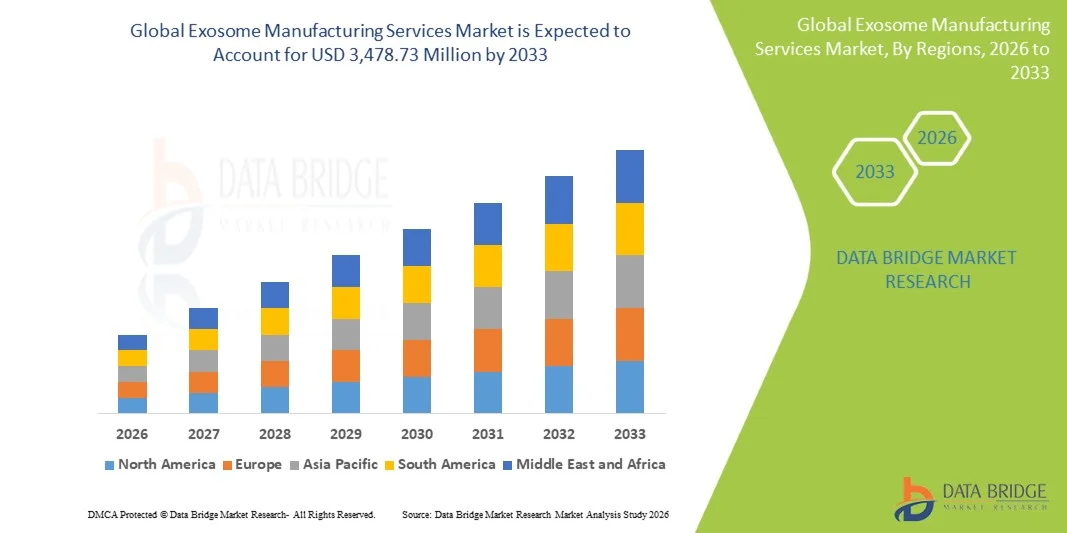
As per Data Bridge Market Research analysis The Exosome Manufacturing Services Market was valued at USD 964.00 million in 2025 and is projected to reach USD 3,478.73 million by 2033, growing at a CAGR of 17.40% from 2026 to 2033. The market is experiencing robust growth driven by increasing investments in exosome-based therapeutics, rising demand for scalable and GMP-compliant manufacturing solutions, and expanding research activities in regenerative medicine, oncology, and targeted drug delivery.
The growing adoption of exosomes as promising therapeutic and diagnostic tools, coupled with the increasing number of clinical trials evaluating exosome-based products, is encouraging biotechnology and pharmaceutical companies to outsource manufacturing operations to specialized service providers. Advances in exosome isolation, purification, characterization, and large-scale production technologies are further supporting market expansion. In addition, stringent regulatory requirements and the need for standardized, high-quality manufacturing processes are accelerating demand for specialized exosome manufacturing services across research, clinical, and commercial applications.
Key Market Trends & Insights
- North America dominated the Exosome Manufacturing Services Market with the largest revenue share of 38.46% in 2025, supported by a strong biotechnology ecosystem, increasing clinical-stage exosome programs, and the presence of leading CDMOs and biopharmaceutical companies.
- The GMP Manufacturing Services segment led the market with a 36.84% share in 2025, driven by the increasing number of clinical-stage exosome therapeutics requiring regulatory-compliant production.
- Asia-Pacific is expected to be the fastest-growing region at a CAGR of 16.4% from 2026 to 2033, fueled by expanding cell and gene therapy research, rising biotechnology investments, and increasing outsourcing activities across China, Japan, South Korea, and India.
- Exosome Isolation Services are the fastest-growing service type, projected to register a CAGR of 16.1%, reflecting the surge in demand for high-yield and reproducible exosome recovery technologies.
- The Bioreactor-Based Production segment dominated the production technology category with a 42.37% revenue share in 2025, led by its ability to support large-scale, standardized, and cost-efficient exosome manufacturing.
- Therapeutics accounted for 44.27% of the market, preferred by growing clinical development of exosome-based treatments for oncology, neurological disorders, inflammatory diseases, and regenerative medicine.
- The Drug Delivery segment is the fastest-growing application category, with a CAGR of 17.3%, driven by increasing interest in exosomes as targeted delivery vehicles for nucleic acids, proteins, and small-molecule therapeutics.
Market Size & Forecast
- Global Market Value (2025): USD 964.00 Million
- Expected Market Value (2033): USD 3,478.73 Million
- Forecast CAGR (2026–2033): 17.40%
- Leading Region in 2025: North America
- Fastest Growing Region: Asia Pacific
Report Scope and Exosome Manufacturing Services Market Segmentation
|
Attributes |
Exosome Manufacturing Services Key Market Insights |
|
Segments Covered |
|
|
Countries Covered |
North America · U.S. · Canada · Mexico Europe · Germany · France · U.K. · Netherlands · Switzerland · Belgium · Russia · Italy · Spain · Turkey · Rest of Europe Asia-Pacific · China · Japan · India · South Korea · Singapore · Malaysia · Australia · Thailand · Indonesia · Philippines · Rest of Asia-Pacific Middle East and Africa · Saudi Arabia · U.A.E. · South Africa · Egypt · Israel · Rest of Middle East and Africa South America · Brazil · Argentina · Rest of South America |
|
Key Market Players |
· Lonza Group Ltd (Switzerland) · Thermo Fisher Scientific Inc. (U.S.) · Sartorius AG (Germany) · Merck KGaA (Germany) · Danaher Corporation (U.S.) · RoosterBio, Inc. (U.S.) · Evox Therapeutics Ltd (U.K.) · Exopharm Limited (Australia) · EverZom SAS (France) · Ciloa SAS (France) · Anjarium Biosciences AG (Switzerland) · ExoCoBio Inc. (South Korea) · Unicyte AG (Switzerland) · Capricor Therapeutics, Inc. (U.S.) · System Biosciences LLC (U.S.) · Creative Biolabs (U.S.) · Creative Bioarray (U.S.) · Takara Bio Inc. (Japan) · NanoSomiX Inc. (U.S.) |
|
Market Opportunities |
· Expansion of exosome-based drug delivery platforms · Growing commercialization of exosome therapeutics · Increasing adoption of exosomes in regenerative medicine and tissue repair |
|
Value Added Data Infosets |
In addition to the insights on market scenarios such as market value, growth rate, segmentation, geographical coverage, and major players, the market reports curated by the Data Bridge Market Research also include in-depth expert analysis, patient epidemiology, pipeline analysis, pricing analysis, and regulatory framework. |
Exosome Manufacturing Services Market Trends
Trend: Increasing Outsourcing of Exosome Manufacturing by Biopharmaceutical Companies
Biotechnology and pharmaceutical companies are increasingly outsourcing exosome development and manufacturing activities to specialized service providers to access advanced production technologies, GMP-compliant facilities, and regulatory expertise without making substantial infrastructure investments. Contract manufacturers are expanding capabilities in exosome isolation, purification, characterization, and scale-up production to support growing clinical pipelines. The trend is further strengthened by the need for standardized manufacturing processes, faster development timelines, and cost-efficient commercialization strategies for exosome-based therapeutics and diagnostics.
For instance, in June 2024, Lonza expanded its advanced therapy manufacturing capabilities, supporting growing industry demand for outsourced production solutions across emerging biologics and extracellular vesicle-based therapeutic programs.
Exosome Manufacturing Services Market Dynamics
Key Market Driver: Rising Clinical Development of Exosome-Based Therapeutics
The increasing number of clinical and preclinical programs focused on exosome-based therapeutics has created substantial demand for specialized manufacturing services capable of delivering scalable, reproducible, and regulatory-compliant production. Biotechnology companies, research institutions, and pharmaceutical developers are relying on manufacturing partners to support process development, analytical characterization, and GMP production while accelerating product development timelines and ensuring consistent product quality across therapeutic applications.
For instance, in January 2025, Aegle Therapeutics continued advancing clinical development activities for exosome-based therapies, highlighting the growing requirement for specialized manufacturing infrastructure and production expertise.
Key Restraint/Challenge: Lack of Standardized Manufacturing and Regulatory Frameworks
A significant restraint in the Exosome Manufacturing Services Market is the absence of universally accepted standards for exosome isolation, characterization, potency assessment, and large-scale production. Variability in source materials, manufacturing methods, and analytical techniques creates challenges in ensuring batch-to-batch consistency and regulatory compliance. The evolving regulatory landscape also increases development complexity, validation requirements, and commercialization timelines for both service providers and therapeutic developers.
For instance, ongoing regulatory discussions by organizations such as the International Society for Extracellular Vesicles continue to emphasize the need for standardized methodologies and quality benchmarks across exosome development and manufacturing activities.
Key Market Opportunity: Expansion of Exosome-Based Drug Delivery Platforms
The growing use of exosomes as targeted drug delivery vehicles presents a significant market opportunity for manufacturing service providers. Exosomes offer advantages including biocompatibility, low immunogenicity, and the ability to transport therapeutic payloads across biological barriers, driving increased investment in scalable production technologies. Service providers capable of supporting exosome engineering, cargo loading, analytical testing, and commercial-scale manufacturing are well positioned to benefit from the expanding therapeutic pipeline.
For instance, in 2024, Evox Therapeutics continued advancing engineered exosome delivery technologies, demonstrating growing industry interest in exosome-enabled drug delivery applications and associated manufacturing service requirements.
Exosome Manufacturing Services Market Scope
The exosome manufacturing services market is segmented on the basis of service type, production technology, application, and end user.
- By Service Type
On the basis of service type, the Exosome Manufacturing Services Market is segmented into exosome isolation services, exosome purification services, exosome characterization & analytical testing, exosome engineering & modification services, process development services, GMP manufacturing services, fill-finish & packaging services, and quality control & regulatory support services. The GMP Manufacturing Services segment dominated the market with a 36.84% share in 2025, owing to the increasing number of clinical-stage exosome therapeutics requiring regulatory-compliant production. Biopharmaceutical companies are increasingly outsourcing GMP manufacturing to specialized service providers with validated facilities and quality systems. The segment plays a critical role in ensuring product consistency, scalability, and compliance with regulatory requirements. Growing investments in cell-free therapies and extracellular vesicle research are further strengthening demand. The expansion of clinical trials involving exosome-based products is also driving manufacturing volumes. The need for commercial-scale production capabilities continues to support the segment’s market leadership.
The Exosome Isolation Services segment is projected to register the fastest growth at a CAGR of 16.1% from 2026 to 2033, driven by increasing demand for high-yield and reproducible exosome recovery technologies. Isolation remains one of the most technically challenging stages in exosome manufacturing and directly impacts product quality. Advances in ultracentrifugation, filtration, chromatography, and microfluidic technologies are improving process efficiency. Growing therapeutic and diagnostic applications are increasing the need for scalable isolation solutions. Research organizations and biotechnology companies are investing heavily in optimized isolation workflows to enhance downstream performance. The rising focus on standardized manufacturing processes is expected to accelerate segment growth throughout the forecast period.
- By Production Technology
On the basis of production technology, the Exosome Manufacturing Services Market is segmented into 2D cell culture, 3D cell culture, bioreactor-based production, and suspension cell culture. The Bioreactor-Based Production segment dominated the market with a 42.37% share in 2025 due to its ability to support large-scale, standardized, and cost-efficient exosome manufacturing. Bioreactors enable higher cell densities and improved exosome yields compared to traditional culture methods. They provide better control over environmental conditions, ensuring consistent product quality and reproducibility. Increasing demand for clinical-grade and commercial-scale production is driving adoption among manufacturing service providers. The technology also supports automation and process optimization, reducing operational variability. Its scalability makes it the preferred production platform for advanced therapeutic development programs.
The 3D Cell Culture segment is expected to witness the fastest growth at a CAGR of 16.8% from 2026 to 2033, driven by its ability to more closely replicate physiological cellular environments. Compared with conventional 2D systems, 3D cultures often produce exosomes with enhanced biological activity and improved therapeutic relevance. Researchers are increasingly adopting this technology to improve exosome yield and functionality. The growing focus on regenerative medicine and precision therapeutics is supporting broader utilization. Continuous innovations in scaffold-based and scaffold-free culture systems are expanding commercial viability. Increasing investment in next-generation manufacturing platforms is expected to accelerate adoption across the industry.
- By Application
On the basis of application, the Exosome Manufacturing Services Market is segmented into therapeutics, drug delivery, regenerative medicine, diagnostics & biomarker discovery, vaccine development, and research applications. The Therapeutics segment led the market with a 44.27% share in 2025, driven by growing clinical development of exosome-based treatments for oncology, neurological disorders, inflammatory diseases, and regenerative medicine. Exosomes are increasingly recognized for their natural cell-to-cell communication capabilities and favorable safety profiles. Pharmaceutical and biotechnology companies are investing heavily in therapeutic pipelines utilizing exosome technologies. The rising number of clinical trials is generating strong demand for manufacturing and process development services. Regulatory progress in advanced therapies is also encouraging commercialization efforts. These factors continue to reinforce the segment’s dominant market position.
The Drug Delivery segment is projected to register the fastest growth at a CAGR of 17.3% from 2026 to 2033, fueled by increasing interest in exosomes as targeted delivery vehicles for nucleic acids, proteins, and small-molecule therapeutics. Their ability to cross biological barriers and deliver payloads with reduced toxicity offers significant advantages over conventional delivery systems. Growing research into engineered exosomes is expanding potential applications across multiple disease areas. Pharmaceutical developers are exploring exosome-based platforms to improve therapeutic efficacy and patient outcomes. Advancements in cargo-loading technologies are further strengthening commercial potential. Rising investments in precision medicine and targeted therapies are expected to drive rapid segment expansion.
- By End User
On the basis of end user, the Exosome Manufacturing Services Market is segmented into biotechnology companies, pharmaceutical companies, academic & research institutes, contract development and manufacturing organizations, and hospitals & clinical research centers. The Biotechnology Companies segment dominated the market with a 52.34% share in 2025, owing to their extensive involvement in exosome research, product development, and clinical translation activities. Many emerging biotechnology firms lack in-house manufacturing infrastructure and rely on specialized service providers for production and analytical support. Increasing venture capital funding and strategic partnerships are accelerating exosome-based innovation. These companies represent a significant portion of the global clinical pipeline for extracellular vesicle therapeutics. Their need for scalable and compliant manufacturing solutions continues to generate strong outsourcing demand. The segment remains the primary revenue contributor across the market.
The Contract Development and Manufacturing Organizations (CDMOs) segment is expected to witness the fastest growth at a CAGR of 16.9% from 2026 to 2033, driven by increasing outsourcing trends across the biopharmaceutical industry. CDMOs are expanding their capabilities to support exosome isolation, characterization, process development, GMP manufacturing, and regulatory compliance. Growing complexity of exosome production is encouraging developers to partner with specialized manufacturing experts. Rising demand for flexible and scalable production capacity is further supporting market growth. Strategic investments in advanced therapy manufacturing facilities are strengthening service offerings. The expanding commercialization of exosome-based products is expected to create substantial opportunities for CDMOs over the forecast period.
Exosome Manufacturing Services Market Regional Analysis
North America dominated the Exosome Manufacturing Services Market with the largest revenue share of 38.46% in 2025, supported by a strong biotechnology ecosystem, increasing clinical-stage exosome programs, and the presence of leading CDMOs and biopharmaceutical companies. The region also benefits from advanced research infrastructure, increasing clinical trial activity, and growing adoption of GMP-compliant exosome production technologies. Rising demand for outsourced manufacturing services across regenerative medicine, oncology, and drug delivery applications continues to accelerate market growth. Increasing funding for extracellular vesicle research and expanding commercialization of exosome-based products further strengthen North America's leadership position in the global market.
U.S. Exosome Manufacturing Services Market Insight
The U.S. exosome manufacturing services market is witnessing strong growth due to rising investments in exosome-based therapeutics, regenerative medicine research, and advanced drug delivery technologies. The country’s mature biotechnology ecosystem, along with increasing adoption of GMP-compliant manufacturing platforms and specialized analytical services, is driving demand across clinical and commercial applications. In addition, growing numbers of clinical trials and increasing outsourcing of manufacturing activities are accelerating demand for exosome production, characterization, and process development services across biotechnology and pharmaceutical companies.
Europe Exosome Manufacturing Services Market Insight
The Europe exosome manufacturing services market remains a major contributor to global revenue, driven by strong research funding, technological innovation, and high demand for advanced biologics manufacturing solutions. The widespread development of exosome-based therapeutics across oncology, regenerative medicine, and rare disease applications is supporting market expansion across the region. Increasing investments in GMP manufacturing infrastructure, coupled with evolving regulatory frameworks and a highly skilled scientific workforce, continue to enhance the adoption of exosome manufacturing services throughout Europe.
U.K. Exosome Manufacturing Services Market Insight
The U.K. exosome manufacturing services market is experiencing steady growth, supported by rising adoption of exosome technologies in therapeutic development, translational research, and precision medicine applications. Increasing investments in advanced bioprocessing infrastructure and growing demand for scalable, regulatory-compliant manufacturing solutions are contributing to market growth. Furthermore, integration of innovative isolation, purification, and characterization technologies is improving manufacturing efficiency and product quality, positioning the U.K. as a key innovation hub in the exosome manufacturing services industry.
Germany Exosome Manufacturing Services Market Insight
The Germany exosome manufacturing services market is expanding steadily due to the country’s strong biotechnology sector, advanced research capabilities, and increasing adoption of next-generation biomanufacturing technologies. Biotechnology companies, pharmaceutical organizations, and research institutes are increasingly utilizing specialized manufacturing services for exosome production, analytical testing, and process optimization activities. Continuous advancements in bioprocess engineering, scalable manufacturing platforms, and quality control technologies, along with strong government support for life sciences innovation, are further driving market growth in Germany.
Asia-Pacific Exosome Manufacturing Services Market Insight
The Asia-Pacific exosome manufacturing services market is expected to witness rapid growth, driven by increasing biotechnology investments, expanding clinical research activities, and rising demand for advanced therapeutic development across countries such as China, India, Japan, and South Korea. Growing awareness regarding exosome-based therapies, rising adoption of specialized manufacturing technologies, and increasing demand for cost-effective outsourcing solutions are supporting regional market expansion. In addition, the growing presence of biopharmaceutical companies and contract manufacturing organizations is accelerating exosome manufacturing service adoption across commercial and academic sectors.
Japan Exosome Manufacturing Services Market Insight
The Japan exosome manufacturing services market is witnessing consistent growth due to rising investments in regenerative medicine, advanced therapeutics, and precision healthcare initiatives. Biotechnology companies, pharmaceutical manufacturers, and research institutes are increasingly adopting specialized exosome manufacturing services for product development, clinical studies, and commercialization purposes. Moreover, increasing integration of advanced cell culture technologies and the country’s focus on innovative healthcare solutions are further contributing to market growth.
China Exosome Manufacturing Services Market Insight
The China exosome manufacturing services market is growing rapidly, driven by increasing biotechnology research, expanding biopharmaceutical manufacturing infrastructure, and rising government support for advanced therapeutic development. Growing adoption of scalable exosome production technologies across biotechnology, pharmaceutical, and academic sectors is significantly boosting market demand. In addition, rising investments in regenerative medicine, increasing clinical trial activity, and rapid advancements in bioprocessing technologies are positioning China as one of the fastest-growing markets for exosome manufacturing services globally.
Exosome Manufacturing Services Market Share
The exosome manufacturing services industry is primarily led by well-established companies, including:
- Lonza Group Ltd (Switzerland)
- Thermo Fisher Scientific Inc. (U.S.)
- Sartorius AG (Germany)
- Merck KGaA (Germany)
- Danaher Corporation (U.S.)
- RoosterBio, Inc. (U.S.)
- Evox Therapeutics Ltd (U.K.)
- Exopharm Limited (Australia)
- EverZom SAS (France)
- Ciloa SAS (France)
- Anjarium Biosciences AG (Switzerland)
- ExoCoBio Inc. (South Korea)
- Unicyte AG (Switzerland)
- Capricor Therapeutics, Inc. (U.S.)
- System Biosciences LLC (U.S.)
- Creative Biolabs (U.S.)
- Creative Bioarray (U.S.)
- Takara Bio Inc. (Japan)
- NanoSomiX Inc. (U.S.)
Latest Developments in Exosome Manufacturing Services Market
- In May 2024, Lonza, a global leader in life sciences manufacturing services, continued expansion of its cell and gene therapy manufacturing infrastructure, strengthening capabilities relevant to extracellular vesicle and exosome production services. The expansion includes enhanced GMP-compliant facilities, process development platforms, and analytical technologies to support advanced biologics manufacturing. This development reflects increasing global demand for scalable manufacturing solutions for emerging therapeutic modalities, including exosome-based therapies
- In March 2023, Exopharm, an Australian biotechnology company specializing in exosome purification technologies, advanced commercialization of its LEAP (Ligand-based Exosome Affinity Purification) platform designed for scalable and high-purity exosome manufacturing. The technology improves isolation efficiency, purity levels, and batch-to-batch consistency, addressing key bottlenecks in downstream processing of extracellular vesicles. This development supports the growing need for industrial-grade purification systems in exosome manufacturing services
- In July 2022, RoosterBio, a biotechnology company focused on scalable cell and exosome manufacturing technologies, announced expansion of its extracellular vesicle production capabilities to support clinical-scale manufacturing of MSC-derived exosome therapies. The company enhanced its bioprocessing systems to improve yield, scalability, and reproducibility of exosome production for regenerative medicine applications. This development reflects the rising demand for standardized and industrial-scale exosome manufacturing platforms to support clinical translation
- In November 2021, AstraZeneca, a global biopharmaceutical company, announced a strategic collaboration with Evox Therapeutics, a biotechnology company specializing in exosome-based drug delivery, to develop next-generation engineered exosome therapeutics targeting rare and severe diseases. The partnership focuses on leveraging Evox’s exosome engineering platform to enable targeted delivery of RNA and protein-based therapies. This collaboration highlights the increasing interest of major pharmaceutical players in exosome-based drug delivery systems and the growing need for scalable manufacturing and development services to support clinical translation of extracellular vesicle technologies
- In October 2021, Lonza, a leading global contract development and manufacturing organization, expanded its extracellular vesicle and exosome analytical capabilities through collaboration with NanoView Biosciences, a company specializing in EV imaging and characterization technologies. The initiative aimed to enhance high-resolution characterization of exosomes to improve quality control, reproducibility, and regulatory compliance in exosome-based therapeutic development. This development underscores the growing importance of advanced analytical tools in exosome manufacturing services, particularly for ensuring product consistency and addressing heterogeneity challenges in clinical-grade production

- Interactive Data Analysis Dashboard
- Company Analysis Dashboard for high growth potential opportunities
- Research Analyst Access for customization & queries
- Competitor Analysis with Interactive dashboard
- Latest News, Updates & Trend analysis
- Harness the Power of Benchmark Analysis for Comprehensive Competitor Tracking
Data collection and base year analysis are done using data collection modules with large sample sizes. The stage includes obtaining market information or related data through various sources and strategies. It includes examining and planning all the data acquired from the past in advance. It likewise envelops the examination of information inconsistencies seen across different information sources. The market data is analysed and estimated using market statistical and coherent models. Also, market share analysis and key trend analysis are the major success factors in the market report. To know more, please request an analyst call or drop down your inquiry.
The key research methodology used by DBMR research team is data triangulation which involves data mining, analysis of the impact of data variables on the market and primary (industry expert) validation. Data models include Vendor Positioning Grid, Market Time Line Analysis, Market Overview and Guide, Company Positioning Grid, Patent Analysis, Pricing Analysis, Company Market Share Analysis, Standards of Measurement, Global versus Regional and Vendor Share Analysis. To know more about the research methodology, drop in an inquiry to speak to our industry experts.
Data Bridge Market Research is a leader in advanced formative research. We take pride in servicing our existing and new customers with data and analysis that match and suits their goal. The report can be customized to include price trend analysis of target brands understanding the market for additional countries (ask for the list of countries), clinical trial results data, literature review, refurbished market and product base analysis. Market analysis of target competitors can be analyzed from technology-based analysis to market portfolio strategies. We can add as many competitors that you require data about in the format and data style you are looking for. Our team of analysts can also provide you data in crude raw excel files pivot tables (Fact book) or can assist you in creating presentations from the data sets available in the report.












