


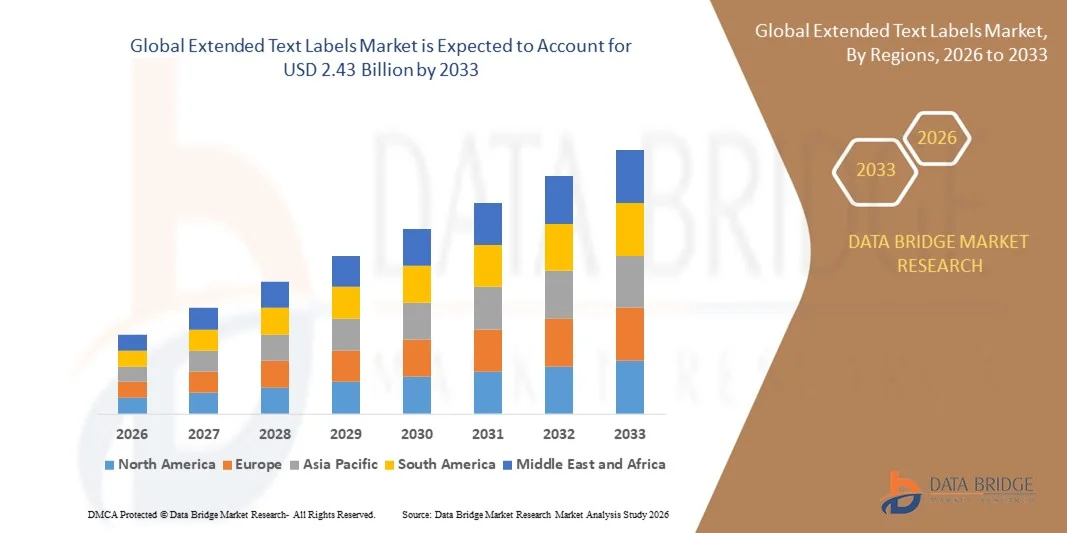
Extended Text Labels Market Size
- The global extended text labels market size was valued at USD 1.66 billion in 2025 and is expected to reach USD 2.43 billion by 2033, at a CAGR of 4.85% during the forecast period
- The market growth is largely fueled by the increasing demand for detailed, durable, and compliant labeling across pharmaceuticals, food and beverages, and chemical products, driving manufacturers to adopt advanced extended text labels that provide multilayered information and tamper-evident features
- Furthermore, rising regulatory requirements, consumer awareness regarding product safety, and the need for enhanced supply chain traceability are establishing extended text labels as essential solutions for packaging, thereby accelerating adoption and significantly boosting market growth
Extended Text Labels Market Analysis
- Extended text labels, offering multilayered and booklet-style labeling solutions, are increasingly vital for conveying comprehensive product information, safety instructions, and compliance details across pharmaceuticals, consumer goods, and specialty chemicals, ensuring both regulatory adherence and enhanced consumer trust
- The escalating demand for extended text labels is primarily fueled by stringent labeling regulations, growing emphasis on product safety and transparency, and increasing adoption of sustainable and interactive labeling technologies that enhance brand visibility and customer engagement
- North America dominated the extended text labels market in 2025, due to increasing demand for pharmaceuticals, food and beverages, and chemical products requiring detailed labeling and regulatory compliance
- Asia-Pacific is expected to be the fastest growing region in the extended text labels market during the forecast period due to rapid urbanization, increasing disposable incomes, and the expansion of pharmaceutical, food, and chemical industries in countries such as China, Japan, and India
- Non re-sealable segment dominated the market with a market share of 63% in 2025, due to its widespread use in packaged goods and pharmaceuticals where permanent labeling ensures compliance and product integrity. Manufacturers prefer non re-sealable labels for regulatory adherence, traceability, and tamper-evident purposes. The market sees strong demand for non re-sealable labels due to their cost-effectiveness and ability to provide extensive product information, instructions, and safety guidelines. Re-sealable labels are also gaining traction as they allow repeated access to the product while maintaining label integrity, supporting consumer convenience. Non re-sealable labels’ compatibility with automated labeling systems and high-speed production lines further reinforces their leadership in the market
Report Scope and Extended Text Labels Market Segmentation
|
Attributes |
Extended Text Labels Key Market Insights |
|
Segments Covered |
|
|
Countries Covered |
North America
Europe
Asia-Pacific
Middle East and Africa
South America
|
|
Key Market Players |
|
|
Market Opportunities |
|
|
Value Added Data Infosets |
In addition to the insights on market scenarios such as market value, growth rate, segmentation, geographical coverage, and major players, the market reports curated by the Data Bridge Market Research also include import export analysis, production capacity overview, production consumption analysis, price trend analysis, climate change scenario, supply chain analysis, value chain analysis, raw material/consumables overview, vendor selection criteria, PESTLE Analysis, Porter Analysis, and regulatory framework. |
Extended Text Labels Market Trends
Rising Adoption of Sustainable and Smart Labeling Solutions
- A significant trend in the extended text labels market is the increasing adoption of sustainable and smart labeling solutions, driven by the growing need for compliance, product safety, and consumer engagement across pharmaceuticals, food and beverages, and chemical products. These labels are enhancing packaging functionality by providing multilayered information, tamper-evident features, and improved recyclability
- For instance, Avery Dennison and CCL Industries are supplying eco-friendly and digitally interactive extended text labels that enable better traceability, regulatory compliance, and consumer communication. Such labels support brand transparency and help manufacturers meet evolving environmental and safety standards
- The demand for multilayer and booklet-style labels is rising as these solutions allow detailed instructions, ingredient listings, and safety warnings to be displayed without increasing package size. This trend positions extended text labels as essential components for high-value and highly regulated packaging
- In the pharmaceutical sector, the integration of extended text labels is growing rapidly to provide comprehensive dosage instructions, multilingual content, and regulatory information, improving patient safety and compliance. This is reinforcing the role of extended text labels as critical tools for product information management
- Food and beverage manufacturers are increasingly deploying sustainable and smart extended text labels to enhance consumer trust and comply with labeling regulations. These solutions offer both environmental benefits and functional advantages such as peelable and re-sealable designs
- Industries focusing on chemicals, personal care, and nutraceuticals are also expanding their use of advanced labeling technologies. The incorporation of smart, eco-friendly, and multilayered labels is strengthening overall packaging standards, improving brand visibility, and driving global market growth
Extended Text Labels Market Dynamics
Driver
Increasing Regulatory Compliance and Product Safety Requirements
- The growing emphasis on regulatory compliance, product safety, and consumer protection is driving the adoption of extended text labels across pharmaceuticals, food and beverages, and specialty chemicals. These labels allow manufacturers to include detailed information, safety instructions, and multilingual content while maintaining compact packaging
- For instance, companies such as Schreiner Group provide multilayer and booklet labels that enable pharmaceutical and chemical manufacturers to meet stringent labeling standards. These solutions ensure regulatory adherence and enhance product transparency, building trust with end-users
- Rising consumer awareness regarding ingredient disclosure, allergens, and safety instructions is accelerating demand for informative and durable labels. Manufacturers are increasingly prioritizing extended text labels to convey accurate and accessible product information
- The expansion of global pharmaceutical and packaged food markets is reinforcing the need for high-quality labeling solutions that comply with international regulations. This is boosting the deployment of multilayer, re-sealable, and smart labels in production lines
- The adoption of extended text labels in emerging economies is also growing, driven by regulatory reforms and increasing consumer expectations for transparent and informative packaging. These factors collectively strengthen market growth and establish extended text labels as essential packaging components
Restraint/Challenge
High Production Costs and Complexity of Multilayer Labels
- The extended text labels market faces challenges due to the complex manufacturing processes involved in producing multilayer and booklet-style labels, which require advanced materials, precision printing, and specialized machinery. These complexities elevate production costs and limit scalability
- For instance, CCL Industries and Faubel & Co. deploy sophisticated folding, gluing, and printing technologies to produce extended text labels that meet high regulatory and quality standards. These intricate processes increase operational expenditure and production timelines
- Ensuring label durability, readability, and compliance under strict regulatory standards adds further cost and process complexity. Manufacturers must balance performance, regulatory adherence, and cost efficiency, which constrains rapid market expansion
- The reliance on specialized adhesives, high-quality paper or synthetic substrates, and multilayer constructions increases supply-side challenges and impacts overall profitability. These factors make it difficult for smaller players to compete with established manufacturers
- Scaling production while maintaining consistent quality, compliance, and cost-effectiveness remains a key challenge. This limits widespread adoption in price-sensitive markets and pressures manufacturers to optimize processes and invest in advanced technologies
Extended Text Labels Market Scope
The market is segmented on the basis of label type, product type, material type, application, and end use.
- By Label Type
On the basis of label type, the extended text labels market is segmented into re-sealable and non re-sealable. The non re-sealable segment dominated the market with the largest revenue share of 63% in 2025, driven by its widespread use in packaged goods and pharmaceuticals where permanent labeling ensures compliance and product integrity. Manufacturers prefer non re-sealable labels for regulatory adherence, traceability, and tamper-evident purposes. The market sees strong demand for non re-sealable labels due to their cost-effectiveness and ability to provide extensive product information, instructions, and safety guidelines. Re-sealable labels are also gaining traction as they allow repeated access to the product while maintaining label integrity, supporting consumer convenience. Non re-sealable labels’ compatibility with automated labeling systems and high-speed production lines further reinforces their leadership in the market.
The re-sealable segment is anticipated to witness the fastest growth rate from 2026 to 2033, fueled by increasing demand in food and beverage, personal care, and premium pharmaceutical segments. For instance, companies such as Avery Dennison are innovating re-sealable labels that enhance usability and freshness, attracting end-users seeking convenience and repeated access. Re-sealable labels also support sustainability initiatives by reducing wastage and extending product shelf life. Their design flexibility allows easy integration with barcodes, QR codes, and smart packaging solutions, driving adoption across multiple industries. Growing consumer preference for convenience-oriented packaging is a key factor accelerating re-sealable label growth.
- By Product Type
On the basis of product type, the extended text labels market is segmented into two/three-ply ECL and booklet/leaflet ECL. The two/three-ply ECL segment dominated the market with the largest revenue share in 2025, owing to its ability to provide layered information while remaining compact for packaging. These labels are widely used in pharmaceutical and chemical packaging where regulatory information, dosage instructions, and safety details must be clearly displayed. The market demand is supported by compatibility with automated labeling machines and cost-efficient production for mass manufacturing. Two/three-ply labels also facilitate tamper-evident packaging, enhancing product security and consumer trust. Their adaptability across diverse bottle, tube, and carton sizes makes them a preferred choice for global manufacturers. The segment benefits from consistent demand in both emerging and developed markets, reinforcing its market dominance.
The booklet/leaflet ECL segment is expected to witness the fastest CAGR from 2026 to 2033, driven by the need to display extensive product information in a single label solution. For instance, companies such as Schreiner MediPharm offer booklet labels that allow inclusion of multilingual instructions and regulatory content without increasing package size. Booklet labels are increasingly adopted in pharmaceuticals, nutraceuticals, and cosmetics where detailed guidance is critical. Their ability to combine convenience, safety, and compliance makes them a preferred solution for premium product lines. Technological advancements in adhesive and folding mechanisms further enhance booklet label usability and durability.
- By Material Type
On the basis of material type, the extended text labels market is segmented into paper, synthetic paper, and plastic. The paper segment dominated the market with the largest revenue share in 2025, driven by its cost-effectiveness, ease of printing, and recyclability. Paper labels are widely used across pharmaceuticals, food and beverage, and consumer goods for regulatory compliance and branding purposes. The market demand is further supported by their compatibility with a range of adhesives, coatings, and printing techniques, ensuring clear readability and durability. Paper-based labels also align with sustainability trends, appealing to eco-conscious manufacturers and end-users. The ability to customize size, shape, and print quality contributes to their continued popularity.
The synthetic paper segment is expected to witness the fastest growth from 2026 to 2033, fueled by its water-resistant, tear-proof, and durable properties suitable for challenging environments. For instance, companies such as CCL Label provide synthetic paper labels that withstand moisture, chemicals, and extreme storage conditions, making them ideal for pharmaceuticals and chemical packaging. Synthetic labels enhance print clarity and longevity while supporting premium branding. Their lightweight nature and compatibility with automated production lines accelerate adoption. Growing demand for robust and sustainable packaging solutions is driving the expansion of synthetic paper labels.
- By Application
On the basis of application, the extended text labels market is segmented into bottles, tubes, cans, cartons, and others. The bottles segment dominated the market with the largest revenue share in 2025, owing to the extensive use of bottle packaging in pharmaceuticals, nutraceuticals, and food and beverages. Bottles require labels that can conform to curved surfaces while conveying detailed product information, including instructions, warnings, and ingredients. The market demand is driven by regulatory compliance, branding needs, and the ability to include tamper-evident features. Manufacturers prioritize bottles for labeling due to their global prevalence, ease of handling, and compatibility with automated labeling systems. Demand is further reinforced by the rising popularity of bottled beverages and liquid medications across regions.
The cartons segment is anticipated to witness the fastest growth rate from 2026 to 2033, supported by increasing use in pharmaceuticals, personal care, and premium food products. For instance, companies such as UPM Raflatac offer carton labels that provide high-quality printability and full-surface coverage for regulatory content. Carton labels enable inclusion of multilanguage information, safety instructions, and marketing content on compact surfaces. Growing demand for secondary packaging that communicates detailed product information is a key factor driving adoption. Their versatility and ability to enhance brand visibility also contribute to rapid growth in this segment.
- By End Use
On the basis of end use, the extended text labels market is segmented into general pharmaceuticals, clinical trials, animal health, chemicals, food and beverages, and others. The general pharmaceuticals segment dominated the market with the largest revenue share in 2025, owing to high regulatory requirements for labeling, extensive product portfolios, and increasing healthcare demand. Pharmaceutical labels ensure compliance with global regulations, provide dosage instructions, and maintain product integrity, making them essential for manufacturers and end-users. The market demand is reinforced by automated labeling systems, high production volumes, and the need for tamper-evident and multi-layered label solutions. Growth is also driven by the expansion of generic and branded drug production worldwide.
The food and beverages segment is expected to witness the fastest CAGR from 2026 to 2033, fueled by increasing demand for packaged foods, beverages, and ready-to-eat products with detailed nutritional and safety information. For instance, companies such as Avery Dennison provide innovative labels that include peelable and multi-layer designs to display ingredients, allergens, and usage instructions. Consumer preference for informative and attractive packaging is driving adoption across dairy, beverages, and processed foods. Labels in this segment often integrate sustainability features and support smart packaging initiatives, accelerating growth. The segment benefits from rising awareness of health, nutrition, and food safety regulations across global markets.
Extended Text Labels Market Regional Analysis
- North America dominated the extended text labels market with the largest revenue share in 2025, driven by increasing demand for pharmaceuticals, food and beverages, and chemical products requiring detailed labeling and regulatory compliance
- Consumers in the region highly value labels that provide clear instructions, tamper-evident features, and durability for diverse packaging formats such as bottles, tubes, and cartons
- This widespread adoption is further supported by advanced manufacturing capabilities, stringent labeling regulations, and the growing preference for multilayered and booklet labels, establishing ETLs as a critical solution across industries
U.S. Extended Text Labels Market Insight
The U.S. extended text labels market captured the largest revenue share in 2025 within North America, fueled by the strong presence of pharmaceutical, food, and chemical manufacturers prioritizing compliance and product safety. The increasing adoption of advanced labeling technologies, such as booklet and multilayer labels, enables companies to display comprehensive product information while maintaining compact packaging. The rising focus on traceability, tamper-evident solutions, and sustainable materials is further driving market expansion. Moreover, automated labeling systems and high-speed production lines are accelerating the adoption of ETLs across large-scale manufacturers in the country.
Europe Extended Text Labels Market Insight
The Europe extended text labels market is projected to expand at a significant CAGR throughout the forecast period, primarily driven by stringent regulatory requirements across pharmaceuticals, chemicals, and food sectors. The increase in consumer awareness regarding product safety and labeling transparency is fostering adoption of re-sealable and multilayer labels. European manufacturers are increasingly investing in advanced printing and labeling technologies to ensure compliance and enhance brand visibility. The region is witnessing growth across pharmaceuticals, nutraceuticals, and premium food products, with ETLs being integrated into both new packaging and reformatted designs.
U.K. Extended Text Labels Market Insight
The U.K. extended text labels market is anticipated to grow at a noteworthy CAGR during the forecast period, driven by rising regulatory compliance requirements and the demand for consumer-friendly packaging solutions. Concerns regarding product safety, traceability, and detailed information display are encouraging manufacturers to adopt multilayer and booklet labels. The U.K.’s developed industrial and e-commerce infrastructure supports advanced labeling systems, enabling efficient large-scale production and distribution. Growing emphasis on sustainable and re-sealable labeling solutions is further stimulating market growth.
Germany Extended Text Labels Market Insight
The Germany extended text labels market is expected to expand at a considerable CAGR during the forecast period, fueled by strong regulatory enforcement and the demand for high-quality, durable labeling solutions. Germany’s focus on innovation, automation, and sustainable packaging supports the adoption of synthetic paper and multilayer labels across pharmaceuticals, chemicals, and food industries. The integration of advanced printing technologies, tamper-evident features, and re-sealable options is becoming increasingly prevalent. Manufacturers prioritize labels that ensure compliance, enhance product safety, and improve consumer engagement.
Asia-Pacific Extended Text Labels Market Insight
The Asia-Pacific extended text labels market is poised to grow at the fastest CAGR during 2026–2033, driven by rapid urbanization, increasing disposable incomes, and the expansion of pharmaceutical, food, and chemical industries in countries such as China, Japan, and India. The growing focus on regulatory compliance, consumer safety, and detailed product information is accelerating ETL adoption. Moreover, APAC is emerging as a manufacturing hub for advanced labels, making multilayer, booklet, and synthetic paper labels more accessible and affordable for domestic and export markets.
Japan Extended Text Labels Market Insight
The Japan extended text labels market is gaining momentum due to the country’s high-tech manufacturing base, strict labeling regulations, and focus on consumer safety. The adoption of multilayer and booklet labels is driven by the need to provide comprehensive instructions and regulatory content on compact packaging. Integration with automated labeling systems and quality control technologies is further fueling growth. Japan’s aging population is likely to drive demand for labels that are clear, easy to read, and user-friendly across pharmaceuticals and consumer goods.
China Extended Text Labels Market Insight
The China extended text labels market accounted for the largest market revenue share in Asia-Pacific in 2025, attributed to rapid urbanization, technological adoption, and the expansion of pharmaceutical and food manufacturing sectors. The country’s growing middle class and increasing awareness of product safety are propelling demand for detailed, durable, and tamper-evident labels. Domestic manufacturers are producing cost-effective multilayer and booklet labels, supporting both local and international supply chains. The push towards smart packaging, regulatory compliance, and high-volume production further strengthens China’s leadership in the regional ETL market.
Extended Text Labels Market Share
The extended text labels industry is primarily led by well-established companies, including:
- Denny Bros Ltd. (U.K.)
- JH Bertrand (Canada)
- Faubel & Co. Nachf. GmbH (Germany)
- CCL Industries (Canada)
- Cimarron Label (U.S.)
- Schreiner Group (Germany)
- Columbine Label (U.S.)
- Resource Label Group (U.S.)
- NSD International (U.K.)
- Beneli AB (Sweden)
- Star Label Products (U.S.)
- ABBEY LABELS (U.K.)
- Unick Fix-A-Form & Printers Ltd. (U.K.)
- Weber Packaging Solutions (U.K.)
- Tapecon, Inc. (U.S.)
- AMBERLEY LABELS (U.K.)
- Coveris (Austria)
- Primeflex, Inc. (U.S.)
- Multi-Color Corporation (U.S.)
- Adcraft Labels (U.S.)
Latest Developments in Global Extended Text Labels Market
- In September 2025, Avery Dennison launched a new suite of advanced labeling solutions at Labelexpo Europe, focusing on recyclability, connectivity, and safety. This development is expected to drive accelerated adoption of sustainable and smart labeling technologies across the extended text labels market, enabling manufacturers to improve supply chain transparency, enhance recyclability, and deliver high-performance labels for complex packaging applications such as pharmaceuticals and consumer goods. The launch positions Avery Dennison as a key innovator in addressing evolving regulatory and consumer demands
- In March 2024, Avery Dennison introduced a new extended text label solution specifically designed for pharmaceutical and specialty chemical containers. This innovation directly addresses stringent labeling regulations by allowing manufacturers to include extensive product information within a compact label format, supporting compliance, safety, and operational efficiency. The solution strengthens market growth in highly regulated sectors by enabling scalable, high-quality label production
- In January 2024, CCL announced the opening of a sustainable sleeve label hub in Austria, featuring nearly 10,000 square meters of production space and a fully automated warehouse. The facility enhances operational efficiency, expands European manufacturing capacity, and strengthens the supply of sustainable labeling solutions, allowing CCL to better meet growing demand across pharmaceutical, food, and consumer goods sectors
- In September 2023, CCL Industries declared plans to open a new production facility in Novi Ligure, northern Italy, marking its second Italian site for food and beverage labeling operations. The facility expands manufacturing scale in a key European market and reinforces CCL’s ability to serve increasing demand for extended text labels across packaged goods, improving responsiveness to regional customer needs and regulatory compliance requirements

- Interactive Data Analysis Dashboard
- Company Analysis Dashboard for high growth potential opportunities
- Research Analyst Access for customization & queries
- Competitor Analysis with Interactive dashboard
- Latest News, Updates & Trend analysis
- Harness the Power of Benchmark Analysis for Comprehensive Competitor Tracking
Global Extended Text Labels Market, Supply Chain Analysis and Ecosystem Framework
To support market growth and help clients navigate the impact of geopolitical shifts, DBMR has integrated in-depth supply chain analysis into its Global Extended Text Labels Market research reports. This addition empowers clients to respond effectively to global changes affecting their industries. The supply chain analysis section includes detailed insights such as Global Extended Text Labels Market consumption and production by country, price trend analysis, the impact of tariffs and geopolitical developments, and import and export trends by country and HSN code. It also highlights major suppliers with data on production capacity and company profiles, as well as key importers and exporters. In addition to research, DBMR offers specialized supply chain consulting services backed by over a decade of experience, providing solutions like supplier discovery, supplier risk assessment, price trend analysis, impact evaluation of inflation and trade route changes, and comprehensive market trend analysis.
Data collection and base year analysis are done using data collection modules with large sample sizes. The stage includes obtaining market information or related data through various sources and strategies. It includes examining and planning all the data acquired from the past in advance. It likewise envelops the examination of information inconsistencies seen across different information sources. The market data is analysed and estimated using market statistical and coherent models. Also, market share analysis and key trend analysis are the major success factors in the market report. To know more, please request an analyst call or drop down your inquiry.
The key research methodology used by DBMR research team is data triangulation which involves data mining, analysis of the impact of data variables on the market and primary (industry expert) validation. Data models include Vendor Positioning Grid, Market Time Line Analysis, Market Overview and Guide, Company Positioning Grid, Patent Analysis, Pricing Analysis, Company Market Share Analysis, Standards of Measurement, Global versus Regional and Vendor Share Analysis. To know more about the research methodology, drop in an inquiry to speak to our industry experts.
Data Bridge Market Research is a leader in advanced formative research. We take pride in servicing our existing and new customers with data and analysis that match and suits their goal. The report can be customized to include price trend analysis of target brands understanding the market for additional countries (ask for the list of countries), clinical trial results data, literature review, refurbished market and product base analysis. Market analysis of target competitors can be analyzed from technology-based analysis to market portfolio strategies. We can add as many competitors that you require data about in the format and data style you are looking for. Our team of analysts can also provide you data in crude raw excel files pivot tables (Fact book) or can assist you in creating presentations from the data sets available in the report.













