


Extensively Drug Resistant Tuberculosis (XDR-TB) Treatment Market Size
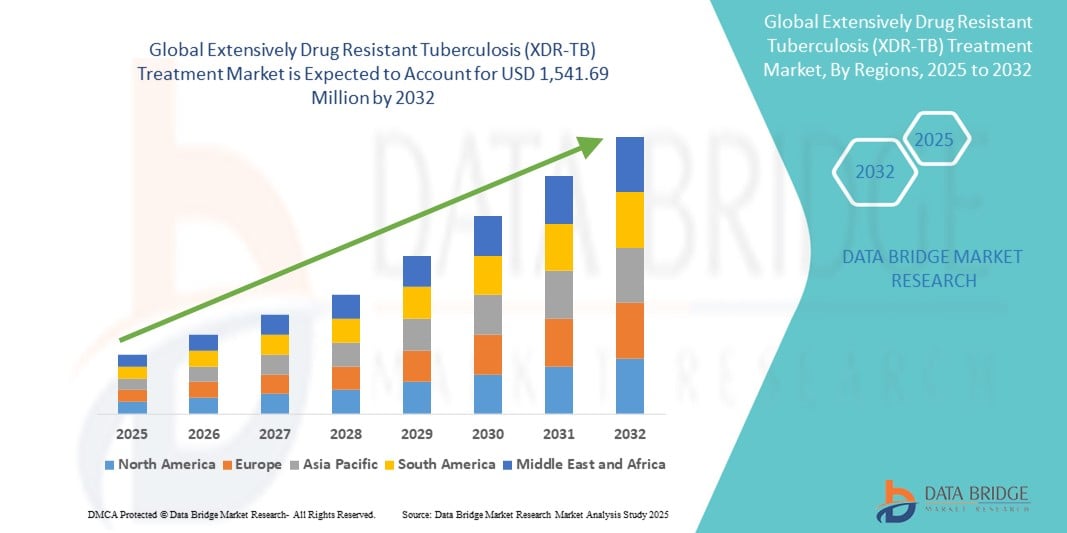
- The global extensively drug resistant tuberculosis (XDR-TB) treatment market size was valued at USD 947.79 million in 2024 and is expected to reach USD 1,541.69 million by 2032, at a CAGR of 6.27% during the forecast period
- The market growth is largely fueled by the rising global burden of drug-resistant tuberculosis and the urgent need for effective therapeutic solutions, prompting increased R&D efforts and regulatory support for novel drug development
- Furthermore, expanding access to advanced diagnostics and personalized treatment regimens in emerging economies is improving case detection and management. These converging factors are accelerating the adoption of innovative treatment approaches, thereby significantly boosting the industry's growth
Extensively Drug Resistant Tuberculosis (XDR-TB) Treatment Market Analysis
- Extensively XDR-TB treatment, involving specialized drug regimens to combat strains resistant to first- and second-line anti-TB drugs, is becoming increasingly critical to global public health efforts due to the limited efficacy of conventional therapies and the high mortality associated with resistant TB strains
- The escalating demand for XDR-TB treatments is primarily fueled by the rising incidence of multidrug-resistant and extensively drug-resistant TB, increased international funding for TB control programs, and accelerating efforts by governments and global health agencies to improve access to effective treatment
- Asia-Pacific dominated the extensively drug resistant tuberculosis (XDR-TB) treatment market with the largest revenue share of 39.5% in 2024, attributed to its high burden of TB cases, large-scale implementation of national control programs, and the integration of newer therapeutic regimens in alignment with global health initiatives
- Middle East and Africa is expected to be the fastest growing region in the extensively drug resistant tuberculosis (XDR-TB) treatment market during the forecast period due to rising TB case detection rates, expanding diagnostic capabilities, and increased support from international health organizations targeting drug-resistant TB in low-resource setting
- Second-Line Anti-TB Drugs segment dominated extensively drug resistant tuberculosis (XDR-TB) treatment market with a market share of 58.1% in 2024, driven by its necessity of using second-line drugs such as fluoroquinolones, bedaquiline, and delamanid in XDR-TB cases where first-line treatments are ineffective
Report Scope and Extensively Drug Resistant Tuberculosis (XDR-TB) Treatment Market Segmentation
|
Attributes |
Extensively Drug Resistant Tuberculosis (XDR-TB) Treatment Key Market Insights |
|
Segments Covered |
|
|
Countries Covered |
North America
Europe
Asia-Pacific
Middle East and Africa
South America
|
|
Key Market Players |
|
|
Market Opportunities |
|
|
Value Added Data Infosets |
In addition to the insights on market scenarios such as market value, growth rate, segmentation, geographical coverage, and major players, the market reports curated by the Data Bridge Market Research also include in-depth expert analysis, pricing analysis, brand share analysis, consumer survey, demography analysis, supply chain analysis, value chain analysis, raw material/consumables overview, vendor selection criteria, PESTLE Analysis, Porter Analysis, and regulatory framework. |
Extensively Drug Resistant Tuberculosis (XDR-TB) Treatment Market Trends
“Advancement of Novel Drug Regimens and Personalized Therapy Approaches”
- A significant and accelerating trend in the global XDR-TB treatment market is the advancement of novel drug regimens and the shift toward more personalized, patient-centric treatment protocols. The integration of new drugs such as bedaquiline, delamanid, and pretomanid into standardized regimens is redefining treatment outcomes for XDR-TB patients by improving efficacy and reducing treatment duration
- For instance, the WHO-endorsed BPaL regimen (bedaquiline, pretomanid, and linezolid) offers a shorter, all-oral treatment course for XDR-TB, showing promising results in terms of cure rates and patient adherence. Similarly, the Nix-TB trial demonstrated the success of this regimen in patients with limited treatment options
- Personalized treatment approaches, informed by rapid molecular diagnostics and drug susceptibility testing, allow clinicians to tailor drug combinations based on the resistance profile of the TB strain, minimizing adverse effects and enhancing treatment success
- Furthermore, increased funding and global collaboration—such as partnerships between the TB Alliance and national health bodies—are fostering clinical trials and fast-track approvals for new treatment protocols. These initiatives aim to expand global access to effective therapies, particularly in high-burden regions
- This trend towards innovative, evidence-based treatment models is fundamentally transforming the XDR-TB care paradigm. As a result, key players such as Johnson & Johnson and Otsuka Pharmaceutical are investing in R&D and access initiatives to scale the deployment of next-generation anti-TB treatments globally
- The demand for safer, more effective, and shorter-duration therapies is rising rapidly across both developed and developing markets, as public health systems and stakeholders prioritize outcome-oriented TB eradication strategies
Extensively Drug Resistant Tuberculosis (XDR-TB) Treatment Market Dynamics
Driver
“Growing Global Burden of Drug-Resistant TB and Enhanced Treatment Accessibility”
- The rising global burden of drug-resistant tuberculosis, including XDR-TB, is a major driver propelling demand for advanced treatment options. According to the WHO, nearly half a million people developed drug-resistant TB in 2023, with a significant portion classified as extensively drug-resistant
- For instance, in September 2024, the Global Fund and Unitaid launched new initiatives to expand access to novel TB drugs in low- and middle-income countries, aiming to accelerate the global rollout of WHO-endorsed treatment regimens. Such coordinated efforts are expected to drive the XDR-TB treatment market in the coming years
- As public health authorities intensify case detection and drug resistance surveillance, more XDR-TB patients are entering treatment pipelines. Coupled with increasing investments in diagnostic tools and therapeutic innovations, this is significantly improving access to care
- Furthermore, national TB programs are adopting standardized short-course therapies, especially oral regimens, to enhance patient compliance and reduce the risk of further resistance. International donor support and pharmaceutical collaborations are also enabling lower treatment costs and broader availability
- The rising awareness about drug resistance, combined with the rollout of community-based and digital adherence programs, is encouraging early diagnosis and sustained treatment engagement—key elements for controlling the XDR-TB epidemic
Restraint/Challenge
“Limited Drug Accessibility and Adverse Treatment Effects”
- Despite recent advances, the global XDR-TB treatment landscape faces significant challenges related to limited drug accessibility, side effects, and infrastructural barriers, particularly in resource-limited regions
- For instance, newer anti-TB drugs such as pretomanid are not yet widely registered or available in many high-burden countries due to regulatory delays, pricing issues, and supply chain constraints
- Treatment regimens for XDR-TB are often associated with severe adverse effects—such as neuropathy, ototoxicity, and hepatotoxicity—especially with prolonged use of second-line drugs such as linezolid or injectable agents. This leads to high rates of treatment discontinuation and poor adherence, undermining outcomes
- Moreover, the requirement for specialized diagnostics and clinical monitoring imposes strain on under-resourced health systems, limiting the scalability of new regimens. Weak pharmacovigilance frameworks and workforce shortages further hinder the effective management of drug-resistant TB cases
- High treatment costs, despite global funding efforts, can still pose a barrier to sustainable access in several low-income settings, especially where healthcare financing is limited
- Addressing these challenges through expanded drug registration, price reductions, enhanced adverse event management, and strengthened health system capacities will be essential to fully realize the benefits of emerging XDR-TB therapies and improve patient outcomes worldwide
Extensively Drug Resistant Tuberculosis (XDR-TB) Treatment Market Scope
The market is segmented on the basis of treatment type, route of administration, end-user, and distribution channel.
- By Treatment Type
On the basis of treatment type, the extensively drug resistant tuberculosis (XDR-TB) treatment market is segmented into first-line anti-TB drugs, second-line anti-TB drugs, and others. The second-line anti-TB drugs segment dominated the market with the largest market revenue share of 58.1% in 2024, driven by the ineffectiveness of first-line treatments against drug-resistant TB strains. These include fluoroquinolones, injectable agents, bedaquiline, delamanid, and linezolid, which are commonly used in XDR-TB regimens. Their critical role in current WHO-recommended therapies makes them central to treatment protocols worldwide.
The others segment, which includes newer and repurposed drugs such as pretomanid, is expected to witness the fastest growth rate from 2025 to 2032, fueled by rising clinical trial activity and global adoption of shorter, all-oral treatment regimens such as the BPaL combination. Increased regulatory approvals and broader global access to novel drugs are expected to contribute significantly to this segment’s expansion.
- By Route Of Administration
On the basis of route of administration, the extensively drug resistant tuberculosis (XDR-TB) treatment market is segmented into oral, parenteral, and others. The oral segment held the largest market revenue share of 64.3% in 2024, owing to its patient-friendly nature, reduced need for clinical supervision, and growing preference for all-oral regimens that improve adherence and outcomes. Oral therapies, such as bedaquiline and pretomanid, offer improved safety profiles and are being rapidly adopted into national TB programs.
The parenteral segment is expected to witness the fastest growth rate from 2025 to 2032, as healthcare systems increasingly phase out injectable therapies due to their side effects and administration challenges, though they are still used in severe cases or where oral alternatives are unavailable.
- By End User
On the basis of end-user, the extensively drug resistant tuberculosis (XDR-TB) treatment market is segmented into hospitals, homecare, specialty clinics, and others. The hospitals segment dominated the market with the largest market revenue share of 42.9% in 2024, attributed to the critical role hospitals play in initiating and managing complex drug regimens for XDR-TB patients. They also provide intensive care and monitoring for adverse drug reactions, which are common with second-line treatments.
The homecare segment is anticipated to witness the fastest growth rate of 13.6% from 2025 to 2032, supported by the increasing decentralization of TB care through directly observed therapy (DOT), telehealth, and mobile health initiatives, particularly in low- and middle-income countries.
- By Distribution Channel
On the basis of distribution channel, the extensively drug resistant tuberculosis (XDR-TB) treatment market is segmented into hospital pharmacy, online pharmacy, and retail pharmacy. The hospital pharmacy segment held the largest market revenue share of 47.8% in 2024, due to the centralized nature of TB drug distribution within hospital settings, especially for managing high-risk and drug-resistant cases. Strict protocols and drug control measures necessitate dispensation through institutional pharmacies to ensure compliance and safety.
The online pharmacy segment is anticipated to witness the fastest growth rate of 14.2% from 2025 to 2032, driven by increasing digital healthcare adoption, particularly in remote and underserved areas. The convenience of online access, coupled with government and NGO-led distribution programs, is boosting segment expansion across emerging markets.
Extensively Drug Resistant Tuberculosis (XDR-TB) Treatment Market Regional Analysis
- Asia-Pacific dominated the extensively drug resistant tuberculosis (XDR-TB) treatment market with the largest revenue share of 39.5% in 2024, attributed to its high burden of TB cases, large-scale implementation of national control programs, and the integration of newer therapeutic regimens in alignment with global health initiatives
- Healthcare systems in the region are increasingly adopting WHO-recommended regimens and scaling up access to newer second-line drugs and diagnostics through public health initiatives and funding support from global organizations such as the Global Fund and USAID
- This widespread adoption is further supported by expanding healthcare infrastructure, growing awareness of TB drug resistance, and strengthened national TB control programs, establishing Asia-Pacific as a critical region for both market demand and treatment advancement in XDR-TB care
China Extensively Drug Resistant Tuberculosis (XDR-TB) Treatment Market Insight
The China extensively drug resistant tuberculosis (XDR-TB) treatment market is anticipated to grow steadily, driven by the government’s emphasis on infectious disease control and digital health transformation. Nationwide screening programs, integration of AI-based diagnostics, and the deployment of treatment support platforms in rural areas are improving early detection and adherence. The market is further bolstered by domestic innovation and investment in anti-TB drug development and infrastructure
India Extensively Drug Resistant Tuberculosis (XDR-TB) Treatment Market Insight
The India extensively drug resistant tuberculosis (XDR-TB) treatment market held the largest revenue share in the Asia-Pacific region in 2024, supported by a high patient load, robust government-led initiatives such as the National Strategic Plan for TB Elimination, and expanding access to WHO-recommended therapies. The inclusion of novel drugs such as bedaquiline and delamanid in public treatment protocols and strengthened public-private partnerships are accelerating treatment uptake. In addition, India's focus on local pharmaceutical manufacturing and cost-effective generic options supports affordability and broad-scale access to essential medicines.
Middle East and Africa Extensively Drug Resistant Tuberculosis (XDR-TB) Treatment Market Insight
The Middle East & Africa extensively drug resistant tuberculosis (XDR-TB) treatment market is projected to grow at the fastest CAGR during the forecast period of 2025 to 2032, driven by rising TB case detection, improving healthcare delivery systems, and enhanced international support. Countries such as South Africa, Kenya, Nigeria, and Saudi Arabia are witnessing growing demand for advanced therapies due to their rising burden of drug-resistant TB and increased funding from global donors and government health agencies. Strengthened laboratory networks, mobile health initiatives, and the rollout of oral treatment regimens in collaboration with global health organizations are addressing barriers to access and improving patient outcomes. As healthcare infrastructure and awareness expand, the region is becoming increasingly critical to the global XDR-TB response
South Africa Extensively Drug Resistant Tuberculosis (XDR-TB) Treatment Market Insight
The South Africa extensively drug resistant tuberculosis (XDR-TB) treatment captured the largest revenue share in the Middle East & Africa region in 2024, owing to its high incidence of TB and co-infection with HIV. The country has been a global leader in implementing decentralized, community-based XDR-TB treatment models supported by strong government initiatives and collaboration with global partners such as the Global Fund and USAID. South Africa was one of the first countries to adopt bedaquiline into its national TB program and is widely regarded for pioneering the implementation of the shorter, all-oral regimens. Advanced digital health tools, mobile clinics, and adherence technologies are also being utilized to improve patient outcomes, especially in underserved rural and peri-urban areas. The country’s commitment to training healthcare workers and investing in laboratory capacity further strengthens its leadership in the regional TB response.
Kenya Extensively Drug Resistant Tuberculosis (XDR-TB) Treatment Market Insight
The Kenya extensively drug resistant tuberculosis (XDR-TB) treatment market is emerging as one of the fastest-growing within the region, driven by expanding diagnostic infrastructure, government-backed treatment programs, and donor-funded access to newer TB drugs. Kenya's National Tuberculosis, Leprosy and Lung Disease Program (NTLD-P) has prioritized early detection and treatment initiation, with significant progress in integrating molecular testing and contact tracing systems. The rollout of community-based DOT (Directly Observed Therapy) and increased health education are improving patient compliance, while partnerships with organizations such as Médecins Sans Frontières (MSF) and Stop TB Partnership are helping to ensure drug availability and affordability. Kenya's focus on strengthening local healthcare systems and rural outreach is expected to support sustained market growth in the years ahead.
Extensively Drug Resistant Tuberculosis (XDR-TB) Treatment Market Share
The Extensively Drug Resistant Tuberculosis (XDR-TB) Treatment industry is primarily led by well-established companies, including:
- Johnson & Johnson Services Inc. (U.S.)
- Otsuka Pharmaceutical Co., Ltd. (Japan)
- Macleods Pharmaceuticals Ltd. (India)
- Lupin Limited (India)
- Cipla Limited (India)
- Hetero Labs Limited (India)
- AstraZeneca (U.K.)
- Roche Holding AG (Switzerland)
- Pfizer Inc. (U.S.)
- Zydus Lifesciences Limited (India)
- Aurobindo Pharma Ltd. (India)
- Sanofi (France)
- Novartis AG (Switzerland)
- Dr. Reddy’s Laboratories Ltd. (India)
- Bayer AG (Germany)
- Shanghai Fosun Pharmaceutical Group Co., Ltd. (China)
- Biocon Limited (India)
- Medochemie Ltd. (Cyprus)
What are the Recent Developments in Global Extensively Drug Resistant Tuberculosis (XDR-TB) Treatment Market?
- In April 2024, the Indian Ministry of Health and Family Welfare partnered with the Global Drug Facility (GDF) to expand access to the BPaL (bedaquiline, pretomanid, and linezolid) regimen nationwide. This initiative is part of India’s National Strategic Plan for TB Elimination, aiming to reduce treatment duration and improve outcomes for XDR-TB patients. The collaboration reflects India’s growing commitment to deploying shorter, all-oral treatment regimens supported by global health agencies
- In March 2024, South Africa’s National Department of Health began the rollout of digital adherence technologies (DATs) for XDR-TB patients across rural provinces, including Limpopo and Eastern Cape. These tools—such as 99DOTS and electronic pillboxes—help track treatment adherence in real time and support community health workers. The initiative is backed by funding from USAID and the Stop TB Partnership, strengthening South Africa’s position as a regional leader in innovative TB care delivery
- In February 2024, the Philippines Department of Health launched a mobile-based TB diagnostic and treatment support system as part of its Enhanced Comprehensive TB Elimination Plan. Supported by WHO and the Global Fund, this system integrates AI-powered symptom checkers and remote treatment monitoring, aiming to improve early XDR-TB detection and patient compliance across underserved areas. The platform is being piloted in Mindanao and is expected to scale nationally by 2026
- In January 2024, the Kenya Medical Research Institute (KEMRI) announced a partnership with Médecins Sans Frontières (MSF) to conduct a multi-site trial assessing the safety and effectiveness of novel oral regimens, including bedaquiline and delamanid combinations, in patients with XDR-TB. This trial, conducted across Nairobi and Kisumu counties, aims to gather local evidence for future national treatment policy revisions and improve survival rates among high-risk population
- In December 2023, Indonesia’s Ministry of Health, in collaboration with USAID and Johnson & Johnson, initiated a nationwide scale-up of shorter XDR-TB treatment courses using novel drugs such as bedaquiline. The initiative focuses on integrating treatment into community-based programs and enhancing lab capacity for rapid resistance testing. This development supports Indonesia’s goal of halving TB-related mortality by 2030 in alignment with WHO’s End TB Strategy

- Interactive Data Analysis Dashboard
- Company Analysis Dashboard for high growth potential opportunities
- Research Analyst Access for customization & queries
- Competitor Analysis with Interactive dashboard
- Latest News, Updates & Trend analysis
- Harness the Power of Benchmark Analysis for Comprehensive Competitor Tracking
Data collection and base year analysis are done using data collection modules with large sample sizes. The stage includes obtaining market information or related data through various sources and strategies. It includes examining and planning all the data acquired from the past in advance. It likewise envelops the examination of information inconsistencies seen across different information sources. The market data is analysed and estimated using market statistical and coherent models. Also, market share analysis and key trend analysis are the major success factors in the market report. To know more, please request an analyst call or drop down your inquiry.
The key research methodology used by DBMR research team is data triangulation which involves data mining, analysis of the impact of data variables on the market and primary (industry expert) validation. Data models include Vendor Positioning Grid, Market Time Line Analysis, Market Overview and Guide, Company Positioning Grid, Patent Analysis, Pricing Analysis, Company Market Share Analysis, Standards of Measurement, Global versus Regional and Vendor Share Analysis. To know more about the research methodology, drop in an inquiry to speak to our industry experts.
Data Bridge Market Research is a leader in advanced formative research. We take pride in servicing our existing and new customers with data and analysis that match and suits their goal. The report can be customized to include price trend analysis of target brands understanding the market for additional countries (ask for the list of countries), clinical trial results data, literature review, refurbished market and product base analysis. Market analysis of target competitors can be analyzed from technology-based analysis to market portfolio strategies. We can add as many competitors that you require data about in the format and data style you are looking for. Our team of analysts can also provide you data in crude raw excel files pivot tables (Fact book) or can assist you in creating presentations from the data sets available in the report.












