


Eye Melanoma Drug Market Size
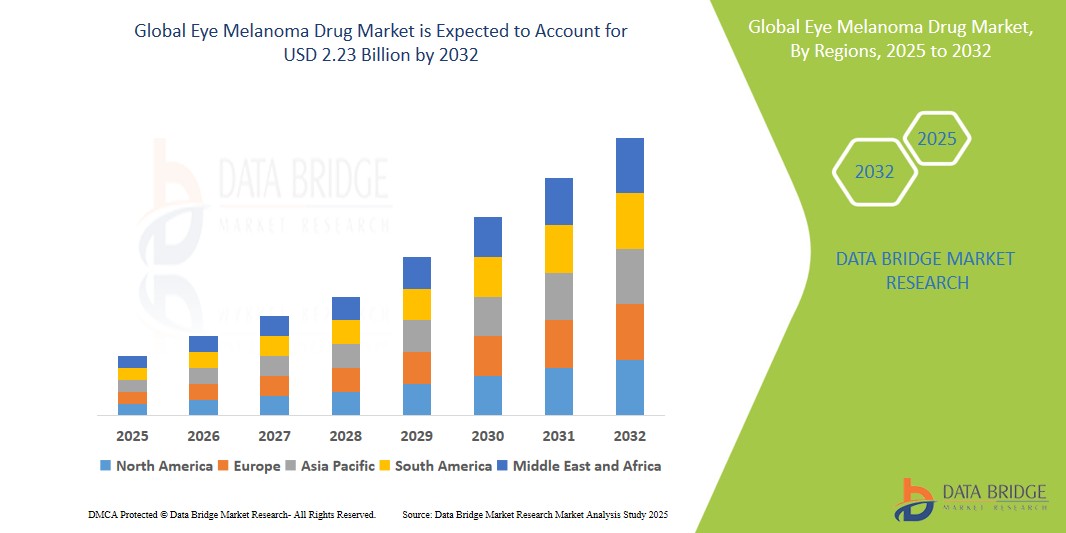
- The Global Eye Melanoma Drug Market size was valued at USD 1.12 billion in 2024 and is expected to reach USD 2.23 billion by 2032, at a CAGR of 9.0% during the forecast period
- This growth is driven by factors such as the rising incidence of ocular cancers, increasing awareness of early detection and treatment, and advancements in immunotherapy and targeted drug development
Eye Melanoma Drug Market Analysis
- Eye melanoma drugs are specialized treatments used to manage malignant tumors of the eye, particularly affecting areas such as the uvea, sclera, and retina. These therapies include immunotherapy, targeted therapy, and chemotherapy, which aim to inhibit cancer cell growth and prevent metastasis
- The demand for eye melanoma drugs is significantly driven by the increasing incidence of uveal melanoma, advancements in precision oncology, and the growing adoption of immunotherapy for ocular cancers
- North America is expected to dominate the eye melanoma drug market due to higher awareness, strong healthcare infrastructure, and ongoing clinical research in oncology
- Europe is also a major contributor, supported by favorable reimbursement policies and rising clinical trials for novel eye cancer therapies
- Asia-Pacific is projected to be the fastest-growing region during the forecast period due to rising healthcare investments, increasing cancer screening programs, and growing awareness about rare eye conditions
- The immunotherapy segment is expected to dominate the market with a market share of 48.5%, driven by the success of immune checkpoint inhibitors like pembrolizumab and ipilimumab, which offer promising outcomes for patients with advanced eye melanoma.
Report Scope and Eye Melanoma Drug Market Segmentation
|
Attributes |
Eye Melanoma Drug Key Market Insights |
|
Segments Covered |
|
|
Countries Covered |
North America
Europe
Asia-Pacific
Middle East and Africa
South America
|
|
Key Market Players |
|
|
Market Opportunities |
|
|
Value Added Data Infosets |
In addition to the insights on market scenarios such as market value, growth rate, segmentation, geographical coverage, and major players, the market reports curated by the Data Bridge Market Research also include import export analysis, production capacity overview, production consumption analysis, price trend analysis, climate change scenario, supply chain analysis, value chain analysis, raw material/consumables overview, vendor selection criteria, PESTLE Analysis, Porter Analysis, and regulatory framework. |
Eye Melanoma Drug Market Trends
“Rising Adoption of Immunotherapy and Personalized Medicine in Ocular Oncology”
- One prominent trend in the treatment of eye melanoma is the increasing adoption of immunotherapy and personalized medicine, particularly through the use of immune checkpoint inhibitors and gene-targeted therapies
- These advanced treatment approaches are tailored to the patient’s specific tumor genetics and immune profile, offering enhanced efficacy and fewer side effects compared to traditional therapies
- For instance, immune checkpoint inhibitors such as pembrolizumab (anti-PD-1) and ipilimumab (anti-CTLA-4) have shown promising results in treating metastatic uveal melanoma, a rare but aggressive form of eye cancer. Their use is expanding in oncology protocols globally.
- As precision oncology evolves, combining genomic profiling with targeted therapies is transforming ocular cancer care, improving survival rates and boosting demand for innovative drug solutions
Eye Melanoma Drug Market Dynamics
Driver
“Rising Incidence of Uveal Melanoma and Advancements in Cancer Immunotherapy”
- Uveal melanoma is the most common primary intraocular malignancy in adults, with increasing incidence noted in regions such as North America and Europe
- The rising awareness about ocular health, advancements in diagnostic technologies (e.g., OCT, angiography), and early detection campaigns are improving diagnosis rates of eye cancers
- Parallelly, breakthroughs in cancer immunotherapy have led to the development of novel drug classes, expanding treatment options for patients with rare cancers like eye melanoma
For instance,
- According to the American Cancer Society (2024), although uveal melanoma is rare, it accounts for over 85% of all eye melanomas, with approximately 2,000–2,500 new cases annually in the U.S. Improved survival and treatment rates are contributing to rising drug demand
- These developments are propelling the market for eye melanoma drugs, as more patients gain access to personalized, effective treatments
Opportunity
“Emergence of Novel Combination Therapies and Orphan Drug Designations”
- The exploration of combination therapies, including immunotherapy with radiation or targeted agents, is unlocking new frontiers in eye melanoma treatment, especially for patients with metastatic or treatment-resistant disease
- Additionally, pharmaceutical companies are capitalizing on orphan drug designations and regulatory incentives offered by authorities such as the FDA and EMA for developing therapies for rare cancers
For instance,
- In March 2024, the FDA granted orphan drug status to a novel compound targeting GNAQ/GNA11-mutated uveal melanoma, supporting accelerated development and market entry
- These regulatory advantages, coupled with growing clinical research investments, represent a major opportunity for drug developers to expand their ocular oncology portfolios and address unmet medical needs.
Restraint/Challenge
“Limited Patient Population and High Cost of Therapy”
- Eye melanoma, particularly uveal melanoma, remains a rare disease, limiting the potential patient pool for commercial drug viability, especially for large pharmaceutical firms seeking high return on investment
- Moreover, advanced immunotherapies and targeted treatments often come with substantial costs, ranging from tens to hundreds of thousands of dollars per patient annually, posing an affordability challenge
For instance,
- In 2023, the average cost of immunotherapy treatment using immune checkpoint inhibitors like pembrolizumab exceeded USD 150,000 annually, according to JAMA Oncology. Such high treatment costs can hinder access in low- and middle-income countries
- As a result, market expansion is constrained by both financial barriers and the need for greater patient recruitment in clinical trials, limiting the growth potential in underdeveloped regions
Eye Melanoma Drug Market Scope
The market is segmented on the basis infection site, diagnosis, treatment, mechanism of action, drugs type, route of administration and end user.
|
Segmentation |
Sub-Segmentation |
|
By Infected Site |
|
|
By Diagnosis |
|
|
By Treatment |
|
|
By Mechanism of Action |
|
|
By Drugs Type |
|
|
By Route of Administration |
|
|
By End Users |
|
In 2025, the immunotherapy segment is projected to dominate the market with the largest share in Mechanism of Action segment
The immunotherapy segment is expected to dominate the global eye melanoma drug market with the largest share of 45.78% in 2025, driven by the increasing success of immune checkpoint inhibitors such as pembrolizumab and ipilimumab. These therapies offer promising outcomes for advanced and metastatic eye melanoma patients by enhancing the body’s immune response to cancer cells. Growing clinical research, FDA approvals, and better overall survival rates further contribute to the dominance of this treatment approach in the eye melanoma landscape.
The intravenous segment is expected to account for the largest share during the forecast period in the route of administration market
In 2025, the intravenous segment is expected to dominate the market with the largest share of 52.13%, as it is the primary route for administering advanced immunotherapy and chemotherapy drugs in eye melanoma patients. Intravenous delivery ensures rapid and efficient drug absorption, making it ideal for treating aggressive or metastatic forms of ocular melanoma. As more biologics and monoclonal antibodies are introduced in the market, the demand for intravenous administration is projected to rise significantly, particularly in hospital and specialty clinic settings.
Eye Melanoma Drug Market Regional Analysis
“North America Holds the Largest Share in the Eye Melanoma Drug Market”
- North America dominates the eye melanoma drug market, attributed to the region’s well-developed healthcare infrastructure, early adoption of advanced oncology treatments, and a strong pipeline of immunotherapy and targeted therapy drugs
- The U.S. accounts for the largest market share due to a higher incidence of ocular melanoma, robust diagnostic and treatment capabilities, and significant investments in cancer drug research
- Favorable reimbursement policies, increasing awareness about rare cancers, and the presence of major pharmaceutical companies actively engaged in drug development support regional market expansion
- Additionally, widespread availability of advanced imaging techniques, access to clinical trials, and growing patient demand for precision medicine are propelling the demand for innovative treatment solutions across the region
“Asia-Pacific is Projected to Register the Highest CAGR in the Eye Melanoma Drug Market”
- The Asia-Pacific region is projected to experience the fastest growth in the global eye melanoma drug market, driven by rising healthcare expenditure, expanding oncology services, and increased efforts in rare cancer diagnosis
- China, India, and Japan are emerging as high-growth markets due to growing awareness of ocular health, increasing incidence of melanoma, and better access to cancer therapies
- Japan leads the region with advanced healthcare systems, ongoing R&D collaborations in immunotherapy, and widespread use of novel biologics for treating rare cancers like eye melanoma
- In China and India, government initiatives to improve oncology care, rising penetration of global pharma companies, and expanding access to tertiary care hospitals are driving the adoption of effective therapies, contributing to accelerated market growth
Eye Melanoma Drug Market Share
The market competitive landscape provides details by competitor. Details included are company overview, company financials, revenue generated, market potential, investment in research and development, new market initiatives, global presence, production sites and facilities, production capacities, company strengths and weaknesses, product launch, product width and breadth, application dominance. The above data points provided are only related to the companies' focus related to market.
The Major Market Leaders Operating in the Market Are:
- Merck & Co., Inc. (U.S.)
- F. Hoffmann-La Roche Ltd (Switzerland)
- GlaxoSmithKline plc (United Kingdom)
- Novartis AG (Switzerland)
- Pfizer Inc (U.S.)
- Sanofi (France)
- AbbVie Inc (U.S.)
- Amgen Inc (U.S.)
- AstraZeneca (United Kingdom)
- Bristol-Myers Squibb Company (U.S.)
- Bayer AG (Germany)
- Johnson & Johnson Services, Inc. (U.S.)
- Carl Zeiss AG (Germany)
- Takeda Pharmaceutical Company Limited (Japan)
- Siemens (Germany)
- Koninklijke Philips N.V. (Netherlands)
- Castle Biosciences, Inc. (U.S.)
- Spectrum Pharmaceuticals, Inc. (U.S.)
- Teva Pharmaceutical Industries Ltd. (Israel)
- Gilead Sciences, Inc. (U.S.)

- Interactive Data Analysis Dashboard
- Company Analysis Dashboard for high growth potential opportunities
- Research Analyst Access for customization & queries
- Competitor Analysis with Interactive dashboard
- Latest News, Updates & Trend analysis
- Harness the Power of Benchmark Analysis for Comprehensive Competitor Tracking
Data collection and base year analysis are done using data collection modules with large sample sizes. The stage includes obtaining market information or related data through various sources and strategies. It includes examining and planning all the data acquired from the past in advance. It likewise envelops the examination of information inconsistencies seen across different information sources. The market data is analysed and estimated using market statistical and coherent models. Also, market share analysis and key trend analysis are the major success factors in the market report. To know more, please request an analyst call or drop down your inquiry.
The key research methodology used by DBMR research team is data triangulation which involves data mining, analysis of the impact of data variables on the market and primary (industry expert) validation. Data models include Vendor Positioning Grid, Market Time Line Analysis, Market Overview and Guide, Company Positioning Grid, Patent Analysis, Pricing Analysis, Company Market Share Analysis, Standards of Measurement, Global versus Regional and Vendor Share Analysis. To know more about the research methodology, drop in an inquiry to speak to our industry experts.
Data Bridge Market Research is a leader in advanced formative research. We take pride in servicing our existing and new customers with data and analysis that match and suits their goal. The report can be customized to include price trend analysis of target brands understanding the market for additional countries (ask for the list of countries), clinical trial results data, literature review, refurbished market and product base analysis. Market analysis of target competitors can be analyzed from technology-based analysis to market portfolio strategies. We can add as many competitors that you require data about in the format and data style you are looking for. Our team of analysts can also provide you data in crude raw excel files pivot tables (Fact book) or can assist you in creating presentations from the data sets available in the report.












