Fabric Conditioner & Enhancer Market Overview
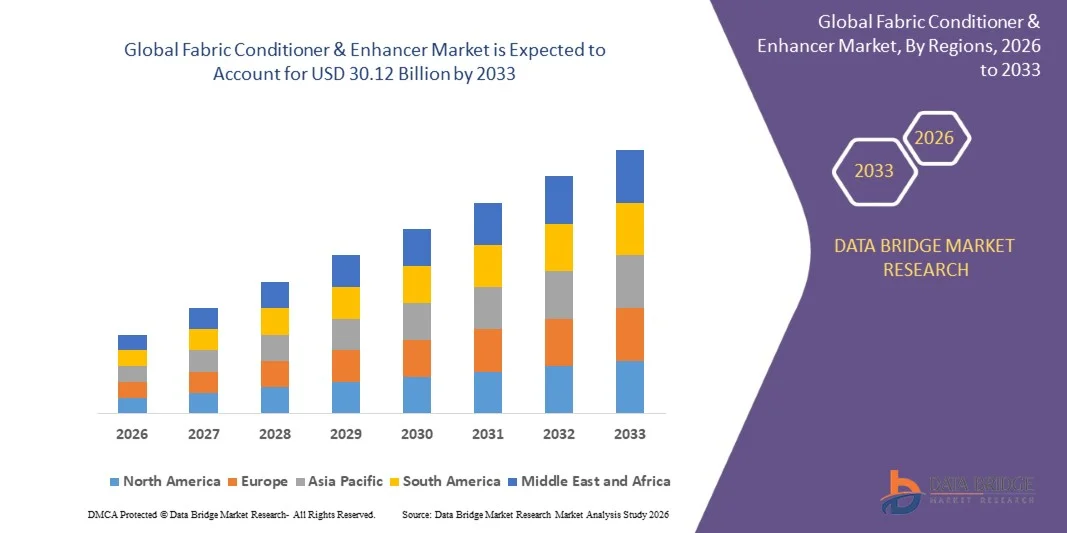
As per Data Bridge Market Research Analysis the Fabric Conditioner & Enhancer Market was valued at USD 18.2 billion in 2025 and is projected to reach USD 30.12 billion by 2033, growing at a CAGR of 6.50% from 2026 to 2033. This expansion is fueled by rising disposable incomes, rapid urbanization, and the increasing penetration of automatic washing machines, particularly in developing regions. Consumers are increasingly seeking products that provide benefits beyond basic cleaning, such as superior softness, static reduction, long-lasting fragrances, and specialized care for different fabric types. The market's growth trajectory is further supported by continuous product innovation, including the development of eco-friendly, hypoallergenic, and highly concentrated formulations that appeal to both environmentally conscious and value-seeking consumers.
Key Market Trends & Insights
- North America is estimated to be the leading region for fabric conditioners, holding the largest market share, driven by high disposable incomes, a strong culture of fabric care, and a mature retail infrastructure.
- Asia-Pacific is expected to be the fastest-growing region, propelled by rapid urbanization, a burgeoning middle class, and increasing adoption of premium laundry products in countries like China and India.
- The Liquid Fabric Softeners segment dominates the product form category, owing to their widespread use and effectiveness, while Dryer Sheets and In-Wash Scent Boosters are gaining significant traction as convenient solutions for fragrance enhancement.
- The Supermarkets/Hypermarkets channel remains the dominant distribution point, but Online Retail is witnessing rapid growth due to the convenience of home delivery, subscription models, and access to a wider range of premium and niche brands.
- A major trend is the surge in demand for Eco-friendly and Sustainable Formulations, with consumers actively seeking biodegradable, plant-based, and dermatologically tested products with reduced environmental impact.
Market Size & Forecast
- Global Market Value (2025): USD 18.2 Billion
- Expected Market Value (2033): USD 30.12 Billion
- Forecast CAGR (2026–2033): 6.50%
- Leading Region in 2025: North America
- Fastest Growing Region: Asia-Pacific
Report Scope and Fabric Conditioner & Enhancer Market Segmentation
|
Attributes |
Fabric Conditioner & Enhancer Key Market Insights |
|
Segments Covered |
|
|
Countries Covered |
North America · U.S. · Canada · Mexico Europe · Germany · France · U.K. · Netherlands · Switzerland · Belgium · Russia · Italy · Spain · Turkey · Rest of Europe Asia-Pacific · China · Japan · India · South Korea · Singapore · Malaysia · Australia · Thailand · Indonesia · Philippines · Rest of Asia-Pacific Middle East and Africa · Saudi Arabia · U.A.E. · South Africa · Egypt · Israel · Rest of Middle East and Africa South America · Brazil · Argentina · Rest of South America |
|
Key Market Players |
· Procter & Gamble (U.S.) · Unilever (U.K.) · Henkel AG & Co. KGaA (Germany) · Colgate-Palmolive Company (U.S.) · Reckitt Benckiser Group plc (U.K.) · Church & Dwight Co., Inc. (U.S.) · Kao Corporation (Japan) · Lion Corporation (Japan) · LG Household & Health Care Ltd. (South Korea) · SC Johnson & Son, Inc. (U.S.) · AlEn Group (Mexico) · Godrej Consumer Products Limited (India) · Blue Moon Group Holdings Limited (China) |
|
Market Opportunities |
· Innovation in long-lasting fragrance technologies like microencapsulation. · Growth in specialized products for different fabric types (e.g., sportswear, delicates) · Leveraging D2C and subscription models for premium and niche brands. |
|
Value Added Data Infosets |
In addition to the insights on market scenarios such as market value, growth rate, segmentation, geographical coverage, and major players, the market reports curated by the Data Bridge Market Research also include in-depth expert analysis, pricing analysis, brand share analysis, consumer survey, demography analysis, supply chain analysis, value chain analysis, raw material/consumables overview, vendor selection criteria, PESTLE Analysis, Porter Analysis, and regulatory framework. |
Fabric Conditioner & Enhancer Market Trends
Trend: Growth in Eco-Conscious & Sustainable Products
There is a significant global trend towards sustainability in the fabric conditioner market. Consumers are increasingly concerned about the environmental impact of their purchases, leading to a surge in demand for biodegradable, plant-based, and non-toxic formulations. Manufacturers are responding by introducing products free from parabens, dyes, and harsh chemicals, and are investing in sustainable packaging, such as recycled materials and concentrated refills, to reduce plastic waste and their carbon footprint. This shift is being reinforced by stricter environmental regulations, particularly in regions like Europe.
Fabric Conditioner & Enhancer Market Dynamics
Key Market Driver: Increasing Consumer Awareness about Fabric Care and Hygiene
A primary driver for the market is the growing consumer awareness regarding the benefits of fabric care products. Consumers are more informed about how fabric conditioners and enhancers can extend garment life, reduce static cling, provide a pleasant fragrance, and maintain the quality of their clothing. This heightened awareness, fueled by marketing and a broader focus on health and wellness, has made fabric softeners a staple in many households, particularly in developed markets where penetration rates exceed 65-70%. The rising concern for allergens and skin sensitivities is also driving demand for hypoallergenic and dermatologically tested options.
Key Restraint/Challenge: Environmental and Health Concerns
A significant challenge for the market is the growing scrutiny of certain chemical ingredients used in traditional fabric softeners, such as quaternary ammonium compounds ("quats"), which have been linked to environmental issues and potential skin irritation. Consumers are becoming more skeptical of synthetic fragrances and chemicals, leading to a demand for "free & clear" or plant-based alternatives. This creates pressure on manufacturers to reformulate products and navigate complex regulatory landscapes, which can increase R&D costs and production complexity.
In September 2025: A study published in the Journal of Hazardous Materials reported the widespread occurrence of quaternary ammonium compounds (QACs) across multiple environmental and human matrices. The research identified dietary intake and dermal absorption as major exposure pathways, underscoring growing concerns about the persistence and potential health impacts of chemicals commonly used in fabric softeners and other household products.
Key Market Opportunity: Development of Premium and Specialized Product Lines
The trend towards premiumization presents a significant market opportunity. Consumers are willing to pay more for products that offer superior performance, innovative benefits (e.g., micro-encapsulated fragrances that last longer), or specialized care for different fabric types like sportswear, wool, or silk. Expanding product portfolios to include these targeted solutions allows manufacturers to differentiate themselves, cater to specific consumer needs, and capture higher-value market segments. The growing commercial sector, including hotels and hospitals, also offers opportunities for high-performance, cost-effective bulk products
Fabric Conditioner & Enhancer Market Scope
The fabric conditioner & enhancer market is segmented on the basis of product form, fragrance type, end-user, distribution channel, and price range.
- By Product Type
On the basis of product form, the market is segmented into liquid fabric softeners, dryer sheets, fabric softener pods/tablets, concentrated formulations, and in-wash scent boosters. The Liquid Fabric Softeners segment dominates the market, driven by their widespread use and effectiveness in delivering softness and fragrance.
The In-Wash Scent Boosters segment is experiencing rapid growth due to the increasing consumer desire for intense, long-lasting fragrance. Concentrated Formulations are also gaining popularity due to their cost-effectiveness and reduced environmental footprint.
- By Fragrance Type
On the basis of fragrance type, the market is segmented into floral, fresh/clean, lavender, citrus, fruity, unscented, and customized/premium fragrances. Floral and Fresh/Clean scents are traditionally the most popular segments, with broad consumer appeal. However, there is a growing trend towards Customized/Premium Fragrances, inspired by high-end perfumes, and Unscented products, catering to the increasing demand for hypoallergenic and "free & clear" options for sensitive individuals.
- By End-User
On the basis of end-user, the market is segmented into residential, commercial, and industrial. The Residential segment holds the largest share, driven by high household penetration in developed markets and growing adoption in developing countries.
The Commercial segment is significant and growing, as businesses in hospitality, healthcare, and laundry services prioritize fabric quality and hygiene for their customers.
- By Distribution Channel
On the basis of distribution channel, the market is segmented into supermarkets/hypermarkets, convenience stores, online retail, specialty stores, and direct-to-consumer. Supermarkets/Hypermarkets remain the dominant channel due to their extensive reach, product variety, and competitive pricing. However, Online Retail is the fastest-growing channel, offering consumers convenience, access to niche products, and the benefit of subscription models for regular purchases
- By Price Range
On the basis of price range, the market is segmented into economy, mid-range, and premium. The Mid-Range segment accounts for the majority of sales, offering a balance between quality and affordability.
However, the Premium segment is growing rapidly, driven by consumers willing to pay more for superior sensory experiences, sustainable credentials, and specialized fabric care benefits.
Fabric Conditioner & Enhancer Market Regional Analysis
North America is estimated to lead the fabric conditioner & enhancer market, accounting for the largest revenue share. This dominance is supported by a mature retail infrastructure, high disposable incomes, a strong cultural emphasis on cleanliness, and high market penetration rates for these products. The U.S. is the primary contributor, with a steady demand for innovative and premium laundry care solutions.
Asia-Pacific is expected to be the fastest-growing region, driven by rapid urbanization, increasing disposable incomes, and an expanding middle class in countries like China and India. The rising awareness of fabric care and the increasing penetration of automatic washing machines are key factors propelling market growth in this region.
U.S. Fabric Conditioner & Enhancer Market Insight
The U.S. market is characterized by a strong consumer preference for premium, high-performance products with advanced features like micro-encapsulated fragrances and eco-friendly formulations. The presence of major brands and a robust e-commerce infrastructure supports a dynamic market with high levels of innovation and competition.
China Fabric Conditioner & Enhancer Market Insight
The China market is experiencing rapid growth, fueled by urbanization and a burgeoning middle class that is increasingly adopting premium laundry habits. The demand for convenient, efficient, and high-quality laundry care products is rising, with strong interest in both international brands and innovative domestic offerings, particularly through digital and e-commerce channels.
India Fabric Conditioner & Enhancer Market Insight
The India fabric conditioner market is expanding as consumer awareness about fabric care and hygiene grows, driven by rising incomes and the influence of modern retail and advertising. There is significant potential for market penetration, with a shift from basic detergents towards value-added laundry solutions, supported by increasing availability through both physical and online retail formats.
Fabric Conditioner & Enhancer Market Share
The fabric conditioner industry is primarily led by well-established companies, including:
- Procter & Gamble (U.S.)
- Unilever (U.K.) - (Comfort)
- Henkel AG & Co. KGaA (Germany)
- Colgate-Palmolive Company (U.S.)
- Reckitt Benckiser Group plc (U.K.)
- Church & Dwight Co., Inc. (U.S.)
- Kao Corporation (Japan)
- Lion Corporation (Japan)
- LG Household & Health Care Ltd. (South Korea)
- SC Johnson & Son, Inc. (U.S.)
- AlEn Group (Mexico)
- Godrej Consumer Products Limited (India)
- Blue Moon Group Holdings Limited (China)
Latest Developments in Fabric Conditioner & Enhancer Market
- In May 2024, Unilever expanded its Comfort portfolio by launching the Comfort Botanicals range, formulated specifically for short wash cycles. The range was developed in response to increasing consumer preference for quick laundry programs while delivering softness and long-lasting fragrance.
- In April 2024, Samsung Electronics and Procter & Gamble (P&G) announced a multi-year partnership to introduce the Tide Cold Certified wash cycle on Samsung's Bespoke AI Laundry Combo in the U.S. and Canada. The collaboration integrates P&G's laundry care formulations with AI-enabled washing technology to improve cleaning performance while reducing energy consumption through cold-water washing.
- In January 2025, Henkel introduced Smartwash, an AI-driven laundry dosing technology that automatically dispenses the optimal amount of detergent for each wash cycle. The innovation aims to reduce product waste, improve washing efficiency, and support more sustainable laundry care practices.

- Interactive Data Analysis Dashboard
- Company Analysis Dashboard for high growth potential opportunities
- Research Analyst Access for customization & queries
- Competitor Analysis with Interactive dashboard
- Latest News, Updates & Trend analysis
- Harness the Power of Benchmark Analysis for Comprehensive Competitor Tracking
Data collection and base year analysis are done using data collection modules with large sample sizes. The stage includes obtaining market information or related data through various sources and strategies. It includes examining and planning all the data acquired from the past in advance. It likewise envelops the examination of information inconsistencies seen across different information sources. The market data is analysed and estimated using market statistical and coherent models. Also, market share analysis and key trend analysis are the major success factors in the market report. To know more, please request an analyst call or drop down your inquiry.
The key research methodology used by DBMR research team is data triangulation which involves data mining, analysis of the impact of data variables on the market and primary (industry expert) validation. Data models include Vendor Positioning Grid, Market Time Line Analysis, Market Overview and Guide, Company Positioning Grid, Patent Analysis, Pricing Analysis, Company Market Share Analysis, Standards of Measurement, Global versus Regional and Vendor Share Analysis. To know more about the research methodology, drop in an inquiry to speak to our industry experts.
Data Bridge Market Research is a leader in advanced formative research. We take pride in servicing our existing and new customers with data and analysis that match and suits their goal. The report can be customized to include price trend analysis of target brands understanding the market for additional countries (ask for the list of countries), clinical trial results data, literature review, refurbished market and product base analysis. Market analysis of target competitors can be analyzed from technology-based analysis to market portfolio strategies. We can add as many competitors that you require data about in the format and data style you are looking for. Our team of analysts can also provide you data in crude raw excel files pivot tables (Fact book) or can assist you in creating presentations from the data sets available in the report.