What is the Face Recognition AI Camera Market Size and Growth Rate?
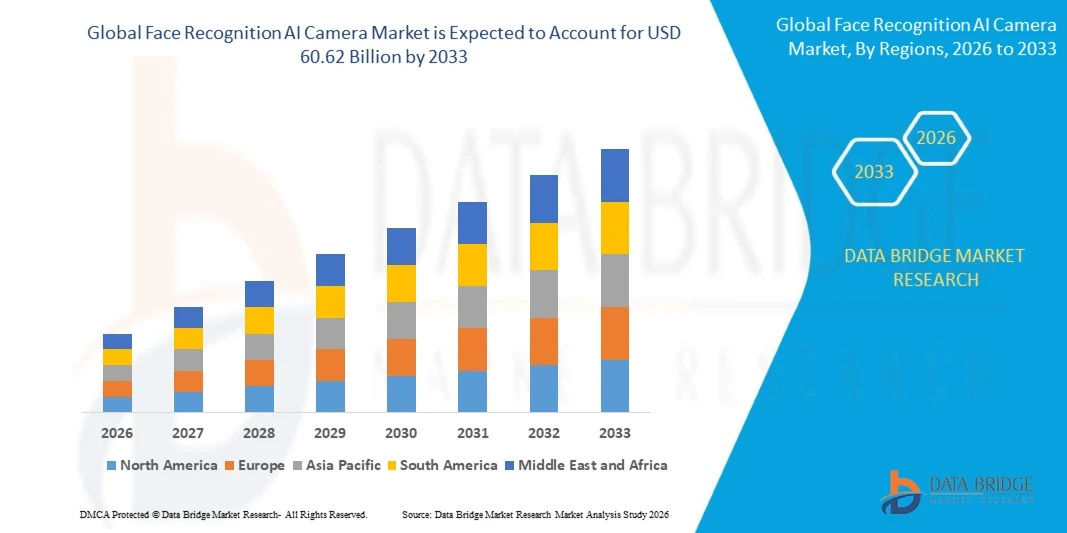
- As per Data Bridge Market Research analysis, the face recognition AI camera market was valued at USD 11.13 billion in 2025 and is projected to reach USD 60.62 billion by 2033, growing at a CAGR of 23.60% from 2026 to 2033.
- The market is experiencing significant growth driven by rising demand for intelligent surveillance systems, rapid advancements in artificial intelligence and facial recognition algorithms, and expanding applications across access control, identity verification, and public safety.
- The increasing need for enhanced security, combined with growing investments in smart city infrastructure and biometric authentication, is compelling governments, businesses, and transportation facilities to adopt advanced face recognition camera technologies. AI-powered cameras with real-time facial identification and analytics are increasingly being deployed to improve security monitoring, automate identity verification, and strengthen access management across commercial, industrial, and public environments.
Market Size & Forecast
- Global Market Value (2025): USD 11.13 Billion
- Expected Market Value (2033): USD 60.62 Billion
- Forecast CAGR (2026–2033): 23.60%
- Leading Region in 2025: North America
- Fastest Growing Region: Asia Pacific
What are the Major Takeaways of the Face Recognition AI Camera Market?
- North America dominated the face recognition AI camera market with the largest revenue share of 38.9% in 2025, supported by advanced security infrastructure, strong technology investments, and widespread adoption of AI-powered surveillance system
- Asia-Pacific is expected to be the fastest-growing region at a CAGR of 19.0% from 2026 to 2033, fueled by expanding smart city projects, increasing surveillance investments, and rising adoption of AI-powered biometric technologies across China, India, and Japan
- The software tools segment led the market with a 58.0% share in 2025, driven by increasing demand for facial detection algorithms, biometric matching software, real-time analytics, and AI-powered identification platforms.
- Services are the fastest-growing component type, projected to register a CAGR of 25.0%, reflecting the surge in demand for system integration, installation, maintenance, customization, and technical support.
- The 2D face recognition segment dominated the technology category with a 35.0% revenue share in 2025, led by its affordability, ease of deployment, and compatibility with conventional camera infrastructure.
- Access control accounted for 32.0% of the market share in 2025, preferred by rising demand for contactless authentication and automated entry management.
- The emotion recognition segment is the fastest-growing application category, with a CAGR of 28.0%, driven by rising demand for AI-powered facial expression analysis and intelligent customer experience analytics across retail, healthcare research, and human-computer interaction applications.
Report Scope and Face Recognition AI Camera Market Segmentation
|
Attributes |
Face Recognition AI Camera Key Market Insights |
|
Segments Covered |
|
|
Countries Covered |
North America
Europe
Asia-Pacific
Middle East and Africa
South America
|
|
Key Market Players |
|
|
Market Opportunities |
|
|
Value Added Data Infosets |
In addition to the insights on market scenarios such as market value, growth rate, segmentation, geographical coverage, and major players, the market reports curated by the Data Bridge Market Research also include in-depth expert analysis, geographically represented company-wise production and capacity, network layouts of distributors and partners, detailed and updated price trend analysis and deficit analysis of supply chain and demand. |
What is the Key Trend in the Face Recognition AI Camera Market?
- Face recognition AI camera manufacturers are increasingly integrating deep learning algorithms, edge AI processing, and real-time facial analytics to improve identification accuracy, reduce response times, and support intelligent security monitoring across commercial and public environments.
- For instance, in January 2024, Hanwha Vision introduced its AI-powered X-series cameras with advanced analytics capabilities, supporting intelligent object classification and more efficient surveillance operations.
- Edge-based facial processing enables cameras to analyze biometric information locally, reducing dependence on cloud connectivity and supporting faster security responses.
- Businesses and public infrastructure operators are increasingly deploying AI-powered facial recognition cameras for automated access control, identity verification, and real-time monitoring in high-traffic locations.
- For instance, in June 2024, Axis Communications continued expanding its AI-enabled network camera portfolio with deep-learning processing capabilities designed to support advanced analytics at the network edge.
- As organizations prioritize intelligent surveillance, faster biometric processing, and efficient security management, the integration of edge AI and advanced facial analytics is expected to accelerate, strengthening the role of face recognition AI cameras across connected security infrastructure.
What are the Key Drivers of the Face Recognition AI Camera Market?
- The rapid advancement of artificial intelligence and deep learning technologies has significantly increased demand for face recognition AI cameras capable of delivering accurate identification, real-time biometric verification, and automated surveillance across diverse environments.
- For instance, in March 2024, IDEMIA reported that Abu Dhabi's Zayed International Airport had processed over 1 million passengers through its new terminal using biometric solutions, demonstrating the growing role of biometric technologies in efficient passenger processing and airport security.
- Government agencies, commercial enterprises, and transportation operators are integrating facial recognition cameras into security infrastructure to strengthen identity verification, improve access management, and reduce dependence on manual monitoring procedures.
- For instance, in January 2024, Hanwha Vision showcased new AI-powered PTZ and mini multidirectional cameras at Intersec 2024, highlighting growing demand for intelligent video surveillance solutions across multiple industries.
- With organizations increasingly prioritizing automated security, operational efficiency, and biometric authentication, face recognition AI cameras are expected to remain an important component of next-generation surveillance and access control systems.
What Factors are Challenging the Growth of the Face Recognition AI Camera Market?
- Face recognition AI cameras face challenges related to privacy concerns, biometric data protection, algorithmic bias, and regulatory compliance, particularly when deployed for continuous surveillance and identification in public spaces.
- These challenges increase implementation complexity for governments and businesses, requiring stronger data governance, transparent identification procedures, and safeguards against unauthorized access to sensitive biometric information.
- For instance, in February 2025, the European Union's AI Act prohibitions on certain AI practices, including specified uses of real-time remote biometric identification in publicly accessible spaces for law enforcement, began applying, increasing the importance of regulatory compliance for facial recognition deployments.
- Differences in recognition accuracy across demographic groups and variations in lighting, image quality, and camera positioning can further affect system reliability, particularly in large-scale identification and security applications.
- For instance, in March 2025, the National Institute of Standards and Technology (NIST) updated its face recognition demographic evaluation data, highlighting differences in false-positive and false-negative rates across demographic groups and reinforcing the need for rigorous algorithm testing.
- Privacy restrictions, compliance costs, and the need for reliable and equitable identification continue to challenge adoption, particularly in highly regulated environments and public surveillance applications, despite increasing demand for AI-powered security solutions.
How is the Face Recognition AI Camera Market Segmented?
The face recognition AI camera market is segmented on the basis of component, technology, verticals, and application.
- By Component
On the basis of component, the face recognition AI camera market is segmented into software tools and services. The software tools segment is expected to dominate the market with an estimated share of 58.0% in 2025, driven by increasing demand for facial detection algorithms, biometric matching software, real-time analytics, and AI-powered identification platforms. These tools enable cameras to detect, analyze, and match facial features against authorized databases. Continuous advancements in deep learning and computer vision are improving recognition accuracy and processing efficiency. Integration with video management systems and access control platforms is expanding software functionality. Growing demand for real-time alerts and automated security monitoring is further supporting adoption.
The services segment is projected to register the fastest growth at a CAGR of 25.0% from 2026 to 2033, supported by increasing demand for system integration, installation, maintenance, customization, and technical support. Organizations require specialized services to integrate facial recognition cameras with existing surveillance and security infrastructure. Deployment across airports, commercial buildings, and public facilities often involves complex configuration and database integration. Ongoing software updates and model optimization create recurring service requirements. Privacy compliance and cybersecurity requirements are also increasing demand for professional consulting and system audits. Growing adoption among organizations without in-house AI expertise is expected to support further expansion.
- By Technology
On the basis of technology, the face recognition AI camera market is segmented into 2D face recognition, 3D face recognition, infrared face recognition, thermal face recognition, and AI-based facial analytics. The 2D face recognition segment is expected to dominate the market with an estimated share of 35.0% in 2025, owing to its affordability, ease of deployment, and compatibility with conventional camera infrastructure. These systems analyze facial features using two-dimensional images captured by cameras. Their relatively low hardware requirements make them suitable for commercial surveillance and access control applications. Integration with existing security systems further supports adoption across offices, retail stores, and public facilities. Continuous improvements in image processing and deep learning are enhancing recognition performance.
The AI-based facial analytics segment is projected to register the fastest growth at a CAGR of 27.0% from 2026 to 2033, driven by increasing demand for intelligent identification, automated monitoring, and advanced facial data analysis. These solutions use artificial intelligence to analyze facial characteristics and improve recognition performance. Integration with real-time video analytics enables faster identification and automated security alerts. Increasing adoption of edge AI processors is supporting faster analysis directly on camera devices. Organizations are also exploring facial analytics for access management, identity verification, and operational monitoring. Continued improvements in deep learning algorithms and computer vision are expected to strengthen demand for intelligent facial analytics.
- By Verticals
On the basis of verticals, the face recognition AI camera market is segmented into BFSI, government and defense, retail and e-commerce, healthcare, education, automotive, and others. The government and defense segment is expected to dominate the market with an estimated share of 30.0% in 2025, supported by increasing demand for public safety, identity verification, border security, and surveillance infrastructure. Government agencies use facial recognition cameras to support identity checks at security checkpoints and restricted facilities. Defense organizations also require advanced identification technologies to strengthen access management and facility protection. Investments in smart cities and public security infrastructure are creating additional deployment opportunities. Integration with existing surveillance networks helps authorities monitor sensitive locations more efficiently.
The retail and e-commerce segment is projected to register the fastest growth at a CAGR of 26.0% from 2026 to 2033, driven by increasing demand for intelligent retail analytics, automated security, and customer engagement technologies. Retailers are exploring AI-powered cameras to support loss prevention, identify security incidents, and analyze store operations. Integration with video analytics platforms can help businesses understand customer movement patterns and optimize store layouts. Facial recognition may also support identity verification in selected payment and loyalty applications, subject to applicable consent and privacy requirements. Advancements in edge computing are improving video data processing in retail environments. Growing investments in smart retail infrastructure are expected to create further opportunities for adoption.
- By Application
On the basis of application, the face recognition AI camera market is segmented into emotion recognition, attendance tracking and monitoring, access control, law enforcement, and others. The access control segment is expected to dominate the market with an estimated share of 32.0% in 2025, driven by rising demand for contactless authentication and automated entry management. Face recognition cameras are increasingly deployed in offices, commercial buildings, airports, and restricted facilities. These systems can verify authorized individuals without requiring physical access cards or conventional passwords. Integration with identity management platforms enables organizations to streamline entry procedures and manage permissions. Contactless authentication also supports operational efficiency in high-traffic environments.
The emotion recognition segment is projected to register the fastest growth at a CAGR of 28.0% from 2026 to 2033, as AI-based facial analysis technologies expand across selected research, retail analytics, and human-computer interaction applications. These systems attempt to classify facial expressions using computer vision and machine learning techniques. Retail and research organizations may use such tools to study aggregate responses to products, interfaces, or services, subject to privacy requirements. Improvements in image processing and deep learning are expanding the capabilities of facial analysis software. Integration with intelligent cameras can support automated analysis of visual information. However, the reliability of inferring emotional states from facial expressions remains contested, and privacy concerns and regulatory restrictions may limit adoption in certain applications.
Which Region Holds the Largest Share of the Face Recognition AI Camera Market?
- North America dominated the face recognition AI camera market with the largest revenue share of 38.9% in 2025, supported by advanced security infrastructure, strong technology investments, and widespread adoption of AI-powered surveillance system
- The region also benefits from increasing demand for intelligent surveillance, growing deployment of AI-powered access control systems, and the presence of established technology providers. Rising investments in smart city initiatives, public safety infrastructure, and real-time facial recognition technologies continue to strengthen North America's leadership position in the global market.
U.S. Face Recognition AI Camera Market Insight
The U.S. face recognition AI camera market is witnessing strong growth due to rising investments in intelligent surveillance systems, biometric authentication, and public safety infrastructure. The country’s advanced technology ecosystem, along with increasing adoption of AI-powered cameras across commercial, government, and transportation applications, is driving market demand. In addition, growing emphasis on automated access control, identity verification, and real-time threat detection is accelerating the adoption of facial recognition technologies across businesses and security facilities.
Asia-Pacific Face Recognition AI Camera Market Insight
The Asia-Pacific face recognition AI camera market is expected to witness rapid growth, driven by increasing urbanization, expanding smart city projects, and rising investments in security infrastructure across China, India, and Japan. Growing adoption of AI-powered surveillance technologies, increasing demand for biometric authentication, and expanding deployment of intelligent monitoring systems are supporting regional market expansion. Additionally, rising investments in transportation infrastructure, commercial security, and digital identity solutions are accelerating the adoption of face recognition AI cameras across public and private sectors.
Japan Face Recognition AI Camera Market Insight
The Japan face recognition AI camera market is witnessing consistent growth due to rising investments in advanced security technologies, biometric authentication, and intelligent infrastructure. Commercial establishments, transportation facilities, and public institutions are increasingly adopting facial recognition cameras for access management, identity verification, and security monitoring. Moreover, increasing integration of AI-based image processing, contactless authentication, and automated surveillance systems, along with the country's focus on technological innovation and operational efficiency, is further contributing to market growth.
China Face Recognition AI Camera Market Insight
The China face recognition AI camera market is growing rapidly, driven by expanding smart city infrastructure, increasing investments in artificial intelligence, and rising demand for intelligent surveillance systems. Growing adoption of facial recognition technologies across transportation hubs, commercial facilities, and public security applications is significantly boosting market demand. In addition, rapid advancements in AI algorithms, domestic camera manufacturing, and biometric identification technologies are supporting deployment across multiple industries, positioning China as a major market for face recognition AI cameras.
U.K. Face Recognition AI Camera Market Insight
The U.K. face recognition AI camera market is experiencing steady growth, supported by rising adoption of intelligent surveillance technologies, biometric security systems, and automated access control solutions. Increasing investments in commercial security infrastructure and growing demand for real-time identification across selected transportation and public safety applications are contributing to market development. Furthermore, integration of AI-powered analytics and network cameras is improving monitoring capabilities, while regulatory requirements concerning biometric data and privacy continue to influence deployment practices across the country.
Germany Face Recognition AI Camera Market Insight
The Germany face recognition AI camera market is expanding steadily due to the country's advanced industrial infrastructure, growing investments in smart security technologies, and increasing adoption of AI-powered monitoring systems. Commercial enterprises, transportation facilities, and industrial organizations are exploring facial recognition cameras for access management, identity verification, and security monitoring. Continuous advancements in computer vision, edge AI processing, and intelligent video analytics, along with increasing emphasis on cybersecurity and data protection, are shaping market development in Germany.
Which are the Top Companies in Face Recognition AI Camera Market?
The face recognition AI camera industry is primarily led by well-established companies, including:
- Hangzhou Hikvision Digital Technology Co., Ltd. (China)
- Zhejiang Dahua Technology Co., Ltd. (China)
- Axis Communications AB (Sweden)
- Hanwha Vision Co., Ltd. (South Korea)
- VIVOTEK Inc. (Taiwan)
- Zhejiang Uniview Technologies Co., Ltd. (China)
- Tiandy Technologies Co., Ltd. (China)
- i-PRO Co., Ltd. (Japan)
- Robert Bosch GmbH (Germany)
- Panasonic Holdings Corporation (Japan)
- Canon Inc. (Japan)
- Sony Group Corporation (Japan)
- NEC Corporation (Japan)
- Fujitsu Limited (Japan)
- Suprema Inc. (South Korea)
- IDEMIA (France)
- CyberLink Corp. (Taiwan)
- Motorola Solutions, Inc. (U.S.)
- Aditya Infotech Limited (India)
- Milesight Technology Co., Ltd. (China)
What are Latest Developments in Face Recognition AI Camera Market?
- In October 2025, EnGenius Technologies announced the launch of its ECC500 AI Surveillance Camera, an 8-megapixel camera featuring on-device and cloud-based AI capabilities for facial recognition, license plate recognition, and intelligent video analytics. Integrated with EnGenius Surveillance Cloud, the camera enables face tracking and cross-camera searches to support security investigations and centralized surveillance management. This launch highlights the growing integration of AI-powered facial recognition and cloud-managed security systems.
- In April 2025, CyberLink released FaceMe SDK 7.2, an updated facial recognition engine featuring faster anti-spoofing processing, enhanced deepfake detection, and improved facial analysis capabilities. The update introduced faster 2D anti-spoofing processing and improvements to infrared and RGB-based verification, helping developers strengthen identity authentication across compatible devices. This development reflects growing industry efforts to improve the security and reliability of AI-powered facial recognition systems.
- In April 2025, Axis Communications announced four AI-powered dome cameras based on its ARTPEC-9 system-on-chip platform. The new models provide high-resolution imaging and edge-based analytics, including detection, classification, tracking, and counting of people and vehicles. They also incorporate cybersecurity features and image-quality monitoring to improve surveillance performance in demanding environments. The launch demonstrates continued advancement in AI-enabled network cameras and intelligent video analytics.
- In September 2024, Suprema announced the launch of its BioEntry W3 AI-powered facial authentication device, designed for high-security environments. The device incorporates a display-free design and its Template on Mobile authentication method to strengthen privacy protection while supporting secure biometric access control. Its durable design makes it suitable for demanding indoor and outdoor installations. This launch highlights the industry's growing focus on combining facial authentication, privacy protection, and robust access management.
- In March 2023, VIVOTEK launched the FD9387-FR-v2, an edge-computing facial recognition camera integrating the SAFR Inside AI platform. The camera supports real-time facial detection and tracking, recognition of people wearing masks, and alerts for unfamiliar faces. It also includes encrypted data storage and transmission, along with local facial data storage capabilities. The launch demonstrated how edge AI can improve facial recognition efficiency while supporting privacy-conscious surveillance and access control.
- In June 2021, AnyVision announced the availability of its Recognition AI software optimized for Ambarella's CV2x edge AI vision processors. The solution enabled compatible IP security cameras to perform facial recognition, person detection, video analytics, and liveness detection directly on the device. This approach reduced reliance on external processing servers and supported real-time biometric access control and surveillance. The development highlighted the growing shift toward edge-based AI processing in facial recognition camera systems.

- Interactive Data Analysis Dashboard
- Company Analysis Dashboard for high growth potential opportunities
- Research Analyst Access for customization & queries
- Competitor Analysis with Interactive dashboard
- Latest News, Updates & Trend analysis
- Harness the Power of Benchmark Analysis for Comprehensive Competitor Tracking
Global Face Recognition Ai Camera Market, Supply Chain Analysis and Ecosystem Framework
To support market growth and help clients navigate the impact of geopolitical shifts, DBMR has integrated in-depth supply chain analysis into its Global Face Recognition Ai Camera Market research reports. This addition empowers clients to respond effectively to global changes affecting their industries. The supply chain analysis section includes detailed insights such as Global Face Recognition Ai Camera Market consumption and production by country, price trend analysis, the impact of tariffs and geopolitical developments, and import and export trends by country and HSN code. It also highlights major suppliers with data on production capacity and company profiles, as well as key importers and exporters. In addition to research, DBMR offers specialized supply chain consulting services backed by over a decade of experience, providing solutions like supplier discovery, supplier risk assessment, price trend analysis, impact evaluation of inflation and trade route changes, and comprehensive market trend analysis.
Data collection and base year analysis are done using data collection modules with large sample sizes. The stage includes obtaining market information or related data through various sources and strategies. It includes examining and planning all the data acquired from the past in advance. It likewise envelops the examination of information inconsistencies seen across different information sources. The market data is analysed and estimated using market statistical and coherent models. Also, market share analysis and key trend analysis are the major success factors in the market report. To know more, please request an analyst call or drop down your inquiry.
The key research methodology used by DBMR research team is data triangulation which involves data mining, analysis of the impact of data variables on the market and primary (industry expert) validation. Data models include Vendor Positioning Grid, Market Time Line Analysis, Market Overview and Guide, Company Positioning Grid, Patent Analysis, Pricing Analysis, Company Market Share Analysis, Standards of Measurement, Global versus Regional and Vendor Share Analysis. To know more about the research methodology, drop in an inquiry to speak to our industry experts.
Data Bridge Market Research is a leader in advanced formative research. We take pride in servicing our existing and new customers with data and analysis that match and suits their goal. The report can be customized to include price trend analysis of target brands understanding the market for additional countries (ask for the list of countries), clinical trial results data, literature review, refurbished market and product base analysis. Market analysis of target competitors can be analyzed from technology-based analysis to market portfolio strategies. We can add as many competitors that you require data about in the format and data style you are looking for. Our team of analysts can also provide you data in crude raw excel files pivot tables (Fact book) or can assist you in creating presentations from the data sets available in the report.