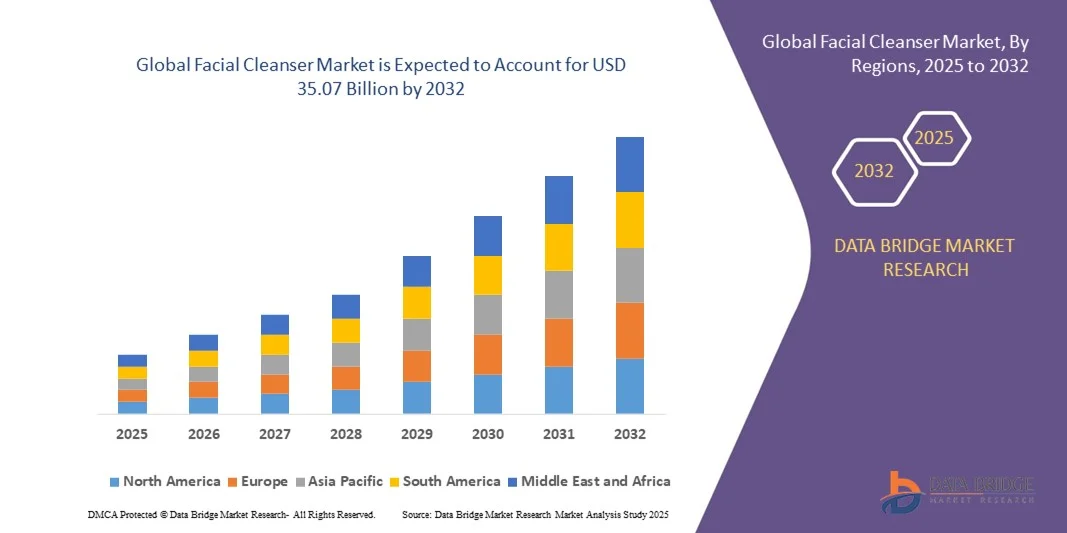
Facial Cleanser Market Size
- The global facial cleanser market size was valued at USD 23.43 billion in 2024 and is expected to reach USD 35.07 billion by 2032, at a CAGR of 5.17% during the forecast period
- The market growth is largely fueled by increasing consumer awareness about skincare, rising demand for personal grooming products, and the growing adoption of natural, herbal, and premium facial cleansers across global markets
- Furthermore, evolving consumer preferences for multifunctional, anti-aging, moisturizing, and specialty skincare solutions are driving higher demand. These factors are accelerating the uptake of facial cleansers across household and professional segments, thereby significantly boosting the industry’s growth
Facial Cleanser Market Analysis
- Facial cleansers are skincare products designed to remove dirt, oil, makeup, and impurities from the skin while maintaining hydration and skin health. They are available in various formulations, including foaming, gel, cream, oil-based, and micellar water, catering to different skin types and concerns
- The escalating demand for facial cleansers is primarily fueled by rising skincare awareness, increasing disposable incomes, urbanization, and the growing influence of social media and beauty trends. Consumers are also seeking products that provide convenience, efficacy, and natural or dermatologically tested ingredients, further driving market expansion
- Asia-Pacific dominated facial cleanser market with a share of over 40% in 2024, due to rising skincare awareness, growing disposable incomes, and rapid urbanization across developing economies
- North America is expected to be the fastest growing region in the facial cleanser market during the forecast period due to increasing skincare awareness, technological innovations in formulations, and growing demand for premium and specialized cleansers
- Natural/herbal segment dominated the market with a market share of 55.5% in 2024, due to growing consumer preference for chemical-free, eco-friendly, and skin-safe products. Natural ingredients such as aloe vera, chamomile, and green tea are perceived as safer and therapeutic for daily use. Rising awareness about sustainability, minimal side effects, and the trend toward organic cosmetics further reinforce its dominance. Consumers also associate herbal cleansers with long-term skin benefits and a holistic approach to skincare
Report Scope and Facial Cleanser Market Segmentation
|
Attributes |
Facial Cleanser Key Market Insights |
|
Segments Covered |
|
|
Countries Covered |
North America
Europe
Asia-Pacific
Middle East and Africa
South America
|
|
Key Market Players |
|
|
Market Opportunities |
|
|
Value Added Data Infosets |
In addition to the insights on market scenarios such as market value, growth rate, segmentation, geographical coverage, and major players, the market reports curated by the Data Bridge Market Research also include in-depth expert analysis, pricing analysis, brand share analysis, consumer survey, demography analysis, supply chain analysis, value chain analysis, raw material/consumables overview, vendor selection criteria, PESTLE Analysis, Porter Analysis, and regulatory framework. |
Facial Cleanser Market Trends
Growing Preference for Natural and Multifunctional Cleansers
- The facial cleanser market is increasingly being driven by the growing preference for natural, plant-based, and multifunctional formulations that cater to health-conscious consumers. With heightened awareness of harmful chemicals and their long-term effects, consumers are shifting toward gentle cleansers featuring botanical extracts and eco-friendly ingredients that provide both safety and effectiveness
- For instance, brands such as The Body Shop and Burt’s Bees have gained recognition for their naturally derived facial cleansers enriched with ingredients such as tea tree oil, aloe vera, and chamomile. These product lines demonstrate how companies are aligning with consumer demand for clean-label, toxin-free skincare options
- The demand for multifunctional cleansers that combine cleansing with additional skincare benefits is significantly rising. These products are being formulated to remove dirt and impurities and also hydrate, exfoliate, balance pH, and address issues such as acne and sensitivity, creating appeal for time-constrained consumers
- Growing interest in sustainability has pushed cosmetic brands to incorporate biodegradable packaging and responsibly sourced ingredients in facial cleansers. This trend supports the broader sustainability goals of both consumers and companies and enhances product acceptance among eco-conscious buyers
- Premium innovations such as cleansers powered by probiotics, antioxidants, and micellar technology are gaining momentum in both mass-market and luxury segments. These additions provide targeted skin benefits while addressing growing demands for efficacy and personalization in skincare routines
- The increasing consumer expectation for facial cleansers to deliver safe, sustainable, and multifunctional care is reshaping market strategies, compelling companies to innovate with natural ingredients, dermatologically tested formulations, and eco-responsible practices, thus ensuring long-term industry growth
Facial Cleanser Market Dynamics
Driver
Rising Skincare Awareness
- Growing global awareness regarding skin health and hygiene is a key driver fueling demand for facial cleansers, as consumers increasingly seek products that support preventative and corrective skincare practices. This transformation is reinforced by rising media influence, wellness trends, and dermatological guidance
- For instance, L’Oréal has emphasized skincare education through its active brands such as CeraVe, which provides dermatologist-developed cleansers that address diverse skin concerns including acne and dryness. Such initiatives highlight how large companies are using awareness campaigns to expand consumer adoption
- With increasing awareness of the impacts of pollution, sun exposure, and aging on skin health, consumers are incorporating cleansers into daily regimens as an essential step for long-term skincare. This has significantly increased usage frequency and broadened adoption across diverse demographic groups
- The rising popularity of digital skincare communities and beauty influencers is prompting younger generations to invest in quality cleansers tailored to their skin type. This has had a direct impact on expanding the market reach of both premium and affordable product categories
- The emphasis on overall wellbeing and self-care is encouraging consumers to buy cleansers that offer proven clinical benefits. As demand grows across emerging and developed nations, greater access to dermatologically supported facial cleansers is cementing their position in mainstream skincare routines globally
Restraint/Challenge
Intense Market Competition
- One key challenge in the facial cleanser market is the intense competition among a wide range of global and regional brands vying for consumer attention. With the market saturated with products across various price points, companies are constantly pressured to differentiate through innovation and marketing strategies
- For instance, multinational giants such as Unilever and Procter & Gamble face strong competition from indie and natural beauty brands, which attract younger audiences by emphasizing niche, eco-friendly, or ingredient-led offerings. This fragmented competitive landscape puts pressure on established players to innovate rapidly
- The availability of a wide array of cleansers targeting diverse skin types creates difficulty for consumers in making purchase decisions. This intensifies the need for companies to strengthen their brand visibility and consumer trust through superior efficacy claims and transparency in ingredient sourcing
- Price competition remains another hurdle, as affordable local and private-label brands often capture significant market share in emerging markets. This forces premium and mid-tier brands to balance cost, perceived value, and innovation simultaneously to remain competitive
- Sustaining long-term growth in the facial cleanser market will require differentiation through credible product claims, authentic branding, and consistent innovation. Companies that address consumer skepticism, emphasize clinical validation, and balance affordability with innovation will be best positioned to withstand competition and secure market leadership
Facial Cleanser Market Scope
The market is segmented on the basis of product type, source, packaging type, skin type, application, price range, age group, cost, target customer, end use, and distribution channel.
- By Product Type
On the basis of product type, the facial cleanser market is segmented into foaming facial cleanser, gel facial cleanser, cream & lotion facial cleanser, oil facial cleanser, no foam cleanser, micellar water, bar facial cleanser, solvent facial cleanser, collagen type cleanser, cleansing cotton pads, and others. The foaming facial cleanser segment dominated the market in 2024, driven by its ability to deeply cleanse and remove excess oil, making it ideal for daily skincare. Consumers value the refreshing feel, effective lathering, and suitability for oily and combination skin types. Its compatibility with multiple skin concerns and availability in retail and online stores further supports its dominance. Growing awareness of personal hygiene and routine skincare also strengthens its market position.
The gel facial cleanser segment is expected to witness the fastest growth from 2025 to 2032, fueled by rising demand among younger consumers and those with sensitive or acne-prone skin. Gel cleansers provide gentle yet effective cleansing without over-drying, often incorporating soothing and anti-acne ingredients. Their lightweight texture and multifunctionality make them a preferred choice for modern skincare routines. Increasing consumer interest in dermatologically tested and innovative gel formulations further drives this segment’s growth.
- By Source
On the basis of source, the facial cleanser market is segmented into synthetic and natural/herbal. The natural/herbal segment dominated the largest market share of 55.5% in 2024, driven by growing consumer preference for chemical-free, eco-friendly, and skin-safe products. Natural ingredients such as aloe vera, chamomile, and green tea are perceived as safer and therapeutic for daily use. Rising awareness about sustainability, minimal side effects, and the trend toward organic cosmetics further reinforce its dominance. Consumers also associate herbal cleansers with long-term skin benefits and a holistic approach to skincare.
The synthetic segment is expected to witness the fastest growth from 2025 to 2032, fueled by technological innovation and development of high-performance cleansers targeting acne, oil control, and anti-aging needs. Synthetic formulations provide consistent efficacy, enhanced shelf life, and availability of potent active ingredients. Rising demand for specialized cleansers that deliver fast results supports growth in this segment.
- By Packaging Type
On the basis of packaging type, the market is segmented into bottles and jars, tubes, dispensers, pouches, blisters and strip packs, and others. The bottles and jars segment dominated in 2024, due to convenience, durability, and larger product volume suitable for household and professional use. Consumers prefer these formats for ease of storage and repeated usage. Bottles and jars also support premium branding, aesthetically appealing designs, and compatibility with various retail settings. The wide acceptance across offline and online channels reinforces its market share.
The dispenser segment is expected to witness the fastest growth from 2025 to 2032, fueled by increasing hygiene awareness and demand for controlled dispensing. Dispensers reduce wastage, maintain product integrity, and offer a user-friendly experience. Growing adoption in households, salons, and spas is accelerating this segment, while premium and travel-friendly designs also contribute to rising popularity.
- By Skin Type
On the basis of skin type, the facial cleanser market is segmented into combination skin, oily skin, neutral skin, dry skin, sensitive skin, mixed skin, and others. The oily skin segment dominated in 2024, driven by high prevalence of sebum-related concerns and acne issues. Consumers prefer products that deeply cleanse, control oil production, and prevent breakouts. Oily skin cleansers often include ingredients such as salicylic acid or tea tree oil that balance skin while maintaining hydration. Urban populations particularly favor these products, contributing to strong market demand.
The sensitive skin segment is expected to witness the fastest growth from 2025 to 2032, fueled by rising awareness of hypoallergenic, gentle, and dermatologically tested products. Consumers increasingly prefer mild formulations that reduce irritation, redness, and inflammation. The growing prevalence of skin allergies and adoption of skin-safe routines across age groups supports the segment’s expansion.
- By Application
On the basis of application, the facial cleanser market is segmented into moisturizing, skin whitening, oiliness, anti-aging, blackheads, dark spots, repair, dryness, and others. The moisturizing segment dominated in 2024, driven by demand for cleansers that hydrate while cleansing. Consumers across age groups prefer products that maintain skin barrier health, prevent tightness, and enhance softness. Multitasking products that combine hydration with gentle cleansing are increasingly popular. The shift toward holistic skincare and daily maintenance routines reinforces the segment’s market share.
The anti-aging segment is expected to witness the fastest growth from 2025 to 2032, driven by rising consumer awareness about early skincare and prevention of wrinkles and fine lines. Anti-aging cleansers often include antioxidants, peptides, and vitamins to rejuvenate skin. Aging populations, increasing disposable incomes, and lifestyle-driven skin concerns support this growth. The segment is also expanding due to rising demand for multifunctional and premium formulations.
- By Price Range
On the basis of price range, the market is segmented into mass and premium. The mass segment dominated in 2024, attributed to affordability, wide accessibility, and catering to the middle-income population. Mass products focus on essential cleansing benefits and attract a broad consumer base. Offline and online retail channels ensure easy availability. Rising skincare awareness in emerging markets also contributes to dominance in this segment.
The premium segment is expected to witness the fastest growth from 2025 to 2032, driven by rising demand for luxury ingredients, advanced formulations, and indulgent experiences. Consumers increasingly invest in products offering targeted benefits, elegant packaging, and brand prestige. Innovation in functional, high-performance cleansers further fuels growth in this segment.
- By Age Group
On the basis of age group, the facial cleanser market is segmented into less than 20 years, 20s and 30s, 40s, 50s+, and others. The 20s and 30s segment dominated in 2024, fueled by high skincare awareness, social media influence, and disposable income. Consumers in this demographic actively seek cleansers that address oiliness, acne, and early signs of aging. Their preference for multifunctional products that fit into busy lifestyles drives market demand.
The less than 20 years segment is expected to witness the fastest growth from 2025 to 2032, driven by adoption of skincare routines among teenagers and young adults. Products targeting acne-prone and sensitive skin are particularly popular. The growing influence of beauty influencers, peer recommendations, and online education about skincare accelerates growth.
- By Cost
On the basis of cost, the facial cleanser market is segmented into less than 25 USD, 25–50 USD, 51–100 USD, 101–200 USD, and more than 200 USD. The less than 25 USD segment dominated in 2024, driven by affordability and accessibility for a broad consumer base. This cost range appeals to middle-income households, students, and first-time buyers looking for daily-use products. The wide availability of essential cleansers in offline and online retail channels reinforces its market share. Rising skincare awareness and frequent repurchase cycles further strengthen its dominance.
The 51–100 USD segment is expected to witness the fastest growth from 2025 to 2032, fueled by rising consumer inclination toward premium formulations, specialized benefits, and branded products. This cost bracket often includes advanced ingredients for anti-aging, brightening, and deep hydration. Increasing disposable incomes, urbanization, and willingness to invest in higher-quality skincare products are driving adoption in this segment.
- By Target Customer
On the basis of target customer, the market is segmented into female and male. The female segment dominated in 2024, driven by higher skincare awareness, consistent usage, and willingness to spend on daily routines. Female consumers actively look for products addressing multiple skin concerns, including hydration, anti-aging, and brightening. The diversity of product formulations and availability in varied packaging types reinforces dominance.
The male segment is expected to witness the fastest growth from 2025 to 2032, fueled by increasing interest in male grooming and skincare. Male-specific cleansers targeting oil control, acne, and quick routines are gaining traction. Urban male consumers are also investing in premium and specialized formulations, expanding market opportunities.
- By End Use
On the basis of end use, the market is segmented into household/retail, parlor, modeling and fashion agencies, movies and entertainment, media houses, and others. The household/retail segment dominated in 2024, driven by individual consumption and growing awareness of personal skincare. Retail and household users prioritize convenience, affordability, and variety. Frequent repurchase cycles and wide availability of brands in offline and online channels further support dominance.
The parlor segment is expected to witness the fastest growth from 2025 to 2032, fueled by professional adoption in salons, spas, and facial treatments. Premium and herbal formulations are increasingly used to enhance client experience. Growing beauty services and rising disposable incomes in urban areas further propel this segment.
- By Distribution Channel
On the basis of distribution channel, the market is segmented into offline and online. The offline segment dominated in 2024, due to established retail presence, product trial opportunities, and consumer trust in physical stores. Consumers prefer seeing and testing products before purchase. Widespread retail networks and brand visibility reinforce market dominance.
The online segment is expected to witness the fastest growth from 2025 to 2032, driven by increasing e-commerce adoption, convenience of doorstep delivery, and availability of exclusive products. Discounts, subscription models, and online reviews are encouraging purchases. Growing digital literacy and smartphone penetration further accelerate online sales.
Facial Cleanser Market Regional Analysis
- Asia-Pacific dominated the facial cleanser market with the largest revenue share of over 40% in 2024, driven by rising skincare awareness, growing disposable incomes, and rapid urbanization across developing economies
- The region’s expanding e-commerce penetration, increasing availability of premium and herbal skincare products, and rising influence of beauty trends from social media are accelerating market growth
- The presence of a large consumer base, favorable government policies for cosmetics manufacturing, and increasing investments in R&D for advanced formulations are contributing to higher adoption of facial cleansers across residential and professional segments
China Facial Cleanser Market Insight
China held the largest share in the Asia-Pacific facial cleanser market in 2024, owing to its massive urban population, rising disposable incomes, and strong e-commerce infrastructure. The country’s domestic cosmetic industry, focus on skincare innovation, and increasing demand for herbal and premium facial cleansers are key growth drivers. Ongoing investments in manufacturing, marketing, and distribution networks further strengthen market presence, while consumer preference for multifunctional and natural products boosts demand.
India Facial Cleanser Market Insight
India is witnessing the fastest growth in the Asia-Pacific region, fueled by rising awareness of personal grooming, increasing skincare adoption among millennials and Gen Z, and growing online retail penetration. The surge in domestic production of herbal and premium skincare products, combined with initiatives promoting self-reliance in cosmetics, is strengthening demand. Expansion of beauty salons, rising disposable incomes, and the growing popularity of international brands are also contributing to robust market growth.
Europe Facial Cleanser Market Insight
The Europe facial cleanser market is expanding steadily, supported by high consumer preference for premium, natural, and ethically produced skincare products. Strong regulatory frameworks ensuring product safety, environmental sustainability, and high-quality formulations are driving market growth. Increasing focus on anti-aging, sensitive skin, and multifunctional facial cleansers, along with the presence of well-established cosmetic brands, is further enhancing adoption.
Germany Facial Cleanser Market Insight
Germany’s facial cleanser market is driven by its strong cosmetics and personal care industry, high consumer purchasing power, and emphasis on premium and dermatologically tested products. The country has a well-established R&D ecosystem for skincare innovation, encouraging the development of advanced facial cleanser formulations. Demand is particularly high for anti-aging, moisturizing, and sensitive-skin products, supported by retail chains, pharmacies, and online distribution networks.
U.K. Facial Cleanser Market Insight
The U.K. market is supported by a mature personal care sector, increasing demand for premium and herbal facial cleansers, and growing awareness of skincare routines. Rising focus on sustainable and ethically sourced products, collaborations between brands and beauty influencers, and high online retail penetration are enhancing market growth. Consumers’ inclination toward multifunctional cleansers and natural ingredients continues to drive adoption in both household and professional segments.
North America Facial Cleanser Market Insight
North America is projected to grow at the fastest CAGR from 2025 to 2032, driven by increasing skincare awareness, technological innovations in formulations, and growing demand for premium and specialized cleansers. Rising influence of social media, health-conscious lifestyles, and preference for natural or organic products are boosting demand. Expansion of online retail channels, subscription-based models, and high spending power further accelerate market growth.
U.S. Facial Cleanser Market Insight
The U.S. accounted for the largest share in the North America facial cleanser market in 2024, underpinned by a highly developed cosmetics industry, strong R&D infrastructure, and high consumer spending on personal care. Innovation in anti-aging, moisturizing, and multifunctional facial cleansers, along with widespread distribution through retail chains and e-commerce platforms, strengthens market dominance. Increasing demand for natural and herbal formulations, as well as personalized skincare solutions, further drives growth in the country.
Facial Cleanser Market Share
The facial cleanser industry is primarily led by well-established companies, including:
- Unilever (U.K.)
- Procter & Gamble (U.S.)
- L'Oréal Paris (France)
- Estée Lauder Inc. (U.S.)
- Johnson & Johnson Consumer Inc. (U.S.)
- AMOREPACIFIC US, INC. (U.S.)
- Kao Singapore Pte. Ltd. (Singapore)
- Shiseido Co., Ltd. (Japan)
- L’OCCITANE INTERNATIONAL SA (France)
- SEPHORA (France)
- Coty Inc. (U.S.)
- Clarins (France)
- Caudalie (France)
- Natura &Co (Brazil)
- Beiersdorf AG (Germany)
Latest Developments in Global Facial Cleanser Market
- In November 2023, Natura &Co announced the sale of The Body Shop to international private equity group Aurelius, signaling a strategic move to simplify and refocus its core operations. This divestment allows Natura &Co to streamline resources while enabling The Body Shop to leverage Aurelius’ expertise in scaling and transforming businesses. The deal is expected to enhance The Body Shop’s competitiveness, accelerate its transformation journey, and strengthen its position in the global skincare and personal care market
- In November 2023, Shiseido Co., Ltd. secured the top spot in the “Corporate Ranking” at the Forbes JAPAN WOMEN AWARD 2023, one of Japan’s most prestigious women’s awards. This recognition underscores Shiseido’s commitment to gender equality, diversity, and empowerment initiatives. By showcasing its efforts on a global platform, the company enhances its corporate image and also strengthens its appeal to socially conscious consumers, investors, and talent, positively impacting its market positioning
- In November 2023, Kao Corporation joined the Japanese Cosmetics & Personal Care Products Industry Buyer Members Sedex working team to improve labor standards across supply chains. This collaboration highlights Kao’s commitment to responsible sourcing and human rights in its operations. By addressing supply chain transparency and sustainability, Kao is likely to reinforce consumer trust, enhance brand credibility, and meet the growing market demand for ethically produced skincare and personal care products
- In June 2022, Kim Kardashian launched SKKN BY KIM, a high-performance skincare line in partnership with Coty, Inc. The launch strengthened Coty’s product portfolio by introducing a premium, celebrity-backed brand with high market visibility. This expansion enables the company to capture a larger share of the luxury and influencer-driven skincare segment, meeting growing consumer demand for celebrity-endorsed, high-quality skincare solutions
- In October 2022, Amorepacific completed the acquisition of additional shares of COSRX, making it a fully incorporated subsidiary with a total investment of 755.1 billion won. This acquisition expands Amorepacific’s presence in the K-beauty segment and strengthens its product offerings in the skincare category. By integrating COSRX’s innovative formulations and loyal consumer base, Amorepacific is positioned to increase market share, enhance brand equity, and drive growth in both domestic and international skincare markets

- Interactive Data Analysis Dashboard
- Company Analysis Dashboard for high growth potential opportunities
- Research Analyst Access for customization & queries
- Competitor Analysis with Interactive dashboard
- Latest News, Updates & Trend analysis
- Harness the Power of Benchmark Analysis for Comprehensive Competitor Tracking
Data collection and base year analysis are done using data collection modules with large sample sizes. The stage includes obtaining market information or related data through various sources and strategies. It includes examining and planning all the data acquired from the past in advance. It likewise envelops the examination of information inconsistencies seen across different information sources. The market data is analysed and estimated using market statistical and coherent models. Also, market share analysis and key trend analysis are the major success factors in the market report. To know more, please request an analyst call or drop down your inquiry.
The key research methodology used by DBMR research team is data triangulation which involves data mining, analysis of the impact of data variables on the market and primary (industry expert) validation. Data models include Vendor Positioning Grid, Market Time Line Analysis, Market Overview and Guide, Company Positioning Grid, Patent Analysis, Pricing Analysis, Company Market Share Analysis, Standards of Measurement, Global versus Regional and Vendor Share Analysis. To know more about the research methodology, drop in an inquiry to speak to our industry experts.
Data Bridge Market Research is a leader in advanced formative research. We take pride in servicing our existing and new customers with data and analysis that match and suits their goal. The report can be customized to include price trend analysis of target brands understanding the market for additional countries (ask for the list of countries), clinical trial results data, literature review, refurbished market and product base analysis. Market analysis of target competitors can be analyzed from technology-based analysis to market portfolio strategies. We can add as many competitors that you require data about in the format and data style you are looking for. Our team of analysts can also provide you data in crude raw excel files pivot tables (Fact book) or can assist you in creating presentations from the data sets available in the report.