


Facial Palsy Market Size
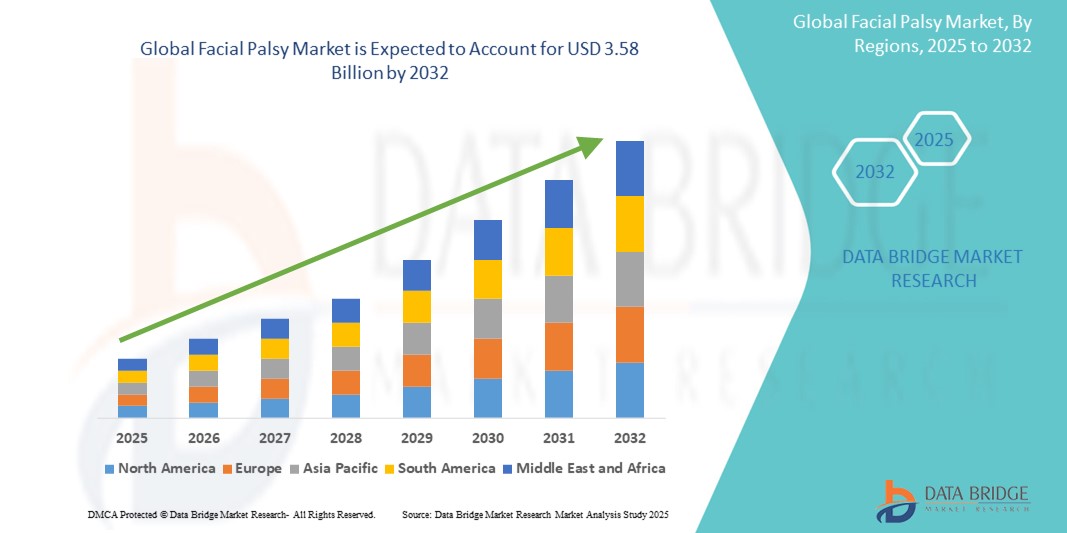
- The global facial palsy market size was valued at USD 2.51 billion in 2024 and is expected to reach USD 3.58 billion by 2032, at a CAGR of 4.50% during the forecast period
- The market growth is largely fueled by the growing adoption of advanced neurodiagnostic and therapeutic technologies, as well as increasing awareness about early intervention and treatment of neurological disorders, leading to improved diagnostic accuracy and patient outcomes in both hospital and specialty clinic settings
- Furthermore, rising consumer demand for non-invasive, effective, and accessible treatment options for facial paralysis is establishing modern neuromodulation and physiotherapy-based interventions as the preferred choice for managing facial palsy. These converging factors are accelerating the uptake of Facial Palsy solutions, thereby significantly boosting the industry's growth
Facial Palsy Market Analysis
- Facial palsy treatment solutions, which include physiotherapy, surgical intervention, and neuromodulation devices, are becoming increasingly essential in both clinical and home healthcare settings due to their effectiveness in restoring facial muscle function, enhancing quality of life, and supporting early rehabilitation efforts
- The escalating demand for facial palsy treatments is primarily fueled by the rising incidence of neurological disorders, increased awareness regarding early treatment, and a growing preference for minimally invasive therapeutic solutions
- North America dominated the facial palsy market with the largest revenue share of 38.6% in 2024, driven by advanced healthcare infrastructure, a high prevalence of facial nerve disorders, and active research initiatives for novel therapies. The U.S. remains the largest contributor within the region, owing to early adoption of electrotherapy devices, botulinum toxin treatments, and strong reimbursement frameworks
- Asia-Pacific is expected to be the fastest-growing region in the facial palsy market during the forecast period, with a projected CAGR of 8.7% from 2025 to 2032, driven by increasing healthcare expenditure, growing awareness regarding facial rehabilitation, and rising geriatric populations in countries like China, India, and Japan
- The MRI segment dominated the facial palsy market with a market revenue share of 42.5% in 2024, attributed to its superior imaging capability in detecting nerve inflammation, soft tissue damage, and tumors associated with facial palsy. MRI is widely preferred by clinicians due to its non-invasive nature and its ability to provide detailed anatomical insights crucial for diagnosis and treatment planning
Report Scope and Facial Palsy Market Segmentation
|
Attributes |
Facial Palsy Key Market Insights |
|
Segments Covered |
|
|
Countries Covered |
North America
Europe
Asia-Pacific
Middle East and Africa
South America
|
|
Key Market Players |
|
|
Market Opportunities |
|
|
Value Added Data Infosets |
In addition to the insights on market scenarios such as market value, growth rate, segmentation, geographical coverage, and major players, the market reports curated by the Data Bridge Market Research also include in-depth expert analysis, pricing analysis, brand share analysis, consumer survey, demography analysis, supply chain analysis, value chain analysis, raw material/consumables overview, vendor selection criteria, PESTLE Analysis, Porter Analysis, and regulatory framework. |
Facial Palsy Market Trends
“Enhanced Convenience Through AI and Voice Integration”
- A significant and accelerating trend in the global facial palsy market is the increasing integration of artificial intelligence (AI) and digital platforms to enhance diagnosis, monitoring, and treatment efficacy. Smart tools supported by AI are enabling clinicians to better analyze facial movement, identify asymmetry patterns, and predict recovery trajectories
- For instance, several research initiatives are now leveraging facial recognition and machine learning algorithms to track patient progress in real-time. Mobile apps using AI can assist patients in performing guided exercises at home, contributing to rehabilitation and improving clinical outcomes
- Moreover, wearable biosensors powered by AI are being tested to monitor neuromuscular signals and deliver real-time feedback. Such innovation is aimed at enhancing user engagement and enabling telehealth providers to deliver more personalized and responsive care
- This convergence of AI, computer vision, and mobile technology is transforming facial palsy management into a more connected and data-driven practice. AI-enabled decision support tools are also assisting neurologists and ENT specialists in choosing optimal treatment pathways based on real-time analytics
- Companies like BioControl Medical and emerging health-tech startups are investing in AI-driven neuromodulation solutions for facial palsy, offering closed-loop therapy options that automatically adjust stimulation based on patient feedback
- The integration of AI and smart interfaces is expected to become a core component of facial palsy treatment, delivering improved clinical accuracy, higher patient compliance, and expanded accessibility to advanced care in remote and underserved regions
Facial Palsy Market Dynamics
Driver
“Growing Demand for Early Diagnosis and Non-Invasive Treatment Modalities”
- The increasing incidence of facial palsy cases globally, driven by factors such as viral infections (e.g., Bell’s palsy), trauma, and tumors, is creating urgent demand for efficient diagnostic and therapeutic solutions
- For instance, in April 2024, Novartis AG launched a clinical research initiative focused on regenerative therapy for peripheral nerve damage, aimed at accelerating recovery for facial palsy patients
- The rising awareness among patients about the benefits of early intervention, along with expanding screening programs in both developed and emerging markets, is supporting market expansion
- In addition, non-invasive treatment options such as facial retraining, transcutaneous electrical stimulation, and corticosteroid therapy are gaining popularity due to their favorable safety profile and accessibility
- Technological advancements in imaging and electromyography (EMG) have also enhanced clinicians’ ability to monitor nerve activity, allowing timely treatment decisions
- The increasing inclusion of facial palsy treatments under public health insurance schemes and private healthcare plans in countries like Japan, the U.S., and South Korea is another key factor bolstering the adoption of early-stage care
Restraint/Challenge
“Limited Access to Specialized Care and High Cost of Advanced Therapies”
- One of the major challenges restraining the growth of the Facial Palsy market is the limited availability of specialized diagnostic and rehabilitation services, especially in low- and middle-income countries
- Although non-invasive treatment options exist, access to specialized neurologists, ENT experts, and rehabilitation therapists remains restricted to urban healthcare facilities
- Furthermore, the cost of advanced therapies—such as surgical nerve grafts, neuromodulation implants, and AI-powered rehabilitation devices—can be prohibitively high for many patients
- For instance, neuromodulation implants developed by companies like LivaNova can cost upwards of several thousand dollars, which is not always reimbursed by insurance providers
- Rehabilitation sessions over long durations also present logistical and financial barriers to continued care, often leading to suboptimal patient outcomes due to therapy discontinuation
- To overcome these constraints, efforts must be made to enhance telemedicine infrastructure, invest in training rural healthcare providers, and develop cost-effective solutions tailored to low-resource settings. Collaborative initiatives between public health agencies and medtech companies will be critical to bridging care gaps and driving equitable market growth
Facial Palsy Market Scope
The market is segmented on the basis of diagnosis, treatment, and end user.
- By Diagnosis
On the basis of diagnosis, the facial palsy market is segmented into Electromyograph (EMG), CT, and MRI. The MRI segment dominated the largest market revenue share of 42.5% in 2024, attributed to its superior imaging capability in detecting nerve inflammation, soft tissue damage, and tumors associated with facial palsy. MRI is widely preferred by clinicians due to its non-invasive nature and its ability to provide detailed anatomical insights crucial for diagnosis and treatment planning.
The Electromyograph (EMG) segment is anticipated to witness the fastest growth rate of 20.3% from 2025 to 2032, driven by its increasing use in evaluating the extent of nerve damage and muscle response. EMG plays a pivotal role in tracking facial nerve recovery and guiding physical rehabilitation strategies, especially in idiopathic and traumatic facial palsy cases.
- By Treatment
On the basis of treatment, the facial palsy market is segmented into Surgical and Non-Surgical. The Non-Surgical segment held the largest market revenue share in 2024, driven by a growing preference for physiotherapy, corticosteroid therapy, botulinum toxin injections, and antiviral medications. These approaches are typically first-line treatments for Bell’s palsy and other mild to moderate forms, where full recovery is expected without surgical intervention.
The surgical segment is expected to witness the fastest CAGR from 2025 to 2032, owing to the increasing number of chronic and recurrent facial palsy cases requiring nerve grafting, facial reanimation procedures, and decompression surgeries. Technological advancements in microsurgical techniques and improved success rates are also contributing to the segment's growth.
- By End User
On the basis of end user, the facial palsy market is segmented into hospitals, specialty centers, and others. The Hospitals segment accounted for the largest market revenue share in 2024, supported by the presence of multidisciplinary diagnostic and therapeutic facilities, including neurologists, ENT specialists, and physiotherapists. Hospitals remain the primary choice for patients seeking comprehensive care and advanced diagnostic imaging.
The specialty centers segment is projected to grow at the fastest CAGR from 2025 to 2032, as these centers offer focused expertise in treating complex neurological and facial nerve disorders. The rising establishment of dedicated facial nerve clinics, combined with personalized treatment programs, is enhancing patient outcomes and fueling segmental growth.
Facial Palsy Market Regional Analysis
- North America dominated the facial palsy market with the largest revenue share of 38.6% in 2024, driven by a growing demand for advanced neurological treatments, increased awareness about facial nerve disorders, and the availability of sophisticated healthcare infrastructure
- Consumers in the region benefit from rapid access to specialized healthcare services, neurology experts, and early diagnosis facilities, all contributing to favorable treatment outcomes
- This widespread adoption is further supported by high healthcare expenditure, strong presence of major pharmaceutical and biotech companies, and increasing investment in research and clinical trials, making North America a leading region for facial palsy treatment innovation
U.S. Facial Palsy Market Insight
The U.S. facial palsy market captured the largest revenue share of 85.5% in 2024 within North America, fueled by the availability of cutting-edge neuromodulation devices, expanding use of tele-rehabilitation platforms, and growing patient preference for non-invasive therapies. The nation’s strong focus on innovation, robust reimbursement frameworks, and support from neurological associations enhance access to both conventional and experimental therapies. Moreover, the increasing adoption of AI-assisted diagnostic tools and mobile-based rehabilitation apps is significantly contributing to the market’s expansion.
Europe Facial Palsy Market Insight
The Europe Facial Palsy Market held the second-largest revenue share of 29.4% in 2024 and is projected to expand at a substantial CAGR of 7.9% during the forecast period, primarily driven by rising neurological research funding, growing public awareness campaigns, and expanded access to rehabilitative care. Increasing collaboration among hospitals, academic institutions, and industry players is boosting the development of advanced therapies. The region also benefits from well-structured healthcare systems that support early intervention and long-term patient monitoring.
U.K. Facial Palsy Market Insight
The U.K. facial palsy market is anticipated to grow at a noteworthy CAGR of 8.3% during the forecast period, driven by the rising incidence of Bell’s palsy and an increased emphasis on early diagnosis and multidisciplinary care. The NHS and private sector are both actively investing in facial rehabilitation programs and virtual care services. The U.K.’s progressive approach to digital health adoption and favorable clinical trial environment further support market growth.
Germany Facial Palsy Market Insight
The Germany facial palsy market is expected to expand at a considerable CAGR of 7.6% during the forecast period, supported by strong demand for precise diagnostic imaging, neurosurgical innovation, and outpatient rehabilitation services. Germany’s leading medical technology ecosystem and emphasis on evidence-based care foster a robust environment for the development and adoption of facial palsy solutions.
Asia-Pacific Facial Palsy Market Insight
The Asia-Pacific facial palsy market is poised to grow at the fastest CAGR of 8.7% during the forecast period of 2025 to 2032, driven by increasing urbanization, rising disposable incomes, and technological advancements in countries such as China, Japan, and India. The region held a revenue share of 22.1% in 2024. Government initiatives promoting digital health and the emergence of APAC as a manufacturing hub for medical components are boosting affordability and access.
Japan Facial Palsy Market Insight
The Japan facial palsy market accounted for 31.8% of the Asia-Pacific market share in 2024. The country’s focus on precision healthcare and aging population drives demand for user-friendly and efficient facial palsy therapies. Japan’s integration of wearable neuromodulation devices and AI-driven rehabilitation systems is also contributing to high adoption rates.
China Facial Palsy Market Insight
The China facial palsy market captured the largest revenue share of 39.6% within Asia-Pacific in 2024, attributed to its expanding middle class, urbanization, and high rates of mobile health adoption.
Strong government support for telemedicine and increasing domestic production of neurodiagnostic and therapeutic equipment are key market drivers.
Facial Palsy Market Share
The Facial Palsy industry is primarily led by well-established companies, including:
- Medtronic (Ireland)
- Stryker (U.S.)
- Axogen Corporation (U.S.)
- Integra LifeSciences Corporation (U.S.)
- GE Healthcare (U.S.)
- Siemens Healthineers AG (Germany)
- Pfizer Inc. (U.S.)
- Novartis AG (Switzerland)
- Sanofi (France)
- GSK plc. (U.K.)
- AbbVie Inc. (U.S.)
- Bayer AG (Germany)
- Ipsen Pharma (France)
- Teva Pharmaceutical Industries Ltd. (Israel)
Latest Developments in Global Facial Palsy Market
- In April 2025, NurExone Biologic Inc., a regenerative medicine company, presented a breakthrough at the ISEV 2025 conference in Vienna with its exosome-based therapy ExoPTEN, designed for nerve regeneration. Preclinical data demonstrated significant recovery in a facial nerve injury model, marking a significant development in treating facial palsy. This innovation highlights the growing role of exosome-based biotherapies in addressing neurological damage and boosting the global facial palsy market's expansion
- In May 2025, researchers at Kyorin University, Japan, introduced a fine-tuned AI-powered diagnostic tool capable of objectively evaluating facial asymmetry caused by facial palsy. Using deep learning and facial analysis algorithms, the system demonstrated high accuracy and consistency across video datasets. This advancement signifies a critical step toward standardized, automated assessment in clinical practice and patient follow-up
- In March 2025, a collaborative study from Shanghai Jiao Tong University reported that botulinum toxin therapy following facial nerve surgery significantly enhanced neuroplasticity and facial symmetry recovery. Published in Frontiers in Neurology, the findings validate the combined surgical-pharmacological approach as a standard in post-operative management for facial palsy
- In February 2025, biotech startup NervGen Pharma Corp. initiated preclinical trials on NVG-291, a novel peptide therapy targeting central and peripheral nerve injuries, including facial nerve regeneration. The therapy works by reactivating pathways critical to nerve repair. This research underlines the expansion of facial palsy treatment beyond symptomatic management toward full functional recovery
- In January 2025, the Facial Paralysis Foundation announced the launch of the "Face Forward Clinical Network", a global registry connecting hospitals across North America, Europe, and Asia for collaborative research on surgical outcomes and novel therapies for facial palsy. The initiative seeks to establish universal best practices and enhance patient-centric innovations in treatment

- Interactive Data Analysis Dashboard
- Company Analysis Dashboard for high growth potential opportunities
- Research Analyst Access for customization & queries
- Competitor Analysis with Interactive dashboard
- Latest News, Updates & Trend analysis
- Harness the Power of Benchmark Analysis for Comprehensive Competitor Tracking
Data collection and base year analysis are done using data collection modules with large sample sizes. The stage includes obtaining market information or related data through various sources and strategies. It includes examining and planning all the data acquired from the past in advance. It likewise envelops the examination of information inconsistencies seen across different information sources. The market data is analysed and estimated using market statistical and coherent models. Also, market share analysis and key trend analysis are the major success factors in the market report. To know more, please request an analyst call or drop down your inquiry.
The key research methodology used by DBMR research team is data triangulation which involves data mining, analysis of the impact of data variables on the market and primary (industry expert) validation. Data models include Vendor Positioning Grid, Market Time Line Analysis, Market Overview and Guide, Company Positioning Grid, Patent Analysis, Pricing Analysis, Company Market Share Analysis, Standards of Measurement, Global versus Regional and Vendor Share Analysis. To know more about the research methodology, drop in an inquiry to speak to our industry experts.
Data Bridge Market Research is a leader in advanced formative research. We take pride in servicing our existing and new customers with data and analysis that match and suits their goal. The report can be customized to include price trend analysis of target brands understanding the market for additional countries (ask for the list of countries), clinical trial results data, literature review, refurbished market and product base analysis. Market analysis of target competitors can be analyzed from technology-based analysis to market portfolio strategies. We can add as many competitors that you require data about in the format and data style you are looking for. Our team of analysts can also provide you data in crude raw excel files pivot tables (Fact book) or can assist you in creating presentations from the data sets available in the report.













