


Factory Automation Market Overview
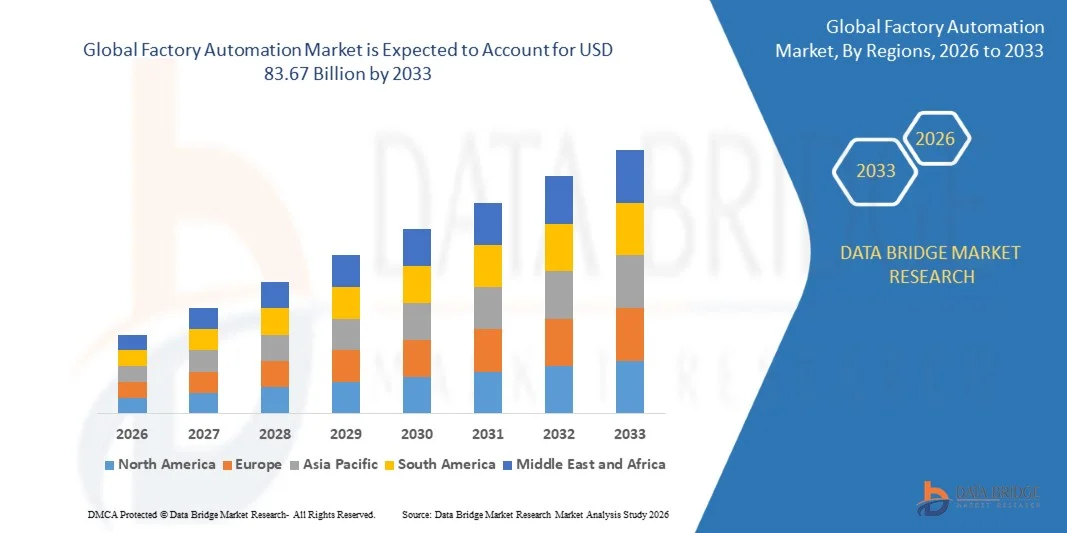
The Factory Automation Market was valued at USD 40.19 Billion in 2025 and is projected to reach USD 83.67 Billion by 2033, growing at a CAGR of 9.60% from 2026 to 2033. The market is experiencing consistent growth driven by increasing adoption of Industry 4.0 technologies, rising deployment of industrial robotics, and growing demand for smart manufacturing solutions across industries. Expanding investments in industrial IoT, artificial intelligence, machine vision systems, and advanced control technologies are further supporting market expansion across both developed and emerging economies.
The growing need for operational efficiency, productivity enhancement, and cost optimization, combined with increasing labor shortages in manufacturing sectors, is encouraging enterprises to accelerate automation adoption across production facilities. Factory automation solutions are increasingly being implemented to improve process accuracy, reduce downtime, enhance workplace safety, and enable real-time monitoring of industrial operations. In addition, the rising focus on digital transformation, predictive maintenance, and connected factory ecosystems is further driving demand for advanced automation technologies across automotive, electronics, food and beverage, oil and gas, and other manufacturing industries.
Key Market Trends & Insights
- North America dominated the Factory Automation Market with the largest revenue share of 27.5% in 2025, supported by high industrial digitization, strong adoption of advanced robotics, and widespread deployment of AI enabled manufacturing systems across key industries
- The sensors segment led the market with a 38% share in 2025, driven by its critical role in enabling real-time monitoring, process accuracy, and predictive maintenance across automated production systems
- Asia-Pacific is expected to be the fastest-growing region at a CAGR of 9.3% from 2026 to 2033, fueled by rapid industrialization, expanding manufacturing bases, and increasing adoption of smart factory technologies across emerging economies
- Industrial robots are the fastest-growing component type, projected to register a CAGR of 14% from 2026 to 2033, supported by increasing deployment of robotics in high-speed and precision-based manufacturing operations
- The programmable logic controller segment dominated the control systems category with a 34.8% revenue share in 2025, led by its extensive deployment across discrete and process industries for reliable machine-level automation and real-time control
- Automotive manufacturing accounted for 33.4% of the market in 2025, preferred by extensive adoption of automation technologies in assembly lines, welding systems, and quality inspection processes
- The manufacturing execution system segment is the fastest-growing control systems category, with a CAGR of 12.5% from 2026 to 2033, driven by rising demand for end-to-end production visibility and real-time operational intelligence
Market Size & Forecast
- Global Market Value (2025): USD 40.19 Billion
- Expected Market Value (2033): USD 83.67 Billion
- Forecast CAGR (2026–2033): 9.60%
- Leading Region in 2025: North America
- Fastest Growing Region: Asia-Pacific
Report Scope and Factory Automation Market Segmentation
|
Attributes |
Factory Automation Key Market Insights |
|
Segments Covered |
|
|
Countries Covered |
North America · U.S. · Canada · Mexico Europe · Germany · France · U.K. · Netherlands · Switzerland · Belgium · Russia · Italy · Spain · Turkey · Rest of Europe Asia-Pacific · China · Japan · India · South Korea · Singapore · Malaysia · Australia · Thailand · Indonesia · Philippines · Rest of Asia-Pacific Middle East and Africa · Saudi Arabia · U.A.E. · South Africa · Egypt · Israel · Rest of Middle East and Africa South America · Brazil · Argentina · Rest of South America |
|
Key Market Players |
· ABB (Switzerland) · Emerson Electric Co. (U.S.) · Mitsubishi Electric Corporation (Japan) · GENERAL ELECTRIC (U.S.) · Texas Instruments Incorporated (U.S.) · Honeywell International Inc. (U.S.) · Rockwell Automation, Inc. (U.S.) · OMRON Corporation (Japan) · Schneider Electric (France) · Siemens (Germany) · Yokogawa India Ltd. (India) · SD3D Printing (India) · Dwyer Instruments, Ltd. (U.S.) · WIKA Instruments India Pvt. Ltd. (India) · FANUC INDIA Private Limited (India) · Hitachi, Ltd. (Japan) · VEGA India Level and Pressure Measurement Pvt. Ltd (India) |
|
Market Opportunities |
· Expansion of Collaborative Robots (Cobots) Across Manufacturing Facilities · Growing Adoption of Software-Defined and Cloud-Based Automation Platforms · Increasing Deployment of Automation Solutions in Emerging Manufacturing Economies |
|
Value Added Data Infosets |
In addition to the market insights such as market value, growth rate, market segments, geographical coverage, market players, and market scenario, the market report curated by the Data Bridge Market Research team includes in-depth expert analysis, import/export analysis, pricing analysis, production consumption analysis, and pestle analysis. |
Factory Automation Market Trends
Trend: Integration of Artificial Intelligence and Industrial IoT in Smart Manufacturing
Manufacturers are increasingly integrating artificial intelligence (AI), Industrial Internet of Things (IIoT), machine learning, and advanced analytics into factory automation systems to improve productivity, operational visibility, and decision-making capabilities. Smart factories are leveraging connected sensors, real-time monitoring platforms, and predictive maintenance solutions to reduce downtime and optimize production processes. The adoption of digital twins, machine vision systems, and autonomous production technologies is further accelerating industrial automation across automotive, electronics, and process manufacturing industries.
Companies such as Siemens are expanding AI-driven industrial automation capabilities through its acquisition of Altair Engineering in March 2025, strengthening simulation, industrial AI, and digital twin technologies that support next-generation smart manufacturing environments.
Factory Automation Market Dynamics
Key Market Driver: Rising Demand for Production Efficiency
The growing need to improve manufacturing productivity, reduce operational costs, and maintain product quality is significantly driving demand for factory automation solutions worldwide. Industries are increasingly deploying robotics, programmable logic controllers, advanced sensors, and automated control systems to enhance throughput while minimizing human intervention and production errors. Rising labor shortages and increasing pressure to achieve higher production efficiency are further accelerating investments in automated manufacturing technologies across multiple industrial sectors.
Major companies such as Rockwell Automation, ABB, and Schneider Electric continue to expand their automation portfolios to help manufacturers improve operational efficiency, increase production flexibility, and support digital transformation initiatives across industrial facilities.
Key Restraint/Challenge: High Implementation Costs
A major challenge in the Factory Automation market is the substantial capital investment required for deploying advanced automation infrastructure, including industrial robots, control systems, sensors, software platforms, and industrial networking technologies. Small and medium-sized manufacturers often face financial constraints when upgrading legacy production facilities to fully automated environments. Integration complexity, workforce training requirements, cybersecurity investments, and ongoing maintenance expenses further increase the total cost of implementation.
The December 2024 production facility expansion announced by Fuji Electric, involving advanced manufacturing equipment and automation systems to increase capacity by 50%, highlights the significant investments required to modernize production infrastructure and achieve higher levels of factory automation.
Key Market Opportunity: Growth of Cloud-Based Automation
The increasing adoption of cloud computing and software-defined manufacturing platforms is creating significant opportunities for the Factory Automation market. Cloud-based automation enables centralized monitoring, remote asset management, real-time analytics, and seamless integration of production data across multiple facilities. These solutions improve scalability, reduce infrastructure costs, and support faster deployment of smart manufacturing capabilities, particularly for enterprises pursuing digital transformation strategies.
Companies such as Schneider Electric are advancing cloud-enabled industrial automation through platforms such as EcoStruxure, while Siemens and Honeywell continue to expand cloud-connected manufacturing solutions that enhance operational visibility, predictive maintenance, and data-driven production optimization across global manufacturing operations.
Factory Automation Market Scope
The factory automation market is segmented on the basis of control systems, component, and end-user.
- By Control Systems
On the basis of control systems, the Factory Automation Market is segmented into Distributed Control Systems, Supervisory Control and Data Acquisition System, Manufacturing Execution System, Safety Instrumented System, Programmable Logic Controller, and Human Machine Interface. The Programmable Logic Controller segment dominated the market with the largest share of 34.8% in 2025, driven by its extensive deployment across discrete and process industries for reliable machine-level automation and real-time control. PLCs are widely preferred due to their robustness, flexibility, and ability to integrate with diverse industrial equipment. Growing modernization of legacy production lines across automotive, electronics, and manufacturing facilities further strengthens adoption. Increasing demand for high-speed production control and reduced operational downtime reinforces its leading position.
The Manufacturing Execution System segment is projected to register the fastest growth at a CAGR of 12.5% from 2026 to 2033, driven by rising demand for end-to-end production visibility and real-time operational intelligence. MES platforms enable seamless coordination between enterprise systems and shop floor operations, improving productivity and quality control. Expanding adoption of Industry 4.0 frameworks and smart factory initiatives is accelerating implementation across large-scale manufacturing units. Integration of advanced analytics and cloud-based monitoring capabilities is enhancing decision-making efficiency. Increasing focus on traceability and compliance across regulated industries further supports segment expansion.
- By Component
On the basis of component, the Factory Automation Market is segmented into Sensors, Controller, Switches and Relays, Industrial Robots, Drives, and Others. The Sensors segment dominated the market with a share of 38% in 2025, supported by its critical role in enabling real-time monitoring, process accuracy, and predictive maintenance across automated production systems. Sensors are extensively used for temperature, pressure, motion, and proximity detection in high-precision manufacturing environments. Rising demand for quality assurance and process optimization across automotive and electronics industries further drives adoption. Continuous integration of IoT-enabled sensing technologies reinforces its strong market position.
The Industrial Robots segment is projected to register the fastest growth at a CAGR of 14% from 2026 to 2033, driven by increasing deployment of robotics in high-speed and precision-based manufacturing operations. Expanding use of collaborative robots and AI-enabled robotic systems is improving flexibility and productivity across production lines. Growing labor cost pressures and shortage of skilled workforce are accelerating automation adoption across industries. Advancements in machine vision and robotic control systems are further enhancing operational efficiency. Rising investments in smart manufacturing facilities continue to strengthen segment expansion.
- By End- User
On the basis of end-user, the Factory Automation Market is segmented into Automotive Manufacturing, Food and Beverage, Oil and Gas Processing, Mining, and Others. The Automotive Manufacturing segment dominated the market with a share of 33.4% in 2025, driven by extensive adoption of automation technologies in assembly lines, welding systems, and quality inspection processes. Automotive producers increasingly rely on robotics and PLC-based systems to enhance production speed and maintain precision standards. Rising demand for electric vehicles is further accelerating automation investments across manufacturing plants. Strong focus on mass customization and lean manufacturing practices reinforces segment leadership. Continuous expansion of global automotive production facilities further supports dominance.
The Oil and Gas Processing segment is projected to register the fastest growth at a CAGR of 13.5% from 2026 to 2033, driven by increasing deployment of automation systems for upstream and downstream operational efficiency. Automation solutions are widely used for real-time monitoring, safety management, and process optimization in complex refinery environments. Rising emphasis on operational safety and emission reduction is accelerating digital transformation in the sector. Integration of predictive analytics and remote monitoring systems is improving asset performance and reducing downtime. Growing investments in smart refinery modernization projects further support strong segment growth.
Factory Automation Market Regional Analysis
North America dominated the factory automation market and accounted for the largest revenue share of 27.5% in 2025, driven by high industrial digitization, strong adoption of advanced robotics, and widespread deployment of AI enabled manufacturing systems across key industries. The region benefits from a highly developed industrial base, early adoption of Industry 4.0 frameworks, and strong investments in smart factory infrastructure. Manufacturers across automotive, aerospace, electronics, and oil and gas sectors are increasingly implementing automation solutions to improve productivity, reduce downtime, and enhance operational efficiency. In addition, strong presence of leading automation technology providers and well established cloud and industrial IoT ecosystems continues to reinforce North America’s leadership position in the global market.
U.S. Factory Automation Market Insight
The U.S. Factory Automation market is experiencing strong growth driven by rapid adoption of industrial robotics, AI powered manufacturing systems, and large scale digital transformation initiatives across production facilities. Enterprises are heavily investing in smart manufacturing technologies to improve efficiency, quality control, and predictive maintenance capabilities. The country’s strong industrial ecosystem, advanced semiconductor and automotive manufacturing base, and high labor cost environment are accelerating automation deployment. In addition, increasing focus on reshoring manufacturing activities and integrating cloud based industrial platforms is further supporting market expansion across the U.S.
Canada Factory Automation Market Insight
The Canada Factory Automation market is witnessing steady growth supported by increasing adoption of industrial robotics, expanding manufacturing modernization programs, and rising investment in smart production technologies. Industries such as automotive, food and beverage, and mining are increasingly deploying automation solutions to enhance productivity and operational safety. The country’s focus on resource efficiency and sustainable manufacturing practices is encouraging the adoption of energy efficient automation systems. In addition, growing integration of IoT enabled industrial solutions and cloud based monitoring platforms is further contributing to market growth in Canada.
Europe Factory Automation Market Insight
The Europe Factory Automation market is expanding steadily due to strong industrial automation adoption, increasing focus on energy efficient manufacturing, and widespread implementation of smart factory initiatives. The region benefits from a highly advanced manufacturing base and strong emphasis on precision engineering and sustainability driven production systems. Enterprises across automotive, machinery, chemical, and food processing sectors are increasingly investing in robotics, PLCs, and MES platforms to improve operational efficiency. Rising regulatory pressure for carbon reduction and continuous investments in AI enabled industrial systems continue to support regional market growth.
U.K. Factory Automation Market Insight
The U.K. Factory Automation market is growing steadily, driven by increasing adoption of digital manufacturing technologies, strong industrial robotics deployment, and rising demand for smart production systems. Manufacturers are focusing on automation to enhance productivity, reduce operational costs, and improve supply chain efficiency. The presence of a well developed advanced manufacturing sector and growing investments in AI driven industrial solutions further support market expansion. In addition, increasing integration of cloud based industrial control systems and predictive analytics is strengthening automation adoption in the U.K.
Germany Factory Automation Market Insight
The Germany Factory Automation market is expanding due to strong leadership in industrial engineering, high adoption of Industry 4.0 technologies, and widespread use of advanced robotics in manufacturing. The country’s automotive and machinery industries are major contributors, heavily relying on automation for precision, efficiency, and mass production capabilities. Strong emphasis on digital factories, smart sensors, and integrated production systems is accelerating market development. In addition, Germany’s focus on energy efficient and sustainable manufacturing practices is further driving automation investments across industries.
Asia-Pacific Factory Automation Market Insight
The Asia-Pacific Factory Automation market is expected to register the fastest growth with a CAGR of 9.3% from 2026 to 2033, driven by rapid industrialization, expanding manufacturing bases, and increasing adoption of smart factory technologies across emerging economies. Rising investments in robotics, industrial IoT, and AI driven automation systems are significantly boosting demand across electronics, automotive, and consumer goods manufacturing sectors. Countries such as China, India, Japan, and South Korea are witnessing strong government support for industrial modernization and digital transformation initiatives. In addition, growing export oriented manufacturing and cost optimization pressures are further accelerating regional market expansion.
Japan Factory Automation Market Insight
The Japan Factory Automation market is witnessing strong growth supported by advanced robotics adoption, high precision manufacturing capabilities, and increasing use of AI enabled industrial systems. Enterprises are leveraging automation to address labor shortages and enhance production efficiency across electronics, automotive, and semiconductor industries. The country’s strong technological ecosystem and leadership in robotics innovation are further reinforcing market growth. In addition, rising integration of smart sensors, industrial IoT, and predictive maintenance solutions is strengthening demand for advanced automation systems in Japan.
China Factory Automation Market Insight
The China Factory Automation market is growing rapidly due to large scale industrial expansion, strong government support for smart manufacturing initiatives, and widespread adoption of robotics and AI driven production systems. Enterprises are increasingly investing in automation to improve efficiency, reduce labor dependency, and enhance global competitiveness. The country’s strong manufacturing base in electronics, automotive, and machinery sectors is a key driver of demand. In addition, rapid expansion of industrial IoT networks and digital factory ecosystems is further accelerating market growth in China.
Factory Automation Market Share
The factory automation industry is primarily led by well-established companies, including:
- ABB (Switzerland)
- Emerson Electric Co. (U.S.)
- Mitsubishi Electric Corporation (Japan)
- GENERAL ELECTRIC (U.S.)
- Texas Instruments Incorporated (U.S.)
- Honeywell International Inc. (U.S.)
- Rockwell Automation, Inc. (U.S.)
- OMRON Corporation (Japan)
- Schneider Electric (France)
- Siemens (Germany)
- Yokogawa India Ltd. (India)
- SD3D Printing (India)
- Dwyer Instruments, Ltd. (U.S.)
- WIKA Instruments India Pvt. Ltd. (India)
- FANUC INDIA Private Limited (India)
- Hitachi, Ltd. (Japan)
- VEGA India Level and Pressure Measurement Pvt. Ltd (India)
Latest Developments in Factory Automation Market
- In February 2026, Rockwell Automation announced the expansion of its industrial AI and edge computing portfolio through enhanced integration of cloud-native control platforms across its Logix automation systems. This development strengthens the Factory Automation market by enabling real-time decision-making at the edge, improving production efficiency, and reducing latency in mission-critical industrial operations. The expansion supports greater adoption of autonomous manufacturing systems across automotive, food processing, and chemical industries, while reinforcing Rockwell’s leadership in intelligent factory solutions
- In January 2026, Schneider Electric launched an upgraded EcoStruxure Automation Expert platform with expanded interoperability features and enhanced cybersecurity architecture for industrial environments. This advancement impacts the Factory Automation market by enabling software-defined automation, simplifying system integration across heterogeneous industrial assets, and improving scalability for smart factories. The solution supports faster deployment of digital manufacturing systems and strengthens adoption of open automation standards across process and discrete industries, further accelerating global industrial transformation
- In March 2025, Siemens AG completed its acquisition of Altair Engineering Inc. for approximately USD 10 billion, strengthening its industrial software and factory automation ecosystem through enhanced capabilities in simulation, high-performance computing, and industrial AI. This acquisition significantly reinforces Siemens’ position in the Factory Automation Market by enabling more advanced digital twin solutions, predictive engineering, and AI driven production optimization. The integration of Altair’s technologies improves design-to-manufacturing workflows and accelerates smart factory deployment across automotive, aerospace, and heavy industries, thereby intensifying competition in high-end automation software segments
- In December 2024, Fuji Electric Co., Ltd. expanded its switchboard and UPS production facilities at its Kobe Factory, introducing skid system production equipment designed to streamline wiring, testing, and inspection processes. This development positively impacts the Factory Automation market by enhancing production efficiency, reducing installation time by 40%, and increasing manufacturing capacity by 50% to meet rising demand from data center and industrial infrastructure projects. The upgrade also supports automation-driven manufacturing optimization and addresses labor shortages, strengthening Fuji Electric’s position in industrial power and automation systems
- In April 2024, Omron Corporation launched the VT-X850, an advanced 3D Computed Tomography (CT) Automatic X-ray Inspection system designed for electric vehicle SMT manufacturing lines. This innovation strengthens the Factory Automation market by improving high-precision defect detection in complex electronic assemblies through AI integrated imaging and high-speed inspection capabilities. The system enhances production quality, reduces inspection errors, and supports the growing demand for automation in EV manufacturing, semiconductor production, and advanced electronics assembly lines

- Interactive Data Analysis Dashboard
- Company Analysis Dashboard for high growth potential opportunities
- Research Analyst Access for customization & queries
- Competitor Analysis with Interactive dashboard
- Latest News, Updates & Trend analysis
- Harness the Power of Benchmark Analysis for Comprehensive Competitor Tracking
Data collection and base year analysis are done using data collection modules with large sample sizes. The stage includes obtaining market information or related data through various sources and strategies. It includes examining and planning all the data acquired from the past in advance. It likewise envelops the examination of information inconsistencies seen across different information sources. The market data is analysed and estimated using market statistical and coherent models. Also, market share analysis and key trend analysis are the major success factors in the market report. To know more, please request an analyst call or drop down your inquiry.
The key research methodology used by DBMR research team is data triangulation which involves data mining, analysis of the impact of data variables on the market and primary (industry expert) validation. Data models include Vendor Positioning Grid, Market Time Line Analysis, Market Overview and Guide, Company Positioning Grid, Patent Analysis, Pricing Analysis, Company Market Share Analysis, Standards of Measurement, Global versus Regional and Vendor Share Analysis. To know more about the research methodology, drop in an inquiry to speak to our industry experts.
Data Bridge Market Research is a leader in advanced formative research. We take pride in servicing our existing and new customers with data and analysis that match and suits their goal. The report can be customized to include price trend analysis of target brands understanding the market for additional countries (ask for the list of countries), clinical trial results data, literature review, refurbished market and product base analysis. Market analysis of target competitors can be analyzed from technology-based analysis to market portfolio strategies. We can add as many competitors that you require data about in the format and data style you are looking for. Our team of analysts can also provide you data in crude raw excel files pivot tables (Fact book) or can assist you in creating presentations from the data sets available in the report.













