What is the Fake Image Detection Market Size and Growth Rate?
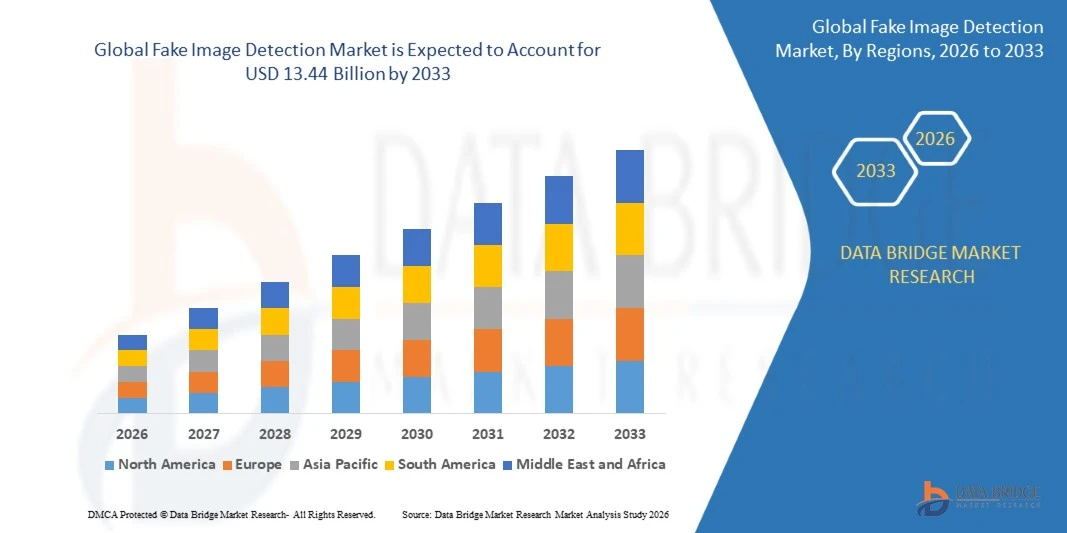
- As per Data Bridge Market Research analysis, the fake image detection market was valued at USD 1.70 billion in 2025 and is projected to reach USD 13.44 billion by 2033, growing at a CAGR of 29.50% from 2026 to 2033.
- The market is experiencing rapid growth driven by the increasing spread of AI-generated images and deepfakes, rising concerns about digital misinformation and online fraud, and advancements in machine learning and image forensic technologies.
- The growing incidence of manipulated visual content across social media, news platforms, e-commerce, and digital identity verification is compelling businesses, government agencies, and media organizations to adopt advanced image detection solutions. AI-powered detection software and cloud-based verification tools are increasingly being used to identify synthetic and altered images, strengthen content authenticity, prevent fraud, and preserve trust in digital communications.
Market Size & Forecast
- Global Market Value (2025): USD 1.70 Billion
- Expected Market Value (2033): USD 13.44 Billion
- Forecast CAGR (2026–2033): 29.50%
- Leading Region in 2025: North America
- Fastest Growing Region: Asia Pacific
What are the Major Takeaways of the Fake Image Detection Market?
- North America dominated the fake image detection market with the largest revenue share of 30.0% in 2025, supported by advanced AI infrastructure, strong cybersecurity investments, and increasing concerns about deepfakes and digital misinformation.
- Asia-Pacific is expected to be the fastest-growing region at a CAGR of 32.47% from 2026 to 2033, fueled by rapid digital transformation, increasing AI adoption, and rising demand for image authenticity verification across China, India, Japan, and South Korea.
- The software segment led the market with a 61.03% share in 2025, driven by increasing adoption of automated image analysis, AI-generated image detection, and deepfake identification solutions.
- Services are the fastest-growing offering type, projected to register a CAGR of 33.08%, reflecting the surge in demand for specialized implementation, consulting, integration, and ongoing technical support
- The machine learning and deep learning segment dominated the technology category with a 69.74% revenue share in 2025, led by the increasing use of AI algorithms to identify synthetic images and digitally manipulated photographs.
- Cloud-based accounted for 66.92% of the market share in 2025, preferred by scalability, flexible computing resources, and the ability to analyze large volumes of visual content.
- The on-premises segment is the fastest-growing deployment mode category, with a CAGR of 28.0%, driven by demand for greater control over sensitive images, proprietary datasets, and confidential information.
Report Scope and Fake Image Detection Market Segmentation
|
Attributes |
Fake Image Detection Key Market Insights |
|
Segments Covered |
|
|
Countries Covered |
North America
Europe
Asia-Pacific
Middle East and Africa
South America
|
|
Key Market Players |
|
|
Market Opportunities |
|
|
Value Added Data Infosets |
In addition to the market insights such as market value, growth rate, market segments, geographical coverage, market players, and market scenario, the market report curated by the Data Bridge Market Research team includes in-depth expert analysis, import/export analysis, pricing analysis, production consumption analysis, and pestle analysis. |
What is the Key Trend in the Fake Image Detection Market?
- Organizations are increasingly adopting AI-powered image detection and digital watermarking technologies to identify synthetic images, manipulated photographs, and deepfakes while strengthening trust in digital content.
- For instance, in May 2025, Google introduced its SynthID Detector verification portal to help identify AI-generated content created using Google AI tools, enabling users to verify images and other digital media through embedded watermarks.
- Digital watermarking and image provenance technologies enable organizations to trace content origins and assess whether visual information has been generated or modified using artificial intelligence.
- News organizations, social media platforms, and digital publishers are increasingly integrating content authentication tools into their workflows to improve verification and reduce the circulation of misleading images
- For instance, in September 2025, Google announced support for C2PA Content Credentials across the Pixel 10 camera and Google Photos, enabling provenance information to accompany photographs and strengthen transparency around image authenticity.
- As synthetic image generation becomes more sophisticated and widely accessible, the adoption of automated detection, invisible watermarking, and content provenance solutions is expected to accelerate, making image verification an increasingly important component of digital trust and online safety.
What are the Key Drivers of the Fake Image Detection Market?
- The rapid advancement of generative artificial intelligence has significantly increased demand for fake image detection solutions capable of distinguishing AI-generated visuals from authentic photographs and identifying digitally manipulated content.
- For instance, in March 2025, the National Institute of Standards and Technology (NIST) published its evaluation plan for AI-generated image discriminators, establishing a framework to assess how effectively detection systems distinguish synthetic images from human-created content.
- Media organizations, government agencies, financial institutions, and technology companies are increasingly adopting image verification solutions to prevent visual fraud, authenticate digital evidence, and strengthen content moderation processes.
- The growing use of AI-generated imagery in online impersonation, misinformation, and fraudulent communications is encouraging enterprises to integrate automated image analysis into existing cybersecurity and verification systems.
- For instance, in February 2025, Agence France-Presse (AFP) reported successfully testing a technology that combined C2PA certification with an invisible encrypted watermark to verify the authenticity of news photographs during the 2024 U.S. elections, demonstrating practical applications for photojournalism.
- With digital platforms increasingly prioritizing content authenticity, fraud prevention, and reliable visual evidence, fake image detection technologies are becoming essential for protecting information integrity and supporting secure digital interactions.
What Factors are Challenging the Growth of the Fake Image Detection Market?
- Fake image detection systems face technical challenges as generative AI models produce increasingly realistic images that can closely resemble authentic photographs, making reliable identification more difficult.
- These limitations can reduce detection accuracy when images undergo compression, cropping, filtering, resizing, or other alterations, creating challenges for organizations that rely on consistent verification results.
- For instance, in January 2025, NIST published Guardians of Forensic Evidence: Evaluating Analytic Systems Against AI-Generated Deepfakes, examining analytical systems used to assess AI-generated deepfakes and highlighting the importance of evaluating their reliability in forensic applications.
- Furthermore, detection tools may produce false positives or false negatives when confronted with unfamiliar image-generation techniques, while watermark-based approaches cannot identify every synthetic image because not all AI systems embed detectable watermarks.
- For instance, in August 2023, Google DeepMind explained that its SynthID image watermarking technology could remain detectable after common image modifications but was not foolproof against extreme manipulations, highlighting the technical limitations of watermark-based identification.
- The continuing evolution of generative AI, inconsistent detection performance, and limited interoperability between authentication technologies create challenges for widespread adoption, requiring ongoing investment in model evaluation, detection accuracy, and complementary verification methods.
How is the Fake Image Detection Market Segmented?
The fake image detection market is segmented on the basis of offering, technology, deployment mode, and end user
- By Offering
On the basis of offering, the fake image detection market is segmented into software and services. The software segment dominated the market with 61.03% share in 2025, driven by increasing adoption of automated image analysis, AI-generated image detection, and deepfake identification solutions. Software platforms enable organizations to analyze large volumes of visual content with limited manual intervention. They integrate machine learning algorithms, image forensics, metadata analysis, and authenticity verification capabilities. Media organizations and social media platforms use these tools to identify manipulated images and support content moderation. Financial institutions and enterprises also deploy image detection software to prevent identity fraud and verify digital documents.
The services segment is projected to register the fastest growth at a CAGR of 33.08% from 2026 to 2033, supported by rising demand for specialized implementation, consulting, integration, and ongoing technical support. Organizations require professional assistance to integrate detection tools into existing cybersecurity and content verification workflows. Consulting services help businesses assess image manipulation risks and establish suitable authentication procedures. Integration services enable compatibility with digital asset management systems, fraud detection platforms, and content moderation tools. Continuous changes in generative AI technologies are also increasing the need for model updates, performance testing, and expert support.
- By Technology
On the basis of technology, the fake image detection market is segmented into machine learning and deep learning, computer vision and neural networks, digital image forensics, pixel-level and frequency-domain analysis, metadata and EXIF analysis, and blockchain-based image authentication. The machine learning and deep learning segment dominated the market with an 69.74% share in 2025, driven by the increasing use of AI algorithms to identify synthetic images and digitally manipulated photographs. These technologies analyze visual patterns, textures, artifacts, and inconsistencies that may not be easily detected through manual inspection. Deep learning models can be trained on large datasets containing authentic and manipulated images to improve classification accuracy. Their ability to process substantial volumes of visual content supports deployment across social media, cybersecurity, and digital investigations. Continuous advancements in neural network architectures are improving the detection of sophisticated AI-generated imagery.
The blockchain-based image authentication segment is projected to register the fastest growth at a CAGR of 34.88% from 2026 to 2033, supported by increasing demand for reliable image provenance and tamper-evident authentication. Blockchain-based systems can record image ownership, timestamps, and provenance information to support verification. These solutions complement AI detection by providing information about content origin and subsequent handling. Media organizations can use provenance records to strengthen the credibility of published photographs. Enterprises can also apply authentication technologies to protect digital assets and support audit requirements.
- By Deployment Mode
On the basis of deployment mode, the fake image detection market is segmented into cloud-based and on-premises deployment. The cloud-based deployment segment dominated the market with 66.92% share in 2025, driven by scalability, flexible computing resources, and the ability to analyze large volumes of visual content. Cloud platforms allow organizations to deploy image detection capabilities without investing extensively in dedicated infrastructure. They support centralized monitoring and integration with social media platforms, enterprise applications, and digital asset management systems. Cloud-based solutions also enable vendors to update detection models as new image-generation techniques emerge. Their accessibility supports organizations operating across multiple locations and digital channels.
The on-premises deployment segment is expected to grow at CAGR of 28.0% from 2026 to 2033, supported by demand for greater control over sensitive images, proprietary datasets, and confidential information. Government agencies, defense organizations, financial institutions, and forensic laboratories may prefer locally hosted detection systems to meet internal security requirements. On-premises solutions allow organizations to manage access controls and integrate detection workflows with existing internal infrastructure. They can also support restricted environments where transferring sensitive visual data to external cloud platforms is undesirable. Demand for customized security configurations and control over data processing is supporting continued investment in these systems.
- By End User
On the basis of end user, the fake image detection market is segmented into government, banking, financial services and insurance (BFSI), healthcare, information technology and telecommunications, defense, media and entertainment, retail and e-commerce, and others. The government and law enforcement segment dominated the market with 34.86% share in 2025, driven by growing requirements to authenticate digital evidence, verify visual intelligence, and investigate image-based misinformation. Government agencies use image analysis tools in digital investigations and document verification. Law enforcement organizations apply forensic techniques to examine potentially manipulated photographs submitted as evidence. Public institutions also require tools to assess the authenticity of visual information circulating online. Increasing concerns about synthetic media and fraudulent digital records are supporting investment in detection systems.
The banking, financial services, and insurance (BFSI) segment is projected to register the fastest growth at a CAGR of 24.37% from 2026 to 2033, supported by rising concerns about identity fraud, fraudulent documentation, and AI-enabled impersonation. Financial institutions increasingly rely on digital photographs and identity documents during customer onboarding and remote verification. Fake image detection can complement existing verification procedures by identifying visual alterations and suspicious synthetic imagery. Insurance companies can also use image analysis to flag potentially manipulated photographs submitted with claims. Growing use of digital banking and remote customer interactions is expanding the need for additional authentication measures.
Which Region Holds the Largest Share of the Fake Image Detection Market?
- North America dominated the fake image detection market with the largest revenue share of 30.0% in 2025, supported by advanced AI infrastructure, strong cybersecurity investments, and increasing concerns about deepfakes and digital misinformation.
- The region also benefits from increasing concerns about digital misinformation, rising cases of identity fraud, and growing adoption of AI-powered content verification tools across government, financial services, and media industries. Increasing investments in digital forensics, content provenance, and synthetic media detection continue to strengthen North America's leadership position in the global market.
U.S. Fake Image Detection Market Insight
The U.S. fake image detection market is witnessing strong growth due to rising concerns about AI-generated deepfakes, digital misinformation, and image-based identity fraud. The country’s advanced artificial intelligence ecosystem, along with increasing adoption of machine learning, digital forensics, and image authentication technologies, is driving demand across government, financial services, media, and cybersecurity applications. In addition, growing emphasis on protecting digital identities, verifying online content, and strengthening information security is accelerating the adoption of fake image detection solutions across enterprises and public institutions.
Asia-Pacific Fake Image Detection Market Insight
The Asia-Pacific fake image detection market is expected to witness rapid growth, driven by increasing digitalization, expanding social media usage, and rising adoption of generative artificial intelligence across countries such as China, India, and Japan. Growing concerns regarding deepfakes, online fraud, and manipulated visual content are supporting regional demand for automated image verification solutions. In addition, increasing investments in cybersecurity infrastructure, AI research, and digital identity protection are accelerating the adoption of image detection technologies across government, financial services, media, and technology sectors.
Japan Fake Image Detection Market Insight
The Japan fake image detection market is witnessing consistent growth due to rising concerns about synthetic media, digital impersonation, and the authenticity of online visual content. Technology companies, financial institutions, media organizations, and government agencies are increasingly exploring AI-powered detection systems to identify manipulated images and strengthen digital verification processes. Moreover, increasing integration of advanced machine learning, digital forensics, and content authentication technologies, alongside the country’s focus on cybersecurity and trustworthy digital services, is further contributing to market growth.
China Fake Image Detection Market Insight
The China fake image detection market is growing rapidly, driven by expanding generative AI applications, widespread digital content consumption, and increasing demand for online content verification. Growing use of AI-generated imagery across social media, e-commerce, and digital communication platforms is strengthening the need for technologies that identify manipulated and synthetic visuals. In addition, rising investments in artificial intelligence, cybersecurity infrastructure, and digital content governance are supporting market development. Increasing adoption of automated image analysis and authentication solutions is positioning China as an important market for fake image detection technologies.
U.K. Fake Image Detection Market Insight
The U.K. fake image detection market is experiencing steady growth, supported by rising demand for digital content verification, fraud prevention, and image authentication across media, financial services, and public-sector applications. Increasing concerns about deepfakes, online misinformation, and manipulated digital evidence are encouraging organizations to adopt advanced detection technologies. Furthermore, integration of AI-powered image analysis, digital forensics, and content provenance tools is improving verification capabilities, positioning the U.K. as an important market for digital trust and image authenticity solutions.
Germany Fake Image Detection Market Insight
The Germany fake image detection market is expanding steadily due to increasing cybersecurity investments, growing adoption of artificial intelligence, and rising demand for reliable digital content authentication. Media organizations, financial institutions, government agencies, and technology companies are increasingly exploring image detection systems to identify synthetic visuals, prevent image-based fraud, and verify digital evidence. Continuous advancements in machine learning, image forensics, and content provenance technologies, alongside strong emphasis on data protection and digital security, are further supporting market growth in Germany.
Which are the Top Companies in Fake Image Detection Market?
The fake image detection industry is primarily led by well-established companies, including:
- Reality Defender, Inc. (U.S.)
- Sensity B.V. (Netherlands)
- Hive AI (U.S.)
- Truepic Inc. (U.S.)
- Attestiv Inc. (U.S.)
- GetReal Security, Inc. (U.S.)
- Paravision Inc. (U.S.)
- Pindrop Security, Inc. (U.S.)
- Adobe Inc. (U.S.)
- Google LLC (U.S.)
- Microsoft Corporation (U.S.)
- Intel Corporation (U.S.)
- OpenAI OpCo, LLC (U.S.)
- Meta Platforms, Inc. (U.S.)
- Qualcomm Incorporated (U.S.)
- Sony Group Corporation (Japan)
- Canon Inc. (Japan)
- Nikon Corporation (Japan)
- DeepMedia, Inc. (U.S.)
- Cyabra Ltd. (Israel)
What are Latest Developments in Fake Image Detection Market?
- In June 2025, Paravision announced the launch of Deepfake Detection 2.0, expanding its identity fraud prevention capabilities to identify both conventional deepfakes and entirely AI-generated faces. The solution analyzes facial imagery and provides authenticity scores to help organizations identify synthetic identities and strengthen digital onboarding and Know Your Customer (KYC) verification. This launch highlights the growing role of advanced image detection in preventing AI-enabled identity fraud.
- In May 2025, Google DeepMind announced SynthID Detector, a verification portal designed to help identify AI-generated content created using Google AI tools. The portal can examine content for SynthID watermarks and provide information to support authenticity assessment across different media formats, including images. The development represents an important advancement in watermark-based AI content verification and digital transparency.
- In September 2024, Amazon Web Services announced Content Credentials for images generated using Amazon Titan Image Generator. The feature adds C2PA-based metadata to generated images, providing information about their origin and creation process. Available through Amazon Bedrock, the implementation enables users to inspect image credentials using compatible verification tools. This development supports greater transparency and provenance tracking for AI-generated visual content.
- In October 2023, Sumsub released For Fake’s Sake, a publicly accessible set of machine learning models designed to detect deepfakes and synthetic fraud in visual assets. Developed by its internal AI and machine learning research team, the solution was made available for free download and use, enabling researchers and organizations to explore methods for identifying AI-generated fake personas. The release contributed to the development of accessible tools for combating synthetic identity fraud and manipulated visual content.
- In June 2021, Meta announced the Image Similarity Challenge and released a dataset designed to help researchers develop improved systems for identifying manipulated images at scale. The dataset included more than one million reference images and 50,000 query images, supporting research into detecting image manipulation and matching altered content with original sources. The initiative also introduced a research competition with a USD 200,000 prize pool, encouraging advances in automated image verification and detection.

- Interactive Data Analysis Dashboard
- Company Analysis Dashboard for high growth potential opportunities
- Research Analyst Access for customization & queries
- Competitor Analysis with Interactive dashboard
- Latest News, Updates & Trend analysis
- Harness the Power of Benchmark Analysis for Comprehensive Competitor Tracking
Data collection and base year analysis are done using data collection modules with large sample sizes. The stage includes obtaining market information or related data through various sources and strategies. It includes examining and planning all the data acquired from the past in advance. It likewise envelops the examination of information inconsistencies seen across different information sources. The market data is analysed and estimated using market statistical and coherent models. Also, market share analysis and key trend analysis are the major success factors in the market report. To know more, please request an analyst call or drop down your inquiry.
The key research methodology used by DBMR research team is data triangulation which involves data mining, analysis of the impact of data variables on the market and primary (industry expert) validation. Data models include Vendor Positioning Grid, Market Time Line Analysis, Market Overview and Guide, Company Positioning Grid, Patent Analysis, Pricing Analysis, Company Market Share Analysis, Standards of Measurement, Global versus Regional and Vendor Share Analysis. To know more about the research methodology, drop in an inquiry to speak to our industry experts.
Data Bridge Market Research is a leader in advanced formative research. We take pride in servicing our existing and new customers with data and analysis that match and suits their goal. The report can be customized to include price trend analysis of target brands understanding the market for additional countries (ask for the list of countries), clinical trial results data, literature review, refurbished market and product base analysis. Market analysis of target competitors can be analyzed from technology-based analysis to market portfolio strategies. We can add as many competitors that you require data about in the format and data style you are looking for. Our team of analysts can also provide you data in crude raw excel files pivot tables (Fact book) or can assist you in creating presentations from the data sets available in the report.