


What is the Famotidine Market Size and Growth Rate?
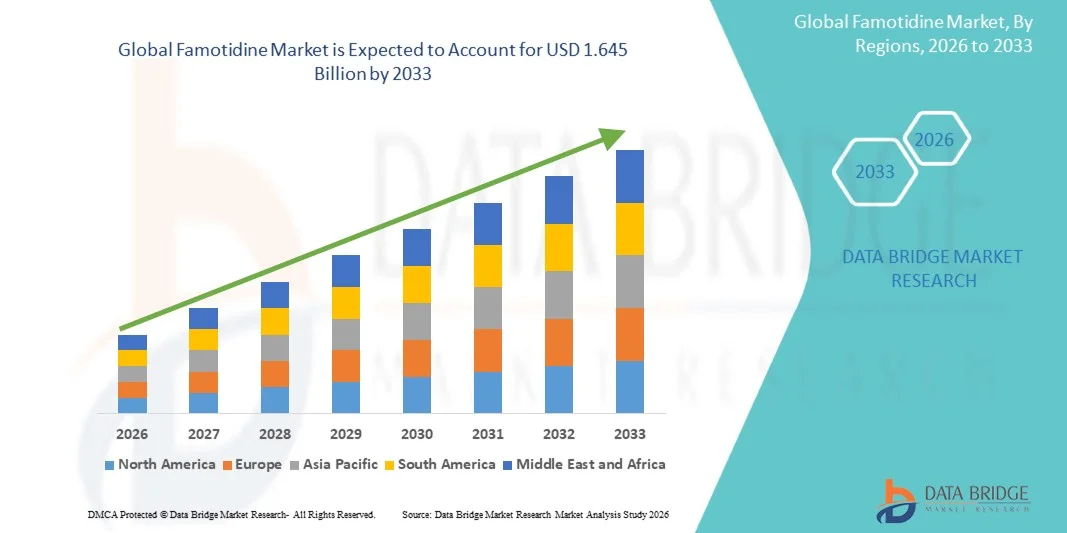
- As per Data Bridge Market Research analysis, the famotidine market was valued at USD 1.184 billion in 2025 and is projected to reach USD 1.645 billion by 2033, growing at a CAGR of 4.20% from 2026 to 2033.
- The market is experiencing consistent growth driven by rising prevalence of gastroesophageal reflux disease (GERD) and peptic ulcer disease, increasing demand for acid-suppressing therapies, growing adoption of generic Famotidine formulations, and expanding access to gastrointestinal healthcare services.
- The increasing incidence of acid-related gastrointestinal disorders, combined with growing demand for effective and affordable acid-suppressing therapies, is encouraging pharmaceutical manufacturers to expand Famotidine formulations. The drug provides effective acid suppression and is widely used across GERD, peptic ulcer disease, Zollinger-Ellison syndrome, erosive esophagitis, and other acid-related conditions, supporting applications across hospitals, clinics, retail pharmacies, and homecare settings.
Market Size & Forecast
- Global Market Value (2025): USD 1.184 Billion
- Expected Market Value (2033): USD 1.645 Billion
- Forecast CAGR (2026–2033): 4.20%
- Leading Region in 2025: North America
- Fastest Growing Region: Asia Pacific
What are the Major Takeaways of the Famotidine Market?
- North America dominated the Famotidine market with the largest revenue share of 40.1% in 2025, supported by the high prevalence of GERD and peptic ulcer disease, strong healthcare expenditure, established pharmaceutical infrastructure, and widespread availability of Famotidine through hospital and retail pharmacies.
- Asia-Pacific is expected to be the fastest-growing region at a CAGR of 5.1% from 2026 to 2033, fueled by rising gastrointestinal disease burden, increasing healthcare investments, expanding pharmaceutical manufacturing, growing availability of generic Famotidine, and improving access to affordable gastrointestinal treatments.
- The tablets segment led the product type segment with a 54.2% share in 2025, driven by convenient oral administration, widespread use in GERD and peptic ulcer disease, and broad availability through retail and online pharmacies.
- Injections are the fastest-growing product type, projected to register a CAGR of 4.7%, reflecting increasing use in hospitals for patients requiring rapid acid suppression, particularly those unable to receive oral Famotidine formulations.
- Gastroesophageal reflux disease (GERD) accounted for 39.2% of the market share in 2025, supported by the increasing prevalence of acid reflux, rising diagnosis rates, and widespread use of Famotidine for acid suppression and symptom management.
- Online pharmacies are the fastest-growing distribution channel, with a CAGR of 6.3%, driven by increasing digital healthcare adoption, convenient access to prescription and over-the-counter medicines, expanding e-commerce infrastructure, and growing preference for home delivery.
Report Scope and Famotidine Market Segmentation
|
Attributes |
Famotidine Key Market Insights |
|
Segments Covered |
|
|
Countries Covered |
North America
Europe
Asia-Pacific
Middle East and Africa
South America
|
|
Key Market Players |
|
|
Market Opportunities |
|
|
Value Added Data Infosets |
In addition to the insights on market scenarios such as market value, growth rate, segmentation, geographical coverage, and major players, the market reports curated by the Data Bridge Market Research also include in-depth expert analysis, patient epidemiology, pipeline analysis, pricing analysis, and regulatory framework. |
What is the Key Trend in the Famotidine Market?
- Increasing use of Famotidine for GERD, peptic ulcer disease, and erosive esophagitis is supporting continued demand across healthcare settings.
- For instance, in 2025, U.S. FDA labeling continued to identify Famotidine for symptomatic nonerosive GERD, erosive esophagitis, gastric ulcers, and duodenal ulcers, supporting its established use across acid-related conditions.
- Increasing availability of multiple dosage forms, including tablets, oral suspension, and injections, is supporting broader use among different patient groups and healthcare settings.
- For instance, in June 2025, the U.S. FDA Orange Book recorded additional Famotidine oral suspension approvals from Aurobindo Pharma and Bionpharma, indicating continued expansion of available formulations.
- Growing use of injectable Famotidine in hospitalized patients is supporting demand where oral administration is not appropriate or cannot be tolerated.
- For instance, in 2025, FDA labeling specified Famotidine Injection for hospitalized adults and as an alternative to oral Famotidine for conditions including GERD, peptic ulcers, and erosive esophagitis.
- The combination of broader formulation availability, established indications, and continued development of generic Famotidine products is expected to support the market's growth.
What are the Key Drivers of the Famotidine Market?
- Growing prevalence of gastroesophageal reflux disease (GERD) and other acid-related gastrointestinal disorders is increasing demand for Famotidine, which is used to reduce gastric acid production and manage symptoms associated with acid reflux.
- For instance, in February 2022, the American College of Gastroenterology highlighted the continued role of acid-suppression therapies in GERD management, supporting demand for established therapies used for acid-related disorders.
- Increasing demand for treatment of peptic ulcer disease, erosive esophagitis, and pathological hypersecretory conditions is supporting the clinical use of Famotidine across hospitals, clinics, and outpatient healthcare settings.
- For instance, FDA labeling identifies Famotidine for the treatment of active gastric and duodenal ulcers, symptomatic nonerosive GERD, erosive esophagitis, and pathological hypersecretory conditions such as Zollinger-Ellison syndrome.
- Increasing availability of Famotidine in tablets, oral suspension, and injectable formulations is supporting broader use across different patient requirements and healthcare settings
- The combination of rising demand for acid-suppression therapies, established clinical indications, multiple dosage forms, and expanding access to generic treatments is expected to support continued growth of the Famotidine market.
Which Factors are Challenging the Growth of the Famotidine Market?
- Increasing availability of proton pump inhibitors (PPIs) and other acid-suppressive therapies creates competitive pressure for Famotidine, particularly in the treatment of frequent or severe GERD.
- For instance, the American College of Gastroenterology's GERD guidance identifies PPIs as the preferred medical treatment for GERD, which can limit the use of H2-receptor antagonists such as Famotidine in certain patients.
- Treatment limitations associated with long-term acid suppression and the need for appropriate patient selection can also influence the sustained use of Famotidine across different indications.
- The availability of alternative H2-receptor antagonists, proton pump inhibitors, and newer acid-suppressive therapies further increases competition within the gastrointestinal therapeutics market.
- Hospital use of injectable Famotidine may also be influenced by clinical requirements, renal-dose considerations, and the availability of oral alternatives when patients can tolerate oral administration.
- The combination of strong competition from alternative acid-suppressive therapies, evolving treatment preferences, and clinical considerations surrounding prolonged acid suppression continues to challenge the growth of the Famotidine market.
How is the Famotidine Market Segmented?
The famotidine market is segmented on the basis of product type, application, distribution channel, and end user.
- By Product Type
On the basis of product type, the famotidine market is segmented into tablets, injections, oral suspension, and others. Tablets dominated the product type segment with 52% share in 2025, owing to their widespread use for gastroesophageal reflux disease (GERD), peptic ulcer disease, and erosive esophagitis. Tablets provide convenient oral administration and are widely used across outpatient and homecare settings. The established availability of Famotidine tablets is further supporting demand for oral formulations. famotidine tablets are indicated for GERD, gastric and duodenal ulcers, and erosive esophagitis.
The injections segment is projected to be the fastest-growing product category at a CAGR of 4.6% during the forecast period, supported by increasing hospital utilization and demand for intravenous acid suppression. Famotidine injection provides an alternative for patients who are unable to take oral medication and is used for short-term treatment in appropriate hospitalized patients. Increasing use of parenteral therapies in hospital settings is further supporting demand for Famotidine injections.
- By Application
On the basis of application, the famotidine market is segmented into gastroesophageal reflux disease (GERD), peptic ulcer disease, Zollinger-Ellison syndrome, erosive esophagitis, and others. Gastroesophageal reflux disease (GERD) dominated the application category with 38.5% share in 2025, supported by the widespread use of famotidine for gastric acid suppression and management of acid reflux symptoms. Famotidine is indicated for symptomatic nonerosive GERD and erosive esophagitis associated with GERD. Increasing diagnosis and treatment of acid-related gastrointestinal disorders is further supporting demand for Famotidine.
The erosive esophagitis segment is projected to be the fastest-growing application at a CAGR of 4.3% during the forecast period, driven by increasing diagnosis of acid-related esophageal damage and demand for effective acid suppression. Famotidine is indicated for erosive esophagitis due to GERD, supporting its use across appropriate patient populations. Growing access to gastrointestinal diagnosis and treatment is creating additional opportunities for Famotidine therapies.
- By Distribution Channel
On the basis of distribution channel, the famotidine market is segmented into hospital pharmacies, retail pharmacies, online pharmacies, and others. Hospital pharmacies dominated the distribution channel segment in 2025, supported by the utilization of famotidine in inpatient treatment and hospital-based acid suppression therapies. The availability of injectable famotidine for hospitalized patients is further supporting distribution through hospital pharmacies. Established hospital procurement systems and increasing pharmaceutical utilization are contributing to the segment's dominance.
The online pharmacies segment is projected to be the fastest-growing distribution channel at a CAGR of 6.1% during the forecast period, driven by increasing digital healthcare adoption, convenient medicine access, expanding e-commerce infrastructure, and growing preference for home delivery. Online pharmacy platforms are supporting convenient access to Famotidine tablets and oral formulations where permitted under applicable regulations. Increasing internet penetration and adoption of digital healthcare services are expected to further strengthen online distribution of famotidine.
- By End User
On the basis of end user, the famotidine market is segmented into hospitals, clinics, and homecare. Hospitals dominated the end-user segment in 2025, supported by the use of Famotidine for inpatient treatment, gastrointestinal disorders, and intravenous acid suppression. The availability of injectable famotidine specifically for hospitalized patients is supporting its utilization across hospital settings. Increasing hospital admissions for gastrointestinal conditions and established pharmaceutical procurement systems are further supporting segment growth.
The homecare segment is projected to be the fastest-growing end-user category during the forecast period, driven by increasing use of oral Famotidine for GERD and peptic ulcer disease, growing preference for convenient treatment, and increasing availability of oral formulations. Famotidine tablets and oral suspension can be administered outside hospital settings for appropriate patients, supporting continued adoption across homecare environments. Growing preference for convenient and accessible gastrointestinal therapies is expected to further support the homecare segment.
Which Region Holds the Largest Share of the Famotidine Market?
- North America dominated the Famotidine market with the largest revenue share of 39.4% in 2025, supported by the high prevalence of gastroesophageal reflux disease, established healthcare infrastructure, strong pharmaceutical distribution networks, and widespread utilization of acid-suppressive therapies.
- The region also benefits from high healthcare expenditure, increasing diagnosis of gastrointestinal disorders, strong availability of prescription medicines, and established pharmaceutical manufacturing capabilities. Growing awareness regarding acid-related gastrointestinal conditions, increasing access to gastrointestinal care, and continued utilization of Famotidine across hospitals, clinics, and outpatient settings continue to strengthen North America’s leadership position in the global market.
U.S. Famotidine Market Insight
The U.S. famotidine market is witnessing strong growth due to the increasing prevalence of gastroesophageal reflux disease, peptic ulcer disease, and other acid-related gastrointestinal conditions. The country’s advanced healthcare infrastructure, high pharmaceutical spending, and established network of hospitals, clinics, and pharmacies are driving continued utilization of famotidine therapies. In addition, widespread availability of tablets, injections, and oral suspension formulations is supporting treatment across inpatient and outpatient healthcare settings. Increasing diagnosis and management of gastrointestinal disorders, combined with growing demand for convenient prescription medicines, is further contributing to market expansion.
Asia-Pacific Famotidine Market Insight
The Asia-Pacific famotidine market is expected to witness rapid growth, driven by the increasing prevalence of gastrointestinal disorders, expanding healthcare infrastructure, and rising access to pharmaceutical treatments across countries such as China, Japan, and India. Growing healthcare expenditure and increasing awareness regarding GERD, peptic ulcer disease, and other acid-related conditions are supporting demand for famotidine. In addition, the expansion of pharmaceutical manufacturing and distribution networks is improving access to affordable gastrointestinal therapies. Increasing adoption of online pharmacies and digital healthcare services is also supporting wider availability of famotidine across the region.
Japan Famotidine Market Insight
The Japan famotidine market is witnessing consistent growth due to the increasing diagnosis and treatment of gastrointestinal disorders, established healthcare infrastructure, and strong access to pharmaceutical therapies. Japanese healthcare providers are increasingly utilizing acid-suppression therapies for the management of GERD, erosive esophagitis, peptic ulcer disease, and other acid-related conditions. Moreover, the country’s aging population, advanced medical facilities, and strong pharmaceutical distribution network are supporting continued demand for famotidine. Increasing preference for convenient oral formulations and expanding access to outpatient healthcare are further contributing to market growth.
China Famotidine Market Insight
The China famotidine market is growing rapidly, driven by increasing prevalence of gastrointestinal disorders, expanding healthcare access, and rising pharmaceutical consumption. Growing urbanization, improving diagnosis rates, and increasing awareness of GERD and other acid-related conditions are contributing to demand for famotidine therapies. In addition, expanding hospital infrastructure and domestic pharmaceutical manufacturing capabilities are improving the availability of affordable treatment options. Increasing adoption of retail and online pharmacy channels is further strengthening access to famotidine across the country.
U.K. Famotidine Market Insight
The U.K. famotidine market is experiencing steady growth, supported by increasing diagnosis of gastroesophageal reflux disease and other acid-related gastrointestinal disorders. The country’s established healthcare system, widespread access to prescription medicines, and strong pharmaceutical distribution infrastructure are contributing to continued utilization of famotidine. Increasing awareness of gastrointestinal health and growing demand for effective acid-suppression therapies are supporting market expansion. Furthermore, the availability of famotidine through hospital and retail pharmacy channels is improving treatment accessibility across the country.
Germany Famotidine Market Insight
The Germany famotidine market is expanding steadily due to the country’s well-developed healthcare infrastructure, increasing prevalence of gastrointestinal disorders, and strong pharmaceutical sector. Famotidine is increasingly utilized for the management of GERD, erosive esophagitis, peptic ulcer disease, and other acid-related gastrointestinal conditions across hospitals and outpatient settings. Continuous investments in healthcare infrastructure and established pharmaceutical distribution networks are supporting widespread availability of treatment options. In addition, increasing demand for convenient oral therapies and growing awareness of gastrointestinal disease management are further contributing to market growth.
Which are the Top Companies in Famotidine Market?
The famotidine industry is primarily led by well-established companies, including:
- Dr. Reddy’s Laboratories Ltd. (India)
- Teva Pharmaceutical Industries Ltd. (Israel)
- Fresenius Kabi AG (Germany)
- Hikma Pharmaceuticals PLC (U.K.)
- Viatris Inc. (U.S.)
- Baxter International Inc. (U.S.)
- Lupin Limited (India)
- Zydus Lifesciences Limited (India)
- Aurobindo Pharma Limited (India)
- Alembic Pharmaceuticals Limited (India)
- Apotex Inc. (Canada)
- Amneal Pharmaceuticals, Inc. (U.S.)
- Sun Pharmaceutical Industries Ltd. (India)
- Glenmark Pharmaceuticals Ltd. (India)
- Torrent Pharmaceuticals Ltd. (India)
What are Latest Developments in Famotidine Market?
- In September 2025, Hetero Drugs received a European Union Written Confirmation for Famotidine USP/EP, strengthening its regulatory-qualified active pharmaceutical ingredient portfolio for European markets. The confirmation supports the company’s capability to manufacture and supply Famotidine API in accordance with regulatory requirements for pharmaceutical applications. The development strengthens the availability of compliant Famotidine raw materials for manufacturers producing tablets and other oral formulations. It also demonstrates continued participation of Indian pharmaceutical manufacturers in the regulated Famotidine API supply chain. Increasing availability of EU-qualified APIs supports pharmaceutical companies requiring standardized Famotidine ingredients for commercial production. This development highlights the continued importance of regulatory compliance in the global famotidine market.
- In July 2025, Dr. Reddy’s Laboratories received a European Union Written Confirmation for Famotidine JP/Ph.Eur./USP, strengthening its position within the regulated Famotidine API supply chain. The confirmation was issued on July 25, 2025, and remains valid through June 2028. The development supports the company’s ability to supply Famotidine API meeting recognized pharmacopoeial and European regulatory requirements. Increasing regulatory-qualified API capacity is supporting pharmaceutical manufacturers requiring consistent and compliant raw materials for formulation development and commercial production. The development also demonstrates continued investment by major Indian pharmaceutical manufacturers in regulated-market supply capabilities. This highlights the sustained importance of API quality and regulatory compliance within the global famotidine market.
- In July 2025, Aurobindo Pharma received U.S. FDA approval for Famotidine for Oral Suspension USP, 40 mg per 5 mL, expanding the availability of generic Famotidine formulations in the U.S. market. The approval provides an additional oral dosage option and supports treatment requirements for patients who may require Famotidine in suspension form. The development strengthens Aurobindo Pharma’s presence in the U.S. gastrointestinal pharmaceutical segment and expands the range of generic Famotidine products available to healthcare providers. Increasing availability of oral suspension formulations supports treatment flexibility across different patient requirements. This development demonstrates continued generic formulation expansion within the famotidine market.
- In February 2025, Zydus Lifesciences received final approval from the U.S. FDA for Ibuprofen and Famotidine Tablets, 800 mg/26.6 mg, expanding the availability of combination therapy in the U.S. pharmaceutical market. The product combines ibuprofen with Famotidine and is intended to reduce the risk of upper gastrointestinal ulcers in patients requiring ibuprofen therapy for rheumatoid arthritis or osteoarthritis. The approval strengthens the company’s portfolio of gastrointestinal-related generic medicines and demonstrates continued development of differentiated Famotidine-containing formulations. Increasing availability of combination products is supporting broader utilization of Famotidine across specific therapeutic requirements. This development highlights continued product diversification within the global famotidine market.
- In May 2026, Lupin received U.S. FDA approval for Famotidine Injection USP, 20 mg/2 mL, expanding the availability of injectable Famotidine in the U.S. market. The approved injection is bioequivalent to Pepcid Injection and is indicated for use in certain hospitalized patients and for short-term treatment when patients are unable to take oral medication. The approval strengthens Lupin’s presence in the U.S. gastrointestinal pharmaceutical segment and expands availability of injectable Famotidine for hospital-based treatment. Increasing availability of injectable formulations supports treatment flexibility across inpatient settings and patients requiring non-oral administration. This development highlights continued generic competition and formulation expansion within the famotidine market.

- Interactive Data Analysis Dashboard
- Company Analysis Dashboard for high growth potential opportunities
- Research Analyst Access for customization & queries
- Competitor Analysis with Interactive dashboard
- Latest News, Updates & Trend analysis
- Harness the Power of Benchmark Analysis for Comprehensive Competitor Tracking
Data collection and base year analysis are done using data collection modules with large sample sizes. The stage includes obtaining market information or related data through various sources and strategies. It includes examining and planning all the data acquired from the past in advance. It likewise envelops the examination of information inconsistencies seen across different information sources. The market data is analysed and estimated using market statistical and coherent models. Also, market share analysis and key trend analysis are the major success factors in the market report. To know more, please request an analyst call or drop down your inquiry.
The key research methodology used by DBMR research team is data triangulation which involves data mining, analysis of the impact of data variables on the market and primary (industry expert) validation. Data models include Vendor Positioning Grid, Market Time Line Analysis, Market Overview and Guide, Company Positioning Grid, Patent Analysis, Pricing Analysis, Company Market Share Analysis, Standards of Measurement, Global versus Regional and Vendor Share Analysis. To know more about the research methodology, drop in an inquiry to speak to our industry experts.
Data Bridge Market Research is a leader in advanced formative research. We take pride in servicing our existing and new customers with data and analysis that match and suits their goal. The report can be customized to include price trend analysis of target brands understanding the market for additional countries (ask for the list of countries), clinical trial results data, literature review, refurbished market and product base analysis. Market analysis of target competitors can be analyzed from technology-based analysis to market portfolio strategies. We can add as many competitors that you require data about in the format and data style you are looking for. Our team of analysts can also provide you data in crude raw excel files pivot tables (Fact book) or can assist you in creating presentations from the data sets available in the report.













