


Fanconi Anaemia Treatment Market Size
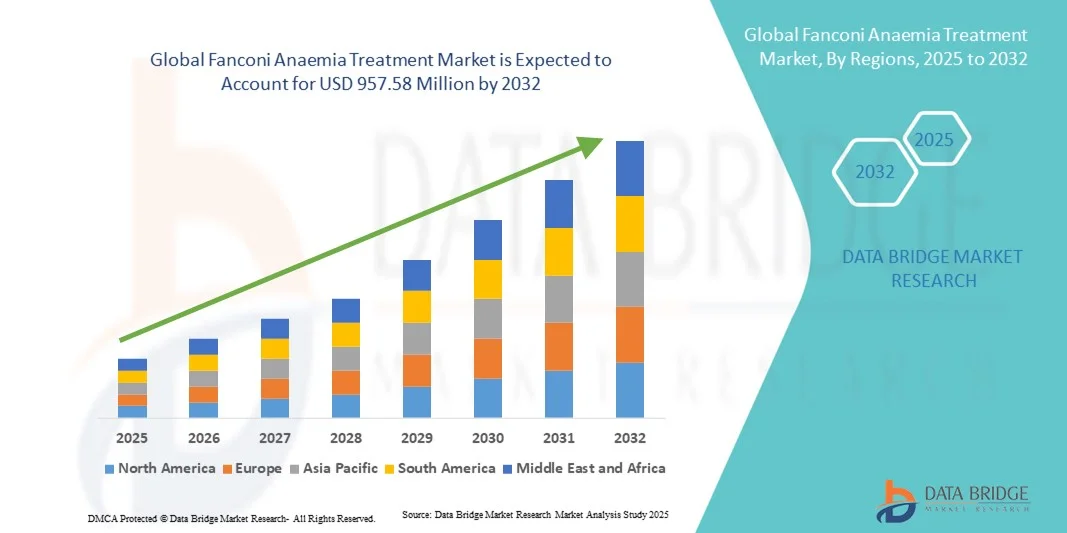
- The global fanconi anaemia treatment market size was valued at USD 614.58 Million in 2024 and is expected to reach USD 957.58 Million by 2032, at a CAGR of 5.70% during the forecast period
- The market growth is largely fueled by the increasing prevalence of Fanconi Anaemia (FA) worldwide and the rising focus on developing advanced therapeutic approaches, including gene therapy, stem cell transplantation, and novel drug formulations. Continuous advancements in molecular diagnostics and personalized medicine are enhancing early detection and treatment outcomes, driving significant progress within the fanconi anaemia treatment market
- Furthermore, increasing research collaborations among academic institutions, biotechnology companies, and pharmaceutical firms are accelerating the development of innovative treatment solutions. Growing awareness about rare genetic disorders, supportive government initiatives, and improved healthcare infrastructure are further propelling market expansion. These converging factors are establishing fanconi anaemia treatment as a vital area of focus in rare disease therapeutics, thereby significantly boosting the industry’s growth
Fanconi Anaemia Treatment Market Analysis
- Fanconi Anaemia Treatment, focused on managing this rare inherited blood disorder through gene therapy, stem cell transplantation, and supportive drug therapies, is gaining significant attention due to advancements in genetic research and increasing awareness of early diagnosis and treatment options
- The growing demand for innovative therapeutic approaches, coupled with expanding clinical trials and rising funding for rare disease research, is driving substantial growth in the Fanconi Anaemia Treatment market globally
- North America dominated the fanconi anaemia treatment market with the largest revenue share of 38.6% in 2024, supported by the presence of advanced healthcare infrastructure, ongoing gene therapy research, and the strong focus of key pharmaceutical companies in developing curative treatments. The U.S. remains the leading contributor, driven by initiatives from the National Institutes of Health (NIH) and the rising adoption of precision medicine
- Asia-Pacific is projected to be the fastest-growing region in the fanconi anaemia treatment market during the forecast period, attributed to increasing healthcare investments, improving diagnostic capabilities, and rising awareness about genetic disorders in countries such as China, Japan, and India
- The Treatment segment dominated the largest market revenue share of 62.4% in 2024, attributed to the rising number of clinical trials, expanding use of gene therapy, and advancements in hematopoietic stem cell transplantation (HSCT)
Report Scope and Fanconi Anaemia Treatment Market Segmentation
|
Attributes |
Fanconi Anaemia Treatment Key Market Insights |
|
Segments Covered |
|
|
Countries Covered |
North America
Europe
Asia-Pacific
Middle East and Africa
South America
|
|
Key Market Players |
|
|
Market Opportunities |
|
|
Value Added Data Infosets |
In addition to the insights on market scenarios such as market value, growth rate, segmentation, geographical coverage, and major players, the market reports curated by the Data Bridge Market Research also include in-depth expert analysis, patient epidemiology, pipeline analysis, pricing analysis, and regulatory framework. |
Fanconi Anaemia Treatment Market Trends
Enhanced Convenience Through AI and Precision Medicine Integration
- A significant and accelerating trend in the global fanconi anaemia treatment market is the deepening integration of artificial intelligence (AI) and advanced precision medicine technologies. This fusion of innovations is significantly enhancing diagnostic accuracy, personalized treatment planning, and patient monitoring
- For instance, AI-based genomic analytics platforms are increasingly being utilized to identify specific gene mutations responsible for Fanconi Anaemia, thereby enabling targeted therapeutic strategies. Similarly, platforms like DeepMind Health and IBM Watson are exploring AI-driven models to predict patient response to various treatment options, improving overall clinical outcomes
- AI integration in Fanconi Anaemia research facilitates capabilities such as analyzing large-scale genomic datasets to detect novel mutations, predicting bone marrow failure progression, and optimizing donor-recipient matching in bone marrow transplantation. For example, AI-assisted cytogenetic analysis can identify chromosomal abnormalities with higher accuracy and speed, reducing diagnostic delays. Furthermore, precision algorithms can assist clinicians in suggesting personalized drug regimens and identifying potential complications before they manifest clinically
- The seamless integration of AI-driven analytics with clinical data platforms and electronic health records (EHRs) allows for centralized management of patient histories, laboratory reports, and treatment outcomes, thus creating a unified and data-driven approach to patient care. Through a single digital interface, researchers and clinicians can access genomic data, monitor therapy responses, and adapt treatment strategies dynamically
- This trend toward more intelligent, intuitive, and interconnected treatment ecosystems is fundamentally reshaping the global approach to rare disease management. Consequently, companies and research institutes such as Rocket Pharmaceuticals, Novartis, and Bluebird Bio are developing AI-supported gene therapy pipelines and automated molecular diagnostics specifically targeting Fanconi Anaemia mutations
- The demand for advanced Fanconi Anaemia treatment solutions integrating AI and precision medicine is growing rapidly across both clinical and research sectors, as healthcare providers increasingly prioritize accuracy, efficiency, and personalized therapeutic outcomes
Fanconi Anaemia Treatment Market Dynamics
Driver
Growing Need Due to Rising Genetic Disorder Awareness and Advancements in Gene Therapy
- The increasing prevalence of inherited bone marrow failure syndromes, coupled with growing awareness of rare genetic disorders, is a significant driver for the heightened demand for Fanconi Anaemia treatment worldwide
- For instance, in April 2024, Rocket Pharmaceuticals announced a major advancement in its lentiviral-based gene therapy platform for Fanconi Anaemia subtype A (FA-A), following successful clinical outcomes in Europe. Such developments by key biopharmaceutical companies are expected to drive the Fanconi Anaemia Treatment industry growth during the forecast period
- As the global healthcare community becomes more aware of the genetic complexity and life-threatening implications of Fanconi Anaemia, there is an increasing emphasis on early genetic screening, cellular therapy, and bone marrow transplantation. These approaches, supported by AI-enhanced diagnostic tools, offer a compelling advancement over traditional symptomatic management
- Furthermore, the growing popularity of personalized medicine and the rapid expansion of genomics-based diagnostic technologies are making AI-assisted gene therapy and molecular testing integral components of Fanconi Anaemia care. This integration enables precision-driven decision-making and reduces treatment-related complications
- The availability of next-generation sequencing (NGS) and CRISPR-based editing tools, combined with robust research funding and expanding clinical trial networks, are key factors propelling the adoption of novel therapeutic options in both academic and commercial healthcare sectors. The trend toward patient-specific cellular reprogramming and the increasing availability of user-friendly genetic analysis kits further contribute to the market’s growth
Restraint/Challenge
Concerns Regarding High Treatment Costs and Ethical Challenges in Genetic Engineering
- Concerns surrounding the high cost of advanced therapies, including gene editing and bone marrow transplantation, pose a significant challenge to the broader adoption of Fanconi Anaemia treatments. Since most of these therapies involve sophisticated technology and personalized manufacturing, they are financially out of reach for many patients, especially in developing regions
- For instance, gene therapy products that rely on viral vector-based delivery can exceed several hundred thousand dollars per treatment, creating affordability challenges for healthcare systems and families alike
- In addition, ethical and regulatory concerns surrounding the use of gene-editing technologies, such as CRISPR-Cas9, add further complexity to market growth. Variations in regulatory frameworks across regions can delay approvals and limit patient access to potentially life-saving therapies
- Addressing these challenges through government funding, patient assistance programs, and international collaborations will be crucial for making advanced treatments more accessible. Companies such as Bluebird Bio and Rocket Pharmaceuticals emphasize their commitment to affordability and patient support programs to expand access in emerging markets
- Another challenge is the limited availability of compatible donors for bone marrow transplants, especially among ethnically diverse populations. This limitation underscores the importance of continued research into autologous stem cell therapies and induced pluripotent stem cell (iPSC)-based solutions
- While technological advancements and policy initiatives are gradually improving access, the perceived complexity and ethical debate surrounding genetic therapies can still hinder widespread adoption. Overcoming these barriers through global research collaborations, improved cost structures, and enhanced patient education will be vital for sustaining long-term market growth
Fanconi Anaemia Treatment Market Scope
The market is segmented on the basis of type, related disorders, end users, and distribution channel.
- By Type
On the basis of type, the Fanconi Anaemia Treatment market is segmented into Diagnosis and Treatment. The Treatment segment dominated the largest market revenue share of 62.4% in 2024, attributed to the rising number of clinical trials, expanding use of gene therapy, and advancements in hematopoietic stem cell transplantation (HSCT). The strong preference for curative treatment modalities, particularly gene editing and bone marrow transplantation, has fueled this dominance. Increased R&D investments from biotech firms and supportive initiatives from regulatory bodies like the FDA and EMA have further strengthened the segment’s growth. Moreover, the introduction of targeted therapies and improved transplant success rates have elevated treatment demand globally, with significant adoption in North America and Europe. Growing access to specialized centers for rare disease management has also contributed to the sustained leadership of this segment.
The Diagnosis segment is anticipated to witness the fastest growth rate, registering a CAGR of 9.8% from 2025 to 2032. This growth is primarily driven by increasing awareness of early genetic screening, rising adoption of next-generation sequencing (NGS), and the availability of cost-effective molecular testing kits. Advancements in diagnostic technologies, such as chromosomal breakage analysis and FANCA/FANCC gene mutation identification, are enabling early disease detection. Governments and healthcare organizations are investing heavily in early diagnostic infrastructure for rare genetic disorders. Moreover, the expansion of newborn screening programs and integration of AI-based analytics in genetic testing are further propelling diagnostic segment growth across both developed and emerging economies.
- By Related Disorders
On the basis of related disorders, the Fanconi Anaemia Treatment market is segmented into Acute Myeloid Leukaemia (AML), Myelodysplastic Syndromes (MDS), Chromosome Instability Syndromes, Acquired Aplastic Anaemia, and Others. The Acute Myeloid Leukaemia (AML) segment dominated the largest market share of 37.2% in 2024, driven by the strong association between Fanconi Anaemia and AML development. The segment’s growth is supported by increasing patient screening for leukemia transformation in FA cases and ongoing advancements in targeted therapy, immunotherapy, and stem cell transplantation. Pharmaceutical companies are focusing on combination drug approaches to enhance survival rates among FA-related AML patients. Continuous funding from cancer research institutes and collaborations between hospitals and research laboratories have accelerated therapy development. Moreover, the increasing global incidence of AML among FA patients is pushing demand for effective, personalized treatments.
The Myelodysplastic Syndromes (MDS) segment is projected to witness the fastest CAGR of 10.4% from 2025 to 2032, driven by growing diagnostic awareness and improved genetic profiling of FA-associated bone marrow failure syndromes. Advances in bone marrow monitoring and the availability of novel therapeutic agents, such as hypomethylating drugs and targeted inhibitors, are boosting treatment outcomes. The expansion of clinical studies focused on FA-related MDS progression and early therapeutic intervention is contributing significantly. Enhanced collaboration between genetic counseling centers and hematology clinics is ensuring faster diagnosis, while the integration of machine learning tools for predictive disease modeling further supports market expansion in this segment.
- By End Users
On the basis of end users, the Fanconi Anaemia Treatment market is segmented into Hospitals, Specialty Clinics, and Others. The Hospitals segment accounted for the largest market revenue share of 58.7% in 2024, attributed to the availability of advanced infrastructure for stem cell transplantation, gene therapy, and comprehensive patient care. Hospitals serve as primary centers for diagnosis, treatment, and follow-up of Fanconi Anaemia cases, offering multidisciplinary expertise involving hematologists, geneticists, and oncologists. Increased funding for hospital-based rare disease programs and the establishment of dedicated centers for bone marrow transplants in major economies such as the U.S., Germany, and Japan have further driven dominance. The rising number of hospital partnerships with research institutes for FA-focused clinical trials continues to reinforce this leadership.
The Specialty Clinics segment is expected to witness the fastest growth rate, with a CAGR of 9.6% from 2025 to 2032. The growth is primarily due to the increasing establishment of niche rare disease and genetic counseling clinics offering tailored care for FA patients. These clinics provide specialized genetic testing, donor matching, and targeted therapy management with reduced waiting times compared to large hospitals. The rise in patient preference for specialized consultation, coupled with advancements in telemedicine and personalized therapy delivery, enhances accessibility. Expansion in private healthcare infrastructure in emerging economies and government-supported rare disease initiatives are further fostering the rapid growth of specialty clinics globally.
- By Distribution Channel
On the basis of distribution channel, the Fanconi Anaemia Treatment market is segmented into Direct Tender, Hospital Pharmacy, Retail Pharmacy, Online Pharmacy, and Others. The Hospital Pharmacy segment dominated the largest market share of 45.3% in 2024, driven by the centralized supply of prescription-based therapies, including bone marrow transplantation medications, immunosuppressants, and gene therapy-related drugs. The presence of integrated supply networks within hospitals ensures timely availability of advanced treatments and supports patient adherence. The strong regulatory framework governing rare disease medication distribution through hospital channels enhances quality assurance and minimizes counterfeit risks. Hospitals also benefit from negotiated tender-based procurement from pharmaceutical manufacturers, allowing cost-effective access to high-value gene therapy drugs.
The Online Pharmacy segment is expected to register the fastest CAGR of 10.9% from 2025 to 2032, fueled by the rising popularity of e-commerce healthcare platforms and telehealth integration for chronic disease management. Increasing internet penetration, digital prescription systems, and patient convenience in ordering rare disease medications online are major drivers. Partnerships between online pharmacies and biotech companies specializing in FA therapy distribution are expanding access in remote and underserved regions. Enhanced data security and traceability systems have improved trust among patients, while the introduction of online consultation support further strengthens this segment’s rapid growth.
Fanconi Anaemia Treatment Market Regional Analysis
- North America dominated the fanconi anaemia treatment market with the largest revenue share of 38.6% in 2024, supported by the presence of advanced healthcare infrastructure, ongoing gene therapy research, and the strong focus of key pharmaceutical companies on developing curative treatments
- The region benefits from a high concentration of clinical research organizations, cutting-edge laboratories, and extensive funding for rare disease research. Growing collaborations between academic institutions and biotech firms are further accelerating the development of innovative therapies
- Moreover, the region’s regulatory support for orphan drug development and early-stage clinical trials has created a favorable environment for the commercialization of Fanconi Anaemia treatments
U.S. Fanconi Anaemia Treatment Market Insight
The U.S. fanconi anaemia treatment market captured the largest revenue share in 2024 within North America, driven by robust advancements in gene therapy, stem cell transplantation, and molecular diagnostics. The country’s strong research ecosystem, backed by initiatives from the National Institutes of Health (NIH), Fanconi Anemia Research Fund (FARF), and leading academic centers, is accelerating clinical progress. Increasing adoption of precision medicine and the use of AI-assisted genomic analysis are improving early diagnosis and personalized treatment planning. Additionally, significant investment from pharmaceutical companies such as Rocket Pharmaceuticals, Bluebird Bio, and Novartis is fueling innovation in gene correction technologies, positioning the U.S. as a global leader in Fanconi Anaemia research and therapy.
Europe Fanconi Anaemia Treatment Market Insight
The Europe fanconi anaemia treatment market is projected to expand at a substantial CAGR throughout the forecast period, primarily driven by the region’s strong healthcare infrastructure, supportive regulatory policies for orphan drugs, and growing research funding for rare genetic disorders. Countries such as Germany, France, and the U.K. are witnessing increased participation in international clinical trials focused on Fanconi Anaemia gene therapies. The European Medicines Agency (EMA) continues to support accelerated approvals for breakthrough treatments. Furthermore, the growing emphasis on early genetic screening programs and cross-border research initiatives enhances patient access to advanced therapeutic options across the continent.
U.K. Fanconi Anaemia Treatment Market Insight
The U.K. fanconi anaemia treatment market is anticipated to grow at a noteworthy CAGR during the forecast period, supported by government-led investments in rare disease research and genomic medicine. The Genomics England initiative and the UK Rare Diseases Framework are playing pivotal roles in improving early detection, data sharing, and clinical management of Fanconi Anaemia. Additionally, collaborations between academic institutions, such as the University of Oxford and the Francis Crick Institute, with global biotech firms are facilitating the development of advanced gene therapy platforms. The growing accessibility of genetic testing and awareness among healthcare professionals are also key contributors to market expansion.
Germany Fanconi Anaemia Treatment Market Insight
The Germany fanconi anaemia treatment market is expected to expand at a considerable CAGR during the forecast period, fueled by the country’s strong biopharmaceutical sector, commitment to precision medicine, and continuous advancements in genetic diagnostics. Germany’s emphasis on innovation, combined with well-established healthcare infrastructure and funding for translational research, has created a robust environment for the development of next-generation gene therapies. Public–private partnerships and collaboration with European research consortia are accelerating therapeutic discovery and clinical validation. Additionally, Germany’s growing focus on sustainability and patient-centered healthcare ensures the long-term integration of advanced therapies for rare diseases such as Fanconi Anaemia.
Asia-Pacific Fanconi Anaemia Treatment Market Insight
The Asia-Pacific fanconi anaemia treatment market is projected to grow at the fastest CAGR during 2025–2032, attributed to increasing healthcare investments, improving diagnostic capabilities, and rising awareness about genetic disorders in countries such as China, Japan, and India. Expanding access to advanced molecular testing, coupled with government initiatives promoting genomics research and rare disease management, is boosting market growth. Regional biopharmaceutical firms are actively collaborating with Western organizations to conduct clinical trials and develop cost-effective treatment models. Moreover, the establishment of gene therapy manufacturing hubs and rare disease registries in Asia is enhancing accessibility and affordability of Fanconi Anaemia treatments across emerging economies.
Japan Fanconi Anaemia Treatment Market Insight
The Japan fanconi anaemia treatment market is gaining momentum due to the nation’s strong focus on regenerative medicine, rapid technological advancement, and an increasing number of clinical research programs targeting rare diseases. Japan’s Ministry of Health, Labour and Welfare (MHLW) has implemented favorable regulatory frameworks for gene and cell-based therapies, accelerating their approval and commercialization. The country’s high prevalence of advanced research institutions and its growing elderly population are also fostering demand for safer and more effective Fanconi Anaemia treatments. Collaborative efforts between domestic companies and global biotech leaders are expected to drive significant therapeutic innovation.
China Fanconi Anaemia Treatment Market Insight
The China fanconi anaemia treatment market accounted for the largest market revenue share in Asia-Pacific in 2024, supported by a rapidly expanding biotechnology industry, improved diagnostic infrastructure, and increasing public awareness of genetic disorders. The Chinese government’s initiatives under programs like Healthy China 2030 are promoting rare disease research and accelerating drug approval pathways. Domestic pharmaceutical firms are investing in gene therapy manufacturing and localized diagnostic solutions to enhance accessibility. Moreover, collaborations with global organizations and the establishment of national rare disease registries are strengthening the country’s position as a key player in the global Fanconi Anaemia Treatment market.
Fanconi Anaemia Treatment Market Share
The Fanconi Anaemia Treatment industry is primarily led by well-established companies, including:
- Rocket Pharmaceuticals. (U.S.)
- Novartis AG (Switzerland)
- CRISPR Therapeutics (Switzerland)
- Bluebird Bio, Inc. (U.S.)
- Editas Medicine (U.S.)
- Sangamo Therapeutics (U.S.)
- Abeona Therapeutics Inc. (U.S.)
- GeneDx , LLC (U.S.)
- Foresee Pharmaceuticals Co., Ltd. (Taiwan)
- Amgen Inc. (U.S.)
- Gilead Sciences, Inc. (U.S.)
- Bristol-Myers Squibb Company (U.S.)
- UniQure N.V. (Netherlands)
- PTC Therapeutics (U.S.)
- Orchard Therapeutics plc. (U.K.)
- GSK Plc. (U.K.)
- Pfizer Inc. (U.S.)
- AbbVie Inc. (U.S.)
- Sanofi (France)
Latest Developments in Global Fanconi Anaemia Treatment Market
- In July 2025, Stanford Medicine announced the success of a groundbreaking stem cell transplant procedure for children with Fanconi anaemia, eliminating the need for chemotherapy or radiation. This innovative approach utilizes a targeted antibody-based conditioning regimen, significantly reducing the risk of secondary cancers and other side effects associated with traditional treatments. The study demonstrated that this method could safely prepare patients for stem cell transplants, offering a promising alternative to conventional therapies
- In April 2025, a Spanish clinical trial published in The Lancet revealed that non-conditioned hematopoietic gene therapy could effectively treat Fanconi anaemia patients. The study showed sustained engraftment and reversal of bone marrow failure in patients treated with lentiviral-mediated gene therapy, without the need for genotoxic conditioning. This approach offers a safer and potentially curative option for individuals with Fanconi anaemia
- In March 2025, Jasper Therapeutics presented new data on briquilimab, an antibody used in stem cell transplantation for Fanconi anaemia patients. The study indicated that briquilimab infusion has a promising safety profile and appears to be well-tolerated in patients with Fanconi anaemia, suggesting its potential as a conditioning agent in stem cell transplants
- In December 2024, Rocket Pharmaceuticals announced that the European Medicines Agency (EMA) accepted its Marketing Authorization Application for RP-L102, a gene therapy for Fanconi anaemia. This milestone brings RP-L102 closer to becoming the first gene therapy approved for Fanconi anaemia in Europe, offering a potential new treatment option for patients with this rare genetic disorder
- In October 2024, a study published in Haematologica demonstrated that gene therapy could restore the transcriptional program of hematopoietic stem cells in Fanconi anaemia patients. The research showed that lentiviral-mediated gene therapy could ameliorate bone marrow failure in non-conditioned patients, highlighting the potential of gene therapy as a treatment for Fanconi anaemia

- Interactive Data Analysis Dashboard
- Company Analysis Dashboard for high growth potential opportunities
- Research Analyst Access for customization & queries
- Competitor Analysis with Interactive dashboard
- Latest News, Updates & Trend analysis
- Harness the Power of Benchmark Analysis for Comprehensive Competitor Tracking
Data collection and base year analysis are done using data collection modules with large sample sizes. The stage includes obtaining market information or related data through various sources and strategies. It includes examining and planning all the data acquired from the past in advance. It likewise envelops the examination of information inconsistencies seen across different information sources. The market data is analysed and estimated using market statistical and coherent models. Also, market share analysis and key trend analysis are the major success factors in the market report. To know more, please request an analyst call or drop down your inquiry.
The key research methodology used by DBMR research team is data triangulation which involves data mining, analysis of the impact of data variables on the market and primary (industry expert) validation. Data models include Vendor Positioning Grid, Market Time Line Analysis, Market Overview and Guide, Company Positioning Grid, Patent Analysis, Pricing Analysis, Company Market Share Analysis, Standards of Measurement, Global versus Regional and Vendor Share Analysis. To know more about the research methodology, drop in an inquiry to speak to our industry experts.
Data Bridge Market Research is a leader in advanced formative research. We take pride in servicing our existing and new customers with data and analysis that match and suits their goal. The report can be customized to include price trend analysis of target brands understanding the market for additional countries (ask for the list of countries), clinical trial results data, literature review, refurbished market and product base analysis. Market analysis of target competitors can be analyzed from technology-based analysis to market portfolio strategies. We can add as many competitors that you require data about in the format and data style you are looking for. Our team of analysts can also provide you data in crude raw excel files pivot tables (Fact book) or can assist you in creating presentations from the data sets available in the report.












