


Farber’s Disease Drug Market Size
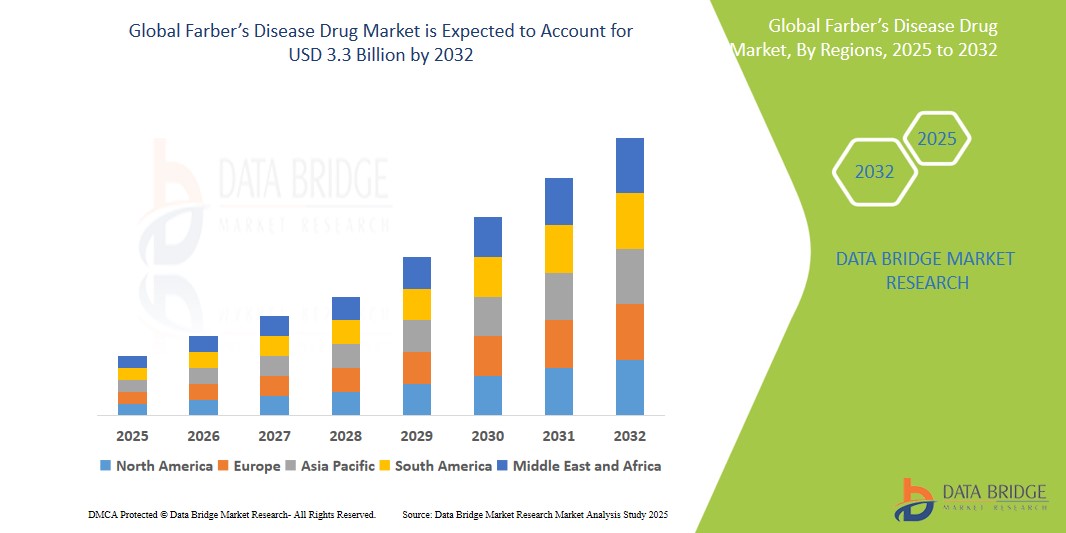
- The Global Farber’s Disease Drug Market size was valued at USD 2.1 billion in 2024 and is expected to reach USD 3.3 billion by 2032, at a CAGR of 6.2% during the forecast period
- This growth is driven by increasing research into rare diseases, improved diagnostic capabilities, and the growing availability of targeted therapies
Farber’s Disease Drug Market Analysis
- Farber’s Disease is a rare lysosomal storage disorder, and the treatment landscape includes supportive medications, enzyme replacement therapies, and, in severe cases, surgical interventions such as bone marrow transplants
- Market growth is fueled by advancements in genetic research, rising awareness of rare diseases, and improved access to orphan drug designations and funding
- North America is expected to dominate the Farber’s Disease drug market due to well-established healthcare systems, availability of advanced therapies, and strong presence of key pharmaceutical players
- Europe follows closely, supported by increased rare disease initiatives and favorable regulatory frameworks
- The medication segment is projected to dominate the market with a share of 63.4% in 2024, due to the increasing reliance on pharmacological management for symptom relief and inflammation control
Report Scope and Farber’s Disease Drug Market Segmentation
|
Attributes |
Farber’s Disease Drug Key Market Insights |
|
Segments Covered |
|
|
Countries Covered |
North America
Europe
Asia-Pacific
Middle East and Africa
South America
|
|
Key Market Players |
|
|
Market Opportunities |
|
|
Value Added Data Infosets |
In addition to the insights on market scenarios such as market value, growth rate, segmentation, geographical coverage, and major players, the market reports curated by the Data Bridge Market Research also include import export analysis, production capacity overview, production consumption analysis, price trend analysis, climate change scenario, supply chain analysis, value chain analysis, raw material/consumables overview, vendor selection criteria, PESTLE Analysis, Porter Analysis, and regulatory framework. |
Farber’s Disease Drug Market Trends
“Increasing Focus on Orphan Drug Development and Gene Therapy Research”
- A key trend in the Farber’s Disease drug market is the growing emphasis on orphan drug development and gene therapy innovation for rare lysosomal storage disorders
- Pharmaceutical companies and biotech firms are increasingly investing in novel treatment approaches, including enzyme replacement therapies (ERT) and gene therapies aimed at correcting the underlying genetic mutations
- For instance, in March 2024, the U.S. FDA granted orphan drug designation to a novel gene therapy candidate targeting acid ceramidase deficiency, the enzyme affected in Farber’s Disease. This designation supports development incentives and faster regulatory pathways for promising rare disease treatments
- These research advancements are likely to offer long-term solutions and improve life expectancy and quality of life in Farber’s Disease patients, thereby driving interest from both public and private healthcare sectors
Farber’s Disease Drug Market Dynamics
Driver
“Rising Awareness and Diagnostic Advancements in Rare Diseases”
- Growing global awareness of rare diseases, supported by advocacy groups, public health initiatives, and expanded newborn screening programs, is driving early diagnosis and intervention in Farber’s Disease
- With improvements in genetic testing and biomarker identification, more patients are being accurately diagnosed, allowing timely treatment to slow disease progression
- For instance, In December 2021, in July 2023, a collaborative study by NIH and international genetic institutes revealed that next-generation sequencing reduced diagnosis time for lysosomal storage disorders by 50%, aiding early therapeutic intervention
- As diagnostic capabilities improve and awareness increases, pharmaceutical demand for rare disease treatment like Farber’s Disease is expected to grow steadily over the forecast period
Opportunity
“Expansion of Treatment Access Through Global Rare Disease Initiatives”
- Governments and organizations are increasingly implementing rare disease frameworks to support patient access to novel therapies through funding, policy reforms, and international collaborations
- These initiatives provide a pathway for companies to introduce innovative drugs in emerging markets where treatment options for Farber’s Disease are currently limited
- For instance, In January 2025, in December 2024, the European Commission expanded the scope of its Rare Disease Action Plan, including funding provisions and regulatory harmonization, enabling faster access to life-saving therapies in underserved regions
- Such policy efforts offer pharmaceutical companies a valuable opportunity to expand their market presence and deliver equitable care to a broader patient base
Restraint/Challenge
“Limited Commercial Viability and High Treatment Costs”
- The commercial development of drugs for ultra-rare diseases like Farber’s Disease presents a significant challenge due to the small patient population and high R&D costs
- Treatments, especially those involving biologics or gene therapy, are often priced in the hundreds of thousands of dollars annually, limiting access in both developed and developing countries
- For instance, In November 2024, according to a 2024 report by Global Genes, the average annual cost of treatment for a lysosomal storage disorder exceeds USD 300,000, creating affordability concerns for patients and healthcare systems
- High treatment costs, along with reimbursement challenges and limited clinical trial data, can delay drug launches and reduce the willingness of payers to cover therapy, ultimately hindering broader market adoption
Farber’s Disease Drug Market Scope
The market is segmented on the basis type, treatment type, route of administration and distribution channel.
|
Segmentation |
Sub-Segmentation |
|
By Application |
|
|
By Treatment Type |
|
|
By Route of Administration |
|
|
By Distribution Channel |
|
|
By End Users |
|
In 2025, the Medication Segment is projected to dominate the market with a largest share in treatment type segment
The medication segment is projected to dominate the Global Farber’s Disease Drug Market with the largest share of 64.18% in the treatment type segment. This dominance is attributed to the widespread use of enzyme replacement therapies (ERT), corticosteroids, and anti-inflammatory drugs in managing disease symptoms and improving patient quality of life. As there is currently no definitive cure, medication remains the primary line of treatment. The growing awareness of rare lysosomal storage disorders and ongoing advancements in drug formulations further strengthen the position of this segment.
The Injectable Route of Administration is expected to account for the largest share during the forecast period in route of administration market
The injectable segment is expected to hold the largest market share of 59.47% in 2025 in the route of administration category. This is due to the prevalent use of intravenous enzyme replacement therapies and biologics, which are commonly administered via injection to achieve faster and more effective systemic absorption. As injectable treatments offer targeted delivery and immediate therapeutic action, they are preferred for managing the progressive nature of Farber’s Disease, especially in moderate to severe cases. Advancements in delivery methods and increasing drug approvals via this route are also contributing to its market lead.
Farber’s Disease Drug Market Regional Analysis
“North America Holds the Largest Share in the Farber’s Disease Drug Market”
- North America dominates the Farber’s Disease Drug Market, owing to its well-established healthcare infrastructure, early adoption of orphan drugs, and robust regulatory support for rare disease treatment
- The U.S. leads the region with a significant market share due to strong R&D capabilities, increasing diagnosis rates of rare lysosomal storage disorders, and substantial funding for rare disease drug development
- Presence of major pharmaceutical companies, supportive policies such as the Orphan Drug Act, and active engagement from rare disease advocacy groups enhance market visibility and treatment accessibility
- Additionally, higher awareness, widespread use of advanced genetic testing, and favorable reimbursement structures are contributing to the sustained market leadership in the region
“Asia-Pacific is Projected to Register the Highest CAGR in the Farber’s Disease Drug Market”
- The Asia-Pacific region is expected to witness the fastest growth in the Farber’s Disease Drug Market during the forecast period, fueled by improving healthcare access, increasing awareness of rare diseases, and growing focus on genetic diagnostics
- Countries like China, India, and Japan are showing increased interest in rare disease management, supported by expanding newborn screening programs and rising government investment in rare and orphan drug sectors
- Japan, with its advanced biopharmaceutical industry and emphasis on rare genetic disorders, is emerging as a vital contributor to market expansion through innovation and early diagnosis initiatives
- Meanwhile, India and China, with their large populations and growing pharmaceutical manufacturing capabilities, are seeing a surge in partnerships and clinical trials aimed at introducing cost-effective rare disease therapies. Rising healthcare expenditure and public-private collaboration further strengthen the region’s growth trajectory
Farber’s Disease Drug Market Share
The market competitive landscape provides details by competitor. Details included are company overview, company financials, revenue generated, market potential, investment in research and development, new market initiatives, global presence, production sites and facilities, production capacities, company strengths and weaknesses, product launch, product width and breadth, application dominance. The above data points provided are only related to the companies' focus related to market.
The Major Market Leaders Operating in the Market Are:
- F. Hoffmann-La Roche Ltd (Switzerland)
- Novartis AG (Switzerland)
- AstraZeneca (UK)
- Pfizer Inc. (U.S.)
- Sanofi (France)
- Johnson & Johnson Services, Inc. (U.S.)
- AbbVie Inc. (U.S.)
- Allergan (Ireland)
- Merck & Co., Inc. (U.S.)
- Amgen Inc. (U.S.)
- DAIICHI SANKYO COMPANY, LIMITED. (Japan)
- Sun Pharmaceutical Industries Ltd. (India)
- Teva Pharmaceutical Industries Ltd. (Israel)
- Takeda Pharmaceutical Company Limited. (Japan)
- GlaxoSmithKline plc (UK)
- Cardinal Health (U.S.)
- Mylan N.V. (U.S.)
- Boehringer Ingelheim International GmbH (Germany)
- Kowa Pharmaceuticals America, Inc. (U.S.)
- WOCKHARDT. Incorporated (India)

- Interactive Data Analysis Dashboard
- Company Analysis Dashboard for high growth potential opportunities
- Research Analyst Access for customization & queries
- Competitor Analysis with Interactive dashboard
- Latest News, Updates & Trend analysis
- Harness the Power of Benchmark Analysis for Comprehensive Competitor Tracking
Data collection and base year analysis are done using data collection modules with large sample sizes. The stage includes obtaining market information or related data through various sources and strategies. It includes examining and planning all the data acquired from the past in advance. It likewise envelops the examination of information inconsistencies seen across different information sources. The market data is analysed and estimated using market statistical and coherent models. Also, market share analysis and key trend analysis are the major success factors in the market report. To know more, please request an analyst call or drop down your inquiry.
The key research methodology used by DBMR research team is data triangulation which involves data mining, analysis of the impact of data variables on the market and primary (industry expert) validation. Data models include Vendor Positioning Grid, Market Time Line Analysis, Market Overview and Guide, Company Positioning Grid, Patent Analysis, Pricing Analysis, Company Market Share Analysis, Standards of Measurement, Global versus Regional and Vendor Share Analysis. To know more about the research methodology, drop in an inquiry to speak to our industry experts.
Data Bridge Market Research is a leader in advanced formative research. We take pride in servicing our existing and new customers with data and analysis that match and suits their goal. The report can be customized to include price trend analysis of target brands understanding the market for additional countries (ask for the list of countries), clinical trial results data, literature review, refurbished market and product base analysis. Market analysis of target competitors can be analyzed from technology-based analysis to market portfolio strategies. We can add as many competitors that you require data about in the format and data style you are looking for. Our team of analysts can also provide you data in crude raw excel files pivot tables (Fact book) or can assist you in creating presentations from the data sets available in the report.












