


What is the Fast-Moving Consumer Goods (FMCG) Logistics Market Size and Growth Rate?
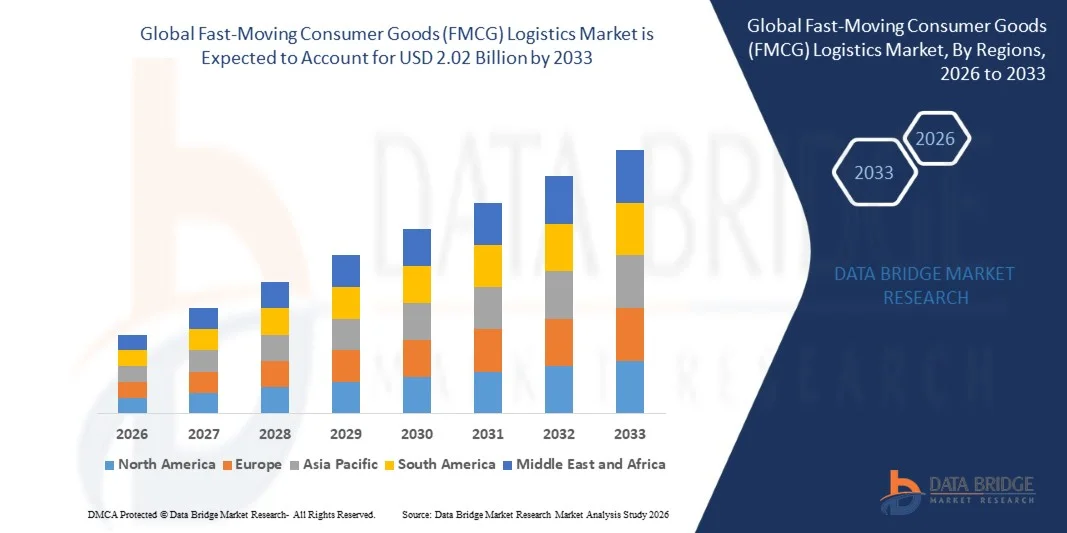
- As per Data Bridge Market Research analysis, the fast-moving consumer goods (FMCG) logistics market was valued at USD 1.20 billion in 2025 and is projected to reach USD 2.02 billion by 2033, growing at a CAGR of 6.70% from 2026 to 2033.
- The market is experiencing steady growth driven by rising consumption of packaged goods, expansion of organized retail, e-commerce, and quick commerce, and increasing outsourcing of warehousing, transportation, and cold-chain services by manufacturers and retailers.
- The increasing need for faster replenishment, real-time inventory visibility, and temperature-controlled handling, combined with growing integration of automation and digital planning tools, is supporting market adoption. FMCG logistics services are being applied across cold chain logistics networks, urban distribution hubs, and warehouse management systems, offering manufacturers and retailers greater supply-chain responsiveness and enabling efficient last-mile delivery.
Market Size & Forecast
- Global Market Value (2025): USD 1.20 Billion
- Expected Market Value (2033): USD 2.02 Billion
- Forecast CAGR (2026–2033): 6.70%
- Leading Region in 2025: Asia-Pacific
- Fastest Growing Region: Middle East and Africa
What are the Major Takeaways of the Fast-Moving Consumer Goods (FMCG) Logistics Market?
- Asia-Pacific dominated the fast-moving consumer goods (FMCG) logistics market with the largest revenue share of 37.85% in 2025, supported by large consumer populations, rapid growth of organized retail and e-commerce, and continuous investment in warehousing and distribution networks.
- Middle East and Africa is expected to be the fastest-growing region at a CAGR of 8.95% from 2026 to 2033, fueled by urbanization, rising packaged-goods consumption, and new logistics-hub and warehousing investments.
- The transportation segment led the service type category with a 51.20% share in 2025, driven by high-volume, high-frequency movement of packaged goods from factories to retail outlets.
- Value-added services is the fastest-growing service type, projected to register a CAGR of 8.30%, reflecting demand for labeling, kitting, co-packing, and e-commerce order preparation.
- The roadways segment dominated the mode of transport category with a 72.40% revenue share in 2025, led by its flexibility and suitability for frequent, small-lot deliveries.
- Ambient logistics accounted for 69.30% of the market share in 2025, preferred for shelf-stable packaged foods, beverages, and household products that do not require temperature control.
- The temperature-controlled segment is the fastest-growing temperature-control category, with a CAGR of 9.20%, driven by rising consumption of dairy, frozen foods, ready-to-eat meals, and fresh produce.
Report Scope and Fast-Moving Consumer Goods (FMCG) Logistics Market Segmentation
|
Attributes |
Fast-Moving Consumer Goods (FMCG) Logistics Key Market Insights |
|
Segments Covered |
|
|
Countries Covered |
North America
Europe
Asia-Pacific
Middle East and Africa
South America
|
|
Key Market Players |
|
|
Market Opportunities |
|
|
Value Added Data Infosets |
In addition to the market insights such as market value, growth rate, market segments, geographical coverage, market players, and market scenario, the market report curated by the Data Bridge Market Research team includes in-depth expert analysis, import/export analysis, pricing analysis, production consumption analysis, and pestle analysis. |
What is the Key Trend in the Fast-Moving Consumer Goods (FMCG) Logistics Market?
- FMCG logistics is evolving toward integrated, technology-enabled networks that combine multi-user warehouses, temperature-controlled storage, real-time inventory visibility, and last-mile delivery capabilities to serve high-velocity, short-shelf-life products across modern retail, e-commerce, and quick-commerce channels.
- For instance, in February 2026, according to DHL Supply Chain, it signed a memorandum of understanding with RLCold to develop more than five million square feet of advanced temperature-controlled facilities across North America, including multi-temperature distribution centers for the food and beverage sector
- Operators are adopting warehouse management systems, automation, and AI-based planning tools to reduce handling time, improve throughput, and preserve product integrity across fast-moving supply chains.
- Sustainability is also becoming a design criterion for new FMCG logistics infrastructure, with carbon-neutral facilities, electric delivery fleets, and energy-efficient cold storage featuring in new investment plans.
- For instance, in April 2026, according to IOL Business Report, DHL Supply Chain announced a R220 million investment in a new multi-user distribution centre in Johannesburg to support consumer-goods customers including FMCG, with construction scheduled to begin in July 2026, operations expected from July 2027, and the facility to be developed as a carbon-neutral, H-Advanced certified site
- As automation, data visibility, and low-emission logistics assets continue to mature, FMCG logistics is expected to evolve into a more responsive and resilient network that supports omnichannel distribution while controlling cost and environmental impact.
What are the Key Drivers of the Fast-Moving Consumer Goods (FMCG) Logistics Market?
- Growth in organized retail, e-commerce, and quick commerce is increasing demand for faster, more frequent, and smaller-batch deliveries of daily-use products, which requires scalable warehousing, distribution, and last-mile capabilities.
- For instance, in April 2026, according to DHL Group, DHL Supply Chain achieved organic revenue growth of 5.7% in the first quarter of 2026, supported by new business wins, contract renewals, and the continued expansion of e-commerce activities.
- Rising urbanization, income growth, and consumption of packaged food, beverages, and personal care products in emerging economies are also supporting demand for outsourced logistics services from FMCG manufacturers and retailers.
- For instance, in March 2026, according to Value Chain Asia, DHL Supply Chain Vietnam operated 16 warehouses, and the company described FMCG as the backbone of its Vietnam business, alongside growth in consumer goods, automotive, technology, life sciences, and retail.
- Manufacturers are further focusing on core activities and outsourcing logistics to specialist providers, which supports long-term contracts for dedicated warehousing, transportation, and value-added services.
What Factors Are Challenging the Growth of the Fast-Moving Consumer Goods (FMCG) Logistics Market?
- FMCG logistics operates on thin margins and is highly exposed to fuel, freight, labor, and insurance cost volatility, while high order frequency and short delivery windows limit the ability to consolidate shipments.
- For instance, in April 2026, according to BW Businessworld, blockades in the Red Sea and the Strait of Hormuz were pushing freight rates up by as much as 300% on some routes, with companies reporting 25–50% increases in ocean freight, 10–20% higher marine insurance costs, and a further 5–10% rise in inland logistics expenses.
- Cold-chain and last-mile operations require specialized assets, energy-intensive storage, and precise monitoring, which raise capital and operating costs, particularly in markets with limited cold-storage capacity and fragmented transport networks.
- In addition, fragmented retail structures, infrastructure gaps, and differing regulations across regions complicate network design and raise the cost of serving smaller outlets and rural areas.
- For instance, in March 2026, according to the Federation of Malaysian Manufacturers (FMM), as reported by Malay Mail, rerouting around the Cape of Good Hope was adding an estimated 10,000 km and up to 14 days to delivery times, marine insurance premiums had jumped by more than 50%, and exporters could face hundreds to over USD 1,000 in additional costs per container.
- The combination of cost volatility, specialized infrastructure needs, and geopolitical supply-chain disruption can compress provider margins and slow investment, particularly among smaller operators that lack the scale to pass higher costs on to customers.
How is the Fast-Moving Consumer Goods (FMCG) Logistics Market Segmented?
The fast-moving consumer goods (FMCG) logistics market is segmented on the basis of service type, mode of transport, temperature control, and end use.
- By Service Type
On the basis of service type, the fast-moving consumer goods (FMCG) logistics market is segmented into transportation, warehousing and distribution, and value-added services. The transportation segment dominated the market with 51.20% share in 2025, supported by the need to move high volumes of packaged food, beverages, and personal and home care products from factories to distribution centers, wholesalers, and retail outlets. Frequent replenishment cycles and wide retail coverage keep freight movement at the core of FMCG supply chains. Route optimization, fleet tracking, and dedicated contract fleets are improving delivery reliability and cost control.
The value-added services segment is projected to register the fastest growth at a CAGR of 8.30% from 2026 to 2033, driven by demand for labeling, kitting, co-packing, returns handling, and e-commerce order preparation. FMCG manufacturers are outsourcing these activities to logistics providers to shorten lead times and customize packs for different retail channels and promotions. Growth in online grocery and quick-commerce channels is increasing the volume of small, multi-item orders that require such services. Integration with warehouse systems and real-time inventory visibility is further supporting adoption.
- By Mode of Transport
On the basis of mode of transport, the fast-moving consumer goods (FMCG) logistics market is segmented into roadways, railways, waterways, and airways. The roadways segment dominated the mode-of-transport category with 72.40% share in 2025, supported by its flexibility, door-to-door reach, and suitability for frequent, small-lot deliveries to retailers and distributors. Road transport connects factories, regional warehouses, urban dark stores, and traditional retail outlets, particularly in emerging economies with fragmented retail structures. Telematics, digital freight matching, and electric delivery vehicles are improving fleet utilization and lowering emissions.
The railways segment is projected to register the fastest growth at a CAGR of 7.60% from 2026 to 2033, driven by government and private efforts to shift long-distance freight from road to rail and by growth of container and parcel services on dedicated freight corridors. Rail offers lower cost per tonne-kilometer and reduced emissions for large-volume FMCG flows between manufacturing clusters and regional distribution hubs. Investments in rail-linked warehouses and multimodal terminals are improving first- and last-mile connectivity. Time-tabled rail services are also becoming more attractive as manufacturers seek predictable lead times.
- By Temperature Control
On the basis of temperature control, the fast-moving consumer goods (FMCG) logistics market is segmented into ambient and temperature-controlled. The ambient segment dominated the temperature-control category with 69.30% share in 2025, supported by the large share of shelf-stable packaged foods, beverages, household products, and personal care items in FMCG volumes. Ambient logistics benefits from lower infrastructure and operating costs than cold chains and can use standard warehouses and vehicles. High-density racking, automation, and cross-docking are improving throughput in ambient distribution centers.
The temperature-controlled segment is projected to register the fastest growth at a CAGR of 9.20% from 2026 to 2033, driven by rising consumption of dairy, frozen foods, ready-to-eat meals, fresh produce, and chilled beverages. Consumers are buying more fresh and premium foods, which require continuous temperature control from production to the shelf. Investments in multi-temperature distribution centers, refrigerated fleets, and real-time temperature monitoring are expanding capacity. Food-safety regulations and the need to reduce spoilage are further encouraging outsourcing of cold-chain logistics.
- By End Use
On the basis of end use, the fast-moving consumer goods (FMCG) logistics market is segmented into food and beverages, personal and home care, healthcare and wellness, and others. The food and beverages segment dominated the end-use category with 58.70% share in 2025, supported by high-frequency purchase patterns, large production volumes, and the need for fast replenishment of packaged foods, beverages, and snacks. Short shelf lives and seasonal demand require responsive warehousing and transport networks. Manufacturers are partnering with logistics providers to extend distribution into smaller towns and rural markets.
The healthcare and wellness segment is projected to register the fastest growth at a CAGR of 8.40% from 2026 to 2033, driven by growth in over-the-counter medicines, nutritional supplements, and wellness products sold through pharmacies and online channels. These products often require tighter handling, traceability, and storage conditions than standard FMCG items. Rising health awareness and expansion of online pharmacies are increasing demand for specialized delivery and warehousing services. Compliance with quality and labeling regulations is encouraging use of experienced logistics partners.
Which Region Holds the Largest Share of the Fast-Moving Consumer Goods (FMCG) Logistics Market?
- Asia-Pacific dominated the fast-moving consumer goods (FMCG) logistics market with the largest revenue share of 37.85% in 2025, supported by large and growing consumer populations, expansion of organized retail and e-commerce, and continued investment in warehousing, cold-chain, and last-mile networks.
- The region also benefits from rising urbanization, increasing disposable incomes, and strong participation of both global logistics providers and fast-growing domestic operators. Increasing adoption of quick commerce, automation, and digital freight platforms continues to strengthen Asia-Pacific's position in the global market.
India Fast-Moving Consumer Goods (FMCG) Logistics Market Insight
The India fast-moving consumer goods (FMCG) logistics market is witnessing strong growth due to rising consumption of packaged goods, expansion of modern retail and quick commerce, and improvements in highway and freight-corridor infrastructure. Third-party logistics providers are adding warehouse capacity in industrial hubs and developing cold-chain facilities for dairy, beverages, and fresh produce. In addition, the push to reach smaller towns and rural markets is creating demand for flexible distribution models and technology-enabled fleet management.
Middle East and Africa Fast-Moving Consumer Goods (FMCG) Logistics Market Insight
The Middle East and Africa fast-moving consumer goods (FMCG) logistics market is expected to witness rapid growth, driven by population growth, urbanization, and investments in ports, free zones, and logistics parks. Retailers and manufacturers are expanding distribution networks to serve growing demand for packaged food and personal care products. In addition, government diversification programs and rising e-commerce activity are supporting demand for modern warehousing and cold-chain capacity across the region.
Saudi Arabia Fast-Moving Consumer Goods (FMCG) Logistics Market Insight
The Saudi Arabia fast-moving consumer goods (FMCG) logistics market is growing rapidly, driven by Vision 2030 logistics initiatives, development of logistics zones near major ports and airports, and expansion of modern retail and online grocery. Investments in temperature-controlled warehousing and national transport corridors are improving distribution capability. Furthermore, rising consumer spending and growing local manufacturing of food and household products are increasing demand for dependable logistics partners.
South Africa Fast-Moving Consumer Goods (FMCG) Logistics Market Insight
The South Africa fast-moving consumer goods (FMCG) logistics market is experiencing steady growth, supported by a developed retail sector, established consumer-goods manufacturers, and its role as a gateway for cross-border distribution into Sub-Saharan Africa. Logistics providers are investing in multi-user distribution centers to serve FMCG customers with local and cross-border fulfilment. In addition, growing emphasis on sustainability, energy resilience, and efficient inventory management is shaping new facility designs.
U.S. Fast-Moving Consumer Goods (FMCG) Logistics Market Insight
The U.S. fast-moving consumer goods (FMCG) logistics market is witnessing consistent growth due to its large and mature consumer market, well-developed retail networks, and strong demand for temperature-controlled distribution of fresh and frozen foods. Contract logistics providers and real estate developers are investing in multi-temperature facilities and automation to improve efficiency. Moreover, growth in e-commerce grocery and the need for resilient supply chains are encouraging manufacturers and retailers to expand outsourcing.
Germany Fast-Moving Consumer Goods (FMCG) Logistics Market Insight
The Germany fast-moving consumer goods (FMCG) logistics market is experiencing steady growth, supported by its central location in European distribution, advanced retail and food-manufacturing sectors, and strong logistics infrastructure. Providers are operating central warehouses and in-plant logistics for frozen, chilled, and ambient products, often under long-term partnerships with manufacturers. Furthermore, emphasis on emission reduction, efficient transport, and supply security is supporting investment in advanced and sustainable logistics solutions.
Which are the Top Companies in Fast-Moving Consumer Goods (FMCG) Logistics Market?
The fast-moving consumer goods (FMCG) logistics industry is primarily led by well-established companies, including:
- DHL Supply Chain (Germany)
- Kuehne + Nagel International AG (Switzerland)
- DSV A/S (Denmark)
- C.H. Robinson Worldwide, Inc. (U.S.)
- XPO, Inc. (U.S.)
- GXO Logistics, Inc. (U.S.)
- Ryder System, Inc. (U.S.)
- A.P. Moller – Maersk A/S (Denmark)
- CEVA Logistics (France)
- GEODIS (France)
- Nippon Express Holdings, Inc. (Japan)
- SF Holding Co., Ltd. (China)
- Kerry Logistics Network Limited (Hong Kong)
- Americold Realty Trust, Inc. (U.S.)
- Lineage, Inc. (U.S.)
- Mahindra Logistics Limited (India)
- Allcargo Logistics Limited (India)
- Transport Corporation of India Limited (India)
- Delhivery Limited (India)
- United Parcel Service, Inc. (U.S.)
What are Latest Developments in Fast-Moving Consumer Goods (FMCG) Logistics Market?
- In May 2026, DHL Supply Chain took over operational management of Pepco's distribution center in Bucharest, Romania, marking its entry into contract logistics in Romania and bringing to five the number of Pepco distribution centers it manages across Europe.
- In May 2026, ColdStar Logistics commissioned a new temperature-controlled facility in Pune, India, with daily processing capacity of more than 3 lakh units, to serve FMCG and fresh-produce customers in Maharashtra.
- In March 2026, DHL Supply Chain and iglo Deutschland extended their exclusive logistics partnership for five years, with DHL continuing to manage the central frozen-food warehouse and in-plant logistics at iglo's Reken (Westphalia) facility, as well as all transport logistics.
- In March 2026, KSH Integrated Logistics launched a new 50,000 sq ft warehouse in Bhiwandi, India, for a global FMCG beverage client, taking its capacity in the region to 250,000 sq ft, with plans to exceed 500,000 sq ft by year-end.
- In January 2026, Lapasar opened a new warehouse in the Klang Valley, Malaysia, bringing its total warehousing capacity to over 250,000 square feet and expanding its dedicated fleet to 100 trucks to support FMCG wholesale operations.

- Interactive Data Analysis Dashboard
- Company Analysis Dashboard for high growth potential opportunities
- Research Analyst Access for customization & queries
- Competitor Analysis with Interactive dashboard
- Latest News, Updates & Trend analysis
- Harness the Power of Benchmark Analysis for Comprehensive Competitor Tracking
Data collection and base year analysis are done using data collection modules with large sample sizes. The stage includes obtaining market information or related data through various sources and strategies. It includes examining and planning all the data acquired from the past in advance. It likewise envelops the examination of information inconsistencies seen across different information sources. The market data is analysed and estimated using market statistical and coherent models. Also, market share analysis and key trend analysis are the major success factors in the market report. To know more, please request an analyst call or drop down your inquiry.
The key research methodology used by DBMR research team is data triangulation which involves data mining, analysis of the impact of data variables on the market and primary (industry expert) validation. Data models include Vendor Positioning Grid, Market Time Line Analysis, Market Overview and Guide, Company Positioning Grid, Patent Analysis, Pricing Analysis, Company Market Share Analysis, Standards of Measurement, Global versus Regional and Vendor Share Analysis. To know more about the research methodology, drop in an inquiry to speak to our industry experts.
Data Bridge Market Research is a leader in advanced formative research. We take pride in servicing our existing and new customers with data and analysis that match and suits their goal. The report can be customized to include price trend analysis of target brands understanding the market for additional countries (ask for the list of countries), clinical trial results data, literature review, refurbished market and product base analysis. Market analysis of target competitors can be analyzed from technology-based analysis to market portfolio strategies. We can add as many competitors that you require data about in the format and data style you are looking for. Our team of analysts can also provide you data in crude raw excel files pivot tables (Fact book) or can assist you in creating presentations from the data sets available in the report.













