


Fatty Acid Diethanolamide Market Size
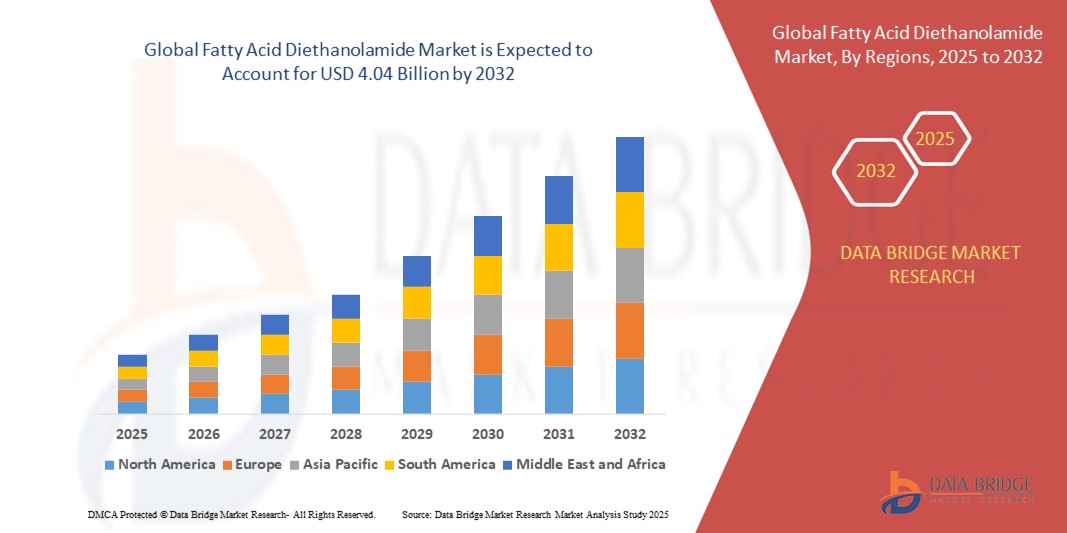
- The global fatty acid diethanolamide market size was valued at USD 2.69 billion in 2024 and is expected to reach USD 4.04 billion by 2032, at a CAGR of 5.20% during the forecast period
- The market growth is largely fuelled by the increasing demand for eco-friendly and biodegradable surfactants in personal care and household cleaning products, as well as the expanding application scope in agrochemicals, textiles, and lubricants
- The shift toward sustainable raw materials, coupled with innovations in bio-based chemistry and improved production processes, is enhancing the quality, cost-efficiency, and commercial appeal of fatty acid diethanolamides across multiple end-use industries
Fatty Acid Diethanolamide Market Analysis
- The rising consumer preference for sustainable and natural ingredients in shampoos, body washes, and liquid detergents is boosting the adoption of fatty acid diethanolamides derived from coconut and palm oils
- Government regulations discouraging the use of harmful petrochemical-based surfactants are further creating a favorable regulatory environment for plant-derived diethanolamides
- North America dominated the fatty acid diethanolamide market with the largest revenue share in 2024, driven by strong demand from the personal care and homecare industries, along with established manufacturing infrastructure and a shift toward biodegradable surfactants
- Asia-Pacific region is expected to witness the highest growth rate in the global fatty acid diethanolamide market, driven by rising disposable incomes, urbanization, expanding middle-class populations, and a surge in demand for personal care and household cleaning products across countries such as China, India, and Southeast Asian nations
- The industrial grade segment dominated the market with the largest revenue share in 2024, driven by its widespread use in manufacturing detergents, industrial cleaners, and emulsifiers. This grade is preferred for its excellent foam-stabilizing, thickening, and emulsifying properties, making it suitable for large-scale cleaning and surfactant-based applications. The availability of cost-effective raw materials and the high demand for biodegradable industrial surfactants further support its dominance
Report Scope and Fatty Acid Diethanolamide Market Segmentation
|
Attributes |
Fatty Acid Diethanolamide Key Market Insights |
|
Segments Covered |
|
|
Countries Covered |
North America
Europe
Asia-Pacific
Middle East and Africa
South America
|
|
Key Market Players |
|
|
Market Opportunities |
• Rising Demand for Bio-Based and Eco-Friendly Surfactants |
|
Value Added Data Infosets |
In addition to the insights on market scenarios such as market value, growth rate, segmentation, geographical coverage, and major players, the market reports curated by the Data Bridge Market Research also include import export analysis, production capacity overview, production consumption analysis, price trend analysis, climate change scenario, supply chain analysis, value chain analysis, raw material/consumables overview, vendor selection criteria, PESTLE Analysis, Porter Analysis, and regulatory framework. |
Fatty Acid Diethanolamide Market Trends
Rising Adoption of Eco-Friendly Surfactants Across End-Use Industries
- Increasing environmental concerns and regulatory pressures are prompting manufacturers to adopt fatty acid diethanolamides (FADEs) as sustainable alternatives to petroleum-based surfactants. These bio-based compounds are gaining favor in personal care and cleaning products due to their biodegradable nature, reduced toxicity, and excellent foaming and emulsifying properties
- The growing preference for green labeling and certification in cosmetics and household cleaners is further encouraging the use of FADEs. Major brands are incorporating coconut- and palm-derived diethanolamides to enhance product sustainability, aligning with consumer expectations for cleaner ingredient profiles and ethical sourcing
- Technological advancements in bio-refining and oleochemical processing are improving the efficiency and yield of FADE production. This is supporting cost-effective scaling and allowing manufacturers to meet rising global demand without compromising on environmental standards or performance
- For instance, in 2023, several Asian detergent manufacturers introduced FADE-based formulations in their new product lines, citing improved skin compatibility and reduced environmental impact. These launches reflect the strategic transition toward renewable ingredients in mass-market applications
- While the trend is gaining momentum, the continued adoption of FADEs hinges on sustainable raw material sourcing, supply chain transparency, and industry-wide collaboration. Innovations in formulation chemistry and feedstock optimization are key to strengthening market acceptance across high-volume applications
Fatty Acid Diethanolamide Market Dynamics
Driver
Surging Demand for Biodegradable Ingredients in Cosmetics and Detergents
• The global shift toward environmentally friendly and sustainable products is significantly driving the demand for fatty acid diethanolamides in personal care and detergent formulations. These surfactants, derived from natural oils, are valued for their ability to create rich lather, improve texture, and stabilize emulsions without harming ecosystems
• Consumers are becoming more ingredient-conscious, prompting manufacturers to reformulate shampoos, body washes, and household cleaners using naturally derived additives such as FADEs. The drive is further supported by regulatory mandates limiting the use of harmful chemicals such as sulfates and phosphates
• Companies are investing in green chemistry R&D to expand their portfolio of FADE-infused products. With increasing preference for plant-based solutions, fatty acid diethanolamides are becoming essential components of mild and safe formulations for sensitive applications
• For instance, in 2022, several European skincare brands launched sulfate-free shampoo ranges formulated with coconut-based diethanolamides, catering to environmentally aware consumers and boosting the ingredient’s commercial relevance
• While demand for FADEs is expected to grow, ensuring long-term raw material sustainability and competitive pricing will be crucial for broader adoption across emerging economies and mass-market segments
Restraint/Challenge
Concerns Over Diethanolamine Content and Regulatory Scrutiny
• One of the key challenges facing the fatty acid diethanolamide market is regulatory concern over the potential presence of free diethanolamine (DEA), a substance flagged for its possible carcinogenic effects in some formulations. These concerns have prompted caution in regions such as North America and Europe
• Regulatory frameworks such as the European Union’s REACH and California’s Proposition 65 require manufacturers to closely monitor and limit DEA residues in end products. This creates added compliance costs and restricts market penetration for suppliers without robust purification and testing infrastructure
• Negative consumer perception related to chemical-sounding ingredients has also affected the appeal of certain diethanolamides, especially in clean-label skincare and food-adjacent product categories. Education and transparency in sourcing and safety are vital to restoring confidence
• For instance, in 2023, regulatory authorities in the U.S. issued updated guidance on the safe use of DEA derivatives in cosmetic products, emphasizing the importance of quality control during synthesis and labeling. This led to a temporary halt in the distribution of several non-compliant products
• To overcome these challenges, industry stakeholders are focusing on reformulating products with ultra-purified FADE variants, enhancing analytical standards, and increasing collaboration with regulators to ensure safe and scalable usage across applications
Fatty Acid Diethanolamide Market Scope
The market is segmented on the basis of type and application.
- By Type
On the basis of type, the fatty acid diethanolamide market is segmented into industrial grade and cosmetic grade. The industrial grade segment dominated the market with the largest revenue share in 2024, driven by its widespread use in manufacturing detergents, industrial cleaners, and emulsifiers. This grade is preferred for its excellent foam-stabilizing, thickening, and emulsifying properties, making it suitable for large-scale cleaning and surfactant-based applications. The availability of cost-effective raw materials and the high demand for biodegradable industrial surfactants further support its dominance.
The cosmetic grade segment is projected to witness the fastest growth rate from 2025 to 2032, owing to the increasing consumer preference for mild, skin-friendly, and natural-based ingredients in personal care products. This segment benefits from its enhanced purity and lower toxicity levels, making it ideal for shampoos, conditioners, lotions, and facial cleansers. The expansion of clean beauty trends and stricter cosmetic formulation regulations are key drivers of its anticipated growth.
- By Application
On the basis of application, the fatty acid diethanolamide market is segmented into shampoo manufacturing, detergent manufacturing, cosmetic manufacturing, and others. The shampoo manufacturing segment held the largest market revenue share in 2024 due to the widespread use of diethanolamides as foam boosters and viscosity enhancers. Their ability to improve the texture and stability of formulations makes them a core ingredient in hair care products globally.
The detergent manufacturing segment is projected to witness the fastest growth rate from 2025 to 2032, driven by the rising demand for biodegradable and efficient cleaning agents. Fatty acid diethanolamides serve as effective emulsifiers and foaming agents in both household and industrial detergents. Increasing environmental concerns and regulatory mandates promoting eco-friendly surfactants are further propelling this segment’s expansion.
Fatty Acid Diethanolamide Market Regional Analysis
• North America dominated the fatty acid diethanolamide market with the largest revenue share in 2024, driven by strong demand from the personal care and homecare industries, along with established manufacturing infrastructure and a shift toward biodegradable surfactants
• The region benefits from rising environmental awareness, stringent regulatory compliance for safe chemical use, and widespread use of detergents and shampoos across household and commercial segments. The increasing preference for mild surfactants in cosmetics further supports market expansion
U.S. Fatty Acid Diethanolamide Market Insight
The U.S. fatty acid diethanolamide market held the largest revenue share in North America in 2024, supported by robust consumption in household cleaning products and personal care items. The country’s high per capita usage of shampoos, soaps, and laundry detergents drives steady demand. In addition, the presence of key manufacturers and advanced R&D capabilities facilitates innovation in eco-friendly formulations. Regulatory encouragement for non-toxic and sustainable ingredients is expected to further bolster product development and usage across sectors.
Europe Fatty Acid Diethanolamide Market Insight
The Europe fatty acid diethanolamide market is projected to witness the fastest growth rate from 2025 to 2032, driven by the region’s focus on green chemistry and sustainable ingredients. European countries are enforcing stricter environmental policies and encouraging the use of biodegradable raw materials in cosmetics and cleaning products. Consumer demand for clean-label formulations and transparent product sourcing has spurred manufacturers to adopt naturally derived surfactants. The market also benefits from the mature personal care industry across Germany, France, and Italy.
Germany Fatty Acid Diethanolamide Market Insight
The Germany fatty acid diethanolamide market is projected to witness the fastest growth rate from 2025 to 2032, fuelled by increasing demand for non-irritating, eco-friendly surfactants in cosmetics and detergents. Germany’s reputation for high-quality personal care brands and technological innovation encourages adoption of advanced surfactant systems. Strong regulatory frameworks promoting environmental safety, along with the shift toward sulfate-free and paraben-free products, are influencing ingredient choices across manufacturers in the country.
U.K. Fatty Acid Diethanolamide Market Insight
The U.K. fatty acid diethanolamide market is projected to witness the fastest growth rate from 2025 to 2032, driven by the rising demand for eco-friendly cleaning and grooming products. With increasing consumer awareness around ingredient transparency and environmental impact, manufacturers are turning to biodegradable surfactants such as fatty acid diethanolamides. The U.K.’s strong presence of natural and organic personal care brands, combined with government efforts to reduce chemical waste and promote green formulations, supports continued market expansion.
Asia-Pacific Fatty Acid Diethanolamide Market Insight
The Asia-Pacific fatty acid diethanolamide market is projected to witness the fastest growth rate from 2025 to 2032, driven by rapid industrialization, rising population, and growing urban demand for cleaning and personal care products. Countries such as China, India, and Indonesia are witnessing significant growth in detergent and shampoo manufacturing. Increased disposable income, awareness of hygiene, and rising demand for affordable yet effective formulations are boosting consumption across both urban and rural regions.
China Fatty Acid Diethanolamide Market Insight
The China fatty acid diethanolamide market accounted for the largest revenue share in Asia-Pacific in 2024, owing to the country’s booming personal care and detergent manufacturing sectors. China's local producers are increasingly incorporating diethanolamides into low-cost, high-performance products to meet mass-market demand. Government focus on industrial sustainability, along with investments in green chemistry, supports product innovation and export capabilities across East Asia.
Japan Fatty Acid Diethanolamide Market Insight
The Japan fatty acid diethanolamide market is projected to witness the fastest growth rate from 2025 to 2032, supported by the country's demand for premium personal care and cosmetic products. Consumers in Japan favor mild, non-irritating ingredients, which increases the use of fatty acid diethanolamides in skincare and haircare formulations. The market is also influenced by Japan’s advanced manufacturing capabilities and focus on product safety and environmental sustainability. Growing preference for sulfate-free shampoos and eco-certified products continues to drive adoption in domestic and export-oriented production.
Fatty Acid Diethanolamide Market Share
The Fatty Acid Diethanolamide industry is primarily led by well-established companies, including:
- Akzo Nobel N.V. (Netherlands)
- Wujiang Jinyu Lanolin Co. Ltd (China)
- BASF SE (Germany)
- Vantage Specialty Chemicals (U.S.)
- Arizona Chemicals (U.S.)
- Colgate-Palmolive Company (U.S.)
- Godrej Industries Limited (India)
- Eastman Chemical Company (U.S.)
- Croda International Plc (U.K.)
- Oleon N.V. (Belgium)
- FMC Corporation (U.S.)
- Dow (U.S.)
- Enzymotec Ltd. (Israel)
- Omega Protein Corporation (U.S.)
- AKER BIOMARINE. (Norway)
- Polaris (U.S.)
- Cargill Incorporated (U.S.)
- GOLDEN OMEGA (U.S.)
- Acasti Pharma Inc. (Canada)
- Stepan Company (U.S.)
- Maruha Nichiro Corporation (Japan)
- Sinomega Biotech Engineering Co., Ltd (China)
- Nippon Suisan Kaisha Ltd. (Japan)
- GC Rieber Oils AS (Norway)
- sSOLUTEX (Germany)
Latest Developments in Global Fatty Acid Diethanolamide Market
- In July 2024, Lubrizol is expanding its portfolio of diethanolamides, focusing on products such as cocoamide diethanolamides. These compounds are integral to personal care formulations, providing conditioning and emulsifying properties. They are also utilized in cleaning products, enhancing performance and stability. The diverse applications highlight Lubrizol's commitment to innovation in surfactants, catering to the growing demand for effective and sustainable ingredients in various industries

- Interactive Data Analysis Dashboard
- Company Analysis Dashboard for high growth potential opportunities
- Research Analyst Access for customization & queries
- Competitor Analysis with Interactive dashboard
- Latest News, Updates & Trend analysis
- Harness the Power of Benchmark Analysis for Comprehensive Competitor Tracking
Global Fatty Acid Diethanolamide Market, Supply Chain Analysis and Ecosystem Framework
To support market growth and help clients navigate the impact of geopolitical shifts, DBMR has integrated in-depth supply chain analysis into its Global Fatty Acid Diethanolamide Market research reports. This addition empowers clients to respond effectively to global changes affecting their industries. The supply chain analysis section includes detailed insights such as Global Fatty Acid Diethanolamide Market consumption and production by country, price trend analysis, the impact of tariffs and geopolitical developments, and import and export trends by country and HSN code. It also highlights major suppliers with data on production capacity and company profiles, as well as key importers and exporters. In addition to research, DBMR offers specialized supply chain consulting services backed by over a decade of experience, providing solutions like supplier discovery, supplier risk assessment, price trend analysis, impact evaluation of inflation and trade route changes, and comprehensive market trend analysis.
Data collection and base year analysis are done using data collection modules with large sample sizes. The stage includes obtaining market information or related data through various sources and strategies. It includes examining and planning all the data acquired from the past in advance. It likewise envelops the examination of information inconsistencies seen across different information sources. The market data is analysed and estimated using market statistical and coherent models. Also, market share analysis and key trend analysis are the major success factors in the market report. To know more, please request an analyst call or drop down your inquiry.
The key research methodology used by DBMR research team is data triangulation which involves data mining, analysis of the impact of data variables on the market and primary (industry expert) validation. Data models include Vendor Positioning Grid, Market Time Line Analysis, Market Overview and Guide, Company Positioning Grid, Patent Analysis, Pricing Analysis, Company Market Share Analysis, Standards of Measurement, Global versus Regional and Vendor Share Analysis. To know more about the research methodology, drop in an inquiry to speak to our industry experts.
Data Bridge Market Research is a leader in advanced formative research. We take pride in servicing our existing and new customers with data and analysis that match and suits their goal. The report can be customized to include price trend analysis of target brands understanding the market for additional countries (ask for the list of countries), clinical trial results data, literature review, refurbished market and product base analysis. Market analysis of target competitors can be analyzed from technology-based analysis to market portfolio strategies. We can add as many competitors that you require data about in the format and data style you are looking for. Our team of analysts can also provide you data in crude raw excel files pivot tables (Fact book) or can assist you in creating presentations from the data sets available in the report.













