


What is the Global Fatty Acid Esters Market Size and Growth Rate?
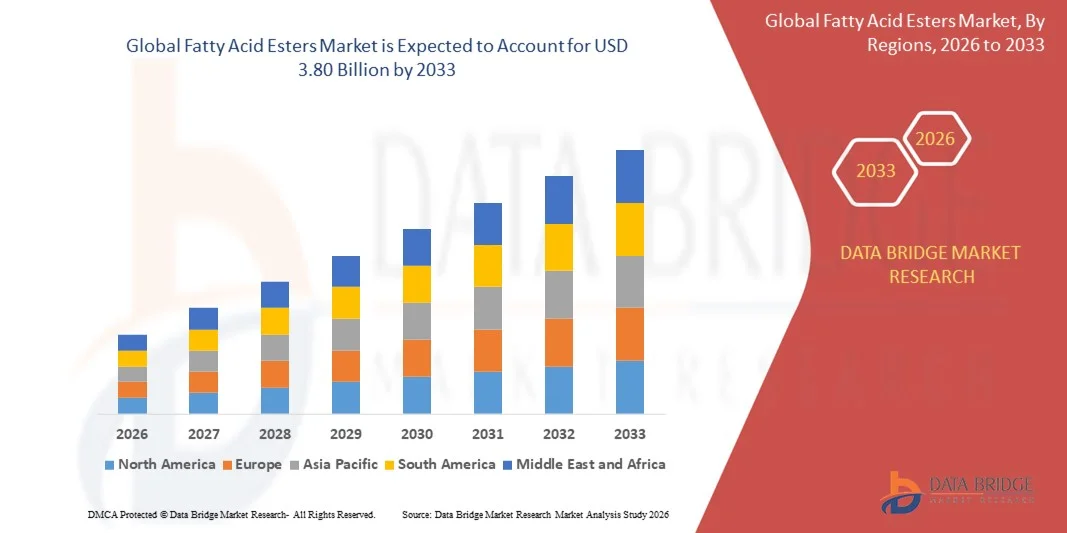
- As per Data Bridge Market Research Analysis the global fatty acid esters market size was valued at USD 2.78 billion in 2025 and is expected to reach USD 3.80 billion by 2033, at a CAGR of4.00% during the forecast period
- The increase in vegetable fats and oils consumption is such asly to influence the growth of the fatty acid esters market. In line with this, the rapid change in the consumer behavior regarding health and lifestyle is also acting as a key determinant which will favor the growth of the fatty acid esters market
Market Size & Forecast
- Global Market Value (2025): USD 2.78 Billion
- Expected Market Value (2033): USD 3.80 Billion
- Forecast CAGR (2026–2033): 4.00%
What are the Major Takeaways of Fatty Acid Esters Market?
- The high demand from food industry across the globe and as well as rise in the demand for personal care products and rapid increase in the demand of the derivatives of fatty acid esters in numerous end-use industries are also expected to positively impact the growth of the fatty acid esters market
- The major factor which is expected to forward the growth of the market is the enduring and upcoming oil and gas projects
- North America dominated the fatty acid esters market with a 48.65% revenue share in 2025, supported by strong consumption of personal care products, growth in processed foods, and rising adoption of bio-based lubricants across the U.S. and Canada
- Asia-Pacific is projected to register the fastest CAGR of 7.36% from 2026 to 2033, driven by rapid growth of cosmetics, food processing, pharmaceuticals, and industrial manufacturing across China, Japan, India, South Korea, and Southeast Asia
- The Medium Chain Triglycerides (MCT) segment dominated the market with a 31.4% revenue share in 2025, driven by rising adoption in nutritional supplements, functional foods, cosmetics, pharmaceuticals, and lipid-based drug delivery systems
Report Scope and Fatty Acid Esters Market Segmentation
|
Attributes |
Fatty Acid Esters Key Market Insights |
|
Segments Covered |
|
|
Countries Covered |
North America
Europe
Asia-Pacific
Middle East and Africa
South America
|
|
Key Market Players |
|
|
Market Opportunities |
|
|
Value Added Data Infosets |
In addition to the insights on market scenarios such as market value, growth rate, segmentation, geographical coverage, and major players, the market reports curated by the Data Bridge Market Research also include in-depth expert analysis, pricing analysis, brand share analysis, consumer survey, demography analysis, supply chain analysis, value chain analysis, raw material/consumables overview, vendor selection criteria, PESTLE Analysis, Porter Analysis, and regulatory framework. |
What is the Key Trend in the Fatty Acid Esters Market?
Increasing Shift Toward Bio-Based, High-Purity, and Multifunctional Fatty Acid Ester
- The fatty acid esters market is witnessing rising adoption of bio-based, high-purity, and multifunctional esters driven by growing demand for sustainable ingredients across food, cosmetics, pharmaceuticals, and industrial applications
- Manufacturers are introducing non-toxic, biodegradable, and high-stability ester formulations to meet regulatory standards and clean-label requirements in the U.S., Europe, and Asia-Pacific
- Increasing demand for emollients, lubricants, plasticizers, surfactants, and stabilizers made from natural fatty acids is boosting adoption across personal care, food processing, and polymer industries
- For instance, Evonik, KLK OLEO, Oleon, and Wilmar International expanded their bio-based ester portfolios with enhanced purity, better oxidative stability, and improved sensory properties for premium applications
- Growing shift toward environmentally friendly chemicals, reduced VOC emissions, and plant-derived raw materials continues to accelerate demand for modern ester formulations
- As global industries move toward sustainable chemistry, green manufacturing, and bio-based feedstocks, Fatty Acid Esters are expected to remain central in replacing petroleum-derived alternatives
What are the Key Drivers of Fatty Acid Esters Market?
- Rising demand for biodegradable, non-toxic, and environmentally friendly ester-based ingredients across cosmetics, lubricants, pharmaceuticals, food processing, and polymer manufacturing sectors
- For instance, in 2025, leading companies such as Cargill, BASF, and KLK OLEO enhanced their fatty acid ester lines to support natural cosmetics, functional foods, and pharma-grade excipients
- Growing expansion of personal care products, functional foods, industrial lubricants, and bio-based plastics across the U.S., Europe, and Asia-Pacific is driving widespread adoption
- Advancements in enzymatic esterification, feedstock purification, and continuous manufacturing technologies have improved product quality, yield efficiency, and oxidative stability
- Rising adoption of oleochemicals, bio-lubricants, and green surfactants is creating strong demand for esters with enhanced performance and cost efficiency
- Supported by expanding bio-refinery projects, R&D investments, and regulatory push toward green chemistry, the Fatty Acid Esters market is expected to continue strong long-term growth
Which Factor is Challenging the Growth of the Fatty Acid Esters Market?
- High production costs associated with premium, pharma-grade, and high-purity esters limit adoption among small manufacturers and cost-sensitive industrial users
- For instance, during 2024–2025, fluctuations in palm oil prices, natural feedstock costs, and logistic disruptions affected production economics for several global suppliers
- Stringent regulatory requirements, quality certifications, and safety compliance increase manufacturing complexity, especially for food and pharmaceutical applications
- Limited awareness in emerging markets regarding ester performance, purity grades, and application-specific benefits slows adoption across industrial and cosmetic users
- Competition from synthetic esters, petrochemical alternatives, and low-cost vegetable oil derivatives creates pricing pressure and reduces product differentiation
- To address these issues, companies are focusing on cost optimization, renewable feedstocks, process innovation, and strategic partnerships to expand global adoption of advanced Fatty Acid Esters
How is the Fatty Acid Esters Market Segmented?
The market is segmented on the basis of product type and application.
- By Product Type
On the basis of product type, the fatty acid esters market is segmented into Medium Chain Triglycerides (MCT), Glyceryl Monostearate, Isopropyl Esters, Polyol Esters, Sucrose Esters, Glycol Esters, and Others. The Medium Chain Triglycerides (MCT) segment dominated the market with a 31.4% revenue share in 2025, driven by rising adoption in nutritional supplements, functional foods, cosmetics, pharmaceuticals, and lipid-based drug delivery systems. MCTs offer superior metabolic efficiency, excellent solubility, and improved stability, making them widely preferred for health & wellness applications. Increasing demand for clean-label, plant-derived, and high-purity ester products further accelerates the adoption of MCTs across global markets.
The Sucrose Esters segment is projected to grow at the fastest CAGR from 2026 to 2033, supported by increasing use in food emulsification, confectionery, infant nutrition, and premium cosmetic formulations. Its multifunctional properties—such as low toxicity, biodegradability, and superior emulsification—continue to enhance adoption across emerging and advanced economies.
- By Application
On the basis of application, the fatty acid esters market is segmented into Personal Care and Cosmetics, Lubricants, Food Processing, Surfactants and Detergents, Pharmaceuticals, and Others. The Personal Care and Cosmetics segment dominated the market with a 29.7% revenue share in 2025, driven by rising demand for natural emollients, conditioners, stabilizers, and texturizing agents in skincare, haircare, and color cosmetics. Fatty acid esters are preferred due to their excellent sensory performance, improved spreadability, and biodegradability, aligning with global clean beauty trends. Growing consumption of premium beauty products across the U.S., Europe, and Asia-Pacific continues to enhance segment dominance.
The Pharmaceuticals segment is projected to grow at the fastest CAGR from 2026 to 2033, supported by increasing application in drug formulations, solubilizers, excipients, controlled-release systems, and lipid-based delivery mechanisms. Expanding R&D activities and rising focus on high-purity, non-toxic ester derivatives strengthen long-term market growth in this segment.
Which Region Holds the Largest Share of the Fatty Acid Esters Market?
- North America dominated the fatty acid esters market with a 48.65% revenue share in 2025, supported by strong consumption of personal care products, growth in processed foods, and rising adoption of bio-based lubricants across the U.S. and Canada. Increasing demand for natural emulsifiers, eco-friendly surfactants, and pharmaceutical-grade esters continues to accelerate production and consumption across key industries. Expanding oleochemical research, tightening environmental regulations, and increasing preference for biodegradable ingredients further strengthen regional leadership
- Leading manufacturers are investing in high-purity ester production, advanced enzymatic esterification technologies, and sustainable feedstock sourcing to expand product portfolios. Rising focus on green chemistry, renewable raw materials, and low-carbon manufacturing enhances market penetration across cosmetics, food, and industrial applications
- High purchasing power, strong R&D investments, and robust presence of global oleochemical players continue to support long-term growth
U.S. Fatty Acid Esters Market Insight
The U.S. is the largest contributor in North America, driven by strong demand for personal care formulations, pharmaceuticals, food emulsifiers, and industrial lubricants. Expansion of clean-label cosmetics, fortified foods, and bio-based chemicals fuels large-scale adoption of fatty acid esters. Growing investments in sustainable ingredient production, biotech innovation, and oleochemical processing technology further enhance market growth. Strong manufacturing capabilities, advanced research facilities, and rising consumer preference for plant-derived ingredients continue to support regional dominance.
Canada Fatty Acid Esters Market Insight
Canada contributes significantly to regional growth due to rising adoption of natural personal care products, processed food additives, and eco-friendly industrial fluids. Increasing demand for biodegradable lubricants, food-grade emulsifiers, and pharmaceutical excipients supports strong market penetration. Government emphasis on sustainability, renewable raw materials, and low-carbon manufacturing strengthens adoption across key end-use industries. Expanding bioscience innovation and growing consumer preference for green ingredients further fuel market expansion.
Asia-Pacific Fatty Acid Esters Market
Asia-Pacific is projected to register the fastest CAGR of 7.36% from 2026 to 2033, driven by rapid growth of cosmetics, food processing, pharmaceuticals, and industrial manufacturing across China, Japan, India, South Korea, and Southeast Asia. Expanding consumer base, rising income levels, and increasing preference for natural and plant-derived ingredients accelerate ester consumption. Strong investments in oleochemical production, abundant availability of palm- and coconut-derived feedstock, and growing exports position Asia-Pacific as the global growth engine. Rapid urbanization, booming e-commerce, and expansion of beauty and wellness industries further boost adoption.
China Fatty Acid Esters Market Insight
China is the largest contributor to Asia-Pacific, supported by robust oleochemical manufacturing capacity, strong domestic demand for cosmetics and food ingredients, and government-backed sustainability initiatives. Increasing adoption of ester-based lubricants, pharmaceutical excipients, and high-performance emulsifiers strengthens market growth. Local production advantages, expanding R&D activities, and competitive pricing enhance China’s global export capabilities.
Japan Fatty Acid Esters Market Insight
Japan shows steady growth driven by strong demand for premium cosmetics, high-quality pharmaceutical ingredients, and advanced food formulations. Preference for high-purity, safe, and biodegradable ingredients supports widespread usage across major industries. Emphasis on product safety, technological innovation, and precision manufacturing strengthens adoption of fatty acid esters. Regulatory focus on environmental performance and clean-label formulations continues to support market expansion.
India Fatty Acid Esters Market Insight
India is emerging as a high-growth market due to rising consumption of personal care products, packaged foods, pharmaceuticals, and industrial lubricants. Expansion of domestic oleochemical production, increasing preference for natural ingredients, and rapid growth in FMCG and pharmaceutical manufacturing fuel strong adoption. Government support for bio-based industries and expanding export capabilities further enhance market prospects.
South Korea Fatty Acid Esters Market Insight
South Korea contributes significantly due to rising demand from cosmetics, specialty chemical manufacturing, processed foods, and pharmaceutical sectors. Strong presence of K-beauty brands, high investment in R&D, and preference for advanced, biodegradable ingredients drive adoption. Growing applications in industrial lubricants, nutraceuticals, and high-performance formulations further support regional market expansion.
Which are the Top Companies in Fatty Acid Esters Market?
The fatty acid esters industry is primarily led by well-established companies, including:
- Cargill, Incorporated (U.S.)
- DuPont (U.S.)
- Evonik Industries AG (Germany)
- Procter & Gamble (U.S.)
- Merck KGaA (Germany)
- Arkema (France)
- Estelle Chemicals Pvt. Ltd. (India)
- Faci Asia Pacific Pte Ltd. (Singapore)
- The Seydel Companies Inc. (U.S.)
- Fine Organics (U.K.)
- Oleon NV (Belgium)
- KLK OLEO (Malaysia)
- Stepan Company (U.S.)
- STEARINERIE DUBOIS (France)
- Zhengzhou Yibang Industry & Commerce Co., Ltd. (China)
- Tokyo Chemical Industry Co. Ltd (Japan)
- ADM (Archer Daniels Midland Company) (U.S.)
- Wilmar International Ltd. (Singapore)
- Berg + Schmidt GmbH & Co. KG (Germany)
- Alnor Oil Company (U.S.)
What are the Recent Developments in Global Fatty Acid Esters Market?
- In July 2023, Wilmar International announced the opening of a new fatty acid ester manufacturing facility in China, aiming to expand its production capabilities in the region. This development strengthens the company’s presence in the Asian oleochemical sector and enhances its global manufacturing footprint
- In March 2024, Shell Indonesia revealed its plan to establish its first grease manufacturing plant in India, with an annual capacity of 12 kilotons to produce Shell Gadus grease products for applications in bearings, gears, and industrial machinery. This move reinforces Shell’s commitment to expanding its lubricants business across key emerging markets
- In June 2022, Cargill completed its first advanced biodiesel facility in Ghent, Belgium, known as the Bioro Biodiesel Refinery, which converts waste oils and residues into renewable fuel for maritime and trucking sectors in Europe. This expansion strengthens Cargill’s role in accelerating sustainable, low-carbon fuel production in the region
- In June 2022, Chevron Corporation acquired Renewable Energy Group Inc., adding complementary capabilities, strategic assets, and customer relationships to strengthen its renewable fuel portfolio in the U.S. This acquisition enhances Chevron’s position as a leading provider of cleaner energy solutions
- In May 2022, Oleon, a subsidiary of the Avril Group, began constructing a new production facility in Baytown, Texas, with a USD 50 million investment to manufacture esters and offer blending services for its expanding oil and gas business. This investment supports Oleon’s long-term strategy to scale operations and meet rising demand for specialty esters

- Interactive Data Analysis Dashboard
- Company Analysis Dashboard for high growth potential opportunities
- Research Analyst Access for customization & queries
- Competitor Analysis with Interactive dashboard
- Latest News, Updates & Trend analysis
- Harness the Power of Benchmark Analysis for Comprehensive Competitor Tracking
Global Fatty Acid Esters Market, Supply Chain Analysis and Ecosystem Framework
To support market growth and help clients navigate the impact of geopolitical shifts, DBMR has integrated in-depth supply chain analysis into its Global Fatty Acid Esters Market research reports. This addition empowers clients to respond effectively to global changes affecting their industries. The supply chain analysis section includes detailed insights such as Global Fatty Acid Esters Market consumption and production by country, price trend analysis, the impact of tariffs and geopolitical developments, and import and export trends by country and HSN code. It also highlights major suppliers with data on production capacity and company profiles, as well as key importers and exporters. In addition to research, DBMR offers specialized supply chain consulting services backed by over a decade of experience, providing solutions like supplier discovery, supplier risk assessment, price trend analysis, impact evaluation of inflation and trade route changes, and comprehensive market trend analysis.
Data collection and base year analysis are done using data collection modules with large sample sizes. The stage includes obtaining market information or related data through various sources and strategies. It includes examining and planning all the data acquired from the past in advance. It likewise envelops the examination of information inconsistencies seen across different information sources. The market data is analysed and estimated using market statistical and coherent models. Also, market share analysis and key trend analysis are the major success factors in the market report. To know more, please request an analyst call or drop down your inquiry.
The key research methodology used by DBMR research team is data triangulation which involves data mining, analysis of the impact of data variables on the market and primary (industry expert) validation. Data models include Vendor Positioning Grid, Market Time Line Analysis, Market Overview and Guide, Company Positioning Grid, Patent Analysis, Pricing Analysis, Company Market Share Analysis, Standards of Measurement, Global versus Regional and Vendor Share Analysis. To know more about the research methodology, drop in an inquiry to speak to our industry experts.
Data Bridge Market Research is a leader in advanced formative research. We take pride in servicing our existing and new customers with data and analysis that match and suits their goal. The report can be customized to include price trend analysis of target brands understanding the market for additional countries (ask for the list of countries), clinical trial results data, literature review, refurbished market and product base analysis. Market analysis of target competitors can be analyzed from technology-based analysis to market portfolio strategies. We can add as many competitors that you require data about in the format and data style you are looking for. Our team of analysts can also provide you data in crude raw excel files pivot tables (Fact book) or can assist you in creating presentations from the data sets available in the report.













