


Fatty Alcohols Market Overview
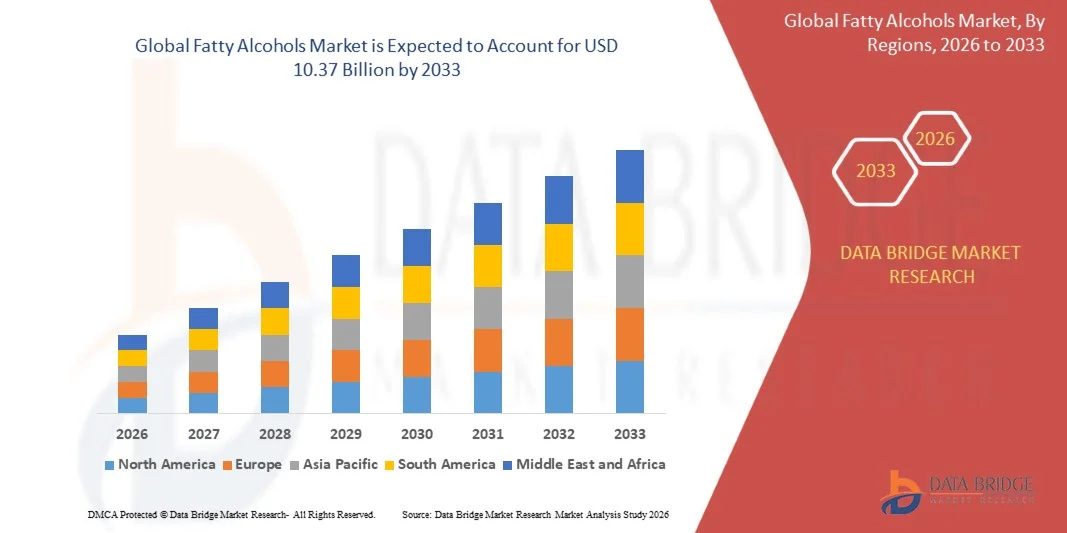
As per Data Bridge Market Research analysis the fatty alcohols market was valued at USD 6.94 billion in 2025 and is projected to reach USD 10.37 billion by 2033, growing at a CAGR of 5.15% from 2026 to 2033. The market is experiencing consistent growth driven by increasing demand for bio-based surfactants, rising consumption of personal care and hygiene products, and expanding applications across soaps & detergents, cosmetics, lubricants, and industrial formulations.
The growing consumer preference for sustainable and biodegradable ingredients, coupled with increasing expenditure on personal care products and supportive regulations promoting renewable chemicals, is encouraging manufacturers to expand oleochemical production and develop eco-friendly formulations. In addition, the rising demand for household and industrial cleaning products, along with the increasing use of fatty alcohols in surfactants and specialty chemical applications, continues to strengthen market growth globally.
Market Size & Forecast
- Global Market Value (2025): USD 6.94 Billion
- Expected Market Value (2033): USD Billion
- Forecast CAGR (2026–2033): 5.15%
- Leading Region in 2025: Asia Pacific
- Fastest Growing Region: Europe
Key Market Trends & Insights
- Asia-Pacific dominated the fatty alcohols market with the largest revenue share of 40.7% in 2025, supported by strong oleochemical production capacity, abundant palm kernel and coconut oil feedstocks, and robust demand from personal care, detergents, and industrial applications
- The C11-C14 segment led the market with a 45.50% share in 2025, driven by its extensive application in surfactant manufacturing, detergents, cleaners, and personal care formulations.
- Europe fatty alcohols market is expected to register a CAGR of 5.2% from 2026 to 2033, driven by increasing demand for sustainable and bio-based ingredients, stringent environmental regulations, and growing adoption of renewable oleochemicals
- C15-C22 are the fastest-growing product type, projected to register a CAGR of 6.7%, reflecting the surge in adoption in premium personal care, cosmetics, pharmaceuticals, and specialty chemical applications
- The pure and midcut segment dominated the type category with a 50.55% revenue share in 2025, led by extensive utilization across detergents, surfactants, personal care, and industrial applications.
- Detergents and cleaners accounted for 35.40% of the market, preferred by extensive use of fatty alcohols as key raw materials for surfactant production
- The cosmetics and personal care segment is the fastest-growing application category, with a CAGR of 7.8%, driven by increasing consumer demand for natural, sustainable, and skin-friendly ingredients.
Report Scope and Fatty Alcohols Market Segmentation
|
Attributes |
Fatty Alcohols Key Market Insights |
|
Segments Covered |
|
|
Countries Covered |
North America
Europe
Asia-Pacific
Middle East and Africa
South America
|
|
Key Market Players |
|
|
Market Opportunities |
|
|
Value Added Data Infosets |
In addition to the insights on market scenarios such as market value, growth rate, segmentation, geographical coverage, and major players, the market reports curated by the Data Bridge Market Research also include import export analysis, production capacity overview, production consumption analysis, price trend analysis, climate change scenario, supply chain analysis, value chain analysis, raw material/consumables overview, vendor selection criteria, PESTLE Analysis, Porter Analysis, and regulatory framework. |
Fatty Alcohols Market Trends
Trend: Rising Preference for Bio-based and Sustainable Fatty Alcohols
Growing concerns over the environmental impact of petroleum-derived products are accelerating the shift toward sustainable alternatives across multiple industries. Increasing consumer preference for bio-based products is encouraging manufacturers to incorporate eco-friendly ingredients into their formulations. Fatty alcohols produced from bio-based oleochemicals are gaining traction due to their lower toxicity, recyclability, and favorable environmental profile compared to conventional petroleum-based substitutes. These products are witnessing strong demand from the personal care and pharmaceutical sectors owing to their minimal side effects and compatibility with sustainable product development initiatives. Industry participants are expanding their renewable product portfolios, with Wilmar International offering WILFAROL 1698, derived from palm oil and palm kernel oil, while KLK OLEO markets vegetable oil-based fatty alcohols under the PALMEROL brand. In addition, regulatory frameworks such as REACH are promoting the use of environmentally responsible ingredients, further supporting market expansion.
The increasing adoption of renewable feedstocks, growing consumer preference for sustainable formulations, and supportive environmental regulations are collectively strengthening demand for bio-based fatty alcohols, positioning sustainability as a key long-term growth driver for the global fatty alcohols market.
Fatty Alcohols Market Dynamics
Key Market Driver: Increasing Adoption of Natural and Sustainably Sourced Ingredients
The growing global preference for environmentally responsible products is significantly influencing the fatty alcohols market. Consumers are increasingly seeking products that are natural, biodegradable, and sustainably sourced, driven by rising environmental awareness and more stringent regulations governing petrochemical-based ingredients. As fatty alcohols are produced from renewable fats and oils, they are widely recognized as effective alternatives to synthetic surfactants and emulsifiers across a range of applications.. The continued growth of clean beauty brands and environmentally conscious purchasing behavior is reinforcing sustainability as a key factor driving demand for fatty alcohol-based formulations. For instance, KLK OLEO offers its PALMEROL range of vegetable-based fatty alcohols for skin care, hair care, toiletries, and home care applications, promoting renewable, environmentally friendly ingredients for sustainable personal care formulations.
As consumer demand for clean-label, biodegradable, and sustainably sourced ingredients continues to rise, fatty alcohols are becoming increasingly important in personal care and home care formulations, strengthening their role as a preferred renewable alternative to petrochemical-derived ingredients.
Key Restraint/Challenge: Supply Chain Uncertainty Due to Raw Material Price Volatility
The fatty alcohols market is challenged by fluctuations in the prices and availability of renewable feedstocks such as palm kernel oil and palm oil, which are key raw materials for oleochemical-based fatty alcohol production. Since feedstock costs represent a major component of fatty alcohol manufacturing expenses, price volatility creates uncertainty for producers and can affect pricing strategies across the value chain. For instance, in March 2024, the Roundtable on Sustainable Palm Oil (RSPO) reported that climate-related disruptions, including the impact of El Niño conditions, were affecting palm oil production levels in key producing regions. Industry participants highlighted concerns regarding tightening palm oil supplies and increasing raw material costs, which could influence the availability and pricing of oleochemical feedstocks used in fatty alcohol manufacturing.
This development demonstrates how weather-related disruptions and supply imbalances in major palm oil-producing regions can create feedstock availability challenges and cost pressures for oleochemical manufacturers, potentially affecting the production economics and supply stability of palm-derived fatty alcohols.
Key Market Opportunity: Advancements in Bio-based Fatty Alcohol Production Technologies
The increasing focus on renewable chemical production is creating new opportunities for fatty alcohol manufacturers as industries seek sustainable alternatives to petroleum-derived ingredients. Research advancements in biotechnology and oleochemical processing are enabling the development of bio-based fatty alcohols from renewable sources, supporting applications in personal care, cosmetics, detergents, and specialty chemicals. The transition toward environmentally friendly ingredients, driven by sustainability goals and demand for biodegradable materials, is expected to accelerate the adoption of renewable fatty alcohol solutions. A research article published in Bioresource Technology Reports demonstrated the production of fatty alcohols from renewable biological sources by engineering Yarrowia lipolytica strains to directly convert glucose into industrially relevant fatty alcohols, including hexadecanol, heptadecanol, octadecanol, and oleyl alcohol. The study highlighted the potential of engineered microorganisms as sustainable platforms for producing fatty alcohols without relying solely on conventional oil-based feedstocks.
This research demonstrates the potential for alternative bio-based production pathways to diversify fatty alcohol supply chains and create growth opportunities as industries increasingly shift toward renewable and sustainable ingredient solutions.
Fatty Alcohols Market Scope
The fatty alcohols market is segmented on the basis of product, type, and application.
- By Product
On the basis of product, the fatty alcohols market is segmented into C6-C10, C11-C14, and C15-C22. The C11-C14 segment dominated the market with 45.50% revenue share in 2025, owing to its extensive application in surfactant manufacturing, detergents, cleaners, and personal care formulations. These medium-chain fatty alcohols are widely preferred due to their favorable chemical properties and compatibility with various formulations. They are key raw materials for producing surfactants used in household and industrial cleaning products. Increasing demand for shampoos, soaps, and hygiene products is further supporting segment growth. Their balanced chain length provides effective emulsification and cleansing properties, making them suitable for consumer product applications. Growing consumption of personal care and home care products globally continues to strengthen the dominance of this segment. A research article published in Industrial & Engineering Chemistry Research highlighted that C12-C14 fatty alcohols are widely utilized as feedstocks for surfactant production due to their surface-active properties, supporting their extensive use in detergent and personal care formulations.
The C15-C22 segment is projected to be the fastest-growing product segment, registering an estimated CAGR of 6.7% during the forecast period. This growth is driven by increasing adoption in premium personal care, cosmetics, pharmaceuticals, and specialty chemical applications. Long-chain fatty alcohols provide superior emollient, thickening, and conditioning properties, making them valuable ingredients in skincare and haircare formulations. Rising consumer preference for natural and multifunctional cosmetic ingredients is increasing their demand across beauty and personal care products. These fatty alcohols are also utilized in lubricants, plasticizers, and specialty chemical applications due to their stability and performance characteristics. Expansion of clean beauty products and sustainable cosmetic formulations is further supporting segment growth. A review published in Cosmetics highlighted that long-chain fatty alcohols, including cetyl alcohol and stearyl alcohol, are widely used in cosmetic formulations as emollients, viscosity modifiers, and stabilizing agents due to their skin-conditioning properties.
- By Type
On the basis of type, the fatty alcohols market is segmented into short chain, pure and midcut, long chain, and higher chain fatty alcohols. The pure and midcut segment dominated the market with an estimated share of 50.55% in 2025, supported by extensive utilization across detergents, surfactants, personal care, and industrial applications. These fatty alcohols offer consistent purity levels and performance characteristics required for large-scale commercial formulations. They are widely used in producing surfactants because of their excellent compatibility with other chemical ingredients. Increasing demand for household cleaners and personal care products is driving consumption of pure and midcut grades. Manufacturers prefer these grades due to their reliable quality, availability, and processing efficiency. Their broad application base across consumer and industrial sectors continues to support segment dominance. BASF Personal Care Solutions highlights the use of fatty alcohols as emollients, consistency enhancers, and formulation ingredients in personal care applications, demonstrating the importance of purified fatty alcohol grades in cosmetic manufacturing.
The long chain and higher chain segment is projected to register the fastest growth, with an estimated CAGR of 6.7% during the forecast period. The segment growth is driven by increasing demand from cosmetics, pharmaceuticals, lubricants, and specialty chemical industries. These fatty alcohols offer superior moisturizing, thickening, and stabilizing characteristics compared with shorter-chain alternatives. Growing adoption of sustainable oleochemical ingredients in personal care formulations is strengthening demand for long-chain variants. Their excellent lubrication properties are also supporting their use in industrial applications. Increasing demand for premium skincare and haircare products is further contributing to segment expansion. Research published in the Journal of Oleo Science reported that long-chain fatty alcohols are important oleochemical intermediates used in cosmetics, surfactants, lubricants, and specialty chemical applications because of their functional characteristics.
- By Application
On the basis of application, the fatty alcohols market is segmented into detergents and cleaners, cosmetics and personal care, lubricants, plasticizers, pharmaceuticals, food and nutrition, and others. The detergents and cleaners segment dominated the market with 35.40% revenue share in 2025, driven by extensive use of fatty alcohols as key raw materials for surfactant production. Fatty alcohol derivatives are essential components in household detergents, laundry products, dishwashing formulations, and industrial cleaners. Increasing hygiene awareness and rising demand for cleaning products are strengthening segment growth. Their biodegradability and compatibility with environmentally friendly formulations are further increasing adoption. Growing industrial cleaning requirements across manufacturing and institutional sectors are also supporting demand. The segment remains a major revenue contributor due to widespread use of surfactant-based products globally. The American Cleaning Institute explains that fatty alcohol ethoxylates, produced from fatty alcohol feedstocks, are widely used as surfactants in household and industrial cleaning products due to their cleaning efficiency and formulation benefits.
The cosmetics and personal care segment is projected to witness the fastest growth, registering an estimated CAGR of 7.8% during the forecast period. The segment growth is supported by increasing consumer demand for natural, sustainable, and skin-friendly ingredients. Fatty alcohols are widely used in creams, lotions, shampoos, conditioners, and skincare products due to their emollient, thickening, and stabilizing properties. Growing preference for clean beauty formulations is encouraging manufacturers to adopt renewable fatty alcohol-based ingredients. Rising disposable income and expanding personal care markets in emerging economies are further accelerating demand. Their non-toxic and skin-conditioning characteristics make them suitable for premium cosmetic formulations. A review article published in Cosmetics stated that fatty alcohols such as cetyl alcohol and stearyl alcohol are frequently used in cosmetic formulations as emollients, stabilizers, and viscosity modifiers, supporting their increasing adoption in personal care products.
Fatty Alcohols Market Regional Analysis
Asia-Pacific dominated the fatty alcohols market with the largest revenue share of 40.7% in 2025, supported by strong oleochemical production capacity, abundant palm kernel and coconut oil feedstocks, and robust demand from personal care, detergents, and industrial applications. The region benefits from the presence of major fatty alcohol manufacturers, expanding chemical processing infrastructure, and increasing consumption of sustainable ingredients across consumer industries. Growing demand for cosmetics, skincare, and household cleaning products in China, India, Indonesia, and other emerging economies is accelerating market development. Increasing adoption of bio-based oleochemicals, renewable raw materials, and environmentally friendly surfactant formulations is further strengthening regional growth. Rising investments in sustainable chemical production and expansion of personal care manufacturing capabilities continue to support Asia Pacific’s leadership position in the global market.
North America Fatty Alcohols Market Insight
The North America fatty alcohols market is witnessing significant growth due to increasing demand for sustainable ingredients, expanding personal care and cosmetics applications, and rising adoption of bio-based surfactants. The region benefits from a well-established chemical industry, advanced manufacturing capabilities, and increasing utilization of fatty alcohol derivatives in detergents, pharmaceuticals, lubricants, and specialty chemicals. Growing consumer preference for natural and biodegradable ingredients, along with increasing focus on renewable raw materials, is accelerating the adoption of fatty alcohol-based formulations across various end-use industries. In addition, rising investments in sustainable chemical production and clean-label product development are supporting market expansion throughout North America. According to the American Cleaning Institute, fatty alcohol ethoxylates, which are derived from fatty alcohol feedstocks, are widely used as surfactants in household and industrial cleaning products due to their effective cleaning properties and compatibility with modern sustainable formulations. This highlights the strong application base of fatty alcohol derivatives in North America’s cleaning and consumer product industries.
U.S. Fatty Alcohols Market Insight
The U.S. fatty alcohols market is witnessing steady growth due to increasing demand for sustainable ingredients, expanding personal care applications, and rising utilization of bio-based surfactants. The country’s developed chemical manufacturing ecosystem, along with growing adoption of renewable oleochemical solutions, is driving demand across cosmetics, detergents, pharmaceuticals, and specialty chemical applications. In addition, increasing consumer preference for natural and biodegradable ingredients, coupled with rising demand for clean-label formulations, is accelerating the adoption of fatty alcohol-based products across personal care and household industries. According to the American Cleaning Institute, fatty alcohol ethoxylates, which are produced from fatty alcohol feedstocks, are widely used as surfactants in household and industrial cleaning products due to their effective cleaning performance, formulation flexibility, and compatibility with sustainable product development.
Europe Fatty Alcohols Market Insight
The Europe fatty alcohols market remains a significant contributor to global demand, driven by increasing adoption of renewable chemicals, strict environmental regulations, and high demand for sustainable personal care and cleaning ingredients. The widespread use of fatty alcohols in cosmetics, detergents, pharmaceuticals, and specialty chemical formulations is supporting market expansion across the region. Increasing investments in bio-based oleochemical solutions, coupled with regulatory emphasis on reducing dependence on petroleum-derived chemicals, continue to enhance the adoption of fatty alcohol products throughout Europe. The European Chemicals Agency (ECHA) under the REACH framework promotes the assessment and safer management of chemical substances, encouraging industries to adopt sustainable and environmentally responsible chemical alternatives. This regulatory environment supports the increasing use of renewable oleochemical-based ingredients such as fatty alcohols.
U.K. Fatty Alcohols Market Insight
The U.K. fatty alcohols market is experiencing gradual growth, supported by rising adoption of sustainable cosmetic ingredients, biodegradable surfactants, and renewable chemical solutions. Increasing demand for fatty alcohols in skincare, haircare, pharmaceutical, and household cleaning formulations is contributing to market development. Furthermore, the growing clean beauty movement, increasing preference for naturally derived ingredients, and regulatory focus on sustainable product formulations are improving fatty alcohol adoption across the U.K. personal care and consumer goods industries. A research review published in the journal Cosmetics reported that fatty alcohols such as cetyl alcohol and stearyl alcohol are extensively used in cosmetic formulations as emollients, viscosity modifiers, and stabilizing agents due to their skin-conditioning properties.
Germany Fatty Alcohols Market Insight
The Germany fatty alcohols market is expanding steadily due to the country’s strong chemical manufacturing base, advanced research capabilities, and increasing adoption of sustainable oleochemical ingredients. Chemical manufacturers and personal care companies are increasingly utilizing fatty alcohols in surfactants, emulsifiers, lubricants, and specialty formulations. Continuous advancements in renewable chemical production, along with strong environmental sustainability initiatives and demand for biodegradable ingredients, are further driving fatty alcohol market growth in Germany. The German Chemical Industry Association (VCI) reported that Germany’s chemical sector is increasingly focusing on sustainable production methods, renewable raw materials, and resource-efficient processes to reduce environmental impact and improve chemical sustainability.
Japan Fatty Alcohols Market Insight
The Japan fatty alcohols market is witnessing consistent growth due to increasing demand for high-quality cosmetic ingredients, specialty chemicals, and sustainable formulation solutions. Japanese personal care manufacturers and chemical companies are increasingly adopting fatty alcohols for skincare, haircare, pharmaceutical, and surfactant applications because of their emollient, stabilizing, and emulsifying properties. Moreover, increasing focus on renewable ingredients, advanced chemical processing technologies, and environmentally responsible product development is further supporting market growth in Japan. A study published in the Journal of Oleo Science evaluated long-chain fatty alcohol properties and highlighted their importance as oleochemical intermediates for applications including cosmetics, surfactants, and specialty chemical formulations.
China Fatty Alcohols Market Insight
The China fatty alcohols market is growing rapidly, driven by expanding personal care manufacturing, increasing detergent consumption, and rising demand for sustainable surfactant ingredients. The country’s large consumer base, growing cosmetics industry, and expanding chemical production infrastructure are supporting fatty alcohol adoption across multiple applications. In addition, increasing investments in renewable oleochemical production, rising awareness regarding environmentally friendly formulations, and growing demand for bio-based ingredients are positioning China as one of the key growth markets for fatty alcohols globally. According to Wilmar International, its WILFAROL fatty alcohol range is produced from palm oil and palm kernel oil and is used in personal care and home care formulations. The commercial availability of palm-based fatty alcohol products highlights the importance of renewable oleochemical feedstocks in China and the broader Asia-Pacific supply chain.
Fatty Alcohols Market Share
The fatty alcohols industry is primarily led by well-established companies, including:
- Wilmar International Limited (Singapore)
- KLK OLEO (Malaysia)
- Emery Oleochemicals (Malaysia)
- BASF (Germany)
- Croda International Plc (U.K.)
- Kao Corporation (Japan)
- Ecogreen Oleochemicals (Singapore)
- Sasol Limited (South Africa)
- Musim Mas Holdings Pte. Ltd. (Singapore)
- Godrej Industries Limited (India)
- VVF LLC (U.S.)
- P&G Chemicals (U.S.)
- Oleon NV (Belgium)
- Evonik Operations GmbH (Germany)
- Kraton Corporation (U.S.)
- Jarchem Innovative Ingredients LLC (U.S.)
- SABIC (Saudi Arabia)
- Exxon Mobil Corporation (U.S.)
- The Dow Chemical Company (U.S.)
- Shell plc (U.K.)
Latest Developments in Fatty Alcohols Market
- In November 2024, BASF and Acies Bio announced a partnership to develop a biotechnology-based platform for sustainable fatty alcohol production. The collaboration focuses on using Acies Bio’s synthetic biology platform to convert renewable methanol into fatty alcohols through fermentation technology. BASF stated that the initiative aims to diversify raw material sources and develop more sustainable production routes for fatty alcohols used in home care and personal care surfactant applications
- In April 2024, BASF showcased new sustainable personal care ingredient solutions at in-cosmetics Global 2024, focusing on renewable raw materials and improved product carbon footprint transparency. The company presented solutions under its Care 360° sustainability initiative, supporting personal care manufacturers in developing environmentally responsible formulations
- In October 2023, KLK OLEO introduced its sustainable personal care ingredient portfolio at in-cosmetics Asia 2023, highlighting renewable-based ingredients and formulation solutions. The company showcased ingredients designed for skin and hair care applications, including sustainable emollients, surfactants, viscosity modifiers, and formulation enhancers. The development demonstrates the growing integration of renewable oleochemical ingredients, including fatty alcohol derivatives, into personal care product development.
- In June 2023, KLK OLEO introduced its expanded portfolio of bio-based specialty chemicals, including PALMEROL fatty alcohols, at Inter Lubric China 2023. The company highlighted PALMEROL fatty alcohols as renewable oleochemical solutions suitable for applications such as metalworking fluids and specialty formulations. The product portfolio expansion reflects increasing demand for sustainable fatty alcohol derivatives in industrial and lubricant applications
- In September 2022, BASF announced an innovation partnership with RiKarbon Inc. to develop bio-based emollients from waste-derived carbon sources for personal care applications. The partnership focused on scaling RiKarbon’s patented technology that converts bio-waste into renewable and biodegradable emollient ingredients. BASF planned to integrate the technology into its Personal Care portfolio to provide sustainable alternatives for cosmetic formulations

- Interactive Data Analysis Dashboard
- Company Analysis Dashboard for high growth potential opportunities
- Research Analyst Access for customization & queries
- Competitor Analysis with Interactive dashboard
- Latest News, Updates & Trend analysis
- Harness the Power of Benchmark Analysis for Comprehensive Competitor Tracking
Global Fatty Alcohol Market, Supply Chain Analysis and Ecosystem Framework
To support market growth and help clients navigate the impact of geopolitical shifts, DBMR has integrated in-depth supply chain analysis into its Global Fatty Alcohol Market research reports. This addition empowers clients to respond effectively to global changes affecting their industries. The supply chain analysis section includes detailed insights such as Global Fatty Alcohol Market consumption and production by country, price trend analysis, the impact of tariffs and geopolitical developments, and import and export trends by country and HSN code. It also highlights major suppliers with data on production capacity and company profiles, as well as key importers and exporters. In addition to research, DBMR offers specialized supply chain consulting services backed by over a decade of experience, providing solutions like supplier discovery, supplier risk assessment, price trend analysis, impact evaluation of inflation and trade route changes, and comprehensive market trend analysis.
Data collection and base year analysis are done using data collection modules with large sample sizes. The stage includes obtaining market information or related data through various sources and strategies. It includes examining and planning all the data acquired from the past in advance. It likewise envelops the examination of information inconsistencies seen across different information sources. The market data is analysed and estimated using market statistical and coherent models. Also, market share analysis and key trend analysis are the major success factors in the market report. To know more, please request an analyst call or drop down your inquiry.
The key research methodology used by DBMR research team is data triangulation which involves data mining, analysis of the impact of data variables on the market and primary (industry expert) validation. Data models include Vendor Positioning Grid, Market Time Line Analysis, Market Overview and Guide, Company Positioning Grid, Patent Analysis, Pricing Analysis, Company Market Share Analysis, Standards of Measurement, Global versus Regional and Vendor Share Analysis. To know more about the research methodology, drop in an inquiry to speak to our industry experts.
Data Bridge Market Research is a leader in advanced formative research. We take pride in servicing our existing and new customers with data and analysis that match and suits their goal. The report can be customized to include price trend analysis of target brands understanding the market for additional countries (ask for the list of countries), clinical trial results data, literature review, refurbished market and product base analysis. Market analysis of target competitors can be analyzed from technology-based analysis to market portfolio strategies. We can add as many competitors that you require data about in the format and data style you are looking for. Our team of analysts can also provide you data in crude raw excel files pivot tables (Fact book) or can assist you in creating presentations from the data sets available in the report.













