What is the Feather Meal Size and Growth Rate?
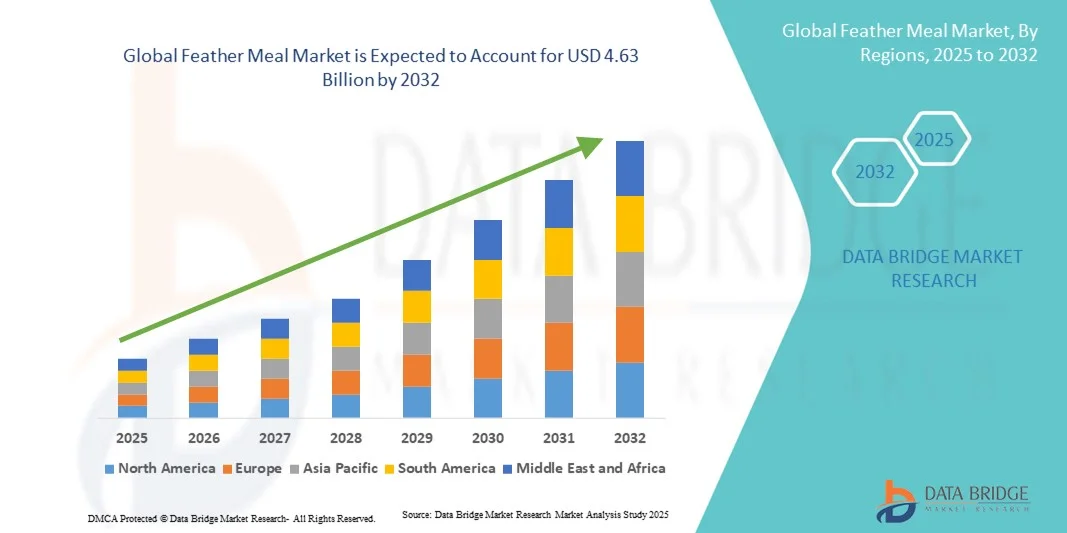
- As per Data Bridge Market Research Analysis the global feather meal market size was valued at USD 3.06 billion in 2024 and is expected to reach USD 4.63 billion by 2032, at a CAGR of 5.30% during the forecast period
- The market growth is largely fuelled by the increasing demand for high-protein animal feed, rising poultry production, and the growing adoption of organic fertilizers in agriculture
- Feather meal, being rich in nitrogen and essential amino acids, is widely used in poultry feed, livestock nutrition, and as a soil amendment, driving consistent demand globally
Market Size & Forecast
- Global Market Value (2024): USD 3.06 billion
- Expected Market Value (2032): USD 4.63 billion
- Forecast CAGR (2024–2032): 5.30%
What are the Major Takeaways of Feather Meal?
- The global feather meal market is witnessing steady growth driven by the rising demand for high-protein feed in the livestock and poultry sectors. Feather meal serves as a cost-effective and nutrient-rich protein source, which enhances animal growth and overall productivity
- Increasing awareness about sustainable and organic fertilizers is further boosting the adoption of feather meal in agriculture, as it provides essential nitrogen and amino acids to the soil while reducing dependence on synthetic fertilizers
- North America dominated the feather meal market with the largest revenue share of 38.5% in 2024, driven by a growing demand for high-protein livestock and poultry feed, as well as increasing adoption of sustainable and cost-effective feed ingredients
- Asia-Pacific region is expected to witness the highest growth rate in the global feather meal market, driven by rising livestock production, growing adoption of alternative protein sources, and expanding feed manufacturing capabilities in countries such as China, Thailand, and Vietnam
- The Conventional segment held the largest market revenue share in 2024, driven by its widespread availability, cost-effectiveness, and consistent protein content for livestock and poultry feed. Conventional feather meal is widely used in large-scale commercial feed operations, providing a reliable and efficient source of amino acids
Report Scope and Feather Meal Market Segmentation
|
Attributes |
Feather Meal Key Market Insights |
|
Segments Covered |
|
|
Countries Covered |
North America
Europe
Asia-Pacific
Middle East and Africa
South America
|
|
Key Market Players |
|
|
Market Opportunities |
|
|
Value Added Data Infosets |
|
What is the Key Trend in the Feather Meal?
Increasing Utilization of Feather Meal in Livestock and Poultry Feed
- The growing adoption of feather meal as a high-protein supplement is transforming the animal feed landscape by providing an economical and sustainable protein source. Its high digestibility and amino acid content allow for improved growth and productivity, particularly in poultry and livestock diets, while also reducing the environmental impact of conventional protein sources. This leads to enhanced feed efficiency and lower production costs, making it a preferred option for feed manufacturers globally
- The rising demand for alternative protein sources in regions with expanding livestock production is accelerating the use of feather meal in feed formulations. Feed manufacturers are actively seeking cost-effective, nutrient-rich ingredients to optimize animal performance while reducing reliance on conventional protein sources such as soybean meal or fish meal. This trend is further reinforced by increasing awareness of sustainable feed practices among farmers and industry stakeholders
- Feather meal's ease of storage, long shelf life, and stable nutritional profile make it attractive for large-scale feed operations, enabling consistent feed quality throughout the production cycle. Farmers benefit from improved herd health, higher meat, milk, and egg yields, and lower feed wastage. This reliability drives consistent demand for feather meal in both emerging and mature markets
- For instance, in 2023, several poultry farms in Southeast Asia reported improved weight gain, feed conversion ratios, and overall livestock performance after incorporating feather meal into feed formulations. The outcome included lower feed costs, enhanced profitability, and a positive impact on local supply chains
- While feather meal adoption is increasing, the market’s growth depends on maintaining consistent quality, adherence to processing standards, and compliance with regulatory frameworks. Ensuring safe and effective utilization across diverse livestock sectors is critical to sustaining long-term industry expansion
Feather Meal Market Dynamics
Driver
Rising Demand for High-Protein Livestock and Poultry Feed
- The increasing need for high-protein feed in livestock and poultry is pushing feed manufacturers to incorporate feather meal as a preferred supplement. Its rich amino acid profile supports rapid growth, better feed conversion, and improved production efficiency, meeting the nutritional needs of modern animal husbandry practices. In addition, feather meal helps reduce dependency on conventional protein sources, contributing to more sustainable feed formulations
- Farmers are increasingly aware of the cost-effectiveness, sustainability, and consistent nutritional content of feather meal compared to conventional protein sources such as soybean or fish meal, which drives adoption in feed formulations. The ability to reduce feed costs while maintaining or improving productivity is a major market incentive, and this also helps small and medium-scale farmers compete more effectively in the market
- Regulatory and industry standards promoting safe, sustainable, and environmentally responsible feed practices are further encouraging the use of feather meal in commercial feed operations. Compliance with food safety standards, animal welfare regulations, and sustainability certifications strengthens market confidence in feather meal-based feeds. This also facilitates exports to regions with strict quality standards
- For instance, in 2022, several large-scale poultry producers in India and Brazil integrated feather meal into standard feed programs, boosting demand across feed manufacturing sectors. The move also encouraged investment in better feather collection, processing infrastructure, and supply chain management to ensure a reliable and consistent raw material supply
- While growing protein demand drives market expansion, manufacturers must focus on high-quality processing, consistent supply, and nutritional optimization to maintain long-term adoption and market trust. Innovations in enzymatic treatments and blending technologies are also expected to enhance digestibility and feed efficiency, supporting further market growth
Restraint/Challenge
High Processing Costs and Variability in Raw Material Quality
- The processing of feathers into safe, digestible meal requires specialized equipment, high-temperature rendering, and energy-intensive methods. This increases production costs and limits availability for small-scale or emerging producers, affecting regional market penetration. Furthermore, energy price fluctuations and maintenance costs of processing facilities add additional financial burden
- Variability in raw feather quality, influenced by bird species, age, and processing conditions, can impact nutrient content, leading to inconsistent feed performance. This poses challenges for large-scale feed formulators who rely on standardized protein content to achieve predictable livestock growth outcomes. Inconsistent quality can also affect animal health, prompting stricter testing and quality assurance protocols
- Limited access to feather collection, transportation, and processing infrastructure in certain regions restricts market growth and delays supply chain operations. Without reliable logistics and processing networks, consistent supply to feed manufacturers is challenging. Remote or rural production zones often face additional barriers such as seasonal availability and lack of storage facilities, exacerbating supply inconsistencies
- For instance, in 2023, several poultry processing units in Sub-Saharan Africa reported production inefficiencies, higher costs, and feed formulation delays due to insufficient feather collection systems and inadequate processing facilities. These challenges limited the ability of producers to scale operations and meet rising demand for high-protein feed
- While feather meal remains a high-demand protein source, addressing processing efficiency, quality standardization, and strengthening collection and supply chain infrastructure is essential for sustained global market growth and wider adoption. Investments in mobile processing units, training programs, and cooperative collection systems can help overcome these barriers and unlock new regional opportunities
How is the Feather Meal Segmented?
The market is segmented on the basis of nature, crude protein content, end use, and distribution channel.
- By Nature
On the basis of nature, the feather meal market is segmented into Organic and Conventional. The Conventional segment held the largest market revenue share in 2024, driven by its widespread availability, cost-effectiveness, and consistent protein content for livestock and poultry feed. Conventional feather meal is widely used in large-scale commercial feed operations, providing a reliable and efficient source of amino acids.
The Organic segment is expected to witness the fastest growth rate from 2025 to 2032, fueled by increasing consumer demand for sustainable and chemical-free animal products. Organic feather meal is preferred in premium feed formulations and organic livestock farms, supporting environmentally responsible and health-conscious farming practices.
- By Crude Protein Content
On the basis of crude protein content, the market is segmented into 75-80%, 80-90%, and More than 90%. The 80-90% segment accounted for the largest revenue share in 2024, owing to its balanced amino acid profile and digestibility, making it suitable for most livestock and poultry feed formulations.
The More than 90% segment is expected to witness the fastest growth rate from 2025 to 2032, driven by the rising demand for highly concentrated protein sources in specialized feed applications. High-protein feather meal supports rapid growth, enhanced feed conversion ratios, and optimized production efficiency.
- By End Use
On the basis of end use, the feather meal market is segmented into Animal Feed, Organic Fertilizers, Agrochemical, and Others. The Animal Feed segment dominated the market in 2024 due to its extensive application in poultry, livestock, and aquaculture feed, where high-protein content is critical for growth and productivity.
The Organic Fertilizers segment is expected to witness the fastest growth rate from 2025 to 2032, as sustainable agriculture and eco-friendly farming practices gain traction globally. Feather meal as a fertilizer enhances soil nutrient content and promotes crop growth, providing dual benefits of waste utilization and sustainable farming.
- By Distribution Channel
On the basis of distribution channel, the market is segmented into B2B and B2C. The B2B segment held the largest share in 2024, fueled by strong demand from feed manufacturers, poultry farms, and large agribusinesses requiring bulk supply and consistent quality.
The B2C segment is expected to witness the fastest growth rate from 2025 to 2032, driven by small-scale farmers and organic livestock producers seeking convenient, ready-to-use feather meal products. Online platforms and direct-to-farm sales are further supporting the expansion of B2C distribution.
Which Region Holds the Largest Share of the Feather Meal?
- North America dominated the feather meal market with the largest revenue share of 38.5% in 2024, driven by a growing demand for high-protein livestock and poultry feed, as well as increasing adoption of sustainable and cost-effective feed ingredients
- Feed manufacturers and farmers in the region highly value feather meal for its high amino acid content, digestibility, and ability to enhance growth and productivity in poultry and livestock operations
- This widespread adoption is further supported by well-established feed processing infrastructure, technological advancements in animal nutrition, and rising awareness of sustainable feed practices, establishing feather meal as a preferred protein source across commercial farms
U.S. Feather Meal Market Insight
The U.S. feather meal market captured the largest revenue share in 2024 within North America, fueled by the rapid expansion of poultry and livestock production and increasing demand for cost-effective, high-protein feed supplements. Farmers are prioritizing feed efficiency and nutritional optimization, which drives consistent adoption of feather meal. In addition, investments in processing and rendering facilities are improving product quality and availability, supporting market growth.
Europe Feather Meal Market Insight
The Europe feather meal market is expected to witness the fastest growth rate from 2025 to 2032, primarily driven by regulatory focus on sustainable feed practices and the growing demand for protein-rich animal feed. Increased urbanization, modernization of livestock farms, and adoption of alternative protein sources are fostering market growth. European feed manufacturers are also exploring innovative processing methods to enhance nutrient bioavailability and feed efficiency.
U.K. Feather Meal Market Insight
The U.K. feather meal market is expected to witness the fastest growth rate from 2025 to 2032, driven by rising poultry and livestock production and a shift toward cost-efficient, high-protein feed supplements. Government initiatives supporting sustainable agriculture and animal nutrition, coupled with increasing awareness among farmers regarding feed quality, are stimulating market adoption. The availability of processed feather meal with standardized protein content is further strengthening market penetration.
Germany Feather Meal Market Insight
The Germany feather meal market is expected to witness the fastest growth rate from 2025 to 2032, fueled by increasing livestock production, high demand for quality feed ingredients, and technological advancements in rendering processes. German feed manufacturers are focusing on producing nutrient-dense, safe, and standardized feather meal to meet both domestic and export requirements. The emphasis on sustainability and biosecurity further drives adoption across commercial livestock and poultry farms.
Asia-Pacific Feather Meal Market Insight
The Asia-Pacific feather meal market is expected to witness the fastest growth rate from 2025 to 2032, driven by rising poultry and livestock production in countries such as India, China, and Southeast Asian nations. Growing population, increasing meat consumption, and demand for high-quality animal feed are propelling market growth. Government initiatives promoting sustainable feed practices and investments in processing infrastructure are further boosting availability and adoption.
Japan Feather Meal Market Insight
The Japan feather meal market is expected to witness the fastest growth rate from 2025 to 2032 due to the country’s high emphasis on poultry and livestock productivity, coupled with rising consumer demand for safe and nutritious animal products. Feed manufacturers are integrating feather meal into standard feed formulations to improve growth rates and feed efficiency. The focus on sustainable and cost-effective protein sources is encouraging long-term adoption across commercial poultry and livestock farms.
China Feather Meal Market Insight
The China feather meal market accounted for the largest market revenue share in Asia-Pacific in 2024, driven by rapid expansion of poultry and livestock farming and growing protein feed demand. Feather meal is increasingly preferred due to its high digestibility, amino acid content, and ability to reduce feed costs. Investments in modern rendering facilities and enhanced processing technologies are ensuring consistent supply and quality, supporting market growth across the country.
Which are the Top Companies in Feather Meal?
The Feather Meal industry is primarily led by well-established companies, including:
- The Boyer Valley Company, Inc. (U.S.)
- FASA (Brazil)
- Sanimax Industries Inc. (Canada)
- APC Company, Inc. (U.S.)
- Apelsa Guadalajara (Mexico)
- Terramar (U.K.)
- West Coast Reduction Ltd. (Canada)
- Valley Proteins, Inc. (U.S.)
- The Fertrell Company (U.S.)
- Agro-industrial Complex Backa Topola LTD (Serbia)
- Easy Gardener Products (U.S.)
- NORDFEED (Denmark)
- Jakom (India)
- SK-PSD (South Korea)
- MoistTech (U.S.)
- Ridley Corporation Limited (Australia)
- Allanasons Pvt Ltd (India)
What are Latest Developments in Feather Meal?
- In January 2024, Darling Ingredients completed the acquisition of Miropasz Group, a Polish rendering company, adding three poultry rendering plants in southeastern Poland with an annual production capacity of 250,000 metric tons of poultry byproducts. This move expanded Darling Ingredients’ feather meal output in Europe and strengthened its regional supply chain, enabling more consistent product availability and meeting growing demand for high-protein feed ingredients
- In May 2022, Darling Ingredients acquired Valley Proteins for USD 1.1 billion, integrating 18 major rendering plants and used cooking oil facilities across the southern, southeastern, and mid-Atlantic regions of the U.S. The acquisition increased feather meal production capacity significantly, allowing the company to serve a larger customer base and enhance operational efficiency
- Also in May 2022, Darling Ingredients acquired FASA Group for USD 560 million, adding 16 rendering plants with an annual processing capacity of 1.3 million metric tons. This expansion bolstered global feather meal production, strengthened Darling Ingredients’ presence in key markets, and supported rising demand for sustainable and high-protein livestock and poultry feed

- Interactive Data Analysis Dashboard
- Company Analysis Dashboard for high growth potential opportunities
- Research Analyst Access for customization & queries
- Competitor Analysis with Interactive dashboard
- Latest News, Updates & Trend analysis
- Harness the Power of Benchmark Analysis for Comprehensive Competitor Tracking
Data collection and base year analysis are done using data collection modules with large sample sizes. The stage includes obtaining market information or related data through various sources and strategies. It includes examining and planning all the data acquired from the past in advance. It likewise envelops the examination of information inconsistencies seen across different information sources. The market data is analysed and estimated using market statistical and coherent models. Also, market share analysis and key trend analysis are the major success factors in the market report. To know more, please request an analyst call or drop down your inquiry.
The key research methodology used by DBMR research team is data triangulation which involves data mining, analysis of the impact of data variables on the market and primary (industry expert) validation. Data models include Vendor Positioning Grid, Market Time Line Analysis, Market Overview and Guide, Company Positioning Grid, Patent Analysis, Pricing Analysis, Company Market Share Analysis, Standards of Measurement, Global versus Regional and Vendor Share Analysis. To know more about the research methodology, drop in an inquiry to speak to our industry experts.
Data Bridge Market Research is a leader in advanced formative research. We take pride in servicing our existing and new customers with data and analysis that match and suits their goal. The report can be customized to include price trend analysis of target brands understanding the market for additional countries (ask for the list of countries), clinical trial results data, literature review, refurbished market and product base analysis. Market analysis of target competitors can be analyzed from technology-based analysis to market portfolio strategies. We can add as many competitors that you require data about in the format and data style you are looking for. Our team of analysts can also provide you data in crude raw excel files pivot tables (Fact book) or can assist you in creating presentations from the data sets available in the report.