


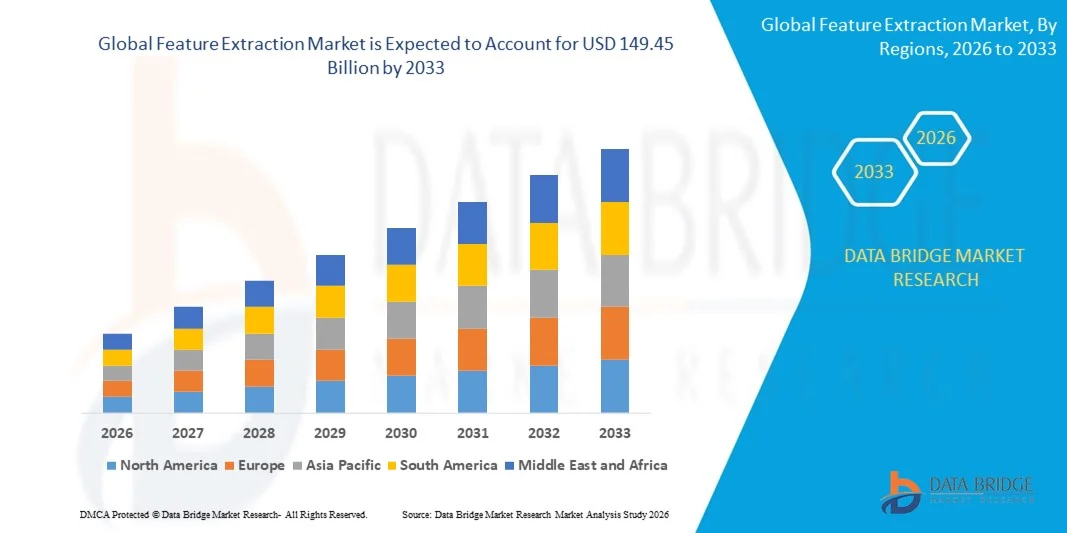
Feature Extraction Market Size
- The global feature extraction market size was valued at USD 10.97 billion in 2025 and is expected to reach USD 149.45 billion by 2033, at a CAGR of 38.60% during the forecast period
- The market growth is largely fuelled by the increasing adoption of AI and machine learning solutions across industries such as healthcare, BFSI, retail, manufacturing, and cybersecurity
- The rising demand for automated data processing and advanced analytics capabilities is further accelerating the market expansion
Feature Extraction Market Analysis
- The market is witnessing rapid advancement due to the increasing use of feature extraction algorithms to streamline high-volume data analysis, enhance model accuracy, and reduce computational load
- In addition, innovations in deep learning, NLP, computer vision, and multimodal data processing are strengthening the adoption of advanced feature extraction solutions across various applications
- North America dominated the feature extraction market with the largest revenue share in 2025, driven by strong adoption of AI, machine learning, and advanced analytics across industries. The region’s early technological maturity and widespread integration of automation tools contribute to its leadership
- Asia-Pacific region is expected to witness the highest growth rate in the global feature extraction market, driven by rising urbanization, strong government support for digitalization, and increasing deployment of AI applications across industries
- The Medical Emergency segment held the largest market revenue share in 2025 due to rising demand for real-time patient monitoring, early detection of critical conditions, and adoption of AI-enabled diagnostic systems in hospitals and clinics
Report Scope and Feature Extraction Market Segmentation
|
Attributes |
Feature Extraction Key Market Insights |
|
Segments Covered |
|
|
Countries Covered |
North America
Europe
Asia-Pacific
Middle East and Africa
South America
|
|
Key Market Players |
|
|
Market Opportunities |
|
|
Value Added Data Infosets |
In addition to the insights on market scenarios such as market value, growth rate, segmentation, geographical coverage, and major players, the market reports curated by the Data Bridge Market Research also include in-depth expert analysis, geographically represented company-wise production and capacity, network layouts of distributors and partners, detailed and updated price trend analysis and deficit analysis of supply chain and demand. |
Feature Extraction Market Trends
Rise of Automation and AI-Enabled Data Processing
- The rapid shift toward automated data processing is transforming the feature extraction landscape by enabling faster, more accurate, and scalable analysis of large and complex datasets. These capabilities support real-time decision-making across industries such as healthcare, finance, retail, and manufacturing, where timely insights are critical
- The increasing demand for efficient data handling in environments with limited computational resources is accelerating the adoption of lightweight and optimized feature extraction frameworks. These tools are particularly valuable where cloud connectivity is limited, helping reduce latency and operational overhead
- The affordability and accessibility of modern AI-based algorithms are making advanced data processing feasible for organizations of different sizes. This encourages more frequent model training and deployment, improving analytical performance and operational efficiency
- For instance, in 2024, several fintech firms in Southeast Asia reported faster fraud-detection responses after implementing real-time feature extraction models that processed transactional data on edge devices, resulting in reduced false positives and improved user experience
- While AI-driven feature extraction tools are improving automation and supporting high-precision analytics, their impact depends on continued innovation, developer training, and cost-effective deployment. Vendors must focus on localized optimization and application-specific solutions to fully capture market demand
Feature Extraction Market Dynamics
Driver
Growing Adoption of AI, ML, and Deep Learning Across Industries
- The widespread use of artificial intelligence and machine learning is pushing enterprises to adopt feature extraction as a core component of their analytical ecosystems. Applications such as computer vision, NLP, predictive analytics, and anomaly detection rely heavily on efficient feature representation, boosting investment in advanced extraction solutions. As data volumes grow exponentially, organizations are prioritizing automated feature engineering to derive meaningful insights at scale
- Businesses are increasingly aware of the operational and financial benefits associated with high-quality feature engineering, such as improved model accuracy, reduced training time, and enhanced automation. This awareness has led to routine integration of feature extraction pipelines even in mid-sized organizations. The shift is further reinforced by the need for faster, more reliable data-driven decision-making in competitive markets
- Public and private sector initiatives are strengthening the adoption of AI tools through funding, infrastructure development, and innovation programs. From cloud credits to national AI missions, supportive frameworks are enabling companies to implement scalable analytical models. These initiatives help reduce implementation barriers and encourage broader usage of advanced extraction technologies
- For instance, in 2023, technology agencies in the United States introduced funding programs to accelerate AI adoption across small enterprises, driving demand for automated feature extraction platforms. Similar programs in Europe and Asia have promoted digital transformation for SMEs, enabling them to access advanced tools previously limited to large corporations. This momentum is significantly expanding the global AI ecosystem
- While industry awareness and institutional support are accelerating adoption, there remains a need to ensure data quality, reduce technical complexity, and enhance model interoperability to maintain consistent market growth. Robust data governance frameworks and standardized protocols are essential to avoid inefficiencies or analytical inaccuracies. Companies must also address integration challenges to fully benefit from feature extraction solutions
Restraint/Challenge
High Computational Requirements and Skill Gaps in Developing and Deploying Feature Extraction Models
- The high computational demands of advanced feature extraction systems, especially deep learning-based models, make them challenging for smaller organizations with limited hardware resources. High-performance GPUs and optimized infrastructure remain costly barriers for widespread deployment. This creates a technological divide, limiting AI adoption in resource-constrained environments
- Many businesses lack personnel trained to build, tune, and integrate complex extraction algorithms. The absence of technical expertise and supporting workflows reduces the ability to fully utilize AI-driven analytics. As a result, organizations face delays, increased costs, and inefficiencies when deploying advanced data processing systems
- Market expansion is also constrained by data management issues, such as inconsistent datasets and underdeveloped pipelines, which hinder extraction accuracy and model reliability. Poor data quality directly impacts model outputs, forcing companies to invest additional time and resources in cleaning and structuring information. These challenges collectively slow down full-scale implementation
- For instance, in 2024, surveys across emerging markets in Latin America revealed that over 60% of small firms faced implementation delays due to limited expertise in machine learning-based feature engineering. Similar barriers exist in Africa and parts of Southeast Asia, where technical training and AI-focused educational programs are still developing. This skill gap restricts adoption despite growing demand
- While extraction technologies continue to advance, addressing computational constraints, skill shortages, and workflow integration challenges is essential. Industry stakeholders must focus on simplified tools, automated platforms, and cost-efficient architectures to unlock long-term market potential. Expanding training programs and democratizing access to AI resources will also play a crucial role in bridging existing gaps
Feature Extraction Market Scope
The market is segmented on the basis of software tool, application area, service, and end user.
- By Software Tool
On the basis of software tool, the feature extraction market is segmented into Facial Expression Recognition, Biosensing Tools and Apps, Speech and Voice Recognition, and Gesture and Posture Recognition. The Facial Expression Recognition segment held the largest market revenue share in 2025, driven by its widespread adoption in healthcare, marketing research, and consumer behavior analysis. These tools enable accurate emotion detection, enhanced user interaction, and improved decision-making across multiple sectors, making them highly preferred by enterprises and service providers.
The Biosensing Tools and Apps segment is expected to witness the fastest growth rate from 2026 to 2033, driven by advances in wearable sensors, real-time physiological monitoring, and integration with AI-driven analytics platforms. Biosensing solutions are increasingly utilized for health monitoring, personalized fitness, and adaptive user interfaces, offering high accuracy and convenience.
- By Application Area
On the basis of application area, the market is segmented into Medical Emergency, Marketing and Advertising, Law Enforcement, Surveillance and Monitoring, Entertainment and Consumer Electronics, and Other Application Areas. The Medical Emergency segment held the largest market revenue share in 2025 due to rising demand for real-time patient monitoring, early detection of critical conditions, and adoption of AI-enabled diagnostic systems in hospitals and clinics.
The Entertainment and Consumer Electronics segment is expected to witness the fastest growth rate from 2026 to 2033, fueled by the integration of feature extraction technologies in gaming, augmented reality, virtual reality, and smart consumer devices, enhancing user experiences and interactivity.
- By Service
On the basis of service, the market is segmented into Storage and Maintenance, and Consulting and Integration. The Consulting and Integration segment held the largest revenue share in 2025, driven by the need for expert deployment of complex feature extraction systems, customized solutions for diverse industries, and support for seamless integration with existing analytics platforms.
The Storage and Maintenance segment is expected to witness the fastest growth rate from 2026 to 2033, propelled by increasing data volumes, demand for secure cloud storage, and regular system updates to maintain high accuracy and performance.
- By End User
On the basis of end user, the market is segmented into Enterprises, Defence and Security Agency, Commercial, Industrial, and Other End Users. The Enterprises segment held the largest market revenue share in 2025, owing to widespread adoption across sectors such as IT, finance, retail, and healthcare for analytics, surveillance, and process optimization.
The Defence and Security Agency segment is expected to witness the fastest growth rate from 2026 to 2033, driven by rising adoption of AI-based surveillance, biometric authentication, and threat detection systems that rely on advanced feature extraction technologies.
Feature Extraction Market Regional Analysis
- North America dominated the feature extraction market with the largest revenue share in 2025, driven by strong adoption of AI, machine learning, and advanced analytics across industries. The region’s early technological maturity and widespread integration of automation tools contribute to its leadership
- Enterprises in the region place high value on accuracy, speed, and efficiency offered by feature extraction models, especially for applications such as predictive analytics, computer vision, and NLP-based systems
- This widespread adoption is further supported by strong digital infrastructure, high investments in AI-driven platforms, and the rising preference for automated data pipelines, establishing feature extraction solutions as core components of enterprise analytics
North America Feature Extraction Market Insight
The North America feature extraction market captured the largest revenue share in 2025, fuelled by the rapid digitization of enterprises and strong demand for real-time analytical capabilities. Organizations are increasingly integrating feature extraction into their AI workflows to enhance decision-making and operational efficiency. The surge in cloud adoption, combined with robust demand for automated data engineering tools and GPU-enabled infrastructure, is further accelerating market expansion. Moreover, the growing deployment of enterprise AI platforms is significantly contributing to the region’s dominance.
U.S. Feature Extraction Market Insight
The U.S. feature extraction market accounted for the largest revenue share in North America in 2025, driven by extensive integration of AI, ML, and data-intensive applications across sectors such as finance, healthcare, retail, and cybersecurity. Companies are prioritizing advanced feature engineering tools to improve model accuracy, reduce processing time, and support scalable analytics. The presence of leading AI research institutes, technology startups, and cloud service providers further strengthens adoption, making the U.S. the primary contributor to market growth in the region.
Europe Feature Extraction Market Insight
The Europe feature extraction market is expected to witness the fastest growth rate from 2026 to 2033, driven by stringent data governance regulations and increasing adoption of AI-powered solutions across industries. The rising need for automated data processing, combined with the region’s focus on digital transformation, is encouraging the use of sophisticated feature extraction models. European enterprises are also adopting these tools to support large-scale data analytics initiatives in sectors such as manufacturing, BFSI, and mobility.
U.K. Feature Extraction Market Insight
The U.K. feature extraction market is expected to witness the fastest growth rate from 2026 to 2033, driven by rapid digitalization, growing AI investments, and rising demand for secure, intelligent data processing solutions. Increasing adoption of analytics-driven decision-making across enterprises is enhancing the use of automated feature engineering tools. The country’s strong innovation ecosystem and accelerated uptake of cloud-based platforms further support market expansion.
Germany Feature Extraction Market Insight
The Germany feature extraction market is expected to witness the fastest growth rate from 2026 to 2033, fueled by the nation’s strong focus on Industry 4.0, digital security, and advanced data analytics. German enterprises emphasize precision, reliability, and sustainability, making feature extraction technologies a preferred choice for enhancing AI workflows. The integration of feature extraction frameworks with automation and enterprise software systems is becoming increasingly common, aligning with the country’s focus on secure and efficient solutions.
Asia-Pacific Feature Extraction Market Insight
The Asia-Pacific feature extraction market is expected to witness the fastest growth rate from 2026 to 2033, driven by rapid urbanization, expanding digital ecosystems, and rising adoption of AI technologies across China, Japan, and India. The region’s shift toward intelligent automation and data-driven business models is accelerating the deployment of advanced feature extraction systems. In addition, APAC’s role as a major center for AI development and hardware manufacturing is significantly enhancing accessibility and affordability.
Japan Feature Extraction Market Insight
The Japan feature extraction market is expected to witness the fastest growth rate from 2026 to 2033 due to the country’s strong technological foundation, rising adoption of AI-powered analytics, and increasing need for automation. Japanese enterprises prioritize high-quality, efficient, and secure analytical systems, which is driving the uptake of feature extraction frameworks. The integration of these tools with IoT, robotics, and smart infrastructure solutions is further boosting market growth, especially as Japan advances toward fully connected smart environments.
China Feature Extraction Market Insight
The China features extraction market accounted for the largest revenue share in Asia-Pacific in 2025, attributed to the country’s expanding digital economy, rapid technological adoption, and significant investment in AI infrastructure. China is one of the world’s largest markets for machine learning and data analytics solutions, and feature extraction tools are becoming essential in sectors such as e-commerce, finance, manufacturing, and urban technology. Strong government support, large-scale data availability, and dominance of domestic AI companies continue to propel market growth in China.
Feature Extraction Market Share
The Feature Extraction industry is primarily led by well-established companies, including:
- Apple Inc. (U.S.)
- Google (U.S.)
- Microsoft (U.S.)
- IBM Corporation (U.S.)
- Affectiva (U.S.)
- Vocalis Health (U.S.)
- Noldus Information Technology bv. (Netherlands)
- Tobii Technology AB (Sweden)
- NEC Corporation (Japan)
- Sentiance NV (Belgium)
- NVISO SA (Switzerland)
- Cipia Vision Ltd. (U.K.)
- Ayonix Corporation (Japan)
- Cognitec Systems GmbH (Germany)
- Sightcorp (Netherlands)
- Crowd Emotion Limited (U.K.)
- Kairos AR, Inc. (U.S.)
- Eyeris (Canada)
- iMotions A/S (Denmark)
- SkyBiometry (U.S.)

- Interactive Data Analysis Dashboard
- Company Analysis Dashboard for high growth potential opportunities
- Research Analyst Access for customization & queries
- Competitor Analysis with Interactive dashboard
- Latest News, Updates & Trend analysis
- Harness the Power of Benchmark Analysis for Comprehensive Competitor Tracking
Global Feature Extraction Market, Supply Chain Analysis and Ecosystem Framework
To support market growth and help clients navigate the impact of geopolitical shifts, DBMR has integrated in-depth supply chain analysis into its Global Feature Extraction Market research reports. This addition empowers clients to respond effectively to global changes affecting their industries. The supply chain analysis section includes detailed insights such as Global Feature Extraction Market consumption and production by country, price trend analysis, the impact of tariffs and geopolitical developments, and import and export trends by country and HSN code. It also highlights major suppliers with data on production capacity and company profiles, as well as key importers and exporters. In addition to research, DBMR offers specialized supply chain consulting services backed by over a decade of experience, providing solutions like supplier discovery, supplier risk assessment, price trend analysis, impact evaluation of inflation and trade route changes, and comprehensive market trend analysis.
Data collection and base year analysis are done using data collection modules with large sample sizes. The stage includes obtaining market information or related data through various sources and strategies. It includes examining and planning all the data acquired from the past in advance. It likewise envelops the examination of information inconsistencies seen across different information sources. The market data is analysed and estimated using market statistical and coherent models. Also, market share analysis and key trend analysis are the major success factors in the market report. To know more, please request an analyst call or drop down your inquiry.
The key research methodology used by DBMR research team is data triangulation which involves data mining, analysis of the impact of data variables on the market and primary (industry expert) validation. Data models include Vendor Positioning Grid, Market Time Line Analysis, Market Overview and Guide, Company Positioning Grid, Patent Analysis, Pricing Analysis, Company Market Share Analysis, Standards of Measurement, Global versus Regional and Vendor Share Analysis. To know more about the research methodology, drop in an inquiry to speak to our industry experts.
Data Bridge Market Research is a leader in advanced formative research. We take pride in servicing our existing and new customers with data and analysis that match and suits their goal. The report can be customized to include price trend analysis of target brands understanding the market for additional countries (ask for the list of countries), clinical trial results data, literature review, refurbished market and product base analysis. Market analysis of target competitors can be analyzed from technology-based analysis to market portfolio strategies. We can add as many competitors that you require data about in the format and data style you are looking for. Our team of analysts can also provide you data in crude raw excel files pivot tables (Fact book) or can assist you in creating presentations from the data sets available in the report.













