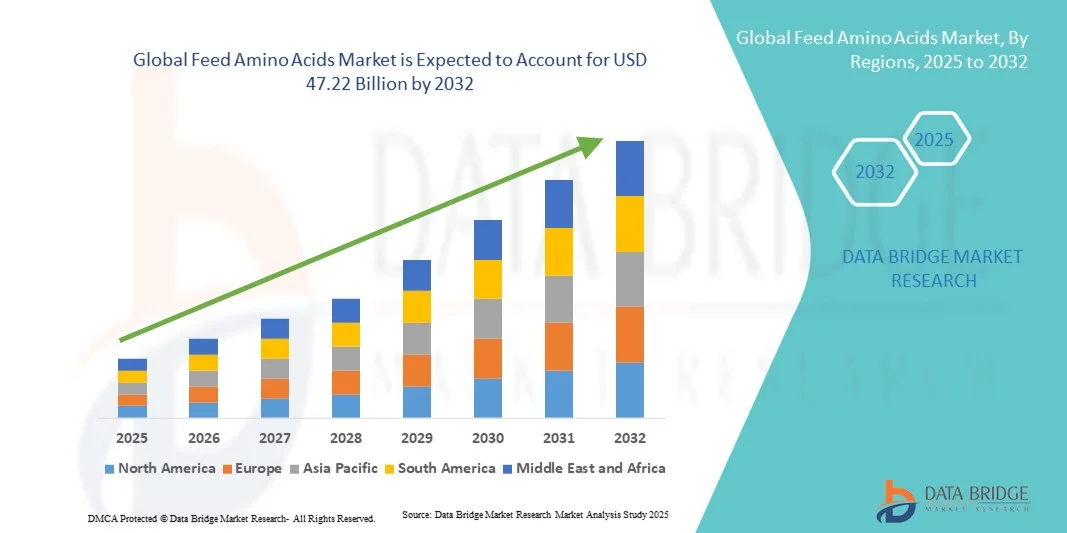
Global Feed Amino Acids Market Size
- The global Feed Amino Acids Market size was valued at USD 32.21 billion in 2024 and is expected to reach USD 47.22 billion by 2032, at a CAGR of 4.90% during the forecast period.
- The market growth is largely driven by the increasing demand for high-quality animal nutrition, coupled with the rising focus on improving livestock productivity and feed efficiency across the globe.
- Furthermore, advancements in feed formulation technologies, along with growing awareness of sustainable and protein-rich diets for livestock, are encouraging the adoption of amino acid supplements in both poultry and livestock sectors. These factors collectively are propelling the expansion of the feed amino acids industry, thereby significantly boosting market growth.
Global Feed Amino Acids Market Analysis
- Feed amino acids, essential nutrients used to enhance livestock growth, feed efficiency, and overall animal health, are increasingly vital components of modern animal nutrition strategies in both poultry and livestock production due to their ability to improve protein utilization, reduce feed costs, and support sustainable farming practices.
- The escalating demand for feed amino acids is primarily fueled by the growing global livestock population, rising focus on high-quality protein production, and increasing adoption of precision feeding techniques to optimize animal performance.
- Asia-Pacific dominated the Global Feed Amino Acids Market with the largest revenue share of 33.4% in 2024, characterized by advanced livestock farming practices, high adoption of feed supplements, and a strong presence of key industry players, with the U.S. experiencing substantial growth in feed amino acid consumption driven by innovations in specialized feed formulations and focus on sustainable livestock production.
- North America is expected to be the fastest-growing region in the Global Feed Amino Acids Market during the forecast period due to increasing livestock production, growing urbanization, and rising demand for animal protein.
- The methionine segment dominated the market with the largest revenue share of 43.5% in 2024, driven by its critical role in poultry and swine nutrition, supporting optimal growth performance, protein synthesis, and feed efficiency
Report Scope and Global Feed Amino Acids Market Segmentation
|
Attributes |
Feed Amino Acids Key Market Insights |
|
Segments Covered |
|
|
Countries Covered |
North America
Europe
Asia-Pacific
Middle East and Africa
South America
|
|
Key Market Players |
• Evonik Industries (Germany)
|
|
Market Opportunities |
|
|
Value Added Data Infosets |
In addition to the insights on market scenarios such as market value, growth rate, segmentation, geographical coverage, and major players, the market reports curated by the Data Bridge Market Research also include import export analysis, production capacity overview, production consumption analysis, price trend analysis, climate change scenario, supply chain analysis, value chain analysis, raw material/consumables overview, vendor selection criteria, PESTLE Analysis, Porter Analysis, and regulatory framework. |
Global Feed Amino Acids Market Trends
Enhanced Livestock Performance Through Precision Nutrition and AI Integration
- A significant and accelerating trend in the global Feed Amino Acids Market is the deepening integration of precision feeding systems with artificial intelligence (AI) and data-driven livestock management platforms. This fusion of technologies is significantly enhancing feed efficiency, animal health, and overall productivity.
- For instance, modern AI-powered feed formulation software can analyze the nutritional requirements of poultry and livestock in real time, adjusting amino acid supplementation to optimize growth and minimize feed waste. Similarly, sensor-equipped feeders can automatically dispense precise quantities of amino acids based on the animals’ weight, age, and health conditions.
- AI integration in feed management enables predictive insights, such as forecasting nutritional deficiencies, suggesting adjustments to feed composition, and detecting early signs of disease through behavioral or consumption patterns. For example, some systems monitor feed intake and growth trends to recommend amino acid adjustments for maximum feed conversion efficiency.
- The seamless integration of feed amino acids with digital livestock management platforms allows centralized control over nutrition, health monitoring, and performance tracking. Through a single interface, farm managers can optimize feed formulations, monitor animal growth, and ensure regulatory compliance across multiple facilities.
- This trend towards more intelligent, precise, and data-driven nutrition strategies is fundamentally reshaping livestock farming practices. Consequently, companies such as Evonik, Adisseo, and CJ CheilJedang are developing AI-enabled feed solutions with real-time monitoring, predictive analytics, and automated supplementation systems.
- The demand for feed amino acids integrated with AI-driven nutrition and livestock management tools is growing rapidly across both developed and emerging markets, as producers increasingly prioritize efficiency, sustainability, and optimal animal performance.
Global Feed Amino Acids Market Dynamics
Driver
Growing Need Due to Rising Demand for Efficient Livestock Nutrition
- The increasing global demand for animal protein, coupled with the rising focus on efficient and sustainable livestock production, is a significant driver for the heightened demand for feed amino acids.
- For instance, in 2024, CJ CheilJedang introduced advanced precision feeding solutions integrating amino acids into automated feed formulations to optimize livestock growth and reduce feed waste. Strategies such as these by key companies are expected to drive feed amino acids market growth during the forecast period.
- As livestock producers seek to improve productivity, reduce environmental impact, and enhance animal health, amino acid supplementation offers targeted nutritional benefits that enhance feed conversion efficiency and overall livestock performance.
- Furthermore, the growing adoption of smart farm management systems and precision feeding technologies is making amino acids an integral component of modern animal nutrition strategies, allowing seamless integration with other feed additives and management practices.
- The ability to optimize growth, reduce protein waste, and improve overall herd or flock performance are key factors propelling the adoption of feed amino acids across both developed and emerging markets. Rising awareness of sustainable livestock practices and the economic benefits of precision feeding further contribute to market growth.
Restraint/Challenge
Concerns Regarding Cost and Regulatory Compliance
- High initial costs of specialized amino acid supplements and feed formulations pose a significant challenge for adoption, particularly among small-scale or price-sensitive livestock producers in developing regions.
- For instance, some producers are hesitant to adopt premium methionine or lysine products due to perceived higher costs, despite their potential for improved productivity.
- Addressing these challenges through cost-effective formulations, bulk supply solutions, and producer education on long-term ROI is crucial for expanding market penetration. Companies such as Evonik and Adisseo emphasize optimized supplementation and sustainable practices to demonstrate value to livestock farmers.
- Additionally, regulatory restrictions on feed additives in certain regions can create barriers, requiring manufacturers to navigate complex approval processes for amino acids and their blends.
- Overcoming these challenges through regulatory compliance, affordable formulations, and increased awareness of productivity and sustainability benefits will be vital for sustained growth in the feed amino acids market.
Global Feed Amino Acids Market Scope
The feed amino acids market is segmented on the basis of type, livestock and form.
- By Type
On the basis of type, the Global Feed Amino Acids Market is segmented into Lysine, Methionine, Threonine, Tryptophan, and Others. The methionine segment dominated the market with the largest revenue share of 43.5% in 2024, driven by its critical role in poultry and swine nutrition, supporting optimal growth performance, protein synthesis, and feed efficiency. Methionine is widely used due to its high digestibility and ability to enhance animal health, making it a staple in commercial feed formulations.
The lysine segment is anticipated to witness the fastest growth rate of 22.1% from 2025 to 2032, fueled by increasing demand in swine and poultry nutrition, where lysine supplementation is essential for maximizing muscle development and minimizing feed costs. Growing awareness of precision feeding and tailored amino acid blends is also contributing to the accelerated adoption of lysine across multiple livestock sectors.
- By Livestock
On the basis of livestock, the Global Feed Amino Acids Market is segmented into Ruminants, Swine, Poultry, Aquaculture, and Others. The poultry segment accounted for the largest market revenue share of 41.8% in 2024, driven by the massive global demand for poultry meat and eggs, which necessitates high-quality protein and amino acid supplementation for optimal feed conversion and rapid growth.
The swine segment is expected to witness the fastest CAGR of 21.9% from 2025 to 2032, fueled by rising pork consumption in Asia-Pacific and Latin America, where intensive swine farming practices require precise amino acid formulations to ensure growth efficiency, reduce nitrogen excretion, and maintain animal health. The growing adoption of integrated livestock production systems and precision nutrition strategies is further accelerating amino acid utilization in both poultry and swine sectors.
- By Form
On the basis of form, the Global Feed Amino Acids Market is segmented into Dry and Liquid. The dry segment dominated the market with the largest revenue share of 61.2% in 2024, owing to its long shelf life, ease of handling, cost-effectiveness, and wide applicability in commercial feed manufacturing. Dry amino acids are preferred for bulk feed formulations, particularly in large-scale poultry and swine operations.
The liquid segment is expected to witness the fastest CAGR of 20.8% from 2025 to 2032, driven by growing interest in precision feeding, automated dispensing systems, and on-farm supplementation that allow tailored amino acid delivery for individual livestock or smaller batches. Liquid formulations also facilitate faster absorption and flexibility in combination with other feed additives, supporting enhanced feed efficiency and growth performance.
Global Feed Amino Acids Market Regional Analysis
- Asia-Pacific dominated the Global Feed Amino Acids Market with the largest revenue share of 33.4% in 2024, driven by the region’s well-established livestock industry, advanced feed production infrastructure, and high adoption of precision feeding technologies.
- Livestock producers in the region prioritize high-quality feed formulations and amino acid supplementation to improve growth performance, feed efficiency, and overall animal health, particularly in poultry, swine, and dairy sectors.
- This widespread adoption is further supported by strong research and development capabilities, regulatory compliance standards, and high awareness of sustainable and efficient livestock production practices. The presence of major industry players, technological innovation in feed additives, and increasing integration of amino acids into automated feeding systems reinforce North America’s dominant position in the global feed amino acids market.
U.S. Feed Amino Acids Market Insight
The U.S. feed amino acids market captured the largest revenue share of 42% in North America in 2024, driven by the country’s highly developed livestock industry and widespread adoption of precision feeding technologies. Producers are increasingly prioritizing amino acid supplementation to enhance growth performance, feed efficiency, and overall animal health across poultry, swine, and dairy sectors. The rising focus on sustainable and environmentally friendly livestock practices, combined with advanced feed formulation techniques and robust R&D infrastructure, further propels market growth. Moreover, the increasing integration of amino acids into automated feed systems and precision nutrition strategies is significantly contributing to market expansion.
Europe Feed Amino Acids Market Insight
The Europe feed amino acids market is projected to expand at a significant CAGR during the forecast period, primarily driven by stringent regulatory standards on animal nutrition and rising demand for high-quality, sustainable livestock products. Increasing urbanization, advanced livestock farming practices, and growing awareness of efficient protein utilization are fostering the adoption of amino acid supplementation. Strong growth is observed across poultry, swine, and ruminant sectors, with amino acids being incorporated into both large-scale commercial feed and precision feeding systems.
U.K. Feed Amino Acids Market Insight
The U.K. feed amino acids market is anticipated to grow steadily during the forecast period, fueled by the rising demand for optimized livestock nutrition and productivity. Concerns regarding feed efficiency, environmental sustainability, and regulatory compliance are encouraging livestock producers to adopt targeted amino acid supplementation. The country’s strong livestock sector, technological adoption in feed production, and increasing use of automated feeding systems are expected to support market growth.
Germany Feed Amino Acids Market Insight
The Germany feed amino acids market is expected to expand at a robust CAGR during the forecast period, driven by increasing awareness of sustainable livestock production and the need for advanced, high-quality feed formulations. Germany’s well-developed animal husbandry infrastructure, combined with strong emphasis on innovation and environmental regulations, promotes the adoption of amino acids across poultry, swine, and dairy sectors. The integration of precision feeding systems and advanced feed additives is further accelerating market growth.
Asia-Pacific Feed Amino Acids Market Insight
The Asia-Pacific feed amino acids market is poised to grow at the fastest CAGR of 22% from 2025 to 2032, driven by rapid urbanization, rising disposable incomes, and increasing demand for animal protein in countries such as China, India, and Japan. The growing adoption of intensive livestock farming practices, government initiatives promoting sustainable agriculture, and the expansion of feed additive manufacturing facilities are fueling market growth. Additionally, rising awareness about feed efficiency and livestock health is encouraging the widespread use of amino acids in both commercial and small-scale farming operations.
Japan Feed Amino Acids Market Insight
The Japan feed amino acids market is gaining momentum due to the country’s focus on precision livestock farming, high-tech feed production, and increasing demand for high-quality animal protein. Amino acids are widely adopted to optimize feed efficiency, support animal health, and reduce environmental impact. The integration of automated feeding systems and precision nutrition strategies is driving growth in poultry, swine, and aquaculture sectors.
China Feed Amino Acids Market Insight
The China feed amino acids market accounted for the largest revenue share in Asia-Pacific in 2024, attributed to rapid urbanization, a growing middle class, and increasing livestock production. Poultry and swine sectors are the major consumers of amino acids, driven by the need for high growth performance and feed efficiency. Government support for sustainable livestock farming, coupled with the presence of strong domestic feed additive manufacturers, is further propelling market expansion. The availability of cost-effective amino acid products and increasing adoption of precision feeding practices are key factors driving market growth.
Global Feed Amino Acids Market Share
The Feed Amino Acids industry is primarily led by well-established companies, including:
• Evonik Industries (Germany)
• Adisseo (France)
• BASF SE (Germany)
• CJ CheilJedang (South Korea)
• Novus International (U.S.)
• Nutreco (Netherlands)
• Archer Daniels Midland Company (U.S.)
• Lallemand Animal Nutrition (Canada)
• Kemin Industries (U.S.)
• Alltech (U.S.)
• AB Vista (U.K.)
• Zhejiang NHU Co., Ltd. (China)
• Global Bio-Chem Technology Group (China)
• Prinova Group LLC (U.S.)
• Bluestar Adisseo Co., Ltd. (China)
• Feedworks Pty Ltd (Australia)
• Sumitomo Chemical Co., Ltd. (Japan)
• Evonik Nutrition & Care GmbH (Germany)
• DSM Nutritional Products (Netherlands)
• Shandong Longlive Bio-Technology Co., Ltd. (China)
What are the Recent Developments in Global Feed Amino Acids Market?
- In April 2023, ADM Animal Nutrition (U.S.) launched a new range of precision feed additives enriched with essential amino acids for poultry and swine in South Africa. This initiative underscores the company’s commitment to enhancing livestock productivity and feed efficiency while addressing regional nutritional challenges. By leveraging its global expertise and advanced formulations, ADM is strengthening its position in the rapidly growing global feed amino acids market.
- In March 2023, Evonik Industries (Germany) introduced its updated AminoSol® range tailored for aquaculture and swine nutrition, designed to optimize growth performance and improve feed conversion ratios. This advancement highlights Evonik’s dedication to developing innovative feed solutions that support sustainable livestock production and animal health globally.
- In March 2023, Cargill, Inc. (U.S.) successfully implemented its integrated feed amino acid program in India, aimed at improving poultry and dairy farm efficiency. The initiative leverages advanced amino acid supplementation strategies to enhance livestock growth, productivity, and overall health, reflecting Cargill’s commitment to sustainable and precision livestock nutrition.
- In February 2023, Novus International, Inc. (U.S.) announced a strategic collaboration with local feed millers in Southeast Asia to expand the distribution of its specialty amino acid solutions. This partnership is designed to improve feed formulation efficiency and promote higher productivity across poultry, swine, and aquaculture sectors, reinforcing Novus International’s focus on innovation and operational excellence in livestock nutrition.
- In January 2023, Nutreco N.V. (Netherlands) unveiled its upgraded amino acid premix line at the International Feed Industry Expo 2023. The new premixes, optimized for swine and poultry diets, enable producers to improve feed efficiency and reduce nitrogen excretion. Nutreco’s innovation demonstrates the company’s commitment to integrating advanced nutritional technologies into livestock feed, enhancing animal performance while supporting environmental sustainability.

- Interactive Data Analysis Dashboard
- Company Analysis Dashboard for high growth potential opportunities
- Research Analyst Access for customization & queries
- Competitor Analysis with Interactive dashboard
- Latest News, Updates & Trend analysis
- Harness the Power of Benchmark Analysis for Comprehensive Competitor Tracking
Data collection and base year analysis are done using data collection modules with large sample sizes. The stage includes obtaining market information or related data through various sources and strategies. It includes examining and planning all the data acquired from the past in advance. It likewise envelops the examination of information inconsistencies seen across different information sources. The market data is analysed and estimated using market statistical and coherent models. Also, market share analysis and key trend analysis are the major success factors in the market report. To know more, please request an analyst call or drop down your inquiry.
The key research methodology used by DBMR research team is data triangulation which involves data mining, analysis of the impact of data variables on the market and primary (industry expert) validation. Data models include Vendor Positioning Grid, Market Time Line Analysis, Market Overview and Guide, Company Positioning Grid, Patent Analysis, Pricing Analysis, Company Market Share Analysis, Standards of Measurement, Global versus Regional and Vendor Share Analysis. To know more about the research methodology, drop in an inquiry to speak to our industry experts.
Data Bridge Market Research is a leader in advanced formative research. We take pride in servicing our existing and new customers with data and analysis that match and suits their goal. The report can be customized to include price trend analysis of target brands understanding the market for additional countries (ask for the list of countries), clinical trial results data, literature review, refurbished market and product base analysis. Market analysis of target competitors can be analyzed from technology-based analysis to market portfolio strategies. We can add as many competitors that you require data about in the format and data style you are looking for. Our team of analysts can also provide you data in crude raw excel files pivot tables (Fact book) or can assist you in creating presentations from the data sets available in the report.