


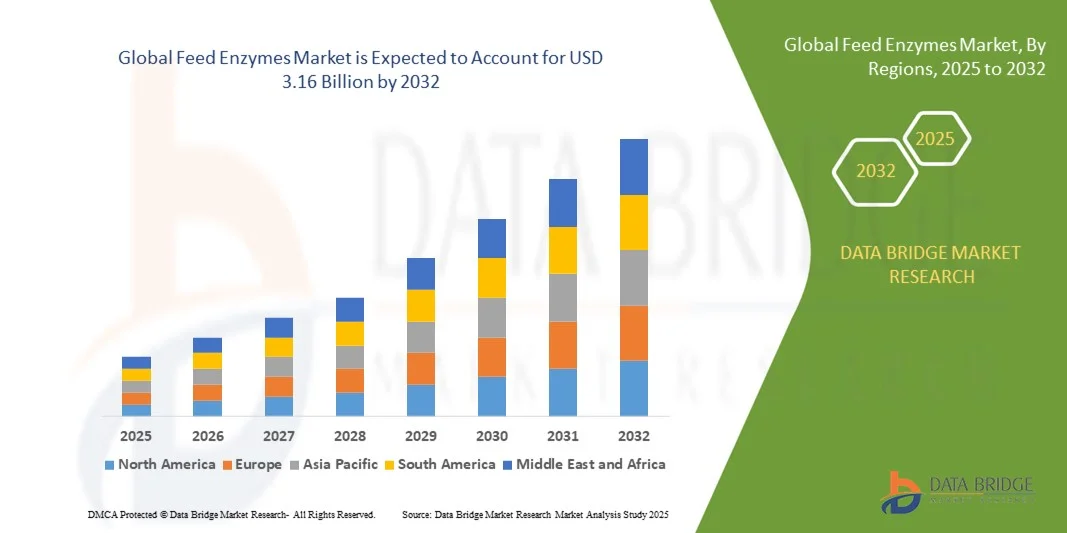
What is the Global Feed Enzymes Market Size and Growth Rate?
- The global feed enzymes market size was valued at USD 1.74 billion in 2024 and is expected to reach USD 3.16 billion by 2032, at a CAGR of 7.7% during the forecast period
- Major factors that are expected to boost the growth of the feed enzymes market in the forecast period are the provision of feed expense effectiveness and the rise in the need for animal-based products, such as meat products, dairy products, and eggs
- Furthermore, the enhanced meat quality or egg production and improvised animal health to surge the consumption of animal-based food products is further anticipated to propel the growth of the feed enzymes market. Also, the increase in the global need for the naturally produced feed and feed additives is further estimated to cushion the growth of the feed enzymes market
What are the Major Takeaways of Feed Enzymes Market?
- The struggle in the hydrolysis of cellulose and the developed inclusion rates of enzymes might have harmful effects which are further projected to impede the growth of the feed enzymes market in the timeline period
- In addition, the invention in the phytase production procedures will further provide potential opportunities for the feed enzymes market in the coming years. However, the rise in the high research and developments investments and thermostability of enzymes might further challenge the growth of the feed enzymes market in the near future
- North America dominated the Feed Enzymes market with the largest revenue share of 42.5% in 2024, driven by the well-established livestock and poultry sectors, high adoption of feed additives, and increasing focus on sustainable and efficient animal nutrition
- The Asia-Pacific Feed Enzymes market is poised to grow at the fastest CAGR of 7.58% during the forecast period of 2025 to 2032, driven by rapid expansion in livestock farming, rising disposable incomes, and increasing protein consumption in countries such as China, India, and Japan
- The Phytase segment dominated the Feed Enzymes market with the largest market revenue share of 45.6% in 2024, driven by its critical role in improving phosphorus digestibility, reducing feed costs, and minimizing environmental phosphorus excretion in livestock
Report Scope and Feed Enzymes Market Segmentation
|
Attributes |
Feed Enzymes Key Market Insights |
|
Segments Covered |
|
|
Countries Covered |
North America
Europe
Asia-Pacific
Middle East and Africa
South America
|
|
Key Market Players |
|
|
Market Opportunities |
|
|
Value Added Data Infosets |
In addition to the insights on market scenarios such as market value, growth rate, segmentation, geographical coverage, and major players, the market reports curated by the Data Bridge Market Research also include in-depth expert analysis, pricing analysis, brand share analysis, consumer survey, demography analysis, supply chain analysis, value chain analysis, raw material/consumables overview, vendor selection criteria, PESTLE Analysis, Porter Analysis, and regulatory framework. |
What is the Key Trend in the Feed Enzymes Market?
Focus on Enhanced Nutritional Efficiency and Sustainability
- A major and accelerating trend in the global feed enzymes market is the increasing focus on nutritional efficiency and sustainable livestock production. Enzymes are being optimized to enhance nutrient absorption, reduce feed waste, and lower environmental impact, aligning with the global push toward sustainable animal agriculture
- For instance, phytase and xylanase enzymes are being widely adopted in poultry and swine feed to improve phosphorus and carbohydrate digestibility, reducing the need for synthetic supplements and decreasing phosphorus excretion in manure
- Modern Feed Enzymes formulations are also combining multiple enzyme activities to improve gut health and feed conversion ratios, supporting precision nutrition strategies across livestock sectors. Companies such as Novozymes and BASF are investing in research to develop multi-functional enzyme blends that enhance productivity while minimizing environmental footprint
- This trend toward innovative, high-efficiency, and eco-friendly feed enzyme solutions is reshaping the expectations of feed producers and livestock farmers, driving widespread adoption across developed and emerging markets
- The rising demand for sustainable animal husbandry practices is pushing companies to prioritize enzyme solutions that support lower carbon emissions, reduced feed costs, and improved animal health. Consequently, R&D and commercial focus on advanced feed enzymes continue to grow
- The integration of enzyme solutions into holistic feed programs is becoming a key differentiator in the market, with demand growing steadily across poultry, swine, ruminants, and aquaculture sectors globally
What are the Key Drivers of Feed Enzymes Market?
- Increasing global demand for high-quality protein and animal products is a significant driver, encouraging feed producers to adopt enzyme solutions that enhance nutrient utilization and improve livestock growth rates
- For instance, in 2024, Novozymes expanded its enzyme portfolio for monogastric animals, introducing blends specifically designed to optimize feed efficiency and reduce environmental impact. Such initiatives are expected to drive market growth during the forecast period
- Growing concerns about environmental sustainability are fueling enzyme adoption, as enzymes help reduce nutrient excretion and greenhouse gas emissions from livestock production
- The rising cost of feed ingredients is another driver, as enzymes enable better feed conversion ratios, lowering the overall cost of animal production
- Advancements in enzyme formulations, such as multi-enzyme blends for diverse feed types, combined with increasing awareness of precision livestock farming, are promoting higher adoption rates across poultry, swine, ruminant, and aquaculture sectors
Which Factor is Challenging the Growth of the Feed Enzymes Market?
- High costs associated with premium feed enzyme products can be a barrier, particularly for small-scale livestock farmers in developing regions
- Variable efficacy of enzymes due to differences in feed composition, animal species, and gut health conditions can limit adoption. Inconsistent performance in field conditions sometimes leads to skepticism among feed manufacturers
- Stringent regulatory requirements for enzyme approvals in certain regions pose additional challenges, as compliance with safety, labeling, and environmental standards can increase costs and delay market entry
- Lack of awareness and technical expertise among smaller livestock operators regarding the correct use and benefits of feed enzymes can hinder market penetration
- Overcoming these challenges through targeted education, cost-effective formulations, and robust field trials is crucial for sustained growth, while innovations in enzyme stability and efficacy continue to expand market acceptance globally
How is the Feed Enzymes Market Segmented?
The feed enzymes market is segmented on the basis of type, source, livestock and form.
- By Type
On the basis of type, the feed enzymes market is segmented into Phytase, Protease, and Carbohydrase. The Phytase segment dominated the Feed Enzymes market with the largest market revenue share of 45.6% in 2024, driven by its critical role in improving phosphorus digestibility, reducing feed costs, and minimizing environmental phosphorus excretion in livestock. Phytase enzymes are widely adopted across poultry, swine, and aquaculture sectors, as farmers and feed manufacturers prioritize both nutritional efficiency and sustainable practices.
The Protease segment is expected to witness the fastest CAGR of 20.8% from 2025 to 2032, propelled by increasing demand for improved protein digestibility, enhanced growth performance, and better gut health in livestock. Proteases are being integrated into feed for ruminants, monogastric animals, and pets, offering flexibility in formulations and supporting premium feed solutions. Overall, the growth in enzyme utilization reflects a global push toward optimized feed efficiency and sustainable animal farming.
- By Source
On the basis of source, the feed enzymes market is segmented into Microorganism, Plant, and Animal. The Microorganism segment held the largest market revenue share of 52% in 2024, owing to its high enzyme activity, scalability in production, and consistent performance across various livestock species. Microbial enzymes, produced by bacteria, fungi, and yeasts, are preferred for their stability, specificity, and compatibility with modern feed processing methods.
The Plant-based segment is expected to witness the fastest CAGR of 18.5% from 2025 to 2032, driven by rising consumer preference for natural, eco-friendly feed additives and regulatory incentives promoting sustainable feed solutions. Plant-derived enzymes are increasingly being utilized in poultry and aquaculture feed for improved digestibility, gut health, and overall performance. The adoption of diverse enzyme sources reflects the industry’s focus on innovation, sustainability, and efficiency in animal nutrition.
- By Livestock
On the basis of livestock, the feed enzymes market is segmented into Ruminants, Swine, Poultry, Aquatic Animals, Pets, Horses, and Others. The Poultry segment dominated the market with the largest revenue share of 48% in 2024, driven by the sector’s rapid growth, high feed intake, and need for optimized nutrient utilization to enhance meat and egg production. Enzymes such as phytase, carbohydrase, and protease are widely used to improve feed conversion ratios and reduce environmental impact.
The Swine segment is expected to witness the fastest CAGR of 19.2% from 2025 to 2032, fueled by the expansion of commercial pig farming in Asia-Pacific and North America, where enzyme supplementation supports faster growth, gut health, and nutrient efficiency. The growing diversity of livestock applications highlights the importance of targeted enzyme solutions to maximize productivity and sustainability.
- By Form
On the basis of form, the feed enzymes market is segmented into Liquid and Dry. The Dry segment held the largest market revenue share of 56% in 2024, driven by its ease of storage, longer shelf life, and compatibility with feed pelleting processes in commercial feed mills. Dry enzyme formulations are widely used in poultry, swine, and ruminant feed due to their stability during high-temperature processing and transport.
The Liquid segment is anticipated to witness the fastest CAGR of 17.6% from 2025 to 2032, fueled by increasing adoption in aquaculture feed and premix applications, where precise dosing and rapid solubility are critical. Liquid enzyme solutions offer flexibility in feed formulation and enable direct incorporation into feed or water systems, reflecting the trend toward customized, efficient, and versatile enzyme delivery methods.
Which Region Holds the Largest Share of the Feed Enzymes Market?
- North America dominated the feed enzymes market with the largest revenue share of 42.5% in 2024, driven by the well-established livestock and poultry sectors, high adoption of feed additives, and increasing focus on sustainable and efficient animal nutrition
- Consumers and feed manufacturers in the region highly value the enhanced productivity, cost-effectiveness, and environmental benefits offered by feed enzymes in livestock and aquaculture feed
- This widespread adoption is further supported by robust infrastructure, technological advancements in feed processing, and stringent regulatory frameworks promoting efficient nutrient utilization, establishing North America as a key market hub for Feed Enzymes
U.S. Feed Enzymes Market Insight
The U.S. feed enzymes market captured the largest revenue share of 78% in North America in 2024, fueled by the extensive poultry, swine, and dairy industries. Increasing awareness regarding feed efficiency, gut health, and sustainable farming practices is driving the adoption of advanced enzyme solutions. Moreover, investments in research and development, alongside innovations in enzyme formulations, are significantly contributing to market expansion.
Europe Feed Enzymes Market Insight
The Europe feed enzymes market is projected to expand at a substantial CAGR during the forecast period, driven by regulatory mandates to reduce environmental phosphorus and nitrogen excretion from livestock. Growing demand for high-performance feed additives and increasing adoption in poultry, swine, and aquaculture applications are further supporting market growth. Countries such as Germany, France, and the U.K. are witnessing higher integration of multi-enzyme solutions for improved feed conversion and productivity.
U.K. Feed Enzymes Market Insight
The U.K. feed enzymes market is anticipated to grow steadily during the forecast period, fueled by the demand for sustainable animal nutrition and innovative feed solutions. The rising preference for enzyme supplementation in poultry and swine feed, coupled with technological advancements in feed processing, is expected to drive growth.
Germany Feed Enzymes Market Insight
The Germany feed enzymes market is expected to grow at a considerable CAGR, supported by strong adoption in livestock and aquaculture feed, coupled with government initiatives promoting sustainable farming. Increasing awareness of environmental sustainability and the demand for high-efficiency feed solutions are further driving the market.
Which Region is the Fastest Growing Region in the Feed Enzymes Market?
The Asia-Pacific feed enzymes market is poised to grow at the fastest CAGR of 7.58% during the forecast period of 2025 to 2032, driven by rapid expansion in livestock farming, rising disposable incomes, and increasing protein consumption in countries such as China, India, and Japan. Government initiatives promoting modern animal farming practices and feed efficiency are encouraging enzyme adoption. In addition, Asia-Pacific’s emergence as a feed and enzyme manufacturing hub ensures affordability and accessibility, widening the consumer base.
Japan Feed Enzymes Market Insight
The Japan feed enzymes market is gaining momentum due to increasing poultry and aquaculture production, coupled with strong demand for gut health and nutrient efficiency in livestock. Enzyme supplementation is increasingly integrated into compound feed formulations, enhancing productivity and animal welfare.
China Feed Enzymes Market Insight
The China feed enzymes market accounted for the largest market revenue share in Asia-Pacific in 2024, driven by the country’s massive poultry, swine, and aquaculture industries. Rapid urbanization, increasing meat consumption, and government support for sustainable farming practices are key factors propelling market growth. The presence of strong domestic enzyme manufacturers and the availability of affordable enzyme solutions further boost adoption across the region.
Which are the Top Companies in Feed Enzymes Market?
The feed enzymes industry is primarily led by well-established companies, including:
- BASF SE (Germany)
- DuPont (U.S.)
- Associated British Foods Plc (U.K.)
- DSM (Netherlands)
- Azelis S.A. (Belgium)
- BEHN MEYER (Germany)
- Adisseo (France)
- Novus International (U.S.)
- Rossari (India)
- BIO-CAT (U.S.)
- BEC Feed Solutions (Australia)
- BioResource International, Inc. (U.S.)
- Bioproton Pty Ltd. (Australia)
- Alltech (U.S.)
- Lesaffre (France)
- Advanced Enzyme Technologies (India)
- Karyotica Biologicals Pvt Ltd. (India)
- Aum Enzymes (India)
- CapriEnzymes (India)
- Enzyme Innovation (U.S.)
- Lumis (India)
- VEMO 99 Ltd. (Bulgaria)
- Biovet (Bulgaria)
- Chr. Hansen Holding A/S (Denmark)
- Novozymes (Denmark)
What are the Recent Developments in Global Feed Enzymes Market?
- In January 2023, Novus International acquired the biotech company Agrivida to develop innovative feed additives, strengthening its product portfolio and supporting advanced solutions for animal nutrition. This strategic acquisition is expected to enhance Novus International’s competitive position in the global feed enzymes market
- In January 2023, BASF and Cargill expanded their collaboration, extending their existing feed enzyme development and distribution to the U.S., focusing on introducing innovative enzyme-based solutions to the market. By leveraging BASF’s enzyme research expertise and Cargill’s application knowledge, the partnership aims to create unique value for animal feed customers and advance industry innovation
- In September 2022, DSM acquired Prodap, a leading Brazilian animal nutrition and technology company, combining technology offerings, consulting services, and specialized nutritional solutions. This acquisition strengthens DSM’s ability to improve efficiency and sustainability in animal farming across Latin America
- In July 2022, Cargill extended its partnership with Innovafeed to provide aquafarmers with innovative and nutritious ingredients, including feed additives, enhancing productivity and supporting sustainable aquaculture practices. This collaboration reinforces Cargill’s commitment to advancing the global feed solutions market

- Interactive Data Analysis Dashboard
- Company Analysis Dashboard for high growth potential opportunities
- Research Analyst Access for customization & queries
- Competitor Analysis with Interactive dashboard
- Latest News, Updates & Trend analysis
- Harness the Power of Benchmark Analysis for Comprehensive Competitor Tracking
Global Feed Enzymes Market, Supply Chain Analysis and Ecosystem Framework
To support market growth and help clients navigate the impact of geopolitical shifts, DBMR has integrated in-depth supply chain analysis into its Global Feed Enzymes Market research reports. This addition empowers clients to respond effectively to global changes affecting their industries. The supply chain analysis section includes detailed insights such as Global Feed Enzymes Market consumption and production by country, price trend analysis, the impact of tariffs and geopolitical developments, and import and export trends by country and HSN code. It also highlights major suppliers with data on production capacity and company profiles, as well as key importers and exporters. In addition to research, DBMR offers specialized supply chain consulting services backed by over a decade of experience, providing solutions like supplier discovery, supplier risk assessment, price trend analysis, impact evaluation of inflation and trade route changes, and comprehensive market trend analysis.
Data collection and base year analysis are done using data collection modules with large sample sizes. The stage includes obtaining market information or related data through various sources and strategies. It includes examining and planning all the data acquired from the past in advance. It likewise envelops the examination of information inconsistencies seen across different information sources. The market data is analysed and estimated using market statistical and coherent models. Also, market share analysis and key trend analysis are the major success factors in the market report. To know more, please request an analyst call or drop down your inquiry.
The key research methodology used by DBMR research team is data triangulation which involves data mining, analysis of the impact of data variables on the market and primary (industry expert) validation. Data models include Vendor Positioning Grid, Market Time Line Analysis, Market Overview and Guide, Company Positioning Grid, Patent Analysis, Pricing Analysis, Company Market Share Analysis, Standards of Measurement, Global versus Regional and Vendor Share Analysis. To know more about the research methodology, drop in an inquiry to speak to our industry experts.
Data Bridge Market Research is a leader in advanced formative research. We take pride in servicing our existing and new customers with data and analysis that match and suits their goal. The report can be customized to include price trend analysis of target brands understanding the market for additional countries (ask for the list of countries), clinical trial results data, literature review, refurbished market and product base analysis. Market analysis of target competitors can be analyzed from technology-based analysis to market portfolio strategies. We can add as many competitors that you require data about in the format and data style you are looking for. Our team of analysts can also provide you data in crude raw excel files pivot tables (Fact book) or can assist you in creating presentations from the data sets available in the report.













