


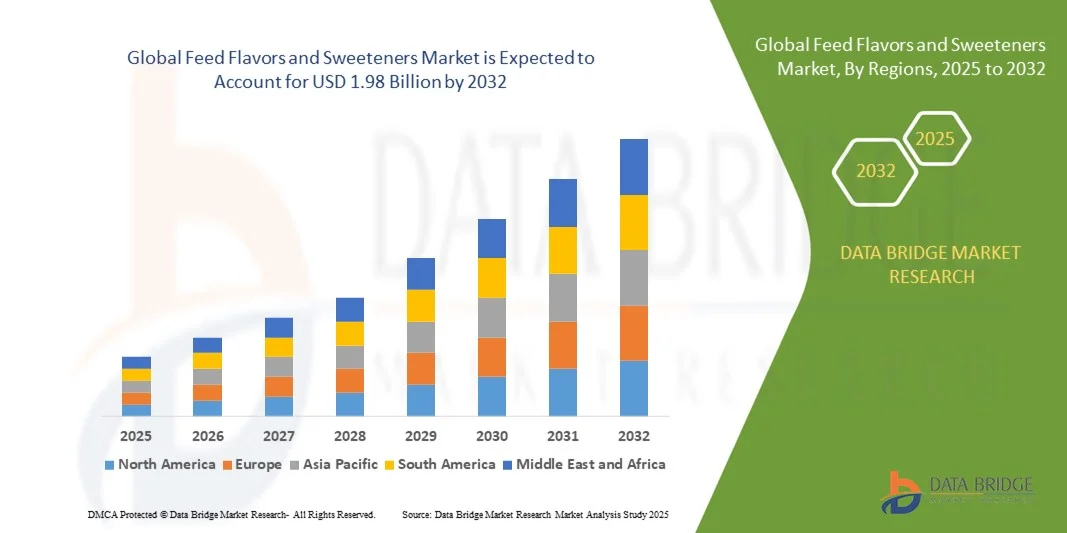
Feed Flavors and Sweeteners Market Size
- The global feed flavors and sweeteners market size was valued at USD 1.32 billion in 2024 and is expected to reach USD 1.98 billion by 2032, at a CAGR of 5.20% during the forecast period
- The market growth is largely fuelled by the rising demand for palatable and performance-enhancing feed additives across livestock, poultry, and aquaculture sectors
Feed Flavors and Sweeteners Market Analysis
- Increasing awareness among livestock producers regarding the benefits of flavor-enhanced feed, such as improved feed intake and weight gain, is a key factor supporting market expansion in global market
- Regulatory support for reducing antibiotic usage in animal nutrition is accelerating the adoption of natural sweeteners and flavors as safe feed additives
- North America dominated the feed flavors and sweeteners market with the largest revenue share of 38.25% in 2024, driven by a strong livestock industry, increasing demand for enhanced feed palatability, and the rising focus on animal health and productivity
- Asia-Pacific region is expected to witness the highest growth rate in the global feed flavors and sweeteners market, driven by rising meat and dairy consumption, expanding livestock populations, government initiatives promoting modern feed practices, and growing adoption of natural and cost-effective feed additives
- The feed flavors segment dominated the market with the largest revenue share in 2024, owing to its critical role in enhancing feed palatability and improving voluntary intake among livestock. Producers often rely on flavor-enhanced feed to encourage consumption during stress periods, such as post-weaning in piglets or diet shifts in dairy cattle
Report Scope and Feed Flavors and Sweeteners Market Segmentation
|
Attributes |
Feed Flavors and Sweeteners Key Market Insights |
|
Segments Covered |
|
|
Countries Covered |
North America
Europe
Asia-Pacific
Middle East and Africa
South America
|
|
Key Market Players |
|
|
Market Opportunities |
|
|
Value Added Data Infosets |
In addition to the insights on market scenarios such as market value, growth rate, segmentation, geographical coverage, and major players, the market reports curated by the Data Bridge Market Research also include in-depth expert analysis, pricing analysis, brand share analysis, consumer survey, demography analysis, supply chain analysis, value chain analysis, raw material/consumables overview, vendor selection criteria, PESTLE Analysis, Porter Analysis, and regulatory framework. |
Feed Flavors and Sweeteners Market Trends
Shift Towards Natural and Functional Ingredients
- Livestock producers across the globe are increasingly replacing synthetic feed additives with botanical extracts and plant-based sweeteners to improve animal health and meet clean-label standards. This transition is heavily influenced by rising consumer demand for naturally sourced food products and sustainable farming practices worldwide
- The restriction and phase-out of antibiotic growth promoters in multiple regions, including North America, Europe, and parts of Asia-Pacific, has accelerated the use of natural functional ingredients that not only enhance feed palatability but also support immune health and gut integrity. This has resulted in the development of feed formulations enriched with essential oils, herbs, and plant-derived sweeteners
- Feed manufacturers are incorporating stevia and glycyrrhizin in swine and poultry diets to mask unpleasant feed odors while promoting higher feed intake during critical phases such as weaning
- For instance, producers in Brazil and India have reported increased feed acceptance in piglets and broilers after introducing stevia-based additives in starter rations, supporting stronger early growth performance
- Clean-label flavor systems with added health benefits are witnessing widespread adoption in markets such as the U.S., China, and Germany, where consumer preference for sustainable animal-derived products is driving innovation in feed formulations. Companies are developing dual-function ingredients that enhance both taste and nutritional value
- The trend is further supported by global research collaborations and government-backed initiatives aimed at reducing synthetic inputs in livestock nutrition and improving transparency across animal food chains. This regulatory and research-driven approach is paving the way for broader integration of natural flavors and sweeteners into commercial feed worldwide
Feed Flavors and Sweeteners Market Dynamics
Driver
Increased Focus on Animal Palatability and Feed Efficiency
- Feed flavors and sweeteners play a critical role in enhancing palatability, encouraging higher feed intake and improving growth performance across diverse livestock species. By masking bitter or unappealing notes in feed, these additives ensure consistent consumption and contribute to better weight gain in animals. The overall result is improved productivity and efficiency for producers
- Better feed appeal helps reduce wastage and ensures animals receive balanced nutrition throughout all growth stages. When animals find feed more appetizing, they are less likely to reject portions, leading to higher nutrient absorption. This contributes to healthier livestock, stable growth cycles, and reduced feed costs
- Flavoring agents effectively mask off-putting odors from additives such as fishmeal, making the feed more acceptable to animals. These ingredients neutralize strong smells that might otherwise cause rejection and under-consumption. As a result, producers can maintain nutrient-rich formulations without compromising intake levels
- In heat-stressed environments, sweeteners help maintain animal appetite and energy levels by enhancing taste. During periods of heat stress, livestock often reduce feed intake, leading to productivity losses. Sweetener-enriched diets counteract this effect by stimulating appetite and encouraging steady consumption
- For instance, dairy farms in India and Spain use molasses-based enhancers during summer months to stabilize milk production and maintain animal performance. Farmers observed not only improved feed intake but also consistent milk yield despite adverse weather. This has proven critical for profitability in hot climates
- Consistent flavoring helps standardize feed taste across batches, promoting steady feeding behavior and ensuring predictable intake. Uniformity in flavor encourages animals to develop a habitual feeding response, reducing stress caused by feed changes. This stability supports long-term growth and performance
Restraint/Challenge
Stringent Regulatory Approvals and Ingredient Restrictions
- The regulatory framework for feed additives across global markets requires extensive testing and documentation before new flavors or sweeteners can be approved. These processes involve safety assessments, residue testing, and efficacy validation, which can take years to complete. Such lengthy approval cycles slow innovation and market entry
- High compliance and testing costs pose significant challenges for innovation, particularly among small and mid-sized additive producers across regions. Larger multinational corporations can absorb regulatory expenses, but smaller firms face barriers to entry. This widens the competitive gap and limits diversity in available products
- The ban or restriction of certain artificial sweeteners in multiple countries has reduced the availability of low-cost options for enhancing feed palatability. Producers are compelled to adopt more expensive natural alternatives, which raises input costs. This shift often results in higher feed prices passed on to livestock farmers
- For example, poultry producers in both Europe and Asia had to reformulate feed after regulatory restrictions limited the use of saccharin. Reformulation involved significant time and R&D investments, delaying product rollout. In addition, alternative ingredients did not always match the same cost-to-performance ratio
- Regulatory inconsistencies between regions often force companies to reformulate products to meet varying national standards, delaying launches and raising costs. A flavor additive approved in one region may face rejection or require modifications in another, complicating global expansion strategies. This creates inefficiencies in supply chains and product development
- For instance, a multinational manufacturer had to adjust its citrus-based flavor formulation to meet both European and North American safety thresholds. The process added extra testing phases, additional labeling requirements, and increased overall production costs. Such hurdles discourage rapid commercialization of new solutions
- Constantly evolving compliance protocols across global markets complicate innovation pipelines, requiring companies to continually redesign or delay new product introductions. These ongoing changes create uncertainty in investment planning and R&D priorities. As a result, companies often adopt conservative approaches that slow market growth
Feed Flavors and Sweeteners Market Scope
The market is segmented on the basis of type, nature, form, livestock, product type, shape, origin, packaging, application, and distribution channel.
- By Type
On the basis of type, the global feed flavors and sweeteners market is segmented into feed flavors and feed sweeteners. The feed flavors segment dominated the market with the largest revenue share in 2024, owing to its critical role in enhancing feed palatability and improving voluntary intake among livestock. Producers often rely on flavor-enhanced feed to encourage consumption during stress periods, such as post-weaning in piglets or diet shifts in dairy cattle.
The feed sweeteners segment is expected to witness a fastest growth rate from 2025 to 2032, driven by the rising demand for masking unpleasant feed odors and boosting taste perception. These additives, including glycyrrhizin and stevia, are increasingly preferred in poultry and swine diets to support consistent intake and performance.
- By Nature
On the basis of nature, the global feed flavors and sweeteners market is segmented into conventional and organic. The conventional segment accounted for the highest market share in 2024, supported by its wide-scale adoption and cost-effectiveness in large-scale livestock operations. Most commercial feed formulations in continue to rely on standardized, lab-tested conventional flavoring and sweetening agents.
The organic segment is expected to witness a fastest growth rate from 2025 to 2032, fueled by shifting consumer preferences towards organic animal products and stricter guidelines on synthetic additives. Organic feed flavors derived from botanical and plant-based sources are gaining traction, especially in niche sectors such as organic dairy and poultry farming.
- By Form
On the basis of form, the global feed flavors and sweeteners market is segmented into dry and liquid. The dry segment held the dominant share in 2024, driven by its longer shelf life, ease of transportation, and suitability for bulk feed production. Dry flavor and sweetener premixes are widely used across compound feed mills due to their convenience in handling and dosing.
The liquid segment is expected to witness a fastest growth rate from 2025 to 2032, owing to its superior solubility and even distribution in feed. Liquid additives are increasingly used in specialty diets, particularly for young animals or during specific feeding phases that require uniform flavor dispersion.
- By Livestock
On the basis of livestock, the global feed flavors and sweeteners market is segmented into ruminants, swine, poultry, pets, equine, aquaculture, and others. The poultry segment dominated the market in 2024 due to the region’s large-scale broiler and layer operations and the high demand for palatable, nutrient-dense diets. Flavor and sweetener additives are often used to mask off-notes in fortified poultry feed, promoting optimal feed conversion.
The aquaculture segment is expected to witness a fastest growth rate from 2025 to 2032, as the European aquafeed industry expands in response to growing seafood demand. The use of tailored flavor systems in fish and shrimp diets helps enhance feed acceptability, especially in recirculating aquaculture systems where water-soluble feed components require careful formulation.
- By Product Type
On the basis of product type, the global feed flavors and sweeteners market is segmented into Whole/In-Shell Feed Flavors and Sweeteners, Natural Feed Flavors and Sweeteners, Diced Feed Flavors and Sweeteners, Paste Feed Flavors and Sweeteners, Blanched Feed Flavors and Sweeteners, Roasted Feed Flavors and Sweeteners, Sliced Feed Flavors and Sweeteners, Feed Flavors and Sweeteners Oil, Feed Flavors and Sweeteners Meal, and Others. The Natural Feed Flavors and Sweeteners segment held the largest market revenue share in 2024, driven by the rising demand for clean-label, plant-derived additives that align with sustainability and consumer health preferences. Natural solutions are widely used to improve feed palatability and animal performance while complying with stringent global regulatory frameworks.
The Feed Flavors and Sweeteners Oil segment is expected to witness the fastest growth rate from 2025 to 2032, owing to its high versatility and ease of blending in compound feeds. Oil-based products provide uniform distribution, better stability, and enhanced aroma, making them increasingly preferred for poultry, swine, and ruminant diets in both developed and emerging livestock markets.
- By Shape
On the basis of shape, the global feed flavors and sweeteners market is segmented into Round Kernels, Almond Kernels, Pointed Kernels, and Others. The Round Kernels segment accounted for the largest share in 2024, supported by their widespread use in standardized formulations that ensure consistent flavor release and feed acceptance. These shapes are popular in commercial feed manufacturing where uniformity is critical for large-scale production.
The Almond Kernels segment is expected to witness a fastest growth rate from 2025 to 2032, driven by its increasing adoption in specialty feed formulations that cater to niche animal groups requiring enhanced palatability and targeted nutritional profiles.
- By Origin
On the basis of origin, the global feed flavors and sweeteners market is segmented into Akcakoca, Levant, Giresun, and Others. The Levant segment captured the largest revenue share in 2024, owing to its strong supply base and growing preference for high-quality ingredients sourced from this origin. Levant-based flavors and sweeteners are valued for their balanced taste profile and cost-effectiveness.
The Giresun segment is expected to witness a fastest growth rate from 2025 to 2032, supported by its premium quality and distinctive characteristics that are increasingly sought after in specialty livestock feeds.
- By Packaging
On the basis of packaging, the global feed flavors and sweeteners market is segmented into Vacuum and Cartons Box, Bags, Pouches, Plastic or Metal Drums, and Others. Bags held the largest share in 2024, largely due to their cost-effectiveness, convenience in transport, and suitability for bulk purchases by commercial feed producers.
Pouches is expected to witness a fastest growth rate from 2025 to 2032, driven by the rising trend of smaller, flexible packaging that caters to household and retail-level purchases, ensuring better preservation and ease of handling.
- By Application
On the basis of application, the global feed flavors and sweeteners market is segmented into Industrial, Food Service Industry, and Household/Retail. The Industrial segment dominated in 2024, backed by large-scale adoption in commercial feed mills and integrated livestock operations, where consistent feed palatability and efficiency gains are critical.
The Household/Retail segment is expected to witness a fastest growth rate from 2025 to 2032, fuelled by the rising adoption of pet feed flavors and small-scale livestock feeding practices, particularly in emerging economies.
- By Distribution Channel
On the basis of distribution channel, the global feed flavors and sweeteners market is segmented into Direct and Indirect. The Direct channel segment held the largest share in 2024, supported by strong business-to-business (B2B) supply chains catering to feed manufacturers, cooperatives, and large-scale farms.
The Indirect channel segment is expected to witness a fastest growth rate from 2025 to 2032, driven by the expanding presence of online platforms, specialty distributors, and retail stores that make feed flavors and sweeteners more accessible to smallholders and household buyers.
Feed Flavors and Sweeteners Market Regional Analysis
- North America dominated the feed flavors and sweeteners market with the largest revenue share of 38.25% in 2024, driven by a strong livestock industry, increasing demand for enhanced feed palatability, and the rising focus on animal health and productivity
- Producers in the region are highly focused on improving feed efficiency, masking undesirable tastes, and boosting intake through flavors and sweeteners, particularly in swine and poultry sectors
- This adoption is further supported by advanced feed manufacturing infrastructure, high awareness among farmers, and increasing investment in sustainable and performance-oriented animal nutrition solutions, positioning feed flavors and sweeteners as critical additives in livestock management
U.S. Feed Flavors and Sweeteners Market Insight
The U.S. feed flavors and sweeteners market captured the largest revenue share in 2024 within North America, supported by strong adoption of advanced feed technologies and the demand for specialized animal nutrition solutions. Farmers are increasingly focused on reducing feed wastage while improving palatability to maximize livestock performance. The rising emphasis on dairy and poultry productivity, along with the adoption of natural and sustainable additives, continues to fuel market growth. Furthermore, large-scale farming operations and innovative product launches by leading feed additive companies significantly contribute to market expansion in the U.S.
Europe Feed Flavors and Sweeteners Market Insight
The Europe feed flavors and sweeteners market is expected to witness a fastest growth rate from 2025 to 2032, driven by strict regulatory standards, consumer preference for natural animal-derived products, and a push toward sustainable farming. The increasing adoption of clean-label and natural ingredients across the region is fostering demand for plant-based flavors and sweeteners. European feed producers are also integrating innovative solutions to improve palatability while maintaining compliance with EU feed safety regulations. The market is experiencing strong traction across swine, poultry, and ruminant sectors, with rapid adoption in both intensive farming and mid-sized operations.
U.K. Feed Flavors and Sweeteners Market Insight
The U.K. feed flavors and sweeteners market is expected to witness a fastest growth rate from 2025 to 2032, supported by rising demand for safe, sustainable, and performance-enhancing feed additives. Concerns over feed acceptance and livestock health are pushing farmers and feed manufacturers to integrate natural flavors and sweeteners. The growing trend of sustainable animal farming and increasing investments in research-backed feed formulations are further accelerating adoption. In addition, the country’s advanced dairy and poultry sectors are contributing to strong market momentum.
Germany Feed Flavors and Sweeteners Market Insight
The Germany feed flavors and sweeteners market is expected to witness a fastest growth rate from 2025 to 2032, driven by the country’s strong livestock production base, innovation in animal nutrition, and emphasis on eco-friendly solutions. German producers are increasingly adopting natural, functional feed additives to meet consumer expectations of traceable and sustainable animal-derived products. Advanced R&D activities, combined with the integration of flavor and sweetener systems in swine and dairy feed, are further stimulating growth. Moreover, regulatory compliance and the demand for clean-label solutions are shaping the market in Germany.
Asia-Pacific Feed Flavors and Sweeteners Market Insight
The Asia-Pacific feed flavors and sweeteners market is expected to witness a fastest growth rate from 2025 to 2032, driven by rapid urbanization, rising meat and dairy consumption, and expanding livestock populations in countries such as China, India, and Japan. Growing demand for cost-effective and efficient feed additives is fostering the adoption of flavors and sweeteners across the region. Government initiatives promoting modern animal farming and the presence of a strong feed production base are further boosting market penetration. APAC’s role as a key manufacturing hub also ensures affordability and accessibility of these additives to a wider consumer base.
Japan Feed Flavors and Sweeteners Market Insight
The Japan feed flavors and sweeteners market is expected to witness a fastest growth rate from 2025 to 2032 due to the country’s advanced livestock management practices, high adoption of precision feeding, and demand for premium animal-derived products. Japanese producers emphasize consistent feed intake and animal welfare, encouraging the use of high-quality flavors and sweeteners. Integration with sustainable and natural feed solutions, along with technological advancements in feed manufacturing, is further driving growth. In addition, Japan’s strong focus on reducing feed wastage and improving production efficiency is creating new opportunities for innovative additive formulations.
China Feed Flavors and Sweeteners Market Insight
The China feed flavors and sweeteners market accounted for the largest market revenue share in Asia-Pacific in 2024, driven by the country’s expanding livestock sector, increasing adoption of modern feed practices, and growing middle-class demand for safe, high-quality meat and dairy products. China’s rapid urbanization and government-backed initiatives for sustainable farming are further supporting the integration of feed flavors and sweeteners. In addition, the presence of strong domestic manufacturers offering affordable solutions, combined with the country’s large-scale poultry and swine industries, continues to propel market growth.
Feed Flavors and Sweeteners Market Share
The Feed Flavors and Sweeteners industry is primarily led by well-established companies, including:
- Kemin Industries, Inc. (U.S.)
- ADM (Switzerland)
- Norel S.A (Spain)
- Layn Natural Ingredients (China)
- DuPont (U.S.)
- Lucta (Spain)
- Pet Flavors Inc. (Private)
- Phytobiotics Futterzusatzstoffe GmbH (Germany)
- CBS Bio Platforms Inc(Canada)
- Adisseo (China)
- Barentz (The Netherlands)
- Alltech (U.S.)
Latest Developments in Global Feed Flavors and Sweeteners Market
- In May 2022, Adisseo entered into a collaboration with Entobel to advance insect meal production. The initiative focuses on improving insect performance and protein meal quality through precise control of feed ingredients, while leveraging synergies with additives such as methionine and enzymes. This partnership is expected to enhance nutritional value, strengthen innovation in sustainable feed solutions, and positively impact the growth of the insect protein market
- In April 2022, Novus International inaugurated a new corporate office in Bangalore, India, strategically located near major poultry hubs such as Coimbatore and Nammakal. The move is designed to facilitate closer engagement with customers, improve service accessibility, and expand the company’s presence in key poultry markets. This development is anticipated to boost Novus International’s regional growth and reinforce its market competitiveness
- In December 2021, BioMar expanded its INICIO Plus product line by introducing a new pellet size of 0.35 mm diameter. Specifically tailored to meet the nutritional requirements of fry species such as trout and salmon, the smaller pellet size ensures optimal feeding efficiency and better growth outcomes. This innovation supports aquaculture producers by improving fry nutrition, thereby contributing to higher survival rates and strengthening BioMar’s position in the aquafeed market

- Interactive Data Analysis Dashboard
- Company Analysis Dashboard for high growth potential opportunities
- Research Analyst Access for customization & queries
- Competitor Analysis with Interactive dashboard
- Latest News, Updates & Trend analysis
- Harness the Power of Benchmark Analysis for Comprehensive Competitor Tracking
Global Feed Flavors And Sweeteners Market, Supply Chain Analysis and Ecosystem Framework
To support market growth and help clients navigate the impact of geopolitical shifts, DBMR has integrated in-depth supply chain analysis into its Global Feed Flavors And Sweeteners Market research reports. This addition empowers clients to respond effectively to global changes affecting their industries. The supply chain analysis section includes detailed insights such as Global Feed Flavors And Sweeteners Market consumption and production by country, price trend analysis, the impact of tariffs and geopolitical developments, and import and export trends by country and HSN code. It also highlights major suppliers with data on production capacity and company profiles, as well as key importers and exporters. In addition to research, DBMR offers specialized supply chain consulting services backed by over a decade of experience, providing solutions like supplier discovery, supplier risk assessment, price trend analysis, impact evaluation of inflation and trade route changes, and comprehensive market trend analysis.
Data collection and base year analysis are done using data collection modules with large sample sizes. The stage includes obtaining market information or related data through various sources and strategies. It includes examining and planning all the data acquired from the past in advance. It likewise envelops the examination of information inconsistencies seen across different information sources. The market data is analysed and estimated using market statistical and coherent models. Also, market share analysis and key trend analysis are the major success factors in the market report. To know more, please request an analyst call or drop down your inquiry.
The key research methodology used by DBMR research team is data triangulation which involves data mining, analysis of the impact of data variables on the market and primary (industry expert) validation. Data models include Vendor Positioning Grid, Market Time Line Analysis, Market Overview and Guide, Company Positioning Grid, Patent Analysis, Pricing Analysis, Company Market Share Analysis, Standards of Measurement, Global versus Regional and Vendor Share Analysis. To know more about the research methodology, drop in an inquiry to speak to our industry experts.
Data Bridge Market Research is a leader in advanced formative research. We take pride in servicing our existing and new customers with data and analysis that match and suits their goal. The report can be customized to include price trend analysis of target brands understanding the market for additional countries (ask for the list of countries), clinical trial results data, literature review, refurbished market and product base analysis. Market analysis of target competitors can be analyzed from technology-based analysis to market portfolio strategies. We can add as many competitors that you require data about in the format and data style you are looking for. Our team of analysts can also provide you data in crude raw excel files pivot tables (Fact book) or can assist you in creating presentations from the data sets available in the report.













