


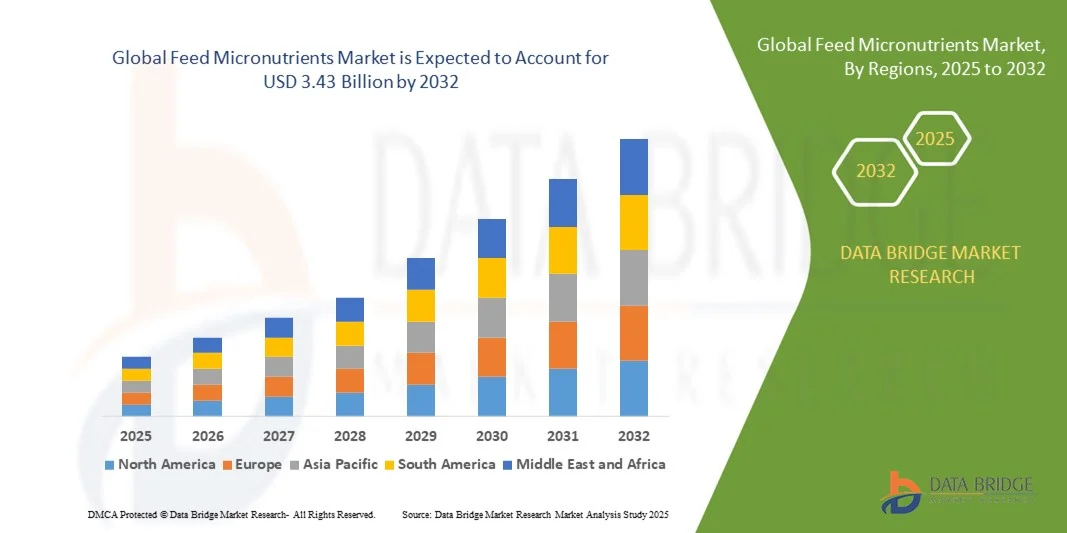
Feed Micronutrients Market Size
- The global feed micronutrients market size was valued at USD 2.07 billion in 2024 and is expected to reach USD 3.43 billion by 2032, at a CAGR of 6.5% during the forecast period
- The market growth is largely fuelled by the increasing demand for nutritionally enriched animal feed to improve livestock health, productivity, and product quality
- Rising awareness among livestock producers about the benefits of vitamins, minerals, and trace elements in feed is driving adoption across commercial and small-scale farms
Feed Micronutrients Market Analysis
- The global feed micronutrients market is witnessing steady growth, driven by the increasing demand for nutritionally enriched animal feed to enhance livestock productivity and health
- Rising awareness among livestock producers about the benefits of vitamins, minerals, and trace elements in feed is encouraging the adoption of fortified feed solutions
- North America dominated the feed micronutrients market with the largest revenue share of 35.4% in 2024, driven by increasing adoption of fortified feed, advanced livestock management practices, and growing awareness about animal nutrition
- Asia-Pacific region is expected to witness the highest growth rate in the global feed micronutrients market, driven by rapid urbanization, expanding aquaculture and poultry sectors, and government initiatives promoting animal nutrition and food safety
- The Trace Minerals segment held the largest market revenue share in 2024, driven by the essential role of minerals such as zinc, iron, copper, and manganese in promoting optimal growth, immunity, and productivity in livestock. Trace mineral supplementation helps prevent deficiencies, improve feed efficiency, and enhance overall animal health, making it widely adopted across poultry, ruminant, and swine farms
Report Scope and Feed Micronutrients Market Segmentation
|
Attributes |
Feed Micronutrients Key Market Insights |
|
Segments Covered |
|
|
Countries Covered |
North America
Europe
Asia-Pacific
Middle East and Africa
South America
|
|
Key Market Players |
|
|
Market Opportunities |
|
|
Value Added Data Infosets |
In addition to the insights on market scenarios such as market value, growth rate, segmentation, geographical coverage, and major players, the market reports curated by the Data Bridge Market Research also include in-depth expert analysis, pricing analysis, brand share analysis, consumer survey, demography analysis, supply chain analysis, value chain analysis, raw material/consumables overview, vendor selection criteria, PESTLE Analysis, Porter Analysis, and regulatory framework. |
Feed Micronutrients Market Trends
Rising Demand for Nutritionally Fortified Animal Feed
- The growing focus on fortified animal feed is transforming the livestock feed industry by enabling improved animal health, growth, and productivity. Micronutrient-enriched feed helps prevent deficiencies, supporting higher quality meat, milk, and egg production. This trend is also encouraging feed manufacturers to innovate and offer more customized nutrient blends for specific livestock needs
- The high demand for mineral, vitamin, and trace element supplementation in both large commercial and smallholder farms is accelerating adoption. These additives help optimize feed efficiency and reduce losses due to poor nutrition. In addition, fortified feed contributes to better immunity and disease resistance in animals, reducing dependence on antibiotics and veterinary interventions
- The affordability and ease of integrating micronutrients into standard feed formulations are making them attractive for routine livestock nutrition management. Farmers benefit from enhanced productivity and lower veterinary costs. Wider adoption is also supported by the growing availability of premixed feed solutions and technical guidance from feed suppliers, ensuring proper usage
- For instance, in 2023, several poultry and dairy farms across India reported improved animal growth and egg production after incorporating fortified feed supplements, leading to higher profitability and reduced disease incidence. These positive outcomes are prompting other regional farms to adopt fortified feed solutions, further boosting market growth
- While micronutrient-enriched feed is driving productivity, its impact depends on continued innovation, cost-effective formulations, and awareness campaigns. Feed manufacturers must focus on region-specific solutions to fully capitalize on growing demand. Moreover, digital platforms and e-commerce channels are emerging as key drivers for wider market penetration and farmer education
Feed Micronutrients Market Dynamics
Driver
Increasing Focus on Livestock Health and Productivity
- Rising awareness among farmers and producers about the importance of micronutrients in livestock diets is boosting market adoption. Adequate supplementation improves growth rates, reproductive performance, and product quality, making it a priority for commercial operations. This trend is reinforced by the increasing demand for traceable, high-quality animal products in domestic and export markets
- Government initiatives and industry standards promoting animal health and food safety are further driving demand for micronutrient-enriched feed. Subsidies and awareness programs encourage the use of fortified feed across large and small farms. Supportive policies and partnerships with NGOs are also playing a key role in expanding access in rural and underdeveloped areas
- The growing global meat, dairy, and egg consumption is creating pressure on producers to optimize animal performance, thereby increasing investment in micronutrient supplementation. In addition, the rise of intensive livestock farming practices is further pushing the need for scientifically balanced feed solutions to maintain productivity and profitability
- For instance, in 2022, EU regulatory guidance on animal feed quality prompted several feed manufacturers to include fortified micronutrient blends, boosting overall market demand. The directive also encouraged innovation in premix formulations and promoted quality assurance standards across the feed industry
- While health awareness and regulations are driving growth, adoption can be hindered in regions with limited technical knowledge and infrastructure for proper feed formulation. Continuous training, farmer outreach programs, and support from local feed cooperatives are critical to overcome these adoption barriers
Restraint/Challenge
High Cost Of Micronutrient Supplements And Limited Accessibility In Rural Regions
- Advanced premixes and fortified feed ingredients often come at a high price, making them less accessible for smallholder and low-income farmers. Cost remains a key barrier for widespread usage. The challenge is compounded by fluctuating raw material prices, which can make micronutrient-enriched feed less affordable in price-sensitive markets
- In many rural areas, there is limited availability of quality micronutrient supplements and inadequate knowledge on proper dosage, reducing effective adoption. This results in inconsistent nutrition management and limits the overall benefits of fortified feed, keeping productivity gains below potential levels
- Supply chain constraints and inconsistent product availability in remote regions further hinder market penetration, leaving farmers reliant on conventional feed with lower nutritional value. Logistical challenges such as poor transport infrastructure and cold storage limitations exacerbate this problem
- For instance, in 2023, reports from Sub-Saharan Africa indicated that over 65% of small-scale livestock farmers had limited access to fortified feed, citing cost and distribution gaps as primary challenges. Similar patterns were observed in parts of Southeast Asia and South America, highlighting the need for targeted market interventions
- While feed supplementation technologies continue to advance, addressing affordability, accessibility, and education is essential. Manufacturers and stakeholders must focus on cost-effective premixes, decentralized distribution, mobile sales units, and farmer training programs to unlock long-term market potential and ensure sustainable livestock health improvements
Feed Micronutrients Market Scope
The market is segmented on the basis of product and livestock type.
- By Product
On the basis of product, the feed micronutrients market is segmented into Trace Minerals and Vitamins. The Trace Minerals segment held the largest market revenue share in 2024, driven by the essential role of minerals such as zinc, iron, copper, and manganese in promoting optimal growth, immunity, and productivity in livestock. Trace mineral supplementation helps prevent deficiencies, improve feed efficiency, and enhance overall animal health, making it widely adopted across poultry, ruminant, and swine farms.
The Vitamins segment is expected to witness the fastest growth rate from 2025 to 2032, driven by increasing awareness of the importance of vitamin supplementation for livestock performance and disease prevention. Vitamin-enriched feed supports improved reproductive health, enhanced immunity, and better meat, milk, and egg quality, making it increasingly popular among both commercial and smallholder livestock producers.
- By Livestock
On the basis of livestock, the market is segmented into Poultry, Ruminant, Aquaculture, Swine, and Equine. The Poultry segment held the largest revenue share in 2024, owing to the high global demand for poultry products and the critical need for micronutrient supplementation to ensure optimal growth, egg production, and immunity in birds.
The Ruminant segment is expected to witness the fastest growth rate from 2025 to 2032, fueled by rising global consumption of dairy and meat products. Micronutrient-enriched feed helps maintain animal health, improve milk yield, and support reproductive performance in cattle, sheep, and goats.
Feed Micronutrients Market Regional Analysis
- North America dominated the feed micronutrients market with the largest revenue share of 35.4% in 2024, driven by increasing adoption of fortified feed, advanced livestock management practices, and growing awareness about animal nutrition
- Farmers and producers in the region highly value the benefits of micronutrient-enriched feed in improving livestock growth, productivity, and overall health
- This widespread adoption is further supported by established distribution networks, technologically advanced feed formulations, and strong regulatory frameworks promoting animal health and food safety, establishing micronutrient-enriched feed as a preferred solution for both large-scale and smallholder operations
U.S. Feed Micronutrients Market Insight
The U.S. feed micronutrients market captured the largest revenue share in 2024 within North America, fueled by increasing demand for nutritionally fortified feed across poultry, swine, and ruminant sectors. Livestock producers are focusing on enhancing productivity, reproductive performance, and product quality through trace mineral and vitamin supplementation. Government incentives, awareness programs, and stringent feed quality standards are further boosting market adoption. Moreover, the growing demand for high-quality meat, dairy, and egg products is encouraging feed manufacturers to innovate and expand micronutrient offerings.
Europe Feed Micronutrients Market Insight
The Europe feed micronutrients market is expected to witness the fastest growth rate from 2025 to 2032, primarily driven by stringent feed regulations, increasing focus on livestock health, and rising demand for high-quality animal products. Urbanization and technological advancements in feed production are fostering adoption across poultry, swine, ruminant, and aquaculture sectors. European farmers and feed manufacturers are increasingly incorporating trace minerals and vitamins into daily feed routines to optimize growth, productivity, and animal welfare.
U.K. Feed Micronutrients Market Insight
The U.K. feed micronutrients market is expected to witness the fastest growth rate from 2025 to 2032, driven by growing awareness of animal nutrition and the need for productivity enhancement in livestock operations. The adoption of fortified feed supplements, including mineral and vitamin premixes, is rising across poultry, dairy, and swine farms. In addition, government-led initiatives and sustainable farming practices are encouraging feed producers to focus on nutrient-enriched solutions, supporting market growth.
Germany Feed Micronutrients Market Insight
The Germany feed micronutrients market is expected to witness the fastest growth rate from 2025 to 2032, fueled by increasing livestock health awareness and strict EU regulatory standards. Feed manufacturers are innovating with customized premixes and fortified formulations to meet animal nutritional requirements. Germany’s well-established agricultural infrastructure, combined with technological adoption in feed production, promotes the use of micronutrient-enriched feed across poultry, swine, ruminant, and aquaculture sectors.
Asia-Pacific Feed Micronutrients Market Insight
The Asia-Pacific feed micronutrients market is expected to witness the fastest growth rate from 2025 to 2032, driven by rising meat, dairy, and egg consumption, increasing livestock populations, and rapid urbanization in countries such as China, India, and Japan. The region’s growing focus on animal health, coupled with government support and advanced feed processing technologies, is driving adoption. Moreover, APAC’s role as a manufacturing hub for feed premixes and supplements is improving accessibility and affordability, further expanding market penetration.
China Feed Micronutrients Market Insight
The China feed micronutrients market accounted for the largest revenue share in Asia-Pacific in 2024, attributed to rapid livestock sector growth, rising consumption of animal-derived products, and increasing adoption of fortified feed across poultry, swine, and aquaculture operations. Government initiatives promoting animal health, coupled with strong domestic feed manufacturing capabilities, are key factors driving market expansion. Nutritionally enriched feed is increasingly being used to improve livestock productivity, product quality, and disease resistance, further fueling market growth.
Japan Feed Micronutrients Market Insight
The Japan feed micronutrients market is expected to witness the fastest growth rate from 2025 to 2032 due to the country’s advanced livestock farming practices, high standards for animal health, and growing focus on productivity and product quality. Poultry, swine, ruminant, and aquaculture producers are increasingly adopting micronutrient-enriched feed to optimize growth, reproductive performance, and disease resistance. Government regulations, coupled with technological advancements in feed formulation and processing, are supporting the widespread use of fortified feed. Moreover, Japan’s aging livestock farming population is driving demand for easy-to-use, high-efficiency feed supplements to maintain productivity and ensure sustainable operations.
Feed Micronutrients Market Share
The Feed Micronutrients industry is primarily led by well-established companies, including:
- Novus International (U.S.)
- RIDLEY Corporation Limited (Australia)
- Biochem Zusatzstoffe Handels- und Produktionsgesellschaft mbH (Germany)
- Phibro Animal Health Corporation (U.S.)
- DSM (Netherlands)
- Alltech (U.S.)
- Cargill, Incorporated (U.S.)
- Nutreco N.V. (Netherlands)
- Mercer Milling Company, Inc. (U.S.)
- Zinpro Corporation (U.S.)
- Pancosma (Switzerland)
- Kemin Industries, Inc. (U.S.)
- Vamso Biotec Pvt. Ltd (India)
- Aries Agro Limited (India)
- Nutrien Ag Solutions (Canada), Inc. (Canada)
- Dow (U.S.)
- Coromandel International (India)
- Haifa Group (Israel)
- Helena Agri-Enterprises, LLC (U.S.)
Latest Developments in Global Feed Micronutrients Market
- In February 2022, Archer Daniels Midland (ADM) announced the acquisition of Comhan Group, a South Africa-based animal feed and feed ingredient importer and distributor. This strategic move aims to strengthen ADM’s presence in the African feed market, enhance supply chain capabilities, and expand its product portfolio. By integrating Comhan’s distribution network, ADM seeks to improve access to high-quality feed ingredients for local livestock producers. The acquisition is expected to boost operational efficiency, support regional market growth, and reinforce ADM’s position as a key player in the global feed micronutrients industry

- Interactive Data Analysis Dashboard
- Company Analysis Dashboard for high growth potential opportunities
- Research Analyst Access for customization & queries
- Competitor Analysis with Interactive dashboard
- Latest News, Updates & Trend analysis
- Harness the Power of Benchmark Analysis for Comprehensive Competitor Tracking
Global Feed Micronutrients Market, Supply Chain Analysis and Ecosystem Framework
To support market growth and help clients navigate the impact of geopolitical shifts, DBMR has integrated in-depth supply chain analysis into its Global Feed Micronutrients Market research reports. This addition empowers clients to respond effectively to global changes affecting their industries. The supply chain analysis section includes detailed insights such as Global Feed Micronutrients Market consumption and production by country, price trend analysis, the impact of tariffs and geopolitical developments, and import and export trends by country and HSN code. It also highlights major suppliers with data on production capacity and company profiles, as well as key importers and exporters. In addition to research, DBMR offers specialized supply chain consulting services backed by over a decade of experience, providing solutions like supplier discovery, supplier risk assessment, price trend analysis, impact evaluation of inflation and trade route changes, and comprehensive market trend analysis.
Data collection and base year analysis are done using data collection modules with large sample sizes. The stage includes obtaining market information or related data through various sources and strategies. It includes examining and planning all the data acquired from the past in advance. It likewise envelops the examination of information inconsistencies seen across different information sources. The market data is analysed and estimated using market statistical and coherent models. Also, market share analysis and key trend analysis are the major success factors in the market report. To know more, please request an analyst call or drop down your inquiry.
The key research methodology used by DBMR research team is data triangulation which involves data mining, analysis of the impact of data variables on the market and primary (industry expert) validation. Data models include Vendor Positioning Grid, Market Time Line Analysis, Market Overview and Guide, Company Positioning Grid, Patent Analysis, Pricing Analysis, Company Market Share Analysis, Standards of Measurement, Global versus Regional and Vendor Share Analysis. To know more about the research methodology, drop in an inquiry to speak to our industry experts.
Data Bridge Market Research is a leader in advanced formative research. We take pride in servicing our existing and new customers with data and analysis that match and suits their goal. The report can be customized to include price trend analysis of target brands understanding the market for additional countries (ask for the list of countries), clinical trial results data, literature review, refurbished market and product base analysis. Market analysis of target competitors can be analyzed from technology-based analysis to market portfolio strategies. We can add as many competitors that you require data about in the format and data style you are looking for. Our team of analysts can also provide you data in crude raw excel files pivot tables (Fact book) or can assist you in creating presentations from the data sets available in the report.













