Feed Minerals Market Size
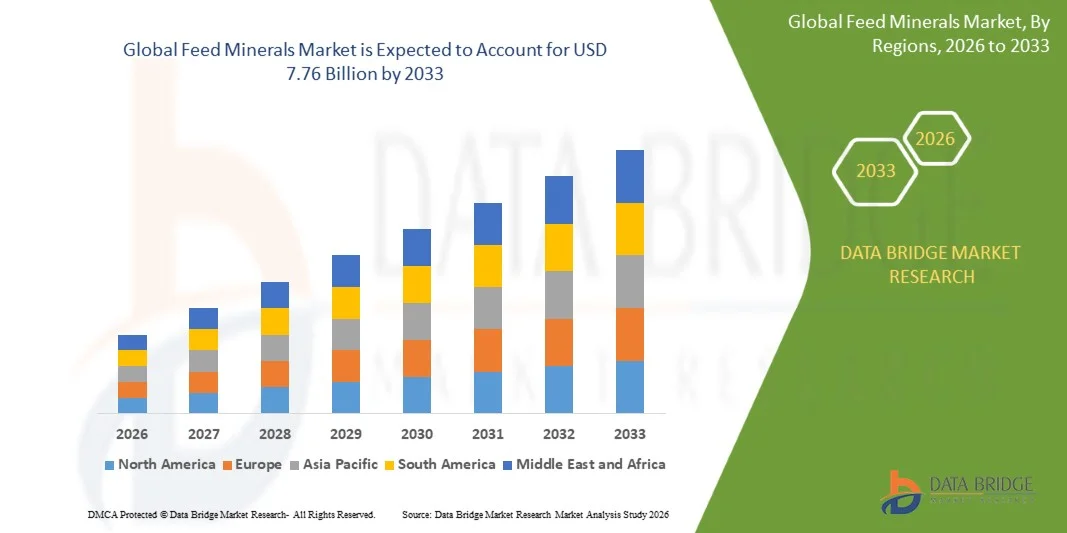
- The global feed minerals market size was valued at USD 4.62 billion in 2025and is expected to reach USD 7.76 billion by 2033, at a CAGR of 6.70% during the forecast period
- The market growth is largely fuelled by the rising demand for nutrient-rich animal feed to improve livestock productivity, health, and immunity across poultry, cattle, and aquaculture sectors
- Increasing awareness regarding animal nutrition and the importance of mineral supplementation in preventing deficiencies and enhancing feed efficiency is further driving market expansion
Feed Minerals Market Analysis
- The feed minerals market is witnessing steady growth due to increasing consumption of animal protein and expansion of intensive livestock farming practices globally
- Rising focus on feed quality, productivity optimization, and sustainable animal farming practices is shaping demand across developed and emerging economies
- North America dominated the global feed minerals market with the largest revenue share in 2025, driven by strong demand for high-quality animal nutrition, advanced livestock farming practices, and rising awareness of feed efficiency and animal health
- The Asia-Pacific region is expected to witness the highest growth rate in the global feed minerals market, driven by expanding livestock production, rising meat and dairy consumption, increasing feed manufacturing capacity, and growing adoption of mineral-enriched animal nutrition solutions
- The macro minerals segment held the largest market revenue share in 2025 driven by their essential role in supporting fundamental physiological functions such as bone development, muscle contraction, nerve transmission, and overall growth performance in livestock. Macro minerals such as calcium, phosphorus, sodium, potassium, magnesium, and sulfur are widely incorporated into animal feed formulations to ensure balanced nutrition and improve productivity across poultry, cattle, swine, and aquaculture sectors. Their high consumption volume and critical nutritional importance further strengthen their dominance in the market, particularly in intensive livestock farming systems where optimized growth and yield efficiency are key priorities
Report Scope and Feed Minerals Market Segmentation
|
Attributes |
Feed Minerals Key Market Insights |
|
Segments Covered |
· By Type: Macro Minerals and Micro Minerals · By Animal Type: Ruminants, Poultry, Swine, Aquaculture, and Other Animal Type |
|
Countries Covered |
North America · U.S. · Canada · Mexico Europe · Germany · France · U.K. · Netherlands · Switzerland · Belgium · Russia · Italy · Spain · Turkey · Rest of Europe Asia-Pacific · China · Japan · India · South Korea · Singapore · Malaysia · Australia · Thailand · Indonesia · Philippines · Rest of Asia-Pacific Middle East and Africa · Saudi Arabia · U.A.E. · South Africa · Egypt · Israel · Rest of Middle East and Africa South America · Brazil · Argentina · Rest of South America |
|
Key Market Players |
• BASF SE (Germany) |
|
Market Opportunities |
• Expansion In Precision Livestock Farming |
|
Value Added Data Infosets |
In addition to the insights on market scenarios such as market value, growth rate, segmentation, geographical coverage, and major players, the market reports curated by the Data Bridge Market Research also include import export analysis, production capacity overview, production consumption analysis, price trend analysis, climate change scenario, supply chain analysis, value chain analysis, raw material/consumables overview, vendor selection criteria, PESTLE Analysis, Porter Analysis, and regulatory framework. |
Feed Minerals Market Trends
“Rising Demand For Mineral-Enriched Animal Nutrition”
- The increasing focus on improving livestock health, productivity, and feed efficiency is significantly shaping the feed minerals market, as producers increasingly prioritize balanced mineral supplementation in animal diets. Feed minerals are gaining importance due to their critical role in supporting metabolic functions, immunity development, bone strength, and reproductive performance across livestock species such as poultry, cattle, swine, and aquaculture. This is further driving their integration into advanced feed formulations used in both commercial farming and integrated livestock production systems across developed and emerging economies
- Growing awareness regarding animal nutrition and deficiency-related health issues has accelerated the adoption of feed minerals in compound feed formulations. Livestock producers are actively incorporating essential macro and micro minerals to improve meat, milk, and egg yield quality, while also reducing disease risks and improving feed conversion ratios. This trend is further supported by rising demand for high-quality animal protein globally, prompting feed manufacturers to develop customized mineral blends tailored to species-specific nutritional requirements and production goals
- Rising emphasis on sustainable and efficient livestock production is influencing feed formulation practices, with manufacturers focusing on traceability, quality control, and optimized mineral blends. These factors are helping feed producers enhance animal performance while ensuring compliance with evolving feed safety standards and environmental regulations. In addition, integration of precision nutrition technologies and digital livestock monitoring systems is enabling more accurate mineral dosing, reducing wastage and improving overall farm productivity and profitability
- For instance, in 2024, major animal nutrition companies in the U.S. and Europe expanded their mineral premix portfolios to support precision feeding systems in poultry and dairy farming. These developments were introduced to improve feed conversion ratios, enhance animal immunity, and support sustainable livestock production practices. The introduction of advanced chelated and bioavailable mineral formulations also strengthened adoption across large-scale commercial farms, contributing to improved operational efficiency and reduced production losses
- While demand for feed minerals continues to grow, sustained market expansion depends on raw material availability, cost optimization, and development of advanced mineral delivery systems that improve bioavailability and feed efficiency. In addition, manufacturers are investing in research and development to enhance nutrient absorption rates, reduce environmental mineral excretion, and create more sustainable feed solutions that align with global sustainability and animal welfare standards
Feed Minerals Market Dynamics
Driver
“Rising Global Demand For Animal Protein”
- Increasing consumption of meat, milk, and eggs is a major driver for the feed minerals market as livestock producers focus on improving animal productivity and health through balanced nutrition. This rising demand is being fueled by population growth, urbanization, and changing dietary preferences toward protein-rich foods. As a result, feed mineral supplementation is becoming essential to ensure optimal animal growth rates, disease resistance, and reproductive efficiency across intensive and semi-intensive livestock production systems
- Expansion of intensive livestock farming systems is boosting the need for mineral-fortified feed formulations to support faster growth rates and improved feed conversion efficiency. Large-scale farming operations are increasingly adopting scientifically formulated feed strategies that include essential macro and trace minerals to enhance productivity. This shift is also supported by advancements in feed technology and automation, enabling more precise nutrient management and consistent animal performance across large herds and flocks
- Growing adoption of commercial animal farming practices is encouraging feed manufacturers to enhance mineral supplementation strategies to meet rising productivity demands. Farmers are increasingly shifting from traditional feeding practices to industrialized feed solutions that ensure standardized nutrition and improved output quality. This transition is further supported by rising investments in livestock infrastructure and increasing demand from meat processing and dairy industries globally
- For instance, in 2023, leading feed producers in China and the U.S. reported increased incorporation of mineral premixes in poultry and dairy feed formulations to support higher output and disease resistance. These formulations helped improve milk yield, egg production rates, and overall herd health while reducing mortality rates in livestock populations. The adoption of advanced mineral blends also enabled producers to achieve better feed efficiency and meet stringent quality standards in export markets
- Although demand is rising, market growth depends on cost-effective sourcing of raw materials and continuous innovation in mineral formulation technologies. In addition, fluctuations in global commodity prices, supply chain disruptions, and regulatory compliance requirements continue to challenge manufacturers, making efficiency improvements and sustainable sourcing strategies critical for long-term market stability
Restraint/Challenge
“High Raw Material Cost And Supply Fluctuations”
- The fluctuating cost of mineral raw materials remains a key challenge, affecting pricing stability and profitability for feed manufacturers. Prices of essential minerals such as zinc, copper, and selenium are influenced by mining output, geopolitical factors, and global trade conditions, leading to volatility in feed production costs. This creates difficulties for manufacturers in maintaining consistent pricing strategies and long-term supply contracts with livestock producers
- Limited availability of high-quality mineral sources in certain regions impacts consistent supply and production planning. Many developing regions rely heavily on imports for specialized feed minerals, increasing dependency on global suppliers and exposing the market to logistical delays and currency fluctuations. This supply imbalance often leads to production bottlenecks and uneven access to advanced feed formulations across different geographies
- Strict regulatory requirements for feed safety and quality standards increase compliance costs and operational complexity for manufacturers. Companies must adhere to stringent guidelines related to permissible mineral levels, contamination control, and environmental safety standards, which require continuous monitoring and testing. In addition, investment in quality assurance systems and certification processes adds to overall production costs and slows down product commercialization timelines
- For instance, in 2024, feed producers in Southeast Asia and parts of Europe faced supply constraints of key trace minerals, leading to price volatility and increased production costs in livestock feed formulations. These disruptions affected feed availability for poultry and dairy farms, resulting in temporary adjustments in production schedules and increased reliance on alternative formulations with modified nutrient compositions
- Addressing these challenges will require improved supply chain management, diversification of sourcing strategies, and development of cost-efficient mineral processing technologies to ensure stable long-term market growth. Furthermore, increased investment in local mineral production, recycling of industrial by-products, and innovation in synthetic mineral alternatives will be critical to reducing dependency on volatile global supply markets
Feed Minerals Market Scope
The market is segmented on the basis of type, communication protocol, unlocking mechanism, and application.
- By Type
On the basis of type, the feed minerals market is segmented into macro minerals and micro minerals. The macro minerals segment held the largest market revenue share in 2025 driven by their essential role in supporting fundamental physiological functions such as bone development, muscle contraction, nerve transmission, and overall growth performance in livestock. Macro minerals such as calcium, phosphorus, sodium, potassium, magnesium, and sulfur are widely incorporated into animal feed formulations to ensure balanced nutrition and improve productivity across poultry, cattle, swine, and aquaculture sectors. Their high consumption volume and critical nutritional importance further strengthen their dominance in the market, particularly in intensive livestock farming systems where optimized growth and yield efficiency are key priorities.
The micro minerals segment is expected to witness the fastest growth rate from 2026 to 2033, driven by increasing awareness of trace mineral deficiencies and their impact on animal immunity, reproduction, and metabolic efficiency. Micro minerals such as zinc, copper, selenium, iron, and manganese are being increasingly adopted in advanced feed formulations due to their role in improving disease resistance, enzyme function, and overall animal health performance. Rising adoption of precision nutrition practices and chelated mineral technologies is further enhancing bioavailability and absorption efficiency, making micro minerals more effective in modern livestock production systems. In addition, growing demand for high-quality animal protein and sustainable farming practices is accelerating the use of micro mineral supplementation across both developed and emerging markets.
- By Animal Type
On the basis of animal type, the feed minerals market is segmented into ruminants, poultry, swine, aquaculture, and other animal types. The poultry segment held the largest market revenue share in 2025 driven by high global demand for chicken meat and eggs, along with the intensive nature of poultry farming that requires precise nutritional management. Feed minerals play a crucial role in improving egg production, bone strength, feed conversion efficiency, and disease resistance in poultry birds. The widespread adoption of commercial poultry farming, particularly in Asia-Pacific and North America, further supports strong consumption of mineral-enriched feed formulations in this segment.
The aquaculture segment is expected to witness the fastest growth rate from 2026 to 2033, driven by rising seafood consumption, expansion of fish farming activities, and increasing focus on sustainable aquaculture production systems. Feed minerals are essential in aquaculture for supporting growth rates, improving shell and bone formation in crustaceans, and enhancing overall water-based animal health. Growing demand for high-protein seafood, along with declining wild fish stocks, is encouraging large-scale adoption of mineral-fortified aquafeed. In addition, advancements in formulated feed technologies and increasing investments in commercial aquaculture infrastructure are further accelerating the use of specialized mineral supplements in this segment.
Feed Minerals Market Regional Analysis
- North America dominated the global feed minerals market with the largest revenue share in 2025, driven by strong demand for high-quality animal nutrition, advanced livestock farming practices, and rising awareness of feed efficiency and animal health
- Producers in the region highly value the benefits of feed minerals in improving growth performance, immunity, and productivity in livestock, poultry, and aquaculture
- This widespread adoption is further supported by large-scale commercial farming, high adoption of precision animal nutrition solutions, and increasing focus on sustainable feed practices, establishing feed minerals as a key component in modern animal husbandry
U.S. Feed Minerals Market Insight
The U.S. feed minerals market captured the largest revenue share in 2025 within North America, fueled by the strong expansion of intensive livestock production and increasing focus on animal health optimization. Farmers and feed manufacturers are increasingly prioritizing mineral-enriched feed formulations to enhance productivity and reduce disease risk in cattle, poultry, and swine. The growing adoption of advanced feed additives, combined with strong integration of scientific nutrition practices and regulatory support for feed quality standards, further supports market growth in the country.
Europe Feed Minerals Market Insight
The Europe feed minerals market is expected to witness the fastest growth rate from 2026 to 2033, primarily driven by stringent regulations on animal feed quality and increasing demand for sustainable livestock production. Rising consumer preference for high-quality meat and dairy products is encouraging farmers to adopt balanced mineral supplementation in animal diets. The region is also witnessing strong growth in organic and trace mineral usage, supported by increasing awareness of animal welfare and environmental sustainability across commercial farming systems.
U.K. Feed Minerals Market Insight
The U.K. feed minerals market is expected to witness steady growth from 2026 to 2033, driven by increasing focus on livestock productivity and food safety standards. Farmers are increasingly adopting mineral-enriched feed solutions to improve animal immunity, reproduction efficiency, and overall farm output. In addition, rising concerns regarding sustainable agriculture and regulatory compliance are encouraging the use of scientifically formulated feed mineral blends across dairy and poultry sectors.
Germany Feed Minerals Market Insight
The Germany feed minerals market is expected to witness strong growth from 2026 to 2033, fueled by high adoption of advanced livestock nutrition practices and a strong emphasis on sustainable farming. The country’s well-developed agricultural infrastructure and focus on high-efficiency animal production systems are supporting demand for feed minerals. Increasing preference for eco-friendly and precision feed formulations is also driving the integration of macro and micro minerals in animal diets across commercial farms.
Asia-Pacific Feed Minerals Market Insight
The Asia-Pacific feed minerals market is expected to witness the fastest growth rate from 2026 to 2033, driven by rapid expansion of livestock production, rising population, and increasing meat consumption in countries such as China, India, and Japan. Growing awareness of animal health and productivity is encouraging farmers to adopt mineral-enriched feed solutions across poultry, swine, and aquaculture sectors. In addition, expanding feed manufacturing capabilities and government support for modernizing agriculture are improving accessibility and affordability of feed minerals in the region.
Japan Feed Minerals Market Insight
The Japan feed minerals market is expected to witness steady growth from 2026 to 2033 due to high focus on livestock quality, advanced farming practices, and demand for safe animal-derived food products. The country’s emphasis on precision nutrition and technological integration in agriculture is supporting the adoption of specialized feed mineral formulations. Rising demand for high-quality dairy, meat, and aquaculture products is further encouraging the use of balanced mineral supplementation in animal feed systems.
China Feed Minerals Market Insight
The China feed minerals market accounted for the largest market revenue share in Asia Pacific in 2025, attributed to rapid urbanization, large-scale livestock production, and strong expansion of the animal feed industry. China remains a major consumer of feed additives, with increasing adoption of mineral-based nutrition solutions across poultry, swine, and aquaculture sectors. Government initiatives supporting modern livestock farming, along with strong domestic manufacturing capabilities, are key factors driving the growth of the feed minerals market in the country.
Feed Minerals Market Share
The Feed Minerals industry is primarily led by well-established companies, including:
• BASF SE (Germany)
• DSM (Netherlands)
• Kemin Industries Inc (U.S.)
• Nutreco (Netherlands)
• Cargill (U.S.)
• Purnina Animal Nutrition LLC (U.A.E.)
• Cargill, Incorporated (U.S.)
• Chr. Hansen (Denmark)
• Novozymes (Denmark)
• Novus International Inc. (U.S.)
• Nutreco N.V. (Netherlands)
• Venkys India (India)
• Novus International (U.S.)
• Kent Nutrition Group (U.S.)
• Brilliant Bio Pharma Private Limited (India)
• Josera Petfood GmbH (Germany)
• Kalmbach Feeds (U.S.)
• Ranch Way Feeds (U.S.)
• Kaydee Feed (India)
Latest Developments in Global Feed Minerals Market
- In July, 2025, Cargill, Inc., acquisition, the company acquired Brazil-based Mig-Plus to expand its feed premix and mineral production capabilities, particularly in swine and ruminant nutrition segments, enhancing its regional supply chain and strengthening its presence in Latin America, which is expected to improve production efficiency and expand its animal nutrition portfolio, positively impacting market competitiveness and distribution reach
- In September, 2025, ADM and Alltech, joint venture, the companies formed a joint venture in North America by integrating 49 feed mills to strengthen animal nutrition operations, combining ADM’s premix expertise with Alltech’s specialty trace mineral technologies, aiming to enhance feed mineral production, improve formulation efficiency, and expand distribution networks, thereby increasing market consolidation and boosting innovation in animal feed solutions

- Interactive Data Analysis Dashboard
- Company Analysis Dashboard for high growth potential opportunities
- Research Analyst Access for customization & queries
- Competitor Analysis with Interactive dashboard
- Latest News, Updates & Trend analysis
- Harness the Power of Benchmark Analysis for Comprehensive Competitor Tracking
Data collection and base year analysis are done using data collection modules with large sample sizes. The stage includes obtaining market information or related data through various sources and strategies. It includes examining and planning all the data acquired from the past in advance. It likewise envelops the examination of information inconsistencies seen across different information sources. The market data is analysed and estimated using market statistical and coherent models. Also, market share analysis and key trend analysis are the major success factors in the market report. To know more, please request an analyst call or drop down your inquiry.
The key research methodology used by DBMR research team is data triangulation which involves data mining, analysis of the impact of data variables on the market and primary (industry expert) validation. Data models include Vendor Positioning Grid, Market Time Line Analysis, Market Overview and Guide, Company Positioning Grid, Patent Analysis, Pricing Analysis, Company Market Share Analysis, Standards of Measurement, Global versus Regional and Vendor Share Analysis. To know more about the research methodology, drop in an inquiry to speak to our industry experts.
Data Bridge Market Research is a leader in advanced formative research. We take pride in servicing our existing and new customers with data and analysis that match and suits their goal. The report can be customized to include price trend analysis of target brands understanding the market for additional countries (ask for the list of countries), clinical trial results data, literature review, refurbished market and product base analysis. Market analysis of target competitors can be analyzed from technology-based analysis to market portfolio strategies. We can add as many competitors that you require data about in the format and data style you are looking for. Our team of analysts can also provide you data in crude raw excel files pivot tables (Fact book) or can assist you in creating presentations from the data sets available in the report.