What is the Feed Mycotoxin Binders Market Size and Growth Rate?
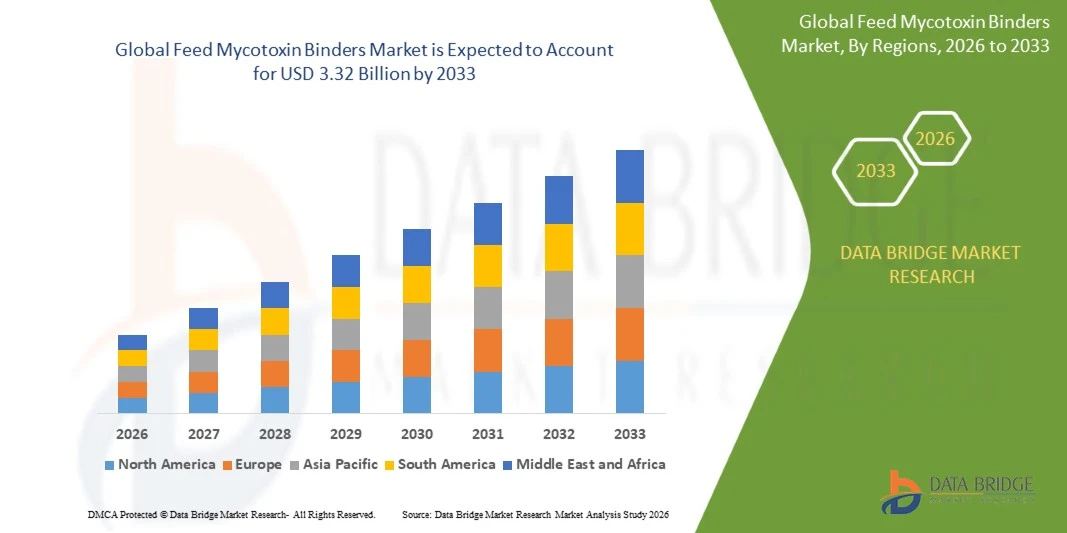
- As per Data Bridge Market Research analysis, the feed mycotoxin binders market was valued at USD 2.49 billion in 2025 and is projected to reach USD 3.32 billion by 2033, growing at a CAGR of 3.70% from 2026 to 2033.
- The market is experiencing consistent growth driven by rising demand for safe animal feed, increasing awareness of mycotoxin contamination, and expanding applications of feed additives across poultry, swine, cattle, and aquaculture production. The growing emphasis on animal health, feed quality, and livestock productivity is further supporting the adoption of effective mycotoxin-binding solutions.
- The increasing prevalence of mycotoxin contamination in feed ingredients, combined with stricter feed safety standards and rising demand for animal-derived food products, is encouraging livestock producers and feed manufacturers to adopt advanced mycotoxin binders. Clay-based adsorbents, yeast-derived binders, and other specialized additives are gaining importance by helping reduce toxin absorption, protect animal health, and improve feed utilization, supporting safer and more efficient livestock production.
Market Size & Forecast
- Global Market Value (2025): USD 2.49 Billion
- Expected Market Value (2033): USD 3.32 Billion
- Forecast CAGR (2026–2033): 3.70%
- Leading Region in 2025: North America
- Fastest Growing Region: Asia Pacific
What are the Major Takeaways of the Feed Mycotoxin Binders Market?
- North America dominated the feed mycotoxin binders market with the largest revenue share of 34.2% in 2025, supported by established livestock production, stringent feed safety standards, and growing adoption of animal nutrition additives.
- Asia-Pacific is expected to be the fastest-growing region at a CAGR of 9.6% from 2026 to 2033, fueled by increasing livestock production, rising demand for animal protein, and growing awareness of feed safety across China, India, and Japan.
- The mycotoxin binders segment led the market with a 42.3% share in 2025, driven by their established use in reducing the bioavailability of harmful mycotoxins in animal feed.
- Mycotoxin modifiers are the fastest-growing product type, projected to register a CAGR of 8.7%, reflecting the surge in demand for technologies that transform mycotoxins into less toxic compounds
- The poultry segment dominated the livestock category with a 39.1% revenue share in 2025, led by the extensive use of formulated feed in commercial broiler and egg production.
- Inorganic accounted for 45.2% of the market share in 2025, preferred by the high adsorption capacity, thermal stability, and cost-effectiveness of inorganic binders such as bentonite, zeolite, and activated carbon
- The liquid segment is the fastest-growing form category, with a CAGR of 7.8%, driven by increasing interest in flexible application methods and convenient integration into selected feed-processing systems.
Report Scope and Feed Mycotoxin Binders Market Segmentation
|
Attributes |
Feed Mycotoxin Binders Key Market Insights |
|
Segments Covered |
|
|
Countries Covered |
North America
Europe
Asia-Pacific
Middle East and Africa
South America
|
|
Key Market Players |
|
|
Market Opportunities |
|
|
Value Added Data Infosets |
In addition to the insights on market scenarios such as market value, growth rate, segmentation, geographical coverage, and major players, the market reports curated by the Data Bridge Market Research also include import export analysis, production capacity overview, production consumption analysis, price trend analysis, climate change scenario, supply chain analysis, value chain analysis, raw material/consumables overview, vendor selection criteria, PESTLE Analysis, Porter Analysis, and regulatory framework. |
What is the Key Trend in the Feed Mycotoxin Binders Market?
- Feed manufacturers are increasingly adopting broad-spectrum mycotoxin binders to address simultaneous contamination from multiple toxins, improve animal health, and maintain livestock productivity under changing climatic conditions.
- For instance, in October 2025, Alltech introduced Mycosorb A+ Evo and Mycosorb Evo, next-generation mycotoxin management solutions designed to provide enhanced binding efficiency and broader protection against multiple mycotoxin threats in animal feed.
- Advanced binder formulations are increasingly designed to address diverse toxins, including aflatoxins, deoxynivalenol, and zearalenone, reflecting the need for more comprehensive feed contamination management.
- Feed additive manufacturers are also expanding local production and distribution to improve product availability and support livestock producers facing region-specific mycotoxin risks.
- For instance, in August 2025, dsm-firmenich inaugurated a new animal nutrition and health feed additive plant in Jadcherla, India, featuring manufacturing capabilities for Mycofix Secure and Mycofix Shield to strengthen mycotoxin risk management in India and the Asia-Pacific region.
- As livestock producers increasingly prioritize feed safety, toxin control, and consistent animal performance, demand for broad-spectrum binders and locally available feed additive solutions is expected to support continued market development.
What are the Key Drivers of the Feed Mycotoxin Binders Market?
- The increasing incidence of mycotoxin contamination in feed ingredients has significantly increased demand for effective binders that reduce toxin bioavailability and protect animal health and livestock productivity.
- For instance, in March 2025, Cargill presented research based on more than 400,000 global feed analyses and findings on how deoxynivalenol (DON) affects poultry gut health, highlighting the importance of mycotoxin risk assessment and effective binders to protect animal health and productivity.
- Livestock producers and feed manufacturers are increasingly incorporating mycotoxin management into feed safety programs to minimize production losses, maintain animal performance, and improve the reliability of feed quality.
- For instance, in October 2025, Alltech launched Mycosorb A+ Evo and Mycosorb® Evo, next-generation mycotoxin binders designed to improve binding efficacy and provide broader protection against multiple toxins, including DON, fusaric acid, and Penicillium-derived toxins
- With rising awareness of toxin-related animal health risks and stronger emphasis on feed safety management, the adoption of mycotoxin binders is expected to increase across commercial livestock production and compound feed manufacturing.
What Factors are Challenging the Growth of the Feed Mycotoxin Binders Market?
- Feed mycotoxin binders face challenges related to variable binding effectiveness, as different products may perform differently depending on toxin type, feed composition, pH, and gastrointestinal conditions.
- For instance, in July 2024, a study published in Mycotoxin Research evaluated nine mineral sorbents against eight mycotoxins and found that binding effectiveness declined substantially when naturally contaminated feed was used; deoxynivalenol binding by activated charcoal fell from 70% in buffer testing to just 3% in feed, highlighting challenges in achieving consistent real-world efficacy.
- These limitations can complicate product selection for feed manufacturers, particularly when feed ingredients contain multiple mycotoxins that may not respond equally to a single binding agent.
- The need for appropriate product selection, reliable efficacy validation, and ongoing feed testing increases operational complexity for livestock producers and feed manufacturers, particularly in cost-sensitive markets.
- For instance, in November 2022, a study published in the Journal of Animal Science analyzed 68 studies containing 1,842 observations and identified substantial variation in binder effectiveness across different mycotoxins and products, alongside potential interactions with essential nutrients such as amino acids and vitamins
- These technical and operational challenges may constrain adoption among smaller feed producers and price-sensitive livestock operations, making demonstrated efficacy, cost-effectiveness, and compatibility with feed formulations important factors in market expansion.
How is the Feed Mycotoxin Binders Market Segmented?
The feed mycotoxin binders market is segmented on the basis of product type, livestock, source, and form.
- By Product Type
On the basis of product type, the feed mycotoxin binders market is segmented into mycotoxin binders and mycotoxin modifiers. The mycotoxin binders segment dominated the market with an 42.3% share in 2025, owing to their established use in reducing the bioavailability of harmful mycotoxins in animal feed. These products commonly use mineral adsorbents, such as bentonite and other clays, to bind toxins within the gastrointestinal tract. They are widely used in poultry, swine, and cattle feed formulations to support animal health and productivity. Their compatibility with commercial feed manufacturing processes supports broad adoption. Increasing awareness of feed contamination and livestock performance losses further strengthens demand.
The mycotoxin modifiers segment is projected to register the fastest growth at CAGR of 8.7% from 2026 to 2033, driven by increasing demand for technologies that transform mycotoxins into less toxic compounds. These products may use enzymes, microorganisms, or other biological mechanisms to modify specific toxins. They offer an alternative to conventional adsorption, particularly for mycotoxins that are difficult to bind effectively. Advances in biotechnology and microbial research are expanding the range of potential applications. Feed manufacturers are increasingly exploring these solutions as part of comprehensive mycotoxin risk-management programs. Growing demand for targeted and multi-mycotoxin control is expected to support segment expansion.
- By Livestock
On the basis of livestock, the feed mycotoxin binders market is segmented into poultry, layers, breeders, swine, aquatic animals, and others. The poultry segment dominated the market with 39.1% share in 2025, driven by the extensive use of formulated feed in commercial broiler and egg production. Poultry birds are vulnerable to mycotoxin exposure, which can affect growth, immunity, feed conversion, and egg production. Large-scale poultry farming increases the need for consistent feed quality and effective toxin management. Feed manufacturers increasingly incorporate mycotoxin-control products into poultry diets to maintain productivity and reduce health risks. Rising global demand for poultry meat and eggs further supports segment expansion.
The aquatic animals segment is projected to witness the fastest growth at a CAGR of 7.5% during the forecast period, driven by the expansion of aquaculture and increasing demand for high-quality fish and shrimp feed. Aquaculture operations increasingly rely on formulated diets containing plant-based ingredients that may introduce mycotoxin contamination. Exposure to these toxins can affect growth, feed utilization, immune function, and survival rates in susceptible aquatic species. Feed producers are therefore exploring suitable binders and other mitigation strategies to improve feed safety. The intensification of fish and shrimp farming is increasing the importance of consistent feed quality. Growing investment in sustainable aquaculture and improved aquatic animal health management is expected to support demand for mycotoxin-control solutions.
- By Source
On the basis of source, the feed mycotoxin binders market is segmented into inorganic and organic. The inorganic segment dominated the market with 45.2% share in 2025, owing to the high adsorption capacity, thermal stability, and cost-effectiveness of inorganic binders such as bentonite, zeolite, and activated carbon. These materials are widely used across livestock sectors because they can trap selected mycotoxins in animal feed. Their established commercial availability and compatibility with conventional feed manufacturing support widespread adoption. Inorganic binders are particularly valued for their effectiveness against aflatoxins. Their relatively economical formulations further support demand among large-scale feed producers.
The organic segment is projected to register the fastest growth at CAGR of 9.0% from 2026 to 2033, supported by increasing demand for natural and biologically derived feed additives. Organic binders include yeast cell walls, glucomannans, and selected plant-derived materials that can bind certain mycotoxins. These products are attracting interest as feed manufacturers seek complementary solutions to mineral-based adsorbents. Research into biological materials and improved formulations is expanding their potential applications. Growing attention to animal nutrition, feed quality, and targeted toxin management is further supporting adoption. Continued product development and efficacy validation are expected to strengthen the position of organic binders in livestock feed formulations.
- By Form
On the basis of form, the feed mycotoxin binders market is segmented into dry and liquid. The dry segment dominated the market with 53.8% share in 2025, driven by its ease of incorporation into feed pellets, premixes, and concentrates. Dry mycotoxin binders can be blended with feed ingredients using conventional manufacturing equipment. Their convenient storage, handling, and transportation make them suitable for large-scale livestock production. Powdered mineral adsorbents and many yeast-derived products are commercially available in dry formats. Their compatibility with established feed production infrastructure supports widespread adoption among feed mills and livestock integrators.
The liquid segment is projected to witness the fastest growth at a CAGR of 7.8% during the forecast period, fueled by increasing interest in flexible application methods and convenient integration into selected feed-processing systems. Liquid formulations can be applied through suitable dosing and spraying equipment, depending on product composition and intended use. They may offer advantages where uniform application or integration into specific liquid-feed systems is required. Developments in formulation technology are helping manufacturers improve product stability, handling, and application consistency. Increasing demand for customized feed management solutions is encouraging interest in alternative delivery formats. However, adoption depends on product compatibility, storage requirements, dosing accuracy, and demonstrated effectiveness against the targeted mycotoxins.
Which Region Holds the Largest Share of the Feed Mycotoxin Binders Market?
- North America dominated the feed mycotoxin binders market with the largest revenue share of 34.2% in 2025, supported by established livestock production, stringent feed safety standards, and growing adoption of animal nutrition additives.
- The region also benefits from extensive commercial poultry and livestock farming, established feed manufacturing infrastructure, and increasing adoption of mycotoxin management solutions. High corn utilization in animal feed, combined with concerns about contamination and livestock productivity, continues to support demand for effective binders. Growing emphasis on animal health, feed quality, and preventive toxin management further strengthens North America's leadership in the global market.
U.S. Feed Mycotoxin Binders Market Insight
The U.S. feed mycotoxin binders market is witnessing steady growth due to rising demand for safe animal feed, increasing awareness of mycotoxin contamination, and growing investments in livestock health and nutrition. The country’s large-scale poultry, swine, and cattle production industries, along with the extensive use of corn-based feed ingredients, are driving demand for effective mycotoxin management solutions. In addition, stringent feed safety requirements, increasing emphasis on animal productivity, and growing adoption of advanced feed additives are accelerating the use of mycotoxin binders across commercial livestock operations.
Asia-Pacific Feed Mycotoxin Binders Market Insight
The Asia-Pacific feed mycotoxin binders market is expected to witness rapid growth, driven by expanding livestock production, rising meat and egg consumption, and increasing investments in commercial poultry and aquaculture farming across countries such as China, India, and Japan. Growing awareness of feed contamination, increasing adoption of formulated animal feed, and rising demand for effective toxin management solutions are supporting regional market expansion. Additionally, the expansion of feed manufacturing facilities and increasing focus on animal health, feed quality, and livestock productivity are accelerating the adoption of mycotoxin binders across the region.
Japan Feed Mycotoxin Binders Market Insight
The Japan feed mycotoxin binders market is witnessing consistent growth due to increasing emphasis on feed safety, livestock health, and efficient animal nutrition management. Poultry producers, feed manufacturers, and livestock operators are increasingly focusing on controlling mycotoxin contamination to maintain animal performance and product quality. Moreover, the country's advanced feed manufacturing infrastructure, growing use of specialized feed additives, and focus on improving production efficiency are contributing to the adoption of mycotoxin binders across commercial livestock and aquaculture operations.
China Feed Mycotoxin Binders Market Insight
The China feed mycotoxin binders market is growing rapidly, driven by extensive poultry and swine production, rising demand for animal protein, and increasing attention to feed quality and livestock health. The widespread use of grain-based feed ingredients, including corn, creates a need for effective management of mycotoxin contamination across commercial feed production. Growing investments in modern feed manufacturing, increasing adoption of specialized feed additives, and rising awareness of toxin-related production losses are significantly boosting market demand. In addition, the expansion of intensive livestock farming and improvements in feed safety management are positioning China as an important market for mycotoxin binders.
U.K. Feed Mycotoxin Binders Market Insight
The U.K. feed mycotoxin binders market is experiencing steady growth, supported by increasing emphasis on animal welfare, feed quality, and livestock productivity. Feed manufacturers and livestock producers are adopting mycotoxin management solutions to address contamination risks in cereals and other feed ingredients. Growing awareness of the effects of mycotoxins on animal health, feed conversion, and production efficiency is contributing to market growth. Furthermore, increasing demand for reliable feed safety practices and specialized nutritional additives is supporting the use of mycotoxin binders across poultry, swine, cattle, and other livestock applications.
Germany Feed Mycotoxin Binders Market Insight
The Germany feed mycotoxin binders market is expanding steadily due to the country's established livestock production sector, advanced animal nutrition industry, and increasing focus on feed safety. Feed manufacturers and livestock producers are increasingly incorporating mycotoxin management into feed quality programs to minimize contamination risks and maintain animal productivity. Continuous developments in mineral-based adsorbents, yeast-derived products, and biological toxin-control technologies are supporting product innovation. In addition, strong emphasis on livestock health, efficient feed utilization, and quality control across commercial animal production is contributing to the adoption of mycotoxin binders in Germany.
Which are the Top Companies in Feed Mycotoxin Binders Market?
The feed mycotoxin binders industry is primarily led by well-established companies, including:
- Alltech, Inc. (U.S.)
- Kemin Industries, Inc. (U.S.)
- BASF SE (Germany)
- Adisseo France SAS (France)
- EW Nutrition GmbH (Germany)
- Olmix SA (France)
- Bentoli, Inc. (U.S.)
- Special Nutrients, Inc. (U.S.)
- Anpario plc (U.K.)
- NOVUS International, Inc. (U.S.)
- Phibro Animal Health Corporation (U.S.)
- Cargill, Incorporated (U.S.)
- Archer-Daniels-Midland Company (U.S.)
- Evonik Industries AG (Germany)
- Impextraco NV (Belgium)
- Oil-Dri Corporation of America (U.S.)
- Dr. Eckel Animal Nutrition GmbH & Co. KG (Germany)
- VETLINE (India)
- NOREL Animal Nutrition (Spain)
- Global Nutritech (Turkey)
What are Latest Developments in Feed Mycotoxin Binders Market?
- In October 2025, Alltech introduced Mycosorb A+ Evo and Mycosorb Evo, next-generation mycotoxin management solutions designed to improve binding efficacy and provide broader protection against multiple mycotoxins in animal feed. The products target challenging toxins, including deoxynivalenol (DON), fusaric acid, and Penicillium-derived toxins. This launch highlights the industry's focus on advanced, broad-spectrum solutions to protect livestock health, performance, and feed quality.
- In June 2024, Camlin Fine Sciences, through its subsidiary Dresen Química, acquired the entire stake in Vitafor Invest NV, a Belgium-based animal nutrition business. The acquisition strengthened its capabilities in feed safety, animal performance, and nutritional solutions while expanding its presence in European and African animal feed markets. This development reflects strategic consolidation in the animal nutrition industry and supports the availability of specialized feed additives and livestock health solutions.
- In February 2024, Cargill published its World Mycotoxin Report, incorporating forage mycotoxin analysis alongside information on contamination across feed ingredients, countries, and regions. The analysis included more than 350,000 mycotoxin analyses annually and introduced additional data relevant to evaluating risks in ruminant nutrition. The initiative supports livestock producers in identifying contamination risks and determining when feed additives and other mitigation measures may be needed.
- In March 2023, Cargill published its World Mycotoxin Report, presenting global findings on contamination prevalence, ingredient-related risks, and species-specific effects. The company also highlighted its Mycotoxin Impact Calculator, a tool designed to help producers evaluate mycotoxin risks and identify appropriate mitigation strategies. The initiative strengthened data-driven approaches to animal feed safety and highlighted the importance of selecting suitable feed additives to protect livestock health and productivity.
- In November 2021, Kemin Industries introduced TOXFIN CARE in Europe, a mycotoxin management solution designed to help protect poultry, ruminants, and swine from the harmful effects of contaminated feed. The formulation combines an adsorbent blend with components intended to support antioxidant defenses, liver function, and immune response. This launch demonstrated the industry's move toward integrated mycotoxin management solutions that address toxin exposure alongside its potential effects on animal health and production performance.
- Interactive Data Analysis Dashboard
- Company Analysis Dashboard for high growth potential opportunities
- Research Analyst Access for customization & queries
- Competitor Analysis with Interactive dashboard
- Latest News, Updates & Trend analysis
- Harness the Power of Benchmark Analysis for Comprehensive Competitor Tracking
Data collection and base year analysis are done using data collection modules with large sample sizes. The stage includes obtaining market information or related data through various sources and strategies. It includes examining and planning all the data acquired from the past in advance. It likewise envelops the examination of information inconsistencies seen across different information sources. The market data is analysed and estimated using market statistical and coherent models. Also, market share analysis and key trend analysis are the major success factors in the market report. To know more, please request an analyst call or drop down your inquiry.
The key research methodology used by DBMR research team is data triangulation which involves data mining, analysis of the impact of data variables on the market and primary (industry expert) validation. Data models include Vendor Positioning Grid, Market Time Line Analysis, Market Overview and Guide, Company Positioning Grid, Patent Analysis, Pricing Analysis, Company Market Share Analysis, Standards of Measurement, Global versus Regional and Vendor Share Analysis. To know more about the research methodology, drop in an inquiry to speak to our industry experts.
Data Bridge Market Research is a leader in advanced formative research. We take pride in servicing our existing and new customers with data and analysis that match and suits their goal. The report can be customized to include price trend analysis of target brands understanding the market for additional countries (ask for the list of countries), clinical trial results data, literature review, refurbished market and product base analysis. Market analysis of target competitors can be analyzed from technology-based analysis to market portfolio strategies. We can add as many competitors that you require data about in the format and data style you are looking for. Our team of analysts can also provide you data in crude raw excel files pivot tables (Fact book) or can assist you in creating presentations from the data sets available in the report.