


Feed Nucleotides Market Overview
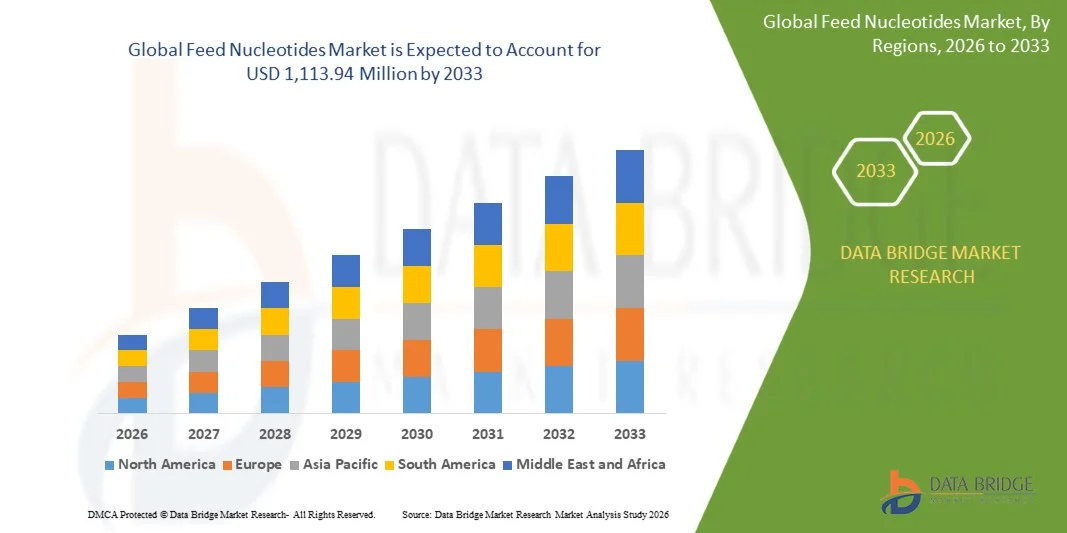
As per Data Bridge Market Research analysis the feed nucleotides market was valued at USD 704.20 million in 2025 and is projected to reach USD 1,113.94 million by 2033, growing at a CAGR of 5.90% from 2026 to 2033. The market is witnessing steady growth driven by increasing demand for high-quality animal nutrition, rising adoption of functional feed additives, and growing emphasis on improving livestock health, immunity, and production efficiency across the poultry, swine, aquaculture, and ruminant industries.
The growing restrictions on antibiotic growth promoters, coupled with increasing awareness regarding animal gut health and disease resistance, are encouraging feed manufacturers and livestock producers to incorporate nucleotide-based feed additives into animal diets. Feed nucleotides are increasingly being used to support intestinal development, enhance immune response, improve nutrient absorption, and promote overall animal performance, particularly during periods of stress, weaning, and disease challenges. Rising demand for sustainable livestock production and high-quality animal protein is further supporting the adoption of feed nucleotides across commercial animal farming operations.
Market Size & Forecast
- Market Value (2025): USD 704.20 Million
- Expected Market Value (2033): USD 1,113.94 Million
- Forecast CAGR (2026–2033): 5.90%
- Leading Region in 2025: North America
- Fastest Growing Region: Asia-Pacific
Key Market Trends & Insights
- North America dominated the feed nucleotides market with the largest revenue share in 2025, supported by the widespread adoption of advanced animal nutrition practices and the growing demand for antibiotic-free livestock production.
- Asia-Pacific feed nucleotides market is expected to witness the fastest growth rate from 2026 to 2033, supported by expanding livestock and aquaculture industries, rising meat consumption, and increasing awareness regarding animal health.
- Yeast/yeast extracts accounted for the largest market share in 2025 due to their widespread use as natural sources of nucleotides, proteins, and bioactive compounds that improve gut health, immunity, and feed efficiency in poultry, swine, ruminants, and aquaculture. Their established commercial availability and cost-effectiveness continue to support segment dominance.
- The single cell organisms segment is expected to witness the fastest growth from 2026 to 2033, driven by increasing advancements in microbial fermentation technologies and growing demand for sustainable, high-purity nucleotide ingredients. Rising investments in precision animal nutrition and alternative feed ingredients are expected to accelerate segment growth.
- The immune enhancers segment accounted for the largest market share in 2025, driven by increasing demand for functional feed additives that improve immune response, intestinal health, and disease resistance while supporting antibiotic-free livestock production.
- The dietary supplements segment is expected to witness the fastest growth from 2026 to 2033, supported by growing awareness of balanced animal nutrition and increasing use of nucleotide supplementation to improve growth performance, recovery from stress, and overall productivity across commercial livestock and aquaculture operations.
- The direct sales segment accounted for the largest market share in 2025, driven by long-term supply agreements between feed additive manufacturers and large feed mills, livestock integrators, and commercial animal producers requiring customized nutritional solutions and technical support.
- The distributor segment is expected to witness the fastest growth from 2026 to 2033, supported by expanding distribution networks, increasing penetration into emerging livestock markets, and growing accessibility of specialty feed ingredients among small- and medium-scale feed manufacturers.
Report Scope and Feed Nucleotides Market Segmentation
|
Attributes |
Feed Nucleotides Key Market Insights |
|
Segments Covered |
|
|
Countries Covered |
North America
Europe
Asia-Pacific
Middle East and Africa
South America
|
|
Key Market Players |
|
|
Market Opportunities |
|
|
Value Added Data Infosets |
In addition to the insights on market scenarios such as market value, growth rate, segmentation, geographical coverage, and major players, the market reports curated by the Data Bridge Market Research also include in-depth expert analysis, pricing analysis, brand share analysis, consumer survey, demography analysis, supply chain analysis, value chain analysis, raw material/consumables overview, vendor selection criteria, PESTLE Analysis, Porter Analysis, and regulatory framework. |
Feed Nucleotides Market Trends
Trend: Rising Adoption Of Functional Feed Additives For Gut Health And Antibiotic-Free Animal Production
Increasing demand for sustainable livestock production, improved animal health, and antibiotic-free feeding practices is driving the adoption of feed nucleotides across the poultry, swine, aquaculture, and ruminant industries. Conventional antibiotic growth promoters are increasingly being restricted due to antimicrobial resistance concerns, encouraging producers to adopt functional feed additives that naturally enhance immunity, intestinal health, and growth performance.
In modern livestock production, manufacturers are increasingly incorporating nucleotide-based feed ingredients to improve gut integrity, nutrient utilization, and immune response, particularly during early growth and periods of stress. For instance, in October 2022, Bioiberica expanded its partnerships with Aska Animal Health Co. and Shintoa Corporation to distribute its Nucleoforce Aqua and Nucleoforce Livestock ingredients in Japan, strengthening the availability of nucleotide-based feed solutions for livestock and aquaculture across the Asia-Pacific region.
The increasing demand for high-quality animal protein and improved feed efficiency is further accelerating the adoption of nucleotide-enriched feed solutions across commercial farming operations. Scientific studies have demonstrated that dietary nucleotides support intestinal development, immune function, and recovery during stress, making them an increasingly important component of antibiotic-free animal nutrition programs.
Feed Nucleotides Market Dynamics
Key Market Driver: Increasing Shift Toward Antibiotic-Free Animal Nutrition
Growing regulatory restrictions on antibiotic growth promoters and increasing consumer demand for safe and sustainable animal protein are encouraging livestock producers to adopt functional feed additives that improve animal performance naturally. Feed nucleotides are increasingly recognized for supporting immune response, intestinal development, and recovery during stress without contributing to antimicrobial resistance.
Feed manufacturers are expanding their nucleotide-based product portfolios to meet the growing demand for functional animal nutrition across poultry, swine, aquaculture, and pet nutrition. For instance, in October 2025, Bioiberica launched three new products under its refreshed Nucleoforce range Nucleoforce Immunity, Nucleoforce Performance, and Nucleoforce High Flowability (HF) to provide targeted immune support, improved production efficiency, and enhanced growth performance across multiple animal species.
Similarly, increasing investments in science-backed functional feed ingredients and precision animal nutrition continue to support the adoption of feed nucleotides as sustainable alternatives to conventional growth-promoting additives.
Key Restraint/Challenge: High Production Costs And Limited Awareness In Developing Markets
Feed nucleotide products require specialized extraction, purification, and fermentation processes that increase production costs compared with conventional feed additives. The relatively higher cost of nucleotide supplementation can limit adoption among small-scale livestock producers, particularly in price-sensitive and developing markets.
In addition, limited awareness regarding the long-term benefits of nucleotide supplementation, together with inconsistent regulatory approvals and product standardization across countries, continues to restrict wider commercialization. Feed manufacturers also face challenges in demonstrating economic returns under different livestock production systems, slowing adoption in cost-conscious markets.
For instance, the European Commission's Catalogue of Feed Materials requires fermentation-derived feed materials, including microbial fermentation products used in animal nutrition, to comply with defined manufacturing, composition, and labeling requirements before commercialization. These regulatory and quality compliance requirements increase production complexity, development costs, and time-to-market for feed ingredient manufacturers, particularly smaller companies entering the feed nucleotides market.
Key Market Opportunity: Expanding Applications In Aquaculture And Young Animal Nutrition
Rapid expansion of aquaculture production and increasing emphasis on improving early-life animal health are creating significant opportunities for feed nucleotide manufacturers. Young animals and aquatic species have limited capacity for endogenous nucleotide synthesis during periods of rapid growth and stress, increasing the need for dietary supplementation.
Manufacturers are expanding nucleotide-based product offerings to improve immune function, intestinal health, feed intake, and production performance across aquaculture and livestock.
In addition, growing investments in precision animal nutrition, sustainable livestock production, and antibiotic-free feeding programs are expected to create significant opportunities for feed nucleotide ingredients across Asia-Pacific, Europe, and South America.
Feed Nucleotides Market Scope
The market is segmented on the basis of product type, industry, and channel.
- By Product Type
On the basis of product type, the feed nucleotides market is segmented into yeast/yeast extracts and single cell organisms. Yeast/yeast extracts accounted for the largest market share in 2025 due to their widespread use as natural sources of nucleotides, proteins, and bioactive compounds that improve gut health, immunity, and feed efficiency in poultry, swine, ruminants, and aquaculture. Their established commercial availability and cost-effectiveness continue to support segment dominance.
The single cell organisms segment is expected to witness the fastest growth from 2026 to 2033, driven by increasing advancements in microbial fermentation technologies and growing demand for sustainable, high-purity nucleotide ingredients. Rising investments in precision animal nutrition and alternative feed ingredients are expected to accelerate segment growth.
- By Industry
On the basis of industry, the feed nucleotides market is segmented into immune enhancers and dietary supplements. The immune enhancers segment accounted for the largest market share in 2025, driven by increasing demand for functional feed additives that improve immune response, intestinal health, and disease resistance while supporting antibiotic-free livestock production.
The dietary supplements segment is expected to witness the fastest growth from 2026 to 2033, supported by growing awareness of balanced animal nutrition and increasing use of nucleotide supplementation to improve growth performance, recovery from stress, and overall productivity across commercial livestock and aquaculture operations.
- By Channel
On the basis of channel, the feed nucleotides market is segmented into direct sales and distributor. The direct sales segment accounted for the largest market share in 2025, driven by long-term supply agreements between feed additive manufacturers and large feed mills, livestock integrators, and commercial animal producers requiring customized nutritional solutions and technical support.
The distributor segment is expected to witness the fastest growth from 2026 to 2033, supported by expanding distribution networks, increasing penetration into emerging livestock markets, and growing accessibility of specialty feed ingredients among small- and medium-scale feed manufacturers.
Feed Nucleotides Market Regional Analysis
North America Feed Nucleotides Market Insight
North America dominated the feed nucleotides market with the largest revenue share in 2025, supported by the widespread adoption of advanced animal nutrition practices and the growing demand for antibiotic-free livestock production. The region benefits from a well-established feed industry, stringent regulations on animal health, and increasing use of functional feed additives to improve gut health, immunity, and feed efficiency. Rising investments in livestock productivity and sustainable animal farming continue to drive the adoption of feed nucleotides across poultry, swine, and aquaculture sectors.
U.S. Feed Nucleotides Market Insight
The U.S. feed nucleotides market captured the largest revenue share in 2025 within North America, driven by increasing demand for high-quality animal protein and growing adoption of functional feed ingredients in commercial livestock production. The country's advanced feed manufacturing industry, focus on precision animal nutrition, and increasing preference for antibiotic-free production systems are supporting market growth. In addition, continuous investments in animal health and feed innovation are further accelerating the adoption of feed nucleotides.
Canada Feed Nucleotides Market Insight
The Canada feed nucleotides market is expected to witness significant growth from 2026 to 2033, supported by increasing investments in sustainable livestock production and animal health management. Growing adoption of functional feed additives in poultry, swine, dairy, and aquaculture industries, coupled with rising consumer demand for safe and high-quality animal protein, is driving market expansion. Furthermore, increasing emphasis on improving feed efficiency and reducing antibiotic use is expected to support the adoption of feed nucleotide products across commercial livestock operations.
Europe Feed Nucleotides Market Insight
The Europe feed nucleotides market is expected to witness the fastest growth rate from 2026 to 2033, primarily driven by stringent regulations restricting antibiotic growth promoters and increasing demand for sustainable animal nutrition. Rising awareness of livestock health, feed efficiency, and animal welfare is encouraging feed manufacturers to incorporate nucleotide-based ingredients into commercial feed formulations. The region is also witnessing increasing investments in precision nutrition and functional feed additives across poultry, swine, and aquaculture industries.
U.K. Feed Nucleotides Market Insight
The U.K. feed nucleotides market is expected to witness the fastest growth rate from 2026 to 2033, driven by growing demand for antibiotic-free animal production and increasing focus on livestock health and productivity. Rising adoption of functional feed additives by commercial livestock producers and increasing awareness regarding gut health management are supporting market growth. In addition, advancements in animal nutrition research and sustainable farming practices are expected to further stimulate demand for feed nucleotide products.
Germany Feed Nucleotides Market Insight
The Germany feed nucleotides market is expected to witness the fastest growth rate from 2026 to 2033, fueled by the country's well-developed feed manufacturing industry and increasing emphasis on sustainable livestock production. Growing demand for high-performance feed additives that enhance immunity, nutrient absorption, and production efficiency is accelerating market growth. Furthermore, Germany's strong focus on animal welfare and precision nutrition continues to encourage the adoption of feed nucleotides across commercial farming operations.
Asia-Pacific Feed Nucleotides Market Insight
The Asia-Pacific feed nucleotides market is expected to witness the fastest growth rate from 2026 to 2033, supported by expanding livestock and aquaculture industries, rising meat consumption, and increasing awareness regarding animal health. Rapid industrialization of feed production, growing investments in commercial farming, and the transition toward antibiotic-free nutrition are driving demand for nucleotide-based feed additives. Increasing feed production in countries such as China, India, Japan, and Southeast Asia is further supporting regional market growth.
Japan Feed Nucleotides Market Insight
The Japan feed nucleotides market is expected to witness the fastest growth rate from 2026 to 2033 due to increasing demand for premium animal nutrition products and advanced livestock management practices. The country's strong aquaculture sector, combined with growing emphasis on improving feed efficiency, animal immunity, and disease resistance, is supporting the adoption of nucleotide-based feed additives. Continuous innovation in feed formulations and sustainable livestock production is expected to further contribute to market growth.
China Feed Nucleotides Market Insight
The China feed nucleotides market accounted for the largest market revenue share in Asia-Pacific in 2025, attributed to the country's large-scale livestock and aquaculture industries, expanding feed manufacturing sector, and increasing demand for high-quality animal protein. Growing government support for modern animal farming, rising adoption of functional feed additives, and increasing focus on reducing antibiotic usage are driving market expansion. The presence of major feed manufacturers and continuous investments in animal nutrition technologies further strengthen China's leading position in the regional market.
Feed Nucleotides Market Share
The Feed Nucleotides industry is primarily led by well-established companies, including:
- DSM (Netherlands)
- BASF SE (Germany)
- Lonza Group (Switzerland)
- Glanbia Plc (Ireland)
- ADM (U.S.)
- Farbest Brands (U.S.)
- SternVitamin GmbH & Co. KG (Germany)
- Adisseo (France)
- Adisseo France SAS (France)
- Ajinomoto Co., Inc. (Japan)
- Leiber GmbH (Germany)
- Lesaffre Group (France)
- Biovet JSC (Bulgaria)
- Hansen A/S (Denmark)
- Danisco A/S (Denmark)
- Elanco (U.S.)
- Kemin Industries, Inc. (U.S.)
Latest Developments in Feed Nucleotides Market
- In October 2025, Bioiberica, Product Launch, introduced three new products under its refreshed Nucleoforce range—Nucleoforce Immunity, Nucleoforce Performance, and Nucleoforce High Flowability (HF). The launch expands the company's nucleotide-based animal nutrition portfolio to support immune health, production efficiency, and growth across livestock, aquaculture, and pet nutrition. The development strengthens innovation in functional feed nucleotides and supports growing demand for science-backed animal nutrition solutions.
- In October 2022, Bioiberica, Distribution Expansion, expanded its partnerships with Aska Animal Health Co. and Shintoa Corporation to distribute its Nucleoforce Aqua and Nucleoforce Livestock products in Japan. The collaboration improved the availability of nucleotide-based feed ingredients for livestock and aquaculture while strengthening Bioiberica's presence in the Asia-Pacific animal nutrition market. The development supports wider adoption of feed nucleotides across commercial animal production.

- Interactive Data Analysis Dashboard
- Company Analysis Dashboard for high growth potential opportunities
- Research Analyst Access for customization & queries
- Competitor Analysis with Interactive dashboard
- Latest News, Updates & Trend analysis
- Harness the Power of Benchmark Analysis for Comprehensive Competitor Tracking
Global Feed Nucleotides Market, Supply Chain Analysis and Ecosystem Framework
To support market growth and help clients navigate the impact of geopolitical shifts, DBMR has integrated in-depth supply chain analysis into its Global Feed Nucleotides Market research reports. This addition empowers clients to respond effectively to global changes affecting their industries. The supply chain analysis section includes detailed insights such as Global Feed Nucleotides Market consumption and production by country, price trend analysis, the impact of tariffs and geopolitical developments, and import and export trends by country and HSN code. It also highlights major suppliers with data on production capacity and company profiles, as well as key importers and exporters. In addition to research, DBMR offers specialized supply chain consulting services backed by over a decade of experience, providing solutions like supplier discovery, supplier risk assessment, price trend analysis, impact evaluation of inflation and trade route changes, and comprehensive market trend analysis.
Data collection and base year analysis are done using data collection modules with large sample sizes. The stage includes obtaining market information or related data through various sources and strategies. It includes examining and planning all the data acquired from the past in advance. It likewise envelops the examination of information inconsistencies seen across different information sources. The market data is analysed and estimated using market statistical and coherent models. Also, market share analysis and key trend analysis are the major success factors in the market report. To know more, please request an analyst call or drop down your inquiry.
The key research methodology used by DBMR research team is data triangulation which involves data mining, analysis of the impact of data variables on the market and primary (industry expert) validation. Data models include Vendor Positioning Grid, Market Time Line Analysis, Market Overview and Guide, Company Positioning Grid, Patent Analysis, Pricing Analysis, Company Market Share Analysis, Standards of Measurement, Global versus Regional and Vendor Share Analysis. To know more about the research methodology, drop in an inquiry to speak to our industry experts.
Data Bridge Market Research is a leader in advanced formative research. We take pride in servicing our existing and new customers with data and analysis that match and suits their goal. The report can be customized to include price trend analysis of target brands understanding the market for additional countries (ask for the list of countries), clinical trial results data, literature review, refurbished market and product base analysis. Market analysis of target competitors can be analyzed from technology-based analysis to market portfolio strategies. We can add as many competitors that you require data about in the format and data style you are looking for. Our team of analysts can also provide you data in crude raw excel files pivot tables (Fact book) or can assist you in creating presentations from the data sets available in the report.













