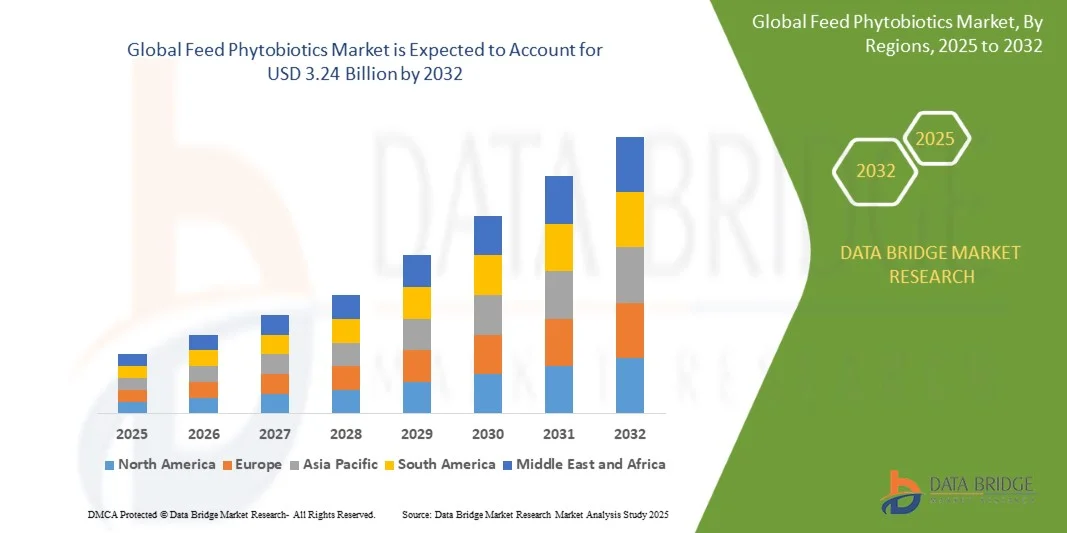
Feed Phytobiotics Market Size
- The global feed phytobiotics market size was valued at USD 1.78 billion in 2024 and is expected to reach USD 3.24 billion by 2032, at a CAGR of 7.8% during the forecast period
- The market growth is largely fueled by the increasing adoption of natural feed additives in livestock production, driven by the rising demand for antibiotic-free and sustainable animal products
- Furthermore, growing awareness among farmers about gut health, immunity, and growth performance is establishing feed phytobiotics as essential solutions in modern livestock nutrition. These factors are accelerating the uptake of phytogenic feed additives, thereby significantly boosting the market’s expansion
Feed Phytobiotics Market Analysis
- Feed phytobiotics are natural plant-based additives, including essential oils, herbs, prebiotics, and probiotics, that improve gut health, immunity, feed efficiency, and overall animal performance across poultry, swine, ruminants, and aquaculture
- The escalating demand for feed phytobiotics is primarily fueled by stricter regulations on antibiotic use, rising consumer preference for safe and high-quality animal products, and the growing focus on sustainable livestock practices
- North America dominated the feed phytobiotics market with a share of over 40% in 2024, due to the increasing adoption of natural feed additives and growing demand for antibiotic-free livestock productss
- Asia-Pacific is expected to be the fastest growing region in the feed phytobiotics market during the forecast period due to rapid urbanization, rising disposable incomes, and increasing livestock production in countries such as China, India, and Japan
- Powder segment dominated the market with a market share of 45.5% in 2024, due to its ease of incorporation into standard feed mixes, uniform distribution, and stability during storage and processing. Powder formulations offer precise dosing, compatibility with various feed types, and enhanced shelf life, making them the preferred choice for large-scale feed manufacturers. They are also widely used in poultry and swine diets to support gut health, improve feed efficiency, and enhance overall productivity
Report Scope and Feed Phytobiotics Market Segmentation
|
Attributes |
Feed Phytobiotics Key Market Insights |
|
Segments Covered |
|
|
Countries Covered |
North America
Europe
Asia-Pacific
Middle East and Africa
South America
|
|
Key Market Players |
|
|
Market Opportunities |
|
|
Value Added Data Infosets |
In addition to the insights on market scenarios such as market value, growth rate, segmentation, geographical coverage, and major players, the market reports curated by the Data Bridge Market Research also include import export analysis, production capacity overview, production consumption analysis, price trend analysis, climate change scenario, supply chain analysis, value chain analysis, raw material/consumables overview, vendor selection criteria, PESTLE Analysis, Porter Analysis, and regulatory framework. |
Feed Phytobiotics Market Trends
“Growing Use of Natural, Antibiotic-Free Feed Additives”
- The feed phytobiotics market is experiencing significant growth driven by the increasing adoption of natural, antibiotic-free feed solutions. Rising consumer demand for sustainable and residue-free animal products is compelling feed manufacturers and farmers to shift from synthetic additives to natural plant-based alternatives that support animal health and productivity
- For instance, companies such as Delacon specialize in plant-derived feed additives, promoting products formulated with herbs, spices, and essential oils that replace antibiotic growth promoters while maintaining animal performance. Cargill has also invested in phytobiotic product lines aimed at addressing natural immunity and supporting growth efficiency in poultry and swine
- Phytobiotics enhance feed intake, nutrient absorption, and digestive efficiency, reducing reliance on chemical additives. Their bioactive compounds contribute to improved intestinal health, and their antimicrobial and anti-inflammatory properties help in maintaining a stable gut microbiome in livestock
- The growing trend toward clean-label animal products and regulatory restrictions on antibiotics in feed are further accelerating the adoption of phytobiotics. Countries in Europe and North America have reinforced bans on antibiotic growth promoters, creating new opportunities for natural feed supplements
- In addition, phytobiotics are being explored in combination with probiotics and enzymes for synergistic effects that improve growth performance and resistance against common diseases. This innovation-oriented trend broadens the functional scope of phytobiotic feed applications across livestock production systems
- The move toward natural and antibiotic-free additives in animal feed underscores a long-term transition toward sustainable livestock practices. As regulatory pressures and consumer preferences continue to align with natural solutions, phytobiotics are becoming increasingly central to the global feed industry’s evolution
Feed Phytobiotics Market Dynamics
Driver
“Rising Focus on Gut Health and Immunity in Livestock”
- The increasing emphasis on livestock gut health and immunity is a major driver of the feed phytobiotics market. Farmers and producers are turning to phytobiotic additives to ensure stronger disease resistance, better digestion, and higher productivity levels without relying on synthetic inputs
- For instance, ADM Animal Nutrition has developed phytobiotic-based formulations aimed at improving poultry gut function and reducing disease outbreaks. BIOMIN, a part of DSM, also markets phytogenic feed additives with proven effects on gastrointestinal health, promoting better growth and feed efficiency in swine and poultry
- Improved gut health leads to enhanced nutrient uptake and optimizes feed-to-growth conversion ratios. This efficiency is critical in meeting rising global demand for animal protein while ensuring sustainable production practices
- Phytobiotics also play an important role in boosting immune response and lowering the incidence of infections, reducing the need for medical intervention. This capability aligns with global trends toward safe, antibiotic-free production of poultry, swine, and ruminants
- With growing consumer concerns regarding food safety and sustainable livestock practices, the adoption of phytobiotics intersects both health and market objectives. Their effectiveness in promoting immunity and digestive performance ensures that they remain vital to long-term livestock productivity strategies
Restraint/Challenge
“High Cost and Inconsistent Efficacy of Phytobiotics”
- The high cost of phytobiotic feed additives remains a primary challenge for broader adoption, particularly in regions with limited financial resources and high production costs. Compared to conventional additives, phytobiotics often require advanced extraction processes, careful formulation, and rigorous quality control that increase overall product pricing
- For instance, premium phytobiotic blends supplied by Delacon or Cargill are often priced higher than traditional feed additives, creating barriers for small-scale farmers operating under cost-sensitive livestock production models. Retail prices make it harder for these operators to justify switching from low-cost chemical solutions to more expensive natural ones
- Another major challenge is the inconsistency of phytobiotic efficacy due to variations in plant raw materials, growing conditions, and extraction methods. Even slight differences in bioactive compound concentration can impact results, leading to unpredictable performance across herds and flocks
- Integration challenges also arise at the farm level, as performance outcomes of phytobiotics may vary due to livestock genetics, health conditions, and feed composition. This variability limits confidence among producers seeking reliable input solutions for large-scale production
- Addressing these issues will require further research to standardize phytobiotic formulations, stronger supply chain control, and cost-reduction innovations in production processes. Ensuring affordability and consistent efficacy will be vital to overcoming restraints and enabling broader adoption of phytobiotics in global livestock farming
Feed Phytobiotics Market Scope
The market is segmented on the basis of type, livestock type, formulation, and function.
• By Type
On the basis of type, the feed phytobiotics market is segmented into essential oils, herbs and spices, prebiotics, and probiotics. The essential oils segment dominated the largest market revenue share in 2024, driven by their well-established efficacy in enhancing feed palatability, improving digestion, and promoting overall livestock health. Essential oils are widely preferred by feed manufacturers due to their natural origin, multifunctional benefits, and compatibility with various feed formulations. In addition, they help reduce reliance on antibiotics, aligning with the growing trend toward sustainable and clean-label livestock production. Their incorporation into feed supports better nutrient absorption and gut microbiota balance, making them a staple choice across poultry, swine, and ruminant diets.
The probiotics segment is anticipated to witness the fastest growth rate from 2025 to 2032, fueled by increasing awareness of gut health management and the rising demand for antibiotic-free livestock products. Probiotics enhance immunity, improve feed efficiency, and maintain intestinal microbiota balance, which is crucial for optimizing animal performance. Their adoption is accelerating across all livestock types, particularly in poultry and swine, due to their proven benefits in reducing disease susceptibility and enhancing growth rates. The growing focus on functional and natural feed additives further supports the expansion of this segment.
• By Livestock Type
On the basis of livestock type, the market is segmented into poultry, swine, ruminants, and aquaculture. The poultry segment held the largest revenue share in 2024, driven by the high consumption of poultry meat and eggs globally, which fuels demand for feed additives that improve growth performance, feed conversion, and immunity. Feed phytobiotics in poultry diets help reduce gut pathogens, support healthy microbiota, and enhance nutrient absorption, making them a preferred solution for large-scale commercial poultry farms. The segment also benefits from the increasing trend of antibiotic-free poultry production and rising consumer demand for safe, high-quality poultry products.
The swine segment is expected to witness the fastest growth during 2025–2032, fueled by the expansion of commercial pig farming and the growing focus on gut health and disease prevention in swine production. Feed phytobiotics improve nutrient utilization, support immune function, and reduce the incidence of gastrointestinal infections, which is crucial in intensive pig farming systems. Rising consumer awareness regarding pork safety and quality further drives the adoption of natural feed additives in this segment.
• By Formulation
On the basis of formulation, the market is segmented into liquid, powder, and granular forms. The powder segment dominated the largest market share of 45.5% in 2024, owing to its ease of incorporation into standard feed mixes, uniform distribution, and stability during storage and processing. Powder formulations offer precise dosing, compatibility with various feed types, and enhanced shelf life, making them the preferred choice for large-scale feed manufacturers. They are also widely used in poultry and swine diets to support gut health, improve feed efficiency, and enhance overall productivity.
The liquid formulation segment is expected to witness the fastest CAGR from 2025 to 2032, driven by its high bioavailability, rapid absorption, and ease of administration through water or feed. Liquid phytobiotics allow for flexible dosing and targeted delivery, which is particularly advantageous in intensive livestock systems. Growing adoption in both poultry and aquaculture sectors for improved growth performance and disease management is fueling the expansion of this segment.
• By Function
On the basis of function, the feed phytobiotics market is segmented into gut health, growth promotion, immunity boosting, and antioxidant. The gut health segment held the largest market revenue share in 2024, supported by the increasing focus on intestinal microbiota management to improve nutrient absorption, reduce pathogenic infections, and enhance overall livestock performance. Feed phytobiotics targeting gut health help maintain microbial balance, enhance digestive enzyme activity, and reduce the dependence on antibiotics, making them critical in modern livestock production. The segment finds wide application across poultry, swine, and ruminants due to its direct impact on feed efficiency and productivity.
The immunity boosting segment is expected to witness the fastest growth during 2025–2032, fueled by rising demand for disease-resistant livestock and the growing trend of antibiotic-free animal products. Phytobiotics with immune-enhancing properties strengthen the animal’s natural defense systems, reduce morbidity, and support better performance under stress conditions. Increasing awareness of livestock health management and adoption in intensive farming systems are key drivers for this segment.
Feed Phytobiotics Market Regional Analysis
- North America dominated the feed phytobiotics market with the largest revenue share of over 40% in 2024, driven by the increasing adoption of natural feed additives and growing demand for antibiotic-free livestock products
- Livestock farmers in the region are focusing on gut health, immunity, and growth performance, encouraging the use of essential oils, probiotics, and prebiotics in animal feed
- The market is further supported by advanced livestock farming infrastructure, high awareness of feed safety, and strong investments in research and development. The U.S., in particular, leads the region due to the large-scale commercial poultry and swine production and increasing focus on sustainable and high-quality animal nutrition
U.S. Feed Phytobiotics Market Insight
The U.S. feed phytobiotics market captured the largest revenue share within North America in 2024, driven by the growing preference for natural feed additives in poultry, swine, and ruminant production. Increasing consumer demand for antibiotic-free and safe animal products is boosting adoption. Farmers are increasingly leveraging feed phytobiotics to improve gut health, immunity, and growth performance. Strong government regulations supporting sustainable livestock practices, coupled with the availability of advanced feed formulations, further propel market growth.
Europe Feed Phytobiotics Market Insight
The Europe feed phytobiotics market is projected to expand at a significant CAGR during the forecast period, fueled by stringent regulations on antibiotic usage in livestock and the rising need for safe and high-quality animal protein. Countries such as Germany, France, and the U.K. are witnessing increased adoption of essential oils, probiotics, and prebiotics in feed formulations. The growing trend of sustainable livestock farming and urbanization is supporting market growth across poultry, swine, and ruminant sectors. Feed manufacturers in the region are focusing on innovative formulations to enhance immunity, gut health, and overall animal performance.
U.K. Feed Phytobiotics Market Insight
The U.K. feed phytobiotics market is anticipated to grow at a notable CAGR, driven by rising awareness regarding livestock health, demand for antibiotic-free meat, and focus on productivity improvement in poultry and swine. The adoption of natural feed additives, such as essential oils and probiotics, is increasing among commercial farms to improve gut health, immunity, and growth rates. The country’s well-established feed industry infrastructure and increasing consumer preference for sustainable livestock products are expected to further stimulate market growth.
Germany Feed Phytobiotics Market Insight
The Germany feed phytobiotics market is expected to expand at a considerable CAGR during the forecast period, fueled by stringent regulations on antibiotic use in livestock and increasing awareness of natural feed solutions. Feed phytobiotics are widely adopted in poultry, swine, and ruminants to improve gut health, feed efficiency, and immunity. Germany’s strong focus on innovation, research, and sustainable livestock practices is encouraging the development and adoption of advanced feed formulations across both commercial and small-scale farms.
Asia-Pacific Feed Phytobiotics Market Insight
The Asia-Pacific feed phytobiotics market is poised to grow at the fastest CAGR during 2025–2032, driven by rapid urbanization, rising disposable incomes, and increasing livestock production in countries such as China, India, and Japan. The region is witnessing strong growth in poultry and swine production, along with rising awareness of antibiotic-free animal products. Government initiatives promoting livestock health, coupled with the availability of affordable feed phytobiotics solutions, are fueling adoption. In addition, the growing middle class and high demand for safe and sustainable meat products are accelerating market expansion.
Japan Feed Phytobiotics Market Insight
The Japan feed phytobiotics market is gaining momentum due to the country’s focus on high-quality animal protein production and growing demand for antibiotic-free livestock products. Adoption of probiotics, essential oils, and prebiotics is increasing to enhance gut health, immunity, and growth performance. Japan’s technologically advanced farming systems and emphasis on animal welfare further support market growth, particularly in poultry and aquaculture.
China Feed Phytobiotics Market Insight
The China feed phytobiotics market accounted for the largest revenue share in Asia-Pacific in 2024, driven by the country’s rapid urbanization, growing livestock industry, and increasing consumer awareness regarding food safety. Poultry and swine production are major contributors to market growth, with rising adoption of essential oils, probiotics, and prebiotics to improve gut health, immunity, and feed efficiency. The push toward sustainable livestock farming, coupled with strong domestic production of feed phytobiotics, is boosting market penetration and affordability.
Feed Phytobiotics Market Share
The feed phytobiotics industry is primarily led by well-established companies, including:
- Cargill, Incorporated (U.S.)
- ADM (Archer Daniels Midland Company) (U.S.)
- Kemin Industries, Inc. (U.S.)
- Delacon Biotechnik GmbH (Austria)
- Phytobiotics Futterzusatzstoffe GmbH (Germany)
- dsm-firmenich (Switzerland)
- Dostofarm GmbH (Germany)
- Alltech, Inc. (U.S.)
- BIOMIN Holding GmbH (Austria)
- Pancosma (ADM Animal Nutrition) (Switzerland)
- Himalaya Wellness Company (India)
- EXFO Inc. (Canada)
- Phytosynthese (France)
- Adisseo (China)
- Silvateam S.p.a. (Italy)
Latest Developments in Feed Phytobiotics Market
- In September 2025, Phytobiotics and Nutrient Bio-Agro Tech Pvt. Ltd. launched Sangrovit Extra in India. This plant-based feed additive is specifically designed to enhance poultry performance under heat stress conditions, addressing a critical challenge in tropical and subtropical regions. The launch is expected to strengthen the adoption of natural feed additives in the Indian market, as farmers increasingly prioritize gut health, immunity, and overall productivity. By introducing a scientifically validated solution, the product is likely to boost awareness of phytobiotics’ benefits in improving feed efficiency, reducing disease incidence, and supporting sustainable livestock farming practices
- In January 2025, Phytobiotics Futterzusatzstoffe GmbH entered into a joint venture with Feed Expert Sp. z o.o., establishing Phytobiotics CEE Sp. z o.o. to serve the Central and Eastern European markets. This strategic partnership combines Feed Expert’s regional expertise with Phytobiotics’ specialization in phytogenic feed additives, enabling the delivery of innovative solutions to improve animal health and growth performance. The venture is expected to expand market penetration, increase product accessibility, and strengthen the competitive landscape, particularly for poultry and swine nutrition, while fostering adoption of natural alternatives to antibiotics across the region
- In October 2024, Phytobiotics introduced the Chicken Checker, an AI-powered mobile application that monitors poultry health in real time by analyzing fecal images to detect potential disease outbreaks. This innovation provides farmers with timely insights, enabling proactive management of flock health and reducing losses due to illness. By integrating technology with animal nutrition, the tool positions phytobiotics as part of a broader data-driven solution for livestock management, enhancing both market credibility and the perceived value of phytogenic feed additives in improving productivity, biosecurity, and operational efficiency
- In September 2024, Phytobiotics hosted its 2024 International IQ Seminar, bringing together global experts to discuss advances in animal nutrition, including AI applications and the integration of phytogenic feed solutions. The event highlighted the growing importance of innovation, natural ingredients, and functional feed additives in meeting evolving livestock industry demands. By promoting knowledge sharing and showcasing cutting-edge solutions, the seminar is expected to reinforce the company’s leadership position in the market and accelerate adoption of phytobiotics among international feed manufacturers and commercial livestock operations
- In January 2024, Phytobiotics launched new flavour additions, including Miracol and Bigarol, aimed at enhancing feed palatability for livestock. These flavours are designed to improve feed intake, digestion, and overall performance, addressing a key challenge in animal nutrition where low palatability can reduce productivity. The introduction strengthens the company’s portfolio and supports market growth by offering functional solutions that increase feed efficiency, optimize animal health, and promote sustainable farming practices. The product launch also reflects a broader trend toward innovation in natural feed additives, helping farmers meet the growing demand for antibiotic-free, high-quality animal products

- Interactive Data Analysis Dashboard
- Company Analysis Dashboard for high growth potential opportunities
- Research Analyst Access for customization & queries
- Competitor Analysis with Interactive dashboard
- Latest News, Updates & Trend analysis
- Harness the Power of Benchmark Analysis for Comprehensive Competitor Tracking
Data collection and base year analysis are done using data collection modules with large sample sizes. The stage includes obtaining market information or related data through various sources and strategies. It includes examining and planning all the data acquired from the past in advance. It likewise envelops the examination of information inconsistencies seen across different information sources. The market data is analysed and estimated using market statistical and coherent models. Also, market share analysis and key trend analysis are the major success factors in the market report. To know more, please request an analyst call or drop down your inquiry.
The key research methodology used by DBMR research team is data triangulation which involves data mining, analysis of the impact of data variables on the market and primary (industry expert) validation. Data models include Vendor Positioning Grid, Market Time Line Analysis, Market Overview and Guide, Company Positioning Grid, Patent Analysis, Pricing Analysis, Company Market Share Analysis, Standards of Measurement, Global versus Regional and Vendor Share Analysis. To know more about the research methodology, drop in an inquiry to speak to our industry experts.
Data Bridge Market Research is a leader in advanced formative research. We take pride in servicing our existing and new customers with data and analysis that match and suits their goal. The report can be customized to include price trend analysis of target brands understanding the market for additional countries (ask for the list of countries), clinical trial results data, literature review, refurbished market and product base analysis. Market analysis of target competitors can be analyzed from technology-based analysis to market portfolio strategies. We can add as many competitors that you require data about in the format and data style you are looking for. Our team of analysts can also provide you data in crude raw excel files pivot tables (Fact book) or can assist you in creating presentations from the data sets available in the report.