Feed Premix Market Overview
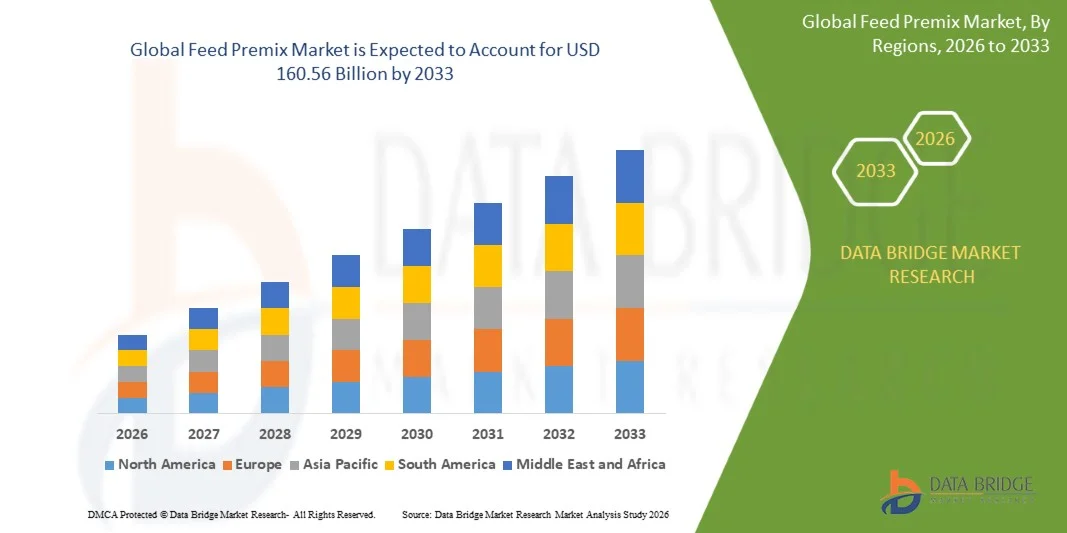
The Feed Premix Market was valued at USD 101.50 billion in 2025 and is projected to reach USD 160.56 billion by 2033, growing at a CAGR of 5.90% from 2026 to 2033. The market is experiencing steady growth driven by rising demand for high-quality animal nutrition, increasing livestock production, and growing awareness of balanced feed formulations that enhance animal health and productivity. Expanding commercial livestock farming and the shift toward precision nutrition solutions are further strengthening market demand across both developed and emerging economies.
The increasing focus on improving feed efficiency and reducing disease outbreaks in livestock populations is accelerating the adoption of vitamin, mineral, and amino acid premixes in animal diets. In addition, rising global meat, dairy, and poultry consumption is encouraging producers to enhance feed quality standards, while technological advancements in feed formulation and micro-ingredient blending are improving nutrient delivery and overall livestock performance.
Key Market Trends & Insights
- North America dominated the feed premix market with the largest revenue share in 2025, supported by a highly organized livestock industry, strong adoption of advanced feed formulations, and well-established animal nutrition companies. The region benefits from high awareness of feed efficiency solutions, stringent regulatory standards for animal health, and continuous innovation in premix formulations used in poultry, swine, and dairy production systems.
- Asia-Pacific is expected to be the fastest-growing region, recording a CAGR of from 2026 to 2033. Growth is driven by rapid expansion of livestock farming, increasing meat and dairy consumption, and rising investments in commercial feed production infrastructure across countries such as China, India, and Southeast Asia. Growing awareness of balanced animal nutrition and government support for modernizing livestock practices are further supporting regional growth.
- The vitamins segment held the largest market revenue share of approximately 34.6% in 2025 driven by its critical role in improving immunity, growth performance, and metabolic functions in livestock across poultry, swine, and dairy applications. Vitamins such as A, D, and E are widely incorporated into commercial premixes due to their direct impact on disease resistance and productivity enhancement in intensive farming systems.
- The amino acids segment is projected to register the fastest growth at a CAGR of 6.9% from 2026 to 2033, driven by increasing adoption of precision protein nutrition strategies in livestock feed formulations. Rising demand for optimized feed conversion ratios and reduced crude protein dependency in poultry and swine diets is accelerating the use of lysine, methionine, and threonine-based premixes globally.
- The poultry segment held the largest market revenue share of approximately 41.2% in 2025 driven by high global consumption of chicken meat and eggs, along with intensive farming practices requiring balanced micronutrient supplementation. Increasing industrial poultry production in countries such as China, Brazil, and the U.S. is further strengthening demand for customized feed premixes.
- The aquatic animals segment is projected to register the fastest growth at a CAGR of 7.4% from 2026 to 2033, driven by rapid expansion of aquaculture farming and rising demand for fish protein globally. Increasing use of fortified premixes in shrimp and fish feed formulations is improving survival rates, disease resistance, and overall yield efficiency in controlled aquaculture environments.
- The dry segment held the largest market revenue share of approximately 72.5% in 2025 driven by its ease of storage, longer shelf life, and cost-effective integration into bulk feed manufacturing processes. Dry premixes are widely used in commercial feed mills due to their stability and uniform mixing capabilities across large-scale livestock operations.
- The liquid segment is projected to register the fastest growth at a CAGR of 7.1% from 2026 to 2033, driven by increasing adoption of precision dosing systems and improved bioavailability of nutrients in liquid formulations. Growing demand for automated feed delivery systems in modern livestock farms is further supporting the expansion of liquid premix applications across high-performance animal nutrition systems.
Market Size & Forecast
- Global Market Value (2025): USD 101.50 Billion
- Expected Market Value (2033): USD 160.56 Billion
- Forecast CAGR (2026–2033): 5.90%
- Leading Region in 2025: North America
- Fastest Growing Region: Asia-Pacific
Report Scope and Feed Premix Market Segmentation
|
Attributes |
Feed Premix Key Market Insights |
|
Segments Covered |
· By Ingredient Type: Vitamins, Minerals, Amino Acids, Antioxidants, BHA, BHT, Ethoxyquin, Fibers, and Others · By Livestock: Poultry, Ruminants, Swine, Aquatic Animals, Equine, and Pets · By Form: Dry and Liquid |
|
Countries Covered |
North America · U.S. · Canada · Mexico Europe · Germany · France · U.K. · Netherlands · Switzerland · Belgium · Russia · Italy · Spain · Turkey · Rest of Europe Asia-Pacific · China · Japan · India · South Korea · Singapore · Malaysia · Australia · Thailand · Indonesia · Philippines · Rest of Asia-Pacific Middle East and Africa · Saudi Arabia · U.A.E. · South Africa · Egypt · Israel · Rest of Middle East and Africa South America · Brazil · Argentina · Rest of South America |
|
Key Market Players |
• DSM (Switzerland) |
|
Market Opportunities |
• Expansion Of Precision Livestock Nutrition Solutions |
|
Value Added Data Infosets |
In addition to the insights on market scenarios such as market value, growth rate, segmentation, geographical coverage, and major players, the market reports curated by the Data Bridge Market Research also include in-depth expert analysis, pricing analysis, brand share analysis, consumer survey, demography analysis, supply chain analysis, value chain analysis, raw material/consumables overview, vendor selection criteria, PESTLE Analysis, Porter Analysis, and regulatory framework. |
Feed Premix Market Trends
Trend: Growth In Precision Animal Nutrition And Functional Feed Formulation
Increasing demand for optimized livestock productivity, improved feed efficiency, and enhanced animal health outcomes is driving the adoption of advanced feed premix solutions across poultry, swine, cattle, and aquaculture sectors. Rising global meat and dairy consumption, coupled with pressure to reduce antibiotic use in animal farming, is encouraging producers to integrate scientifically balanced vitamin-mineral premixes and functional additives into feed formulations.
In modern livestock systems, feed manufacturers are increasingly incorporating customized premix blends, such as amino acids, enzymes, and probiotics, to improve nutrient absorption and growth performance. For instance, large-scale poultry producers in the U.S. and Brazil are adopting precision premix formulations to improve feed conversion ratios by nearly 6–10% while reducing overall feed wastage and mortality rates in high-density farming operations.
The expansion of commercial aquaculture and intensive dairy farming is also increasing demand for specialized premixes designed for species-specific nutritional requirements. In addition, regulatory restrictions on antibiotic growth promoters in regions such as the European Union are accelerating the shift toward fortified feed premixes, improving immunity and disease resistance in livestock populations.
Feed Premix Market Dynamics
Key Market Driver: Rising Demand For High Efficiency Livestock Nutrition Systems
The livestock industry is increasingly focused on improving productivity while minimizing feed costs and environmental impact, creating strong demand for nutrient-dense premix solutions. Feed manufacturers are adopting precision nutrition approaches to ensure balanced micronutrient delivery, supporting better growth rates and reproductive performance in animals.
Large integrated farming operations in countries such as China and India are expanding the use of premixes in poultry and swine feed to enhance feed conversion efficiency and reduce production cycles. For instance, adoption of customized vitamin-mineral premixes has been shown to improve milk yield in dairy cattle by approximately 8–12% in controlled feeding programs, supporting higher farm profitability and operational efficiency.
Key Restraint/Challenge: Volatility In Raw Material Prices And Supply Chain Disruptions
The feed premix industry faces challenges due to fluctuating prices of key raw materials such as vitamins, amino acids, and trace minerals, which directly impact production costs and profit margins. Supply chain disruptions and dependence on limited global suppliers for certain micronutrients further create procurement uncertainties for manufacturers.
In addition, variations in raw material quality and regulatory compliance requirements across different regions increase formulation complexity and limit scalability for small and mid-sized feed producers. These challenges are particularly significant in emerging markets where cost sensitivity remains a key factor influencing feed adoption decisions.
Key Market Opportunity: Expansion Of Functional And Species-Specific Feed Additives
Growing focus on animal health optimization and disease prevention is creating strong opportunities for functional feed premixes enriched with probiotics, enzymes, and immunity-boosting compounds. Rising demand for high-value livestock products such as organic meat, antibiotic-free poultry, and premium dairy is accelerating innovation in targeted nutritional solutions.
Feed producers are increasingly developing species-specific premixes tailored for poultry, aquaculture, and ruminants to improve digestion efficiency and overall productivity. For instance, aquaculture producers in Southeast Asia are integrating specialized mineral and vitamin premixes to enhance growth rates and reduce disease susceptibility, supporting improved yield consistency in intensive fish farming systems across the region.
Feed Premix Market Scope
The market is segmented on the basis of ingredient type, livestock, and form.
- By Ingredient Type
On the basis of ingredient type, the feed premix market is segmented into vitamins, minerals, amino acids, antioxidants, BHA, BHT, ethoxyquin, fibers, and others. The vitamins segment held the largest market revenue share of approximately 34.6% in 2025 driven by its critical role in improving immunity, growth performance, and metabolic functions in livestock across poultry, swine, and dairy applications. Vitamins such as A, D, and E are widely incorporated into commercial premixes due to their direct impact on disease resistance and productivity enhancement in intensive farming systems.
The amino acids segment is projected to register the fastest growth at a CAGR of 6.9% from 2026 to 2033, driven by increasing adoption of precision protein nutrition strategies in livestock feed formulations. Rising demand for optimized feed conversion ratios and reduced crude protein dependency in poultry and swine diets is accelerating the use of lysine, methionine, and threonine-based premixes globally.
- By Livestock
On the basis of livestock, the feed premix market is segmented into poultry, ruminants, swine, aquatic animals, equine, and pets. The poultry segment held the largest market revenue share of approximately 41.2% in 2025 driven by high global consumption of chicken meat and eggs, along with intensive farming practices requiring balanced micronutrient supplementation. Increasing industrial poultry production in countries such as China, Brazil, and the U.S. is further strengthening demand for customized feed premixes.
The aquatic animals segment is projected to register the fastest growth at a CAGR of 7.4% from 2026 to 2033, driven by rapid expansion of aquaculture farming and rising demand for fish protein globally. Increasing use of fortified premixes in shrimp and fish feed formulations is improving survival rates, disease resistance, and overall yield efficiency in controlled aquaculture environments.
- By Form
On the basis of form, the feed premix market is segmented into dry and liquid. The dry segment held the largest market revenue share of approximately 72.5% in 2025 driven by its ease of storage, longer shelf life, and cost-effective integration into bulk feed manufacturing processes. Dry premixes are widely used in commercial feed mills due to their stability and uniform mixing capabilities across large-scale livestock operations.
The liquid segment is projected to register the fastest growth at a CAGR of 7.1% from 2026 to 2033, driven by increasing adoption of precision dosing systems and improved bioavailability of nutrients in liquid formulations. Growing demand for automated feed delivery systems in modern livestock farms is further supporting the expansion of liquid premix applications across high-performance animal nutrition systems.
Feed Premix Market Regional Analysis
North America Feed Premix Market Insight
North America dominated the feed premix market with the largest revenue share of 37.9% in 2025, supported by a highly developed livestock industry, strong adoption of precision animal nutrition, and strict regulatory standards on feed quality and safety. Producers in the region increasingly rely on vitamin-mineral premixes and functional additives to enhance feed efficiency, improve animal immunity, and support antibiotic-free livestock production systems. This widespread adoption is further strengthened by large-scale commercial poultry and dairy farming operations, advanced feed manufacturing infrastructure, and strong integration of scientific nutrition practices across the animal husbandry sector.
U.S. Feed Premix Market Insight
The U.S. feed premix market captured the largest revenue share in North America in 2025, driven by high demand for poultry and meat products and the rapid shift toward precision livestock farming. Farmers and feed producers are increasingly focusing on optimized premix formulations to improve feed conversion ratios and overall animal productivity. The growing emphasis on sustainable animal nutrition, along with strong investments in feed R&D and advanced supplementation technologies, is significantly supporting market expansion.
Europe Feed Premix Market Insight
The Europe feed premix market is expected to witness the fastest growth rate from 2026 to 2033, primarily driven by strict regulations on antibiotic usage in animal feed and increasing demand for high-quality meat and dairy products. The region’s strong focus on animal welfare standards and sustainable farming practices is accelerating the adoption of customized premix solutions across livestock categories. Growth is further supported by rising organic livestock production and increasing demand for nutrient-rich feed formulations in commercial farming systems.
U.K. Feed Premix Market Insight
The U.K. feed premix market is expected to witness steady growth from 2026 to 2033, driven by increasing awareness of livestock health management and rising demand for high-quality animal protein. Farmers are increasingly adopting specialized premix solutions to enhance productivity and reduce disease risks in poultry and dairy farming. The shift toward sustainable agriculture practices and improved feed efficiency is further supporting market development.
Germany Feed Premix Market Insight
The Germany feed premix market is expected to witness strong growth from 2026 to 2033, fueled by advanced livestock production systems and a strong emphasis on sustainable and high-efficiency animal nutrition. The country’s focus on reducing antibiotic dependency in animal farming is driving increased adoption of fortified premixes enriched with vitamins, minerals, and amino acids. Integration of precision feeding technologies in large-scale farms is further enhancing market growth.
Asia-Pacific Feed Premix Market Insight
The Asia-Pacific feed premix market is expected to witness the fastest growth rate from 2026 to 2033, supported by rapid expansion of livestock production, rising meat consumption, and increasing adoption of industrial animal farming systems in countries such as China, India, and Vietnam. The region’s growing middle-class population and increasing demand for affordable protein sources are driving large-scale use of feed premixes. Government initiatives promoting modern livestock farming practices are further accelerating market expansion.
Japan Feed Premix Market Insight
The Japan feed premix market is expected to witness steady growth from 2026 to 2033 due to high demand for quality meat and dairy products and increasing focus on animal health management. The country’s advanced livestock industry emphasizes precision nutrition and functional feed additives to improve productivity and feed efficiency. Rising adoption of technologically advanced feed formulation practices is further supporting market growth.
China Feed Premix Market Insight
The China feed premix market accounted for the largest market revenue share in Asia-Pacific in 2025, attributed to its massive livestock population, rapid industrialization of animal farming, and strong demand for poultry and pork products. The country’s expanding feed manufacturing industry and increasing use of vitamin-mineral premixes in large-scale farming operations are key factors driving market growth. Government support for modernized agriculture and food security initiatives is further strengthening market expansion.
Feed Premix Market Share
The Feed Premix industry is primarily led by well-established companies, including:
• DSM (Switzerland)
• Cargill, Incorporated (U.S.)
• DLG (Denmark)
• ADM (U.S.)
• Charoen Pokphand Foods PCL (Thailand)
• Land O’ Lakes, Inc. (U.S.)
• AB Agri Ltd (U.K.)
• BEC Feed Solutions (Australia)
• Lexington (U.S.)
• Agrofeed Kft (Hungary)
• Kaesler Nutrition GmbH (Germany)
• Avitech Nutrition Pvt. Ltd. (India)
• Advanced Animal Nutrition Pty Ltd (Australia)
• Nutreco (Netherlands)
• Phibro Animal Health Corporation (U.S.)
• LOTUS MINECHEM RESOURCES PVT. LTD. (India)
• Agrifirm (Netherlands)
• Masterfeeds (Canada)
Latest Developments in Feed Premix Market
- In February 2025, Novonesis completed the acquisition of DSM-Firmenich’s Feed Enzyme Alliance stake valued at EUR 1.5 billion (USD 1.55 billion), strengthening its biosolutions portfolio and expanding distribution capabilities across animal nutrition markets. This development is expected to enhance revenue contribution by around 3% while improving enzyme-based feed efficiency solutions, supporting sustainable livestock productivity and reinforcing competitive positioning in global feed premix and additive supply chains.
- In November 2024, Cargill launched TruPet, a concentrated postbiotic ingredient designed to improve gut health, immunity, and digestive performance in companion animals, marking a key innovation in pet nutrition. The solution maintains stability across extrusion and retort processing, making it suitable for modern pet food manufacturing systems. This launch strengthens demand for advanced functional feed additives and expands Cargill’s presence in the premium pet nutrition segment.
- In September 2024, DSM-Firmenich expanded its premix and additives manufacturing facility in Egypt with a 10,000 square meter advanced production site equipped with Buhler Technologies and integrated plant control systems. The expansion enhances supply efficiency across Egypt, the Middle East, Africa, and Southern Europe, improving localized production capacity and reducing dependency on imports. This move supports rising regional demand for customized feed premix solutions and strengthens regional feed security.
- In January 2024, Archer Daniels Midland Company (ADM) acquired PT Trouw Nutrition Indonesia, a leading premix manufacturer with advanced facilities in Pasuruan and Cibitung, including laboratories and warehousing infrastructure. The acquisition strengthens ADM’s feed additives and premix business while expanding its footprint in Southeast Asia’s high-growth animal nutrition market. It enhances production scalability and supports rising demand for protein-rich livestock feed solutions in the region.
- In August 2024, ForFarmers acquired Piast, a Polish feed producer, while also advancing plans to acquire Van Triest Veevoeders, a Dutch co-products specialist, to strengthen its sustainable feed solutions portfolio. These strategic moves expand ForFarmers’ European production network and improve raw material utilization efficiency. The developments enhance supply chain resilience and support the growing shift toward circular economy-based animal nutrition solutions in Europe.

- Interactive Data Analysis Dashboard
- Company Analysis Dashboard for high growth potential opportunities
- Research Analyst Access for customization & queries
- Competitor Analysis with Interactive dashboard
- Latest News, Updates & Trend analysis
- Harness the Power of Benchmark Analysis for Comprehensive Competitor Tracking
Global Feed Premix Market, Supply Chain Analysis and Ecosystem Framework
To support market growth and help clients navigate the impact of geopolitical shifts, DBMR has integrated in-depth supply chain analysis into its Global Feed Premix Market research reports. This addition empowers clients to respond effectively to global changes affecting their industries. The supply chain analysis section includes detailed insights such as Global Feed Premix Market consumption and production by country, price trend analysis, the impact of tariffs and geopolitical developments, and import and export trends by country and HSN code. It also highlights major suppliers with data on production capacity and company profiles, as well as key importers and exporters. In addition to research, DBMR offers specialized supply chain consulting services backed by over a decade of experience, providing solutions like supplier discovery, supplier risk assessment, price trend analysis, impact evaluation of inflation and trade route changes, and comprehensive market trend analysis.
Data collection and base year analysis are done using data collection modules with large sample sizes. The stage includes obtaining market information or related data through various sources and strategies. It includes examining and planning all the data acquired from the past in advance. It likewise envelops the examination of information inconsistencies seen across different information sources. The market data is analysed and estimated using market statistical and coherent models. Also, market share analysis and key trend analysis are the major success factors in the market report. To know more, please request an analyst call or drop down your inquiry.
The key research methodology used by DBMR research team is data triangulation which involves data mining, analysis of the impact of data variables on the market and primary (industry expert) validation. Data models include Vendor Positioning Grid, Market Time Line Analysis, Market Overview and Guide, Company Positioning Grid, Patent Analysis, Pricing Analysis, Company Market Share Analysis, Standards of Measurement, Global versus Regional and Vendor Share Analysis. To know more about the research methodology, drop in an inquiry to speak to our industry experts.
Data Bridge Market Research is a leader in advanced formative research. We take pride in servicing our existing and new customers with data and analysis that match and suits their goal. The report can be customized to include price trend analysis of target brands understanding the market for additional countries (ask for the list of countries), clinical trial results data, literature review, refurbished market and product base analysis. Market analysis of target competitors can be analyzed from technology-based analysis to market portfolio strategies. We can add as many competitors that you require data about in the format and data style you are looking for. Our team of analysts can also provide you data in crude raw excel files pivot tables (Fact book) or can assist you in creating presentations from the data sets available in the report.