What is the Feed Processing Market Size and Growth Rate?
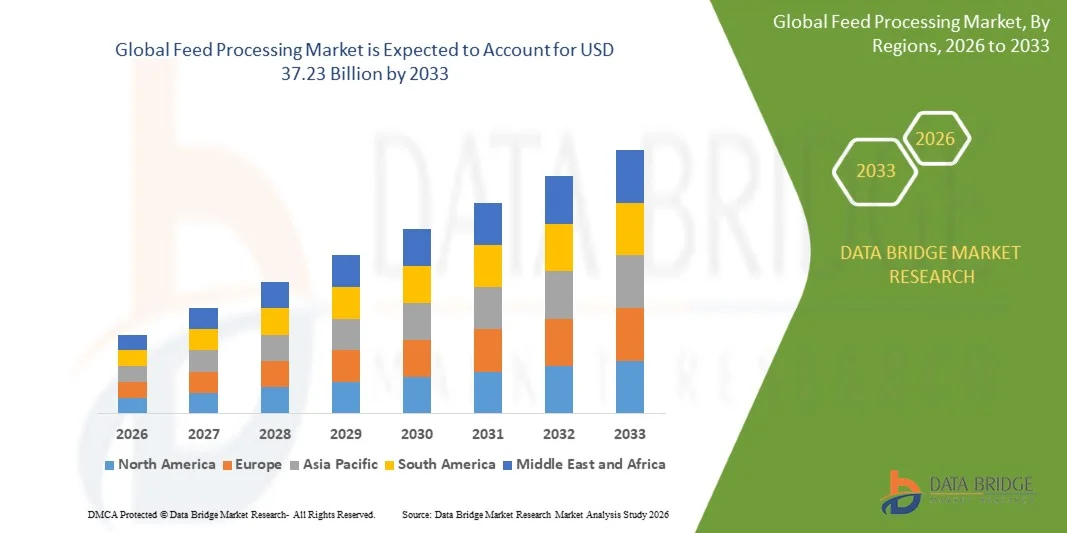
- As per Data Bridge Market Research analysis, the feed processing market was valued at USD 25.01 billion in 2025 and is projected to reach USD 37.23 billion by 2033, growing at a CAGR of 5.1% from 2026 to 2033.
- The market is experiencing steady growth driven by the rising global compound feed production to support expanding livestock and aquaculture industries, increasing demand for pelletized and extruded feed offering improved digestibility and reduced waste, and growing adoption of automated feed mill equipment to improve processing efficiency and product consistency.
- The growing emphasis on feed safety, nutritional consistency, and operational efficiency is compelling commercial feed mills and integrated livestock producers to invest in advanced grinding, mixing, pelleting, and extrusion equipment. Fully automated processing lines are increasingly complementing semi-automatic systems, offering improved throughput, reduced labor dependency, and more precise control over feed formulation and quality parameters.
- The growing integration of feed processing operations with broader precision livestock farming systems is enabling producers to more closely link feed formulation and processing parameters with real-time animal performance data, supporting continuous improvement in feed conversion efficiency across integrated production operations.
Market Size & Forecast
- Global Market Value (2025): USD 25.01 Billion
- Expected Market Value (2033): USD 37.23 Billion
- Forecast CAGR (2026–2033): 5.1%
- Leading Region in 2025: Asia-Pacific
- Fastest Growing Region: North America
What are the Major Takeaways of the Feed Processing Market?
- Asia-Pacific dominated the global feed processing market with the largest revenue share of 39.24% in 2025, supported by the region’s position as the world’s largest compound feed producer, extensive livestock and aquaculture industries, and significant investment in feed mill modernization across China and India.
- North America is expected to be the fastest-growing region at a CAGR of 6.4% from 2026 to 2033, fueled by accelerating automation adoption, rising pet food and aqua feed production, and growing investment in feed mill capacity expansion across the United States and Canada.
- The pelleting equipment segment led the market with a 32.68% share in 2025, driven by widespread adoption of pelletized feed offering improved digestibility, reduced feed wastage, and easier handling and storage compared to mash feed.
- The extrusion equipment segment is the fastest-growing equipment type, projected to register a CAGR of 6.9%, reflecting rising demand for extruded feed products across pet food and aqua feed applications requiring precise texture and nutrient retention control.
- The compound feed type segment dominated the feed type category with a 61.47% revenue share in 2025, led by its widespread use across poultry, swine, and cattle production systems requiring nutritionally balanced, standardized feed formulations.
- The poultry livestock segment accounted for 34.85% of the market share in 2025, preferred due to the industry’s high production volumes, rapid production cycles, and stringent feed conversion efficiency requirements.
- The fully automatic automation level segment is the fastest-growing category, with a CAGR of 7.2%, driven by increasing feed mill investment in labor-saving, precision-controlled processing technology to improve consistency and reduce operational costs.
Report Scope and Feed Processing Market Segmentation
|
Attributes |
Feed Processing Key Market Insights |
|
Segments Covered |
|
|
Countries Covered |
North America
Europe
Asia-Pacific
Middle East and Africa
South America
|
|
Key Market Players |
|
|
Market Opportunities |
|
|
Value Added Data Infosets |
In addition to the insights on market scenarios such as market value, growth rate, segmentation, geographical coverage, and major players, the market reports curated by the Data Bridge Market Research also include import export analysis, production capacity overview, production consumption analysis, price trend analysis, climate change scenario, supply chain analysis, value chain analysis, raw material/consumables overview, vendor selection criteria, PESTLE Analysis, Porter Analysis, and regulatory framework. |
What is the Key Trend in the Feed Processing Market?
- Feed mill operators are increasingly integrating real-time process monitoring and control systems into grinding, mixing, and pelleting equipment, enabling continuous quality tracking and rapid adjustment of processing parameters to maintain consistent feed formulation output.
- For instance, in March 2025, FAMSUN showcased its FimCOS+ intelligent control system at VIV Asia 2025, providing real-time operational coordination, cost tracking, and automated management capabilities for feed and pet food manufacturing, reflecting the growing adoption of digital process-control technologies in feed mills.
- Growing demand for specialized aqua feed and pet food products is driving increased investment in extrusion technology capable of producing precisely sized, texturally consistent floating or sinking feed pellets tailored to specific species and life-stage nutritional requirements.
- Equipment manufacturers are increasingly focused on developing energy-efficient processing technologies that reduce electricity and steam consumption per ton of feed produced, addressing rising energy costs and sustainability commitments among feed mill operators.
- For instance, in February 2025, Andritz introduced an upgraded pellet mill design featuring improved die and roller configurations that reduce specific energy consumption per ton of pelletized feed produced, targeting feed mills seeking to lower operating costs amid rising energy prices.
- Growing adoption of predictive maintenance technology, utilizing vibration and temperature sensors integrated into grinding, mixing, and pelleting equipment, is enabling feed mill operators to identify potential mechanical issues before they result in unplanned downtime or production quality deviations.
- For instance, in January 2025, AGI highlighted the growing role of predictive maintenance in feed mills, with IoT sensors monitoring parameters such as temperature and vibration to identify potential equipment problems before they cause failures, supporting improved uptime and maintenance planning.
- As commercial feed mills, integrated livestock producers, and pet food manufacturers continue to prioritize processing efficiency, product consistency, and energy optimization, the adoption of advanced feed processing equipment is expected to accelerate, reinforcing its essential role in global animal nutrition supply chains.
What are the Key Drivers of the Feed Processing Market?
- The rising global demand for animal protein, driven by population growth and increasing per-capita meat, dairy, and seafood consumption, has significantly increased compound feed production requirements, driving sustained investment in feed processing capacity expansion.
- For instance, in September 2025, SKIOLD supplied a complete aquaculture feed processing line for the new NamViet Pilmico feed mill in Vietnam, including extrusion, pelleting, and other processing equipment, demonstrating continued investment in feed-production capacity to serve the region's growing aquaculture industry. The facility was commissioned in September 2025 and includes an aquaculture feed line with capacity of up to 10 tonnes per hour.
- The growing global aquaculture industry, expanding rapidly to meet rising seafood demand amid static or declining wild-catch fisheries output, is driving substantial investment in specialized aqua feed extrusion equipment capable of producing precisely formulated floating and sinking feed products.
- For instance, in June 2025, AsiaPolis, together with the Singapore Food Agency, Singapore Institute of Technology, Aboitiz Foods, and Clextral, launched Asia's first Feed Extrusion Training Programme, providing aquaculture professionals with hands-on training in twin-screw extrusion, pellet buoyancy, drying, coating, and feed-quality control. The initiative reflects increasing regional focus on advanced extrusion technology for aquaculture feed production.
- Rising global pet ownership rates, particularly across urbanizing middle-class populations in emerging markets, are driving substantial growth in premium pet food production, requiring specialized extrusion equipment capable of producing precisely formulated kibble with consistent texture and appearance.
- For instance, in October 2024, Smack Pet Food announced an expansion into the United States to increase production capacity and support growing demand for its premium pet food products across the U.S., Europe, and Asia, reflecting continued investment in pet food manufacturing capacity to serve expanding premium and super-premium segments.
- With rising global animal protein demand, expanding aquaculture and pet food industries, and continued emphasis on feed safety and processing efficiency, feed processing equipment will remain an essential component of the global animal nutrition and agriculture supply chain.
Which Factors are Challenging the Growth of the Feed Processing Market?
- Feed processing equipment requires substantial upfront capital investment, particularly for fully automated processing lines incorporating advanced grinding, mixing, pelleting, and extrusion technology, creating cost barriers for smaller feed mills and on-farm processing operations.
- These high capital costs limit modernization among smaller regional feed mills, particularly in emerging markets where feed production remains fragmented across numerous smaller-scale operations with limited access to financing for equipment upgrades.
- For instance, between January and April 2025, FeedPi's State of Feed Manufacturing survey of 214 feed mills across India and Southeast Asia found that 73% of mills still relied on spreadsheets for formulation, with complexity and cost identified as key factors limiting adoption of available digital technologies.
- The technical complexity of modern automated feed processing systems requires skilled technicians for operation, calibration, and maintenance, creating a workforce skills gap that can be particularly challenging for feed mills operating in regions with limited access to specialized agricultural equipment training programs.
- For instance, in June 2025, Bühler opened a new Milling Academy in Switzerland to provide hands-on training for food and feed millers, highlighting the industry's need to address a shrinking skilled workforce while adapting to increasingly advanced processing technologies.
- The ongoing volatility in raw material and energy costs, including steel, electrical components, and industrial energy prices, continues to create pricing pressure for equipment manufacturers while extending payback periods for feed mill operators evaluating new equipment investment. Recent industry commentary indicates that rising raw-material and energy costs are encouraging Asian feed mills to reconsider plant design and energy efficiency investments.
How is the Feed Processing Market Segmented?
The feed processing market is segmented on the basis of equipment type, process type, feed type, livestock, automation level, and end user.
- By Equipment Type
On the basis of equipment type, the global feed processing market is segmented into grinding equipment, mixing equipment, pelleting equipment, extrusion equipment, conveying equipment, and others. The pelleting equipment segment dominated the market with a 32.68% share in 2025, owing to widespread adoption of pelletized feed offering improved digestibility, reduced feed wastage, and easier handling and storage compared to mash feed. These systems remain the preferred choice for commercial feed mills producing high-volume compound feed for poultry, swine, and cattle operations.
The extrusion equipment segment is projected to register the fastest growth at a CAGR of 6.9% from 2026 to 2033, driven by rising demand for extruded feed products across pet food and aqua feed applications requiring precise texture and nutrient retention control. Growing investment in specialized extrusion technology for floating aqua feed and premium pet food products is accelerating segment expansion.
- By Process Type
On the basis of process type, the global feed processing market is segmented into grinding, mixing, pelleting, extrusion, coating & spraying, and packaging. The pelleting process segment led the market with a 30.42% share in 2025, supported by its critical role in converting mash feed into durable, easily handled pellets that reduce feed segregation and waste during storage and transport.
The extrusion process segment is expected to experience the fastest growth at a CAGR of 6.7% from 2026 to 2033, driven by increasing adoption of extrusion technology for producing high-quality pet food and aqua feed products with precisely controlled texture, density, and nutrient stability.
- By Feed Type
On the basis of feed type, the global feed processing market is segmented into compound feed, pet food, aqua feed, and others. The compound feed segment dominated the market with a share of 61.47% in 2025 due to its widespread use across poultry, swine, and cattle production systems requiring nutritionally balanced, standardized feed formulations. the continued global expansion of intensive livestock farming operations is reinforcing the dominance of this segment.
The aqua feed segment is expected to witness the fastest CAGR of 7.4% from 2026 to 2033, driven by this growth is fueled by rapid global aquaculture industry expansion, requiring specialized extrusion processing equipment capable of producing precisely formulated floating and sinking feed products for diverse fish and shrimp species.
- By Livestock
On the basis of livestock, the global feed processing market is segmented into poultry, swine, cattle/ruminants, aquaculture, and others. The poultry segment dominated the market with a share of 34.85% in 2025 due to the industry’s high production volumes, rapid production cycles, and stringent feed conversion efficiency requirements driving continuous investment in processing equipment. the widespread global expansion of commercial poultry production is reinforcing this segment’s leading position.
The aquaculture segment is expected to witness the fastest CAGR of 7.6% from 2026 to 2033, driven by rising global seafood demand and rapid aquaculture industry expansion requiring specialized feed processing equipment capable of producing species-specific extruded feed formulations.
- By Automation Level
On the basis of automation level, the global feed processing market is segmented into manual, semi-automatic, and fully automatic. The semi-automatic segment dominated the market with a share of 46.28% in 2025 due to its balance of moderate capital investment requirements and meaningful processing efficiency improvements, making it an accessible upgrade path for mid-sized feed mills. established equipment availability and technician familiarity continue to support strong demand for semi-automatic processing systems.
The fully automatic segment is expected to witness the fastest CAGR of 7.2% from 2026 to 2033, driven by increasing feed mill investment in labor-saving, precision-controlled processing technology to improve consistency, reduce operational costs, and address ongoing skilled labor shortages within the feed processing industry.
- By End User
On the basis of end user, the global feed processing market is segmented into commercial feed mills, on-farm feed processing, and pet food manufacturers. The commercial feed mills segment dominated the market with a share of 58.36% in 2025 due to their large-scale production volumes and continuous investment in modern, high-throughput processing equipment to serve broad regional customer bases. the widespread consolidation of feed production into larger commercial operations is reinforcing this segment’s leading position.
The pet food manufacturers segment is expected to witness the fastest CAGR of 7.8% from 2026 to 2033, driven by rising global pet ownership rates and growing consumer demand for premium, extruded pet food products requiring specialized processing equipment capable of producing precisely formulated kibble and treats.
Which Region Holds the Largest Share of the Feed Processing Market?
- Asia-Pacific dominated the feed processing market and accounted for the largest revenue share of 39.24% in 2025, supported by the region’s position as the world’s largest compound feed producer, extensive livestock and aquaculture industries, and significant investment in feed mill modernization across the region.
- The region also benefits from a large concentration of domestic feed processing equipment manufacturers, rapidly expanding commercial livestock and aquaculture sectors, and strong government support for agricultural modernization and food security initiatives. Continued growth in regional meat and seafood consumption continues to strengthen Asia-Pacific’s leadership position in the global market.
China Feed Processing Market Insight
The China feed processing market is growing rapidly, driven by the country’s position as the world’s largest compound feed producer, extensive livestock and aquaculture industries, and significant government investment in agricultural modernization. Growing adoption of automated pelleting and extrusion equipment across large-scale commercial feed mills is significantly boosting market demand. In addition, rising domestic feed processing equipment manufacturing capabilities and increasing exports to other Asian and African markets are positioning China as both the largest producer and consumer within the global feed processing market.
India Feed Processing Market Insight
The India feed processing market is witnessing robust growth, driven by rapidly expanding poultry and aquaculture industries, rising demand for compound feed among commercial livestock producers, and growing government investment in agricultural infrastructure modernization. Increasing adoption of pelleting and mixing equipment among both commercial feed mills and larger on-farm operations is supporting market expansion. Additionally, the entry of international feed processing equipment manufacturers and growing domestic production capacity are further accelerating market adoption across the country.
Europe Feed Processing Market Insight
The Europe feed processing market is expanding due to strict safety regulations, automation, and the need for energy-efficient machinery. Germany, France, and Spain dominate production, utilizing advanced pelleting, grinding, and conditioning technologies to optimize nutritional value. Growth is highly driven by the European Union's stringent environmental mandates, pushing manufacturers to adopt low-emission, waste-reducing equipment. Consequently, modern feed mills are heavily prioritizing smart digital monitoring systems to ensure complete ingredient traceability, improve processing precision, and lower overall operational costs.
Germany Feed Processing Market Insight
The Germany feed processing market is expanding steadily, supported by the country’s advanced agricultural machinery manufacturing base, strong livestock production sector, and increasing adoption of precision feed processing technology across commercial feed mills. Equipment manufacturers headquartered in the region continue to invest in energy-efficient and digitally integrated processing solutions. Continued focus on sustainable feed production and agricultural technology innovation is further driving market growth in Germany.
Netherlands Feed Processing Market Insight
The Netherlands feed processing market benefits from the country’s globally recognized agricultural technology sector, strong presence of leading feed processing equipment manufacturers, and advanced compound feed and aqua feed production capabilities. Dutch equipment manufacturers continue to lead in developing innovative extrusion and pelleting technologies for both domestic and export markets. Continued investment in sustainable and energy-efficient feed processing solutions is further reinforcing the Netherlands’ position as a key innovation hub in the global feed processing equipment industry.
Which are the Top Companies in Feed Processing Market?
The feed processing industry is primarily led by well-established companies, including:
- Andritz AG (Austria)
- Bühler Group (Switzerland)
- CPM Holdings, Inc. (U.S.)
- Muyang Group (China)
- Van Aarsen International B.V. (Netherlands)
- Dinnissen B.V. (Netherlands)
- Wenger Manufacturing, Inc. (U.S.)
- Ottevanger Milling Engineers B.V. (Netherlands)
- Sprout.Matador (CPM) (Belgium)
- Amandus Kahl GmbH & Co. KG (Germany)
- Roskamp Champion (CPM) (U.S.)
- Zhengchang Group (China)
- Yem Machinery Co., Ltd. (China)
- La Meccanica S.r.l. (Italy)
- Insta-Pro International (U.S.)
- Extru-Tech, Inc. (U.S.)
- Bliss Industries, LLC (U.S.)
- Salmatic B.V. (Netherlands)
- Triott Group (Netherlands)
- Famsun Co., Ltd. (China)
What are Latest Developments in Feed Processing Market?
- In September 2025, Andritz launched a new generation pellet mill platform featuring integrated digital process control and reduced specific energy consumption, targeting feed mills seeking to improve pellet quality consistency while lowering operational energy costs.
- In January 2025, Bühler Group expanded its feed processing equipment manufacturing facility in Asia-Pacific to increase production capacity and meet rising regional demand from feed mill operators investing in new processing lines.
- In November 2025, Muyang Group introduced an upgraded extrusion system specifically designed for premium pet food production, featuring enhanced texture control and expanded formulation flexibility for pet food manufacturers.
- In November 2024, Wenger Manufacturing launched a new aqua feed extrusion line optimized for shrimp feed production, addressing growing demand from Southeast Asian aquaculture operations for specialized processing equipment.
- In June 2023, Van Aarsen International partnered with several feed mill operators in Africa to conduct field trials of its compact, modular pelleting systems, demonstrating improved feed processing capacity for smaller-scale regional feed production operations.
- In August 2024, Zhengchang Group expanded its manufacturing capacity for grinding and mixing equipment to meet rising demand from feed mill operators across Southeast Asia and Africa investing in new compound feed production capacity.

- Interactive Data Analysis Dashboard
- Company Analysis Dashboard for high growth potential opportunities
- Research Analyst Access for customization & queries
- Competitor Analysis with Interactive dashboard
- Latest News, Updates & Trend analysis
- Harness the Power of Benchmark Analysis for Comprehensive Competitor Tracking
Data collection and base year analysis are done using data collection modules with large sample sizes. The stage includes obtaining market information or related data through various sources and strategies. It includes examining and planning all the data acquired from the past in advance. It likewise envelops the examination of information inconsistencies seen across different information sources. The market data is analysed and estimated using market statistical and coherent models. Also, market share analysis and key trend analysis are the major success factors in the market report. To know more, please request an analyst call or drop down your inquiry.
The key research methodology used by DBMR research team is data triangulation which involves data mining, analysis of the impact of data variables on the market and primary (industry expert) validation. Data models include Vendor Positioning Grid, Market Time Line Analysis, Market Overview and Guide, Company Positioning Grid, Patent Analysis, Pricing Analysis, Company Market Share Analysis, Standards of Measurement, Global versus Regional and Vendor Share Analysis. To know more about the research methodology, drop in an inquiry to speak to our industry experts.
Data Bridge Market Research is a leader in advanced formative research. We take pride in servicing our existing and new customers with data and analysis that match and suits their goal. The report can be customized to include price trend analysis of target brands understanding the market for additional countries (ask for the list of countries), clinical trial results data, literature review, refurbished market and product base analysis. Market analysis of target competitors can be analyzed from technology-based analysis to market portfolio strategies. We can add as many competitors that you require data about in the format and data style you are looking for. Our team of analysts can also provide you data in crude raw excel files pivot tables (Fact book) or can assist you in creating presentations from the data sets available in the report.